

ABS vs polycarbonate is a housing-requirements decision, not a contest with one universal winner. ABS is a common candidate for opaque housings; polycarbonate merits consideration when impact, temperature or transparency requirements drive the shortlist. Protolabs describes these broad material roles, but a family name does not qualify a particular grade for a finished enclosure. [5] Protolabs.
The useful next step is to compare named grades against the actual load, temperature, cleaning exposure, appearance and approval requirements. This guide explains how to read the evidence and turn it into a material decision. It does not provide a generic shrinkage chart, a resin-price forecast or proof that SSP has already produced a particular housing.
Material-selection answer in brief
- Define the housing’s acceptance requirements before comparing resin families.
- Compare exact grades, colors, methods and conditions, not isolated property numbers.
- Separate short-term laboratory data from service-life and assembled-part evidence.
- Evaluate cleaning exposure with the actual assembly stresses present.
- Release the material together with its tooling, process and verification record.
ABS vs polycarbonate: define what the housing must do
Begin with a marked assembly drawing. Identify the faces people touch, the features that locate internal components and the joints that retain the cover. List the actual service environment and which failures matter: excessive movement, a cracked mounting feature, loss of appearance, interference with an internal component or another defined outcome. A statement such as “strong industrial plastic” is not a testable requirement.
Separate mandatory limits from preferences. A required optical function belongs in the first group; a preferred surface feel might belong in the second. Assign an evidence owner to each mandatory requirement. If nobody can explain how a requirement will be evaluated, the material selection is not ready for a final ranking.
| Housing input | Question to resolve | Proposed evidence |
|---|---|---|
| Load and assembly | Where do forces enter, and how is the cover retained? | Assembly drawing, fastening method and load cases |
| Temperature | Which locations see heat, for how long, and under what load? | Defined exposure profile and component acceptance method |
| Impact or handling | What event must the assembled product withstand? | Project-specific event definition and functional inspection |
| Chemical exposure | Which cleaners, oils or incidental fluids can contact it? | Named formulations, use conditions and test plan |
| Appearance and optics | Which faces require a controlled finish or visibility? | Cosmetic zones, optical requirements and approved evaluation |
| Approval and supply | Which grade, color and documents must accompany production? | Controlled material specification and supply confirmation |
Keep the decision specific to the enclosure. A material that is promising for a detachable cover is not automatically appropriate for a loaded mounting foot, a transparent window or an electrical barrier. If one housing combines those functions, record the separate acceptance questions rather than collapsing them into a single “durability” score.
Read named-grade data without creating a false ranking
The manufacturer portals identify Terluran GP-22 as ABS and Makrolon 2405 as PC. The selected property examples below retain their displayed methods. The ABS portal currently presents ASTM data, while the PC page includes ISO data. [1] INEOS Styrolution; [2] Covestro. Converting units does not make different test methods or specimen conditions identical.
| Property example | Terluran GP-22 ABS | Makrolon 2405 PC | Interpretation boundary |
|---|---|---|---|
| Density | 1.04 g/cm³; ASTM D 792 | 1,200 kg/m³; ISO 1183-1 | Useful for a bounded mass estimate, not a strength ranking |
| Tensile modulus | 334 × 10³ psi; ASTM D 638 | 2,400 MPa; ISO 527-1,-2, 1 mm/min | Retain method and condition; do not claim a precise stiffness advantage from this pair |
| Thermal data to request | Method, applied load and specimen condition | The same identifying information | Compare equivalent evidence before selecting a service limit |
| Property status | Typical values for uncolored products | Typical data, not warranted performance unless agreed | Obtain grade/color-specific application evidence |
Source-specific examples from the current manufacturer pages [1] INEOS Styrolution and [2] Covestro. These are not family-wide specifications or approvals.
Read the complete property label. Tensile modulus answers a different question from tensile strength, and neither label describes an assembled housing drop test. Ask the supplier to identify the relevant data for the intended temperature and loading condition. If the needed comparison is missing, label that cell “evidence required” rather than assigning a favorable value based on the polymer name.
Archive the source revision used for the decision. The same commercial family can include several grades, and a procurement description should not silently allow any product with the letters ABS or PC on the bag. The proposed material record should identify manufacturer, exact grade, color and any permitted alternatives, each with its own approval status.
Treat heat, stiffness and impact as separate questions
A heat-deflection number is not a housing release temperature
Makrolon 2405’s page lists heat-deflection temperatures of 124°C at 1.80 MPa and 137°C at 0.45 MPa under ISO 75-1,-2. [2] Covestro. The different values for the same grade demonstrate why the test load must remain attached to the number. Neither value is presented here as an allowable continuous temperature for an assembled housing.
For the component review, specify where heat acts, the exposure duration and what must remain acceptable afterward. Decide whether the question concerns movement while hot, permanent change after cooling, joint retention or another function. Request the supplier data and component evaluation appropriate to that question; do not release a cover merely because its nominal ambient temperature is below a datasheet number.
An impact-resistant family still needs an application test
Protolabs describes impact performance as a reason to consider PC, while also identifying ABS as a tough, widely used housing material. [5] Protolabs. Use those descriptions to build a shortlist, not to announce that every PC enclosure will outperform every ABS enclosure. The proposed component test should retain the actual geometry, fasteners, support and acceptance criteria.
Keep appearance and structural acceptance separate. A housing that remains closed may still fail a critical clearance check; a visible mark may or may not be acceptable under the agreed cosmetic requirement. Define these decisions before testing. If the article’s reader has no project load case yet, the appropriate outcome is a provisional shortlist rather than an invented safety factor.
Assess cleaning exposure together with assembly stress
Covestro’s chemical-resistance document identifies medium composition, temperature, exposure time and inherent or applied stress as influencing factors. It also emphasizes practical testing on finished parts. [3] Covestro. A compatibility statement copied from an unstressed specimen therefore does not close the assembled-housing question.
Prepare an exposure register with the actual cleaner or fluid name, concentration if applicable, application method, contact duration and removal procedure. Include contact at seams and fastened regions in the proposed review. Ask whether the material approval covers the exact color and finishing system. If a cleaner is replaced later, retain that change as a re-review trigger.
Covestro and Metrex describe testing particular polycarbonate-based grades using pre-strained specimens, wipe/dry cycles and retained tensile properties. [4] Covestro. That example is valuable because it states a material, exposure and evaluation method. It does not approve Makrolon 2405, another PC grade or ABS for every disinfectant.
The ABS comparison must also consider the complete surface system. INEOS Styrolution warns that coating solvents need suitable selection to avoid substrate stress cracking. [1] INEOS Styrolution. The proposed approval should therefore include any paint, print, adhesive or other contact system actually used, rather than assuming that a successful raw-material check covers all finishing operations.
Do not rely on appearance alone as the only evidence where retained function matters. Covestro notes that stress cracks may be difficult to see in opaque material and discusses mechanical evaluation. [3] Covestro. Agree the inspection and functional evidence for the real enclosure; this guide does not prescribe a universal chemical exposure cycle.
Review resin handling, part geometry and the physical mold
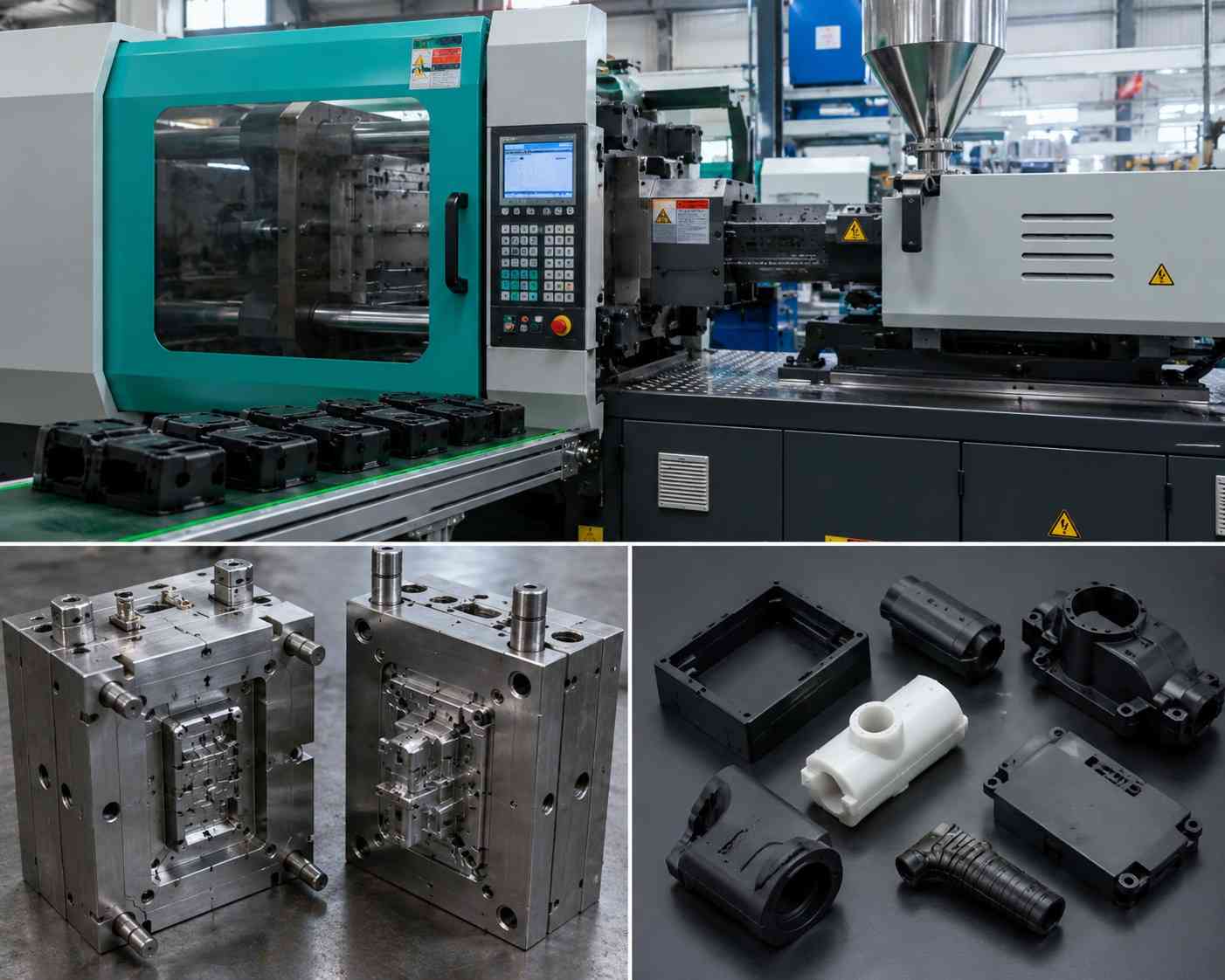
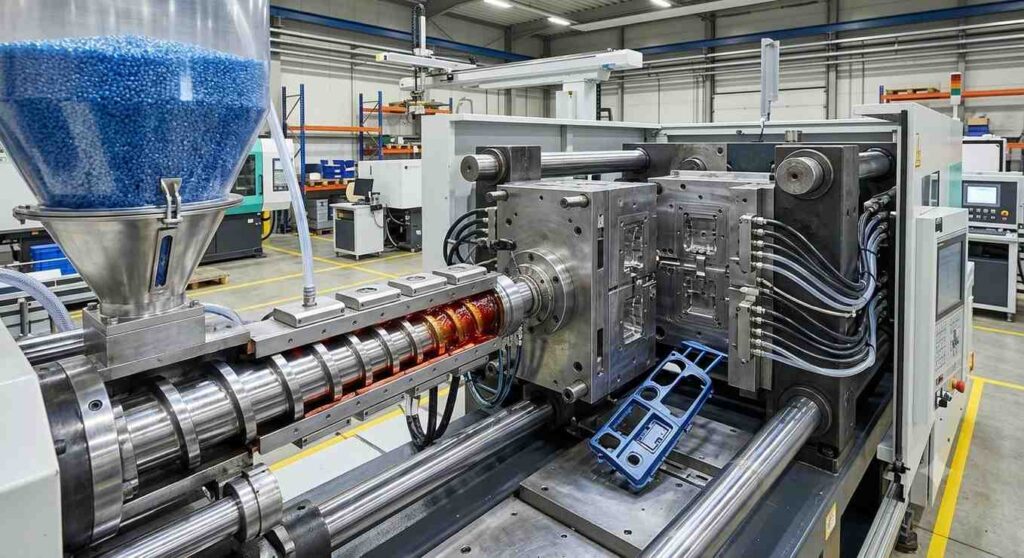
Use the selected grade’s supplier guidance for preparation and molding, then validate the application-specific process. Both manufacturer sources qualify their processing advice as indicative or reference guidance. [1] INEOS Styrolution; [2] Covestro. Do not copy test-specimen settings into a different tool and call them a qualified production recipe.
A practical review should identify the resin-handling equipment, drying verification method, permitted interruptions and material traceability. Record setpoints separately from measured conditions. The purpose is not to create one generic ABS recipe and one generic PC recipe, but to establish what evidence is needed for the named grade in the proposed production arrangement.
Review assembly features and cosmetic faces with the complete CAD model. Keep ribs, bosses, transitions and fastening interfaces visible in the review. Where rib geometry is the unresolved question, consult the separate rib-design and wall-section guide. This material comparison should not become a competing catalogue of rib ratios or shrinkage allowances.
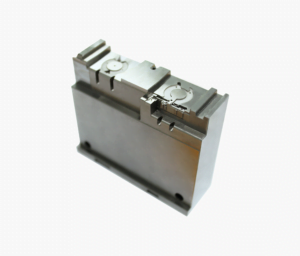
For the tool itself, discuss the selected resin and proposed approval plan alongside SSP’s custom injection mold configurations. Confirm the actual cavity layout, interface and material requirements for the order. A material-selection article does not establish that a particular tool configuration or resin is available for every project.
A bounded mass calculation using published density
Suppose a hypothetical housing contains 40 cm³ of solid plastic according to its nominal CAD model. This volume is an illustrative input, not an SSP drawing or measured molded volume. Using the published densities, 1,200 kg/m³ converts to 1.20 g/cm³. The first screening estimate is mass = density × volume. [1] INEOS Styrolution; [2] Covestro.
Makrolon 2405 example: 1.20 g/cm³ × 40 cm³ = 48.0 g
Difference: 48.0 − 41.6 = 6.4 g
The nominal mass difference is 6.4 g, or approximately 15.4% relative to the 41.6 g example. The arithmetic holds the volume constant. It says nothing about which housing meets the load or temperature requirement, and it is not a measured comparison of production parts.
If the design changes after material review, rerun the calculation with the revised geometry. Separate the part’s net material from runner or process waste when preparing a quotation. Do not turn this simple estimate into a claim about cycle time, total manufacturing cost or environmental impact; none of those quantities has been calculated here.
Use a requirement-led decision matrix
The following scenarios are original review examples, not tested applications. Each identifies a sensible next question rather than naming a universally correct material. A candidate remains provisional until its missing evidence is resolved.
| Illustrative housing situation | Initial comparison approach | Evidence that must decide |
|---|---|---|
| Opaque cover with controlled appearance | Keep an appropriate ABS grade on the shortlist; compare PC if another requirement justifies it | Finished appearance, assembly and defined service checks |
| Housing with a clear viewing region | Investigate a suitable transparent PC grade or a separately specified window concept | Optical function and complete housing acceptance |
| Frequently cleaned assembled enclosure | Compare exact grade/exposure combinations, including assembly stress | Supplier guidance plus representative exposure and function evidence |
| Housing near a persistent heat source | Compare relevant grade-specific thermal and mechanical data | Time, temperature, loading and dimensional acceptance |
| Neither shortlisted grade meets every mandatory input | Expand the shortlist rather than relaxing an unapproved requirement | Documented alternative and revised verification plan |
PC/ABS can be a separate candidate when the two initial options leave unresolved trade-offs; Protolabs discusses it as a distinct blend option. [5] Protolabs. Do not assume a particular blend inherits every desirable property of both parent families. Ask for its own grade data and treat its approval as a separate decision.
For commercial comparison, request quotations against the same drawing revision, order assumptions and evidence requirements. A lower resin price alone cannot answer the housing decision. Avoid publishing a current price premium without a dated, comparable quotation. This guide contains no resin market forecast or claim that one family always produces a cheaper finished part.
Release the material with an evidence record
Use a pass/fail gate for mandatory requirements before applying preferences or weighted scores. Otherwise, an attractive appearance score could conceal an unresolved functional limit. Record why each candidate was retained, rejected or held for more evidence, and identify who approved the decision.
| Release item | Proposed record | Change that prompts review |
|---|---|---|
| Material identity | Manufacturer, exact grade, color and approved alternatives | Supplier, grade or color change |
| Exposure and function | Defined tests, observations and acceptance decisions | Cleaner, environment or duty change |
| Tool and process | Drawing revision and qualified production arrangement | Tool modification, transfer or material-handling change |
| Appearance and assembly | Controlled inspection and assembly criteria | Finish, fastener or interface change |
| Supply and documentation | Confirmed availability and required supplier evidence | Unapproved substitution or missing documents |
Request the records that apply to the actual end use. Covestro’s Makrolon 2405 page includes restrictions on regulated applications and directs users to obtain appropriate approval. [2] Covestro. A generic example grade should not be described as medical-, food-contact- or drinking-water-approved on the basis of this article.
For the next manufacturing discussion, bring the drawing, candidate-grade data and open questions to SSP’s plastic-part molding services. For orientation to the company and its two tooling families, see SSP Precision’s manufacturing overview. Confirm project-specific capability and acceptance before ordering; no tolerance or qualification is promised here.
Frequently asked questions
Which is better for a housing, ABS or polycarbonate?
Neither family wins every requirement. Use broad material traits to shortlist grades, then decide against the actual housing evidence. [5] Protolabs.
Can datasheet stiffness numbers be compared directly?
Only with their methods and conditions retained. The two portals used here display different test methods, so this guide does not calculate a precise relative stiffness advantage from them. [1] INEOS Styrolution; [2] Covestro.
Does heat-deflection temperature define continuous service temperature?
It does not close the component approval question. Retain the stated test load and obtain evidence for the actual service profile, geometry and function. [2] Covestro.
Is polycarbonate compatible with every cleaner?
No family-wide approval is established. Chemical exposure, temperature, duration and stress must be considered for the selected material and part. [3] Covestro.
Can ABS be changed to PC without a review?
The recommended practice is to treat that as a controlled material change. Recheck the drawing, tooling, process, assembly and acceptance evidence instead of assuming a family substitution is already approved.
References and limits
The sources below support the attributed material observations. All selection worksheets and scenarios are proposed engineering practices. The mass example combines published typical densities with an explicitly hypothetical volume.
- INEOS Styrolution: Terluran GP-22, properties and processing guidance (displayed ASTM data).
- Covestro: Makrolon 2405, typical properties and grade restrictions.
- Covestro: Makrolon, The chemical resistance (edition 2016-12).
- Covestro and Metrex: Investigating disinfectants and polycarbonate-based materials.
- Protolabs: Selecting a Thermoplastic for Your Injection-Molded Part.