

What Is Conformal Cooling in Injection Molding?
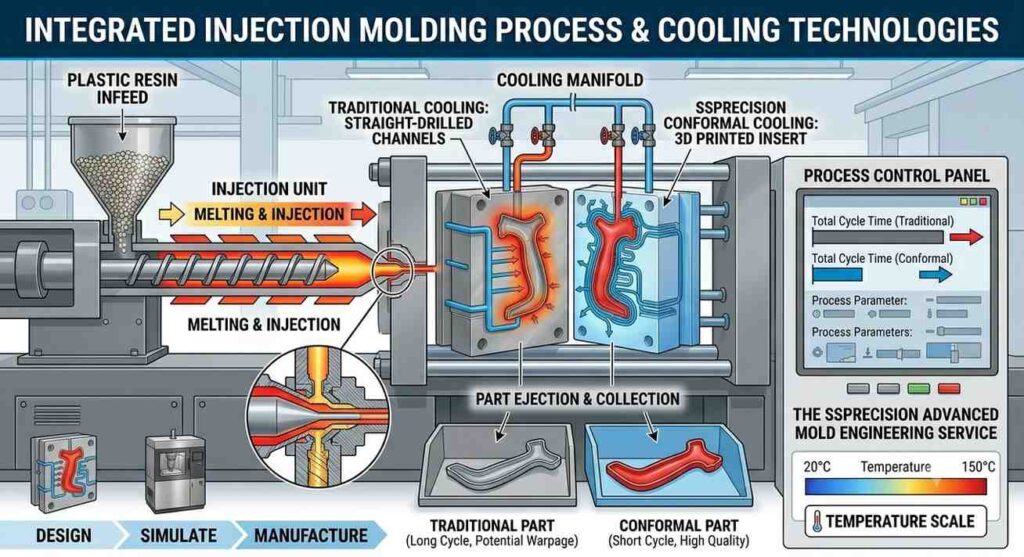
In the world of Conformal Cooling Injection Molding, how a mold gets cooled is just as critical as how it is designed. Conformal Cooling means a mold cooling technique where the cooling channels are engineered to follow , or “conform to,” the exact shape of the mold cavity. Unlike traditional straight-drilled channels that run in fixed lines, conformal channels curve and wind around complicated part geometries — delivering coolant steadily, right where the heat really builds up.
In simple terms, imagine wrapping a flexible hose around a curved object instead of running a rigid pipe past it. The flexible hose covers more surface area and removes heat in an even way. That is basically the core principle behind conformal cooling.
At SSPrecision, conformal cooling is a cornerstone in our advanced mold engineering services. We design, simulate and manufacture 3D Printed Mold Inserts with conformal channels that precisely target thermal issue zones — the hot spots that stretch cycle times and can reduce part quality.
Understanding Mold Hot Spots: The Root of the Problem
Hot spots are localized areas inside a mold where heat collects faster than standard cooling systems can pull it away. They are a major driver behind failures that show up as reduced mold cycle time issues in high volume production. A hot spot as small as 5 cm² can add 8–12 seconds to every cycle , and when you scale that to 100,000+ annual shots, it can mean weeks of lost production time.
Common Causes of Mold Hot Spots
- Deeply recessed, or ribbed part shapes that are difficult to reach with straight drill channels
- Uneven wall thickness creating different heat loads across the cavity
- Gate locations where concentrated melt flow and thermal energy are focused
- Core pins and thin features with a high surface-area to volume ratio
- Coolant flow rate that is inadequate, or channel placement that sits too far from the cavity surface
Industry data shows that cooling makes up around 50–70% of the whole injection molding cycle time, so even a 15% cut in cooling time can translate into annual output gains that reach tens of thousands of pieces. At SSPrecision, engineers don’t just guess though, they inspect hot spot patterns using thermal simulation software before cutting even a single gram of steel or anything like that.
How Advanced Mold Cooling with Conformal Channels Works
Advanced Mold Cooling through conformal channel design relies on three engineering pillars: proximity, uniformity, and flow efficiency.
Proximity — Getting Closer to the Heat
Typically, standard cooling channels are drilled 12–20 mm off the cavity surface, mostly because of machining limits and such. Conformal channels, which are produced with metal additive manufacturing (3D printing), can be placed as near as 3–5 mm. That’s about a 4× improvement in the thermal transfer distance. From basic thermal conduction logic, if you reduce the gap to the heat source by half, the cooling rate tends to jump by roughly four times, or at least that’s what the principle suggests.
Uniformity — Eliminating Temperature Gradients
SSPrecision runs Moldflow-integrated cooling simulation to map the heat spread across essentially every cavity area. The conformal channels are planned so that coolant residence time and temperature delta stay balanced, within about ±3–5°C over the mold face. In contrast, conventional cooling often lands closer to ±15–20°C. This kind of uniformity helps prevent warpage, sink marks, and also differential shrinkage, you know the usual troublemakers that can send scrap rates above 10% in some operations.
Flow Efficiency — Turbulent Flow by Design
Conformal channels aren’t just contoured, they’re also dimensioned to encourage turbulent coolant movement, typically with a Reynolds number above 10,000. Turbulent flow tends to move heat as much as 3× more effectively than laminar flow. SSPrecision targets channel cross-sections in the 6–10 mm range, plus uses subtle baffles to keep heat extraction steady through the entire cooling sequence, not just in one portion.
Conformal Cooling vs. Conventional Cooling: Performance Comparison
| Parameter | Conventional Cooling | Conformal Cooling | Improvement |
| Cycle Time | 30–45 seconds | 18–28 seconds | Up to 40% faster |
| Temperature Uniformity | ±15–20°C variation | ±3–5°C variation | ~75% more uniform |
| Warpage Rate | High (5–8%) | Low (1–2%) | 60–75% reduction |
| Scrap Rate | 8–12% | 2–4% | Up to 65% lower |
| Energy Consumption | Baseline (100%) | ~75% of baseline | ~25% savings |
Source: SSPrecision internal project data & industry benchmarks (2022–2024)
3D Printed Mold Inserts: The Technology Behind Conformal Cooling
Traditional subtractive machining cannot really create the highly complex internal channel shapes needed for actual conformal cooling. So this is where 3D Printed Mold Inserts, made via Direct Metal Laser Sintering (DMLS) or Selective Laser Melting (SLM) start to feel genuinely transformative, not just “helpful”.
At SSPrecision, our metal additive manufacturing services let you do things like:
- Channels with intricate curves, spirals, and bifurcations that you just cannot drill in a normal conventional way
- Internal geometries with wall thicknesses around 0.8 mm, thin enough between the channel region and the cavity surface
- Multi-zone cooling routes, so you can target different thermal loads inside one single insert
- Fast iteration of conformal cooling insert concepts, typically in 5–10 business days
- Full-density tool steel inserts (H13, P20, maraging steel) that match the mechanical behavior you’d expect from wrought material
A 2023 case study from SSPrecision’s automotive team showed what happens when a bumper trim mold switches from classic cooling to 3D-printed conformal inserts. Cycle time dropped from 42 seconds to 26 seconds, that is a 38% improvement—also warpage related rejects fell from 9.4% to 1.8% .
SSPrecision Capabilities: Advanced Mold Cooling Solutions
SSPrecision has a fully connected workflow for Conformal Cooling Injection Molding work, from design simulation all the way to the finished mold insert delivery. Our engineers bring decades of tooling experience, then pair it with modern additive manufacturing, so you can end up with measurable production wins.
| SSPrecision Capability | Detail |
| Design Software | CAD/CAE simulation with Moldflow & cooling analysis |
| Manufacturing Method | Metal 3D printing (DMLS/SLM) for complex insert geometry |
| Materials Supported | Tool steel (H13, P20), stainless, maraging steel |
| Tolerance Range | ±0.05 mm dimensional accuracy on cooling channels |
| Industries Served | Automotive, medical devices, electronics, consumer goods |
| Lead Time | Prototype inserts in as little as 5–10 business days |
If you’re building a new mold, or retrofitting existing tooling with advanced cooling inserts, SSPrecision provides end to end support, tailored to your production environment, and yes, your schedule too.
SSP Is a Trusted Partner for Die Manufacturing Cost Optimization
SSP Precision is an ISO 9001 & IATF 16949 certified manufacturer delivering end-to-end precision solutions, from design and prototyping to high‑volume production, for the automotive, medical, electronics, aerospace, and industrial sectors. We handle every stage in‑house – DFM engineering, rapid prototyping, CNC machining, EDM, grinding, and global logistics – to manufacture the tooling that makes your parts and the parts themselves.
What we build and supply: visit our sites: https://SSP.com.cn/
- Stamping dies manufacturing and stamping die parts – high‑precision transfer stamping dies and progressive/compound dies for volume metal stamping.
- Injection molding and injection mold – custom injection molds for plastic components, including single‑, multi‑cavity, and over‑molding & insert‑molding tools that combine metal and plastic in one part.
- Specialty molded components – eco‑friendly green mold parts and microscopic medical micro‑molded parts.
- Precision metal and plastic end‑use parts – high‑volume serial production of precision products (metal stampings, plastic moldings) with full PPAP traceability.
Tooling spare parts manufacturing & – tooling spare parts (punches, inserts, ejector pins) and precision robotics spare parts to keep your production running.
Frequently Asked Questions (FAQ)
Q1. What kinds of parts really gain the most from conformal cooling?
Most often it’s parts with deep draws, tricky shapes, uneven wall thicknesses, or those tight dimensional tolerances where everything has to stay pretty consistent. Think about automotive trim panels, medical housings, electronic enclosures, and thin-wall containers. Also any part where hot spots keep showing up, causing warpage, or you need a long enough cooling hold time to keep quality steady, tends to be a strong fit for conformal cooling.
Q2. Roughly how much can conformal cooling cut down my cycle time?
It depends on the part geometry and how your cooling system is already set up, but common reductions land around 20% to 40%. In some serious hot spot situations, SSPrecision has recorded cycle time improvements up to about 45%. Even a 20% reduction when you’re running 500,000 shots/year means roughly 100,000 more shots each year , which adds up fast and it can be a big revenue swing.
Q3. Is conformal cooling more expensive than conventional tooling?
You’ll usually see higher upfront costs. For 3D-printed conformal inserts, the initial tooling investment is typically about 20% to 40% higher than conventional inserts. Still, the ROI tends to show up within 3 to 6 months, mostly because cycle time goes down, scrap tends to reduce, and energy consumption is also lower. SSPrecision includes a detailed ROI review in the overall project evaluation, so you get a clear picture before moving forward.
Q4. How does SSPrecision make sure the cooling channels are actually good inside the printed inserts?
SSPrecision checks every conformal insert using CT scanning, pressure testing, and Moldflow-correlated thermal validation. We verify channel integrity, surface roughness, and coolant flow rates against the design specifications before anything ships out.
Q5. Can conformal cooling be added to an existing mold
Yes. SSPrecision can design conformal cooling inserts so they replace the usual cores or cavities already in your existing mold bases. It’s basically a retrofit thing, so the manufacturer can upgrade the cooling performance without swapping the whole mold, which lowers the upgrade costs pretty a lot.
Read More – Intelligence That Protects Your Production Line
- Stamping Tool Steel HRC Hardness Chart – A 2–3 HRC shift can swing die life by 20–40%—here’s the complete hardness chart for D2, SKD11, M2, and more, plus grade-specific wear data and application guidance.
- Troubleshooting Progressive Die Failures & Tool Wear – A 0.01mm drift or a faint burr is often the first warning—here’s how to read the data, schedule maintenance, and stretch tool life before scrap piles up.
- Micro Injection Molding: Controlling Flash on Tiny Parts – When parts weigh under 0.1 gram, even a 10-micron flash is a giant defect—here’s how to control the process on the smallest scale.
- Why Injection Molds Fail: Cracking & Galling Fixes – 62% of unplanned mold downtime comes from just three failure modes—here’s the root-cause data and preventive fixes for cracking, galling, and ejection issues.
- What Drives Metal Stamping Die Costs? – A progressive die can cost anywhere from $8,000 to over $150,000—here’s a breakdown of the 5 key cost drivers, global price comparisons, and when to repair vs. replace.
- Injection Molding Guide: Costs, Materials, Process, and Mold Tooling – A prototype mold can cost $3,000, while a high-volume production mold runs $80,000+—here’s how to match tooling class to real production volume and avoid overpaying for steel.