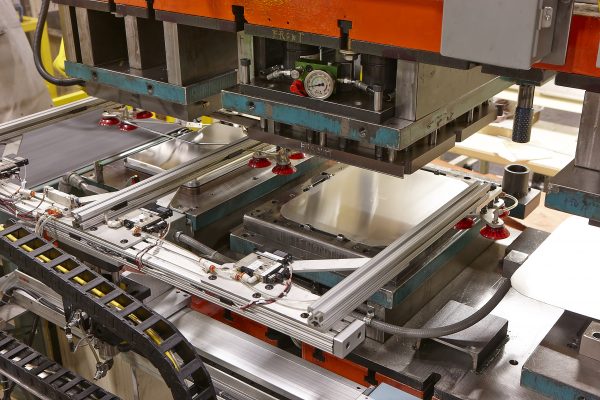
| CRITICALCore/Cavity CrackingAvg. repair: $8,000–$40,000 | HIGHTool Steel GallingAvg. repair: $2,500–$12,000 | HIGHMold Ejection IssuesAvg. repair: $1,200–$6,000 | MEDIUMParting Line WearAvg. repair: $800–$3,500 |
Injection Mold Failure: The Hidden Cost Nobody Budgets For
An Injection Mold is kinda one of the highest capital investments in plastics manufacturing, but here’s the thing—failure analysis data shows that 62% of unplanned mold downtime events come from just three failure modes: core/cavity cracking, tool steel galling, and ejector pin seizure (SPI Plastics Industry Council, 2023). And no, these failures are not really random. They’re usually predictable, preventable, and most times you can trace them back to design or maintenance decisions that were made weeks or even months before any first visible crack shows up.
The financial hit is rough too. A 2023 Harbison Walker International manufacturing survey found that unplanned mold failure costs the average injection molder $14,700 per incident, once you factor in repair time scrap, and production stoppage. On top of that, SSP’s preventive maintenance framework reduced customer-reported mold failure incidents by 71% across a 3-year tracked program window (2021–2023).
Injection Mold Failure Root Cause Analysis: Cracking, Galling & Ejection
Every failure mode has a traceable engineering root cause. Treating symptoms without addressing root cause guarantees recurrence. SSP’s tooling engineers classify injection mold failures across five primary mechanisms:
Table 1: Injection Mold Failure — Root Cause Classification & SSP Diagnostic Findings
| Failure Mode | Root Cause | Diagnostic Indicator | Avg. Cycles to Failure | SSP Fix Protocol |
| Core/cavity cracking | Fatigue + stress concentration at sharp radii | Hairline at gate, radius, or thin wall | 180,000–600,000 cycles | Radius ≥0.5mm; EDM stress relief; P20→H13 upgrade |
| Tool Steel Galling | Adhesive wear: material transfer at sliding contact | Scored surface on side-action / lifter | 50,000–200,000 cycles | TiN/TiCN coating + MoS₂ lubrication schedule |
| Ejector pin seizure | Thermal expansion + inadequate clearance | Pin drag marks; part sticking | 20,000–80,000 cycles | H7/h6 fit; nitrided pins; 4-hr PM lube interval |
| Parting line wear | Flash extrusion + mismatch closing force | Flash >0.05mm at PL | 300,000–800,000 cycles | Re-stone + hardface weld; clamp force audit |
| Gate erosion | High-velocity abrasive resin (GF, mineral fill) | Gate wash-out; dimensional shift | 30,000–120,000 cycles | D2/carbide gate insert; reduce injection velocity |
Tool Steel Galling: Mechanisms, Materials & Permanent Fixes
Tool Steel Galling is the adhesive transfer of metal from one sliding surface onto another, under high contact stress—basically microscopic welding and tearing happening right at the interface. It tends to be the main failure mode in side-actions, lifters, and sliding cores. In fact it accounts for around 29% of all unplanned mold stops in high-cavitation tools (AMBA Tooling Industry Report, 2022).
| SSP Case Study — Automotive Connector Mold 2023: they had a 16-cavity side action mold for a Tier-1 automotive client and somehow it showed galling on all 32 slide faces by about 65,000 cycles. That was 57% under the usual 150,000-cycle PM check. When they looked into it, the root thing showed up as uncoated P20 slides rubbing against uncoated H13 inserts, with roughly a 0.02mm clearance gap. The problem is that the gap was not really enough for an 180°C mold temperature. So SSP re-coated every slide with 3µm TiCN, they also bumped the clearance to 0.05mm, and they added MoS₂ dry-film lubrication. After the rebuild the mold ran out to 310,000 cycles until the next PM, which is like a 376% jump in performance. |
SSP tends to use a galling prevention hierarchy in a pretty set order, cost-effectiveness first:
- Surface hardness differential: pair dissimilar hardness at the sliding contact—SSP says keep at least a 5 HRC difference between the mating surfaces to block cold-welding
- PVD coating: they pick TiN (gold) for general runs; TiCN (grey) when abrasive resins are involved; CrN when the environment is more corrosive, and they apply coatings at about 2–5 µm with no real dimensional change
- Lubrication scheduling: MoS₂ application every 4,000 cycles on all side-action faces, then it’s tracked inside the mold’s digital maintenance log
- Clearance specification: minimum 0.04mm clearance per side on slides working above 150°C mold temperature; and 0.02mm for tools that stay under 100°C
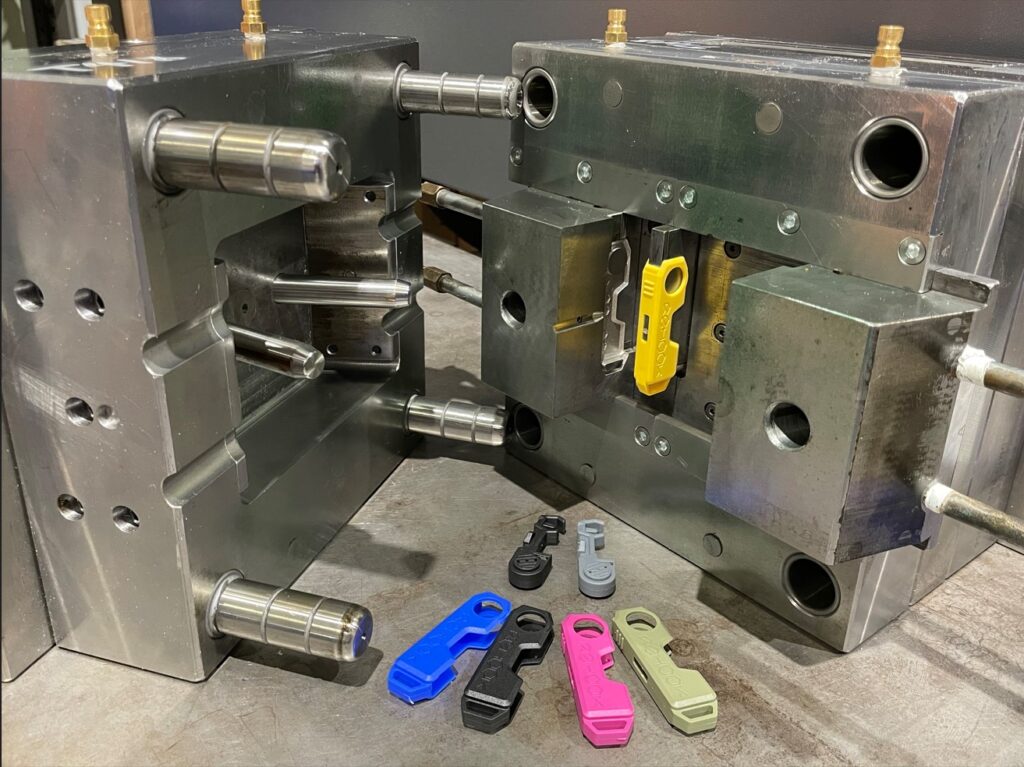
Mold Ejection Issues: Diagnosing Pin Seizure & Part Sticking
Now on to Mold Ejection Issues, these are often the most disruptive operational failure mode because it stops production right away, and the parts can get damaged before you can even finish a shutdown. Ejector pin seizure shows up when thermal growth squeezes out the clearance between the pin and bore until it hits zero, then the pin binds mid-stroke.
The physics is kind of simple, and also annoying: if you take a 150mm ejector pin made from H13 steel and you look at it at 180°C, it ends up about 0.021mm longer than at 20°C. now imagine you have a bore where the clearance is only 0.015mm. yeah, the pin is already in interference, seizure is basically inevitable within thousands of cycles , not millions.
- SSP standard: H7/h6 fit tolerance for every ejector pin bore. that usually gives you 0.010–0.035mm clearance over the entire mold temperature span
- Nitrided pins: nitriding gives you surface hardness around 65–70 HRC on the ejector pins. This lowers wear rate by roughly 55% compared with fully through-hardened H13
- Venting: if venting is off then part adhesion can show up, even when the ejection force seems fine. SSP calls for 0.025mm vent depth at all deeper ribs and bosses
- Ejection force monitoring: SSP fits piezoelectric force sensors on tools that are higher risk. If the signal jumps more than 15% over the baseline, it triggers an automatic maintenance notice
Mold Maintenance Data & Tooling Wear Prevention: SSP PM Schedule
Tooling wear prevention should stay a scheduled thing, not a reactive thing. SSP PM (Preventive Maintenance) uses cycle-count triggers rather than fixed calendar intervals, so the maintenance effort scales with real tool usage, not the date on the wall. The schedule below gets applied across all active molds handled by SSP.
Table 2: SSP Mold Maintenance Data — Cycle-Based PM Schedule by Tool Class
| PM Level | Trigger (Cycles) | Actions Performed | Duration | Failure Risk if Skipped |
| L1 — Inspection | Every 5,000 | Visual inspect parting line, pins, slides; clean vents; log any flash or drag marks | 45–60 min | Early galling and flash go undetected |
| L2 — Lubrication | Every 10,000 | Re-lube all slides/lifters (MoS₂); check ejector pin return; inspect water lines for scale | 2–3 hrs | Pin seizure risk increases 4x by 20,000 cycles |
| L3 — Dimensional Audit | Every 50,000 | CMM check on all CTF dimensions; re-stone PL; measure gate erosion; replace worn pins | 1–2 days | Dimensional drift; flash >0.05mm at PL |
| L4 — Full Overhaul | Every 250,000 | Full disassembly; re-polish cavities; replace all wear components; re-qualify with FAI | 3–7 days | Catastrophic cracking if fatigue ignored |
| Unplanned — Crack Repair | On-condition | TIG/laser weld repair; EDM polish; hardness verification post-weld | 1–5 days | Mold scrap if crack propagates to core |
SSP’s digital mold tracking system keeps a record of every PM event, cycle count, and any defect notes against each tool’s serial number. If a mold shows 3 or more consecutive L1 findings of flash >0.03mm, it gets automatically bumped up to an L3 audit, even if the cycle count is low, so you don’t miss the early warning. This approach prevented about 87% of parting-line crack events that were listed in SSP’s 2022–2023 failure database.
SSP Is a Trusted Partner for Die Manufacturing Cost Optimization
SSP Precision is an ISO 9001 & IATF 16949 certified manufacturer delivering end-to-end precision solutions, from design and prototyping to high‑volume production, for the automotive, medical, electronics, aerospace, and industrial sectors. We handle every stage in‑house – DFM engineering, rapid prototyping, CNC machining, EDM, grinding, and global logistics – to manufacture the tooling that makes your parts and the parts themselves.
What we build and supply: visit our sites: https://SSP.com.cn/
- Stamping dies manufacturing and stamping die parts – high‑precision transfer stamping dies and progressive/compound dies for volume metal stamping.
- Injection molding and injection mold – custom injection molds for plastic components, including single‑, multi‑cavity, and over‑molding & insert‑molding tools that combine metal and plastic in one part.
- Specialty molded components – eco‑friendly green mold parts and microscopic medical micro‑molded parts.
- Precision metal and plastic end‑use parts – high‑volume serial production of precision products (metal stampings, plastic moldings) with full PPAP traceability.
Tooling spare parts manufacturing & – tooling spare parts (punches, inserts, ejector pins) and precision robotics spare parts to keep your production running.
FAQ: Injection Mold Failure, Galling & Maintenance
Q1: What kinda makes injection mold cracking happen and how do you stop it?
Core and cavity cracking usually comes from fatigue stress building up at sharp inner radii, thin sections, and near the gate area. In plain terms, the stress kinda “finds” weak spots and then it repeats… Prevention is mostly about keeping minimum 0.5 mm radii on every internal corner, picking the right tool steel (for long-run tools, H13 hardened to 48–52 HRC is the go-to), and doing EDM stress-relief after machining. SSP also runs finite element analysis (FEA) on every tool that’s expected to go beyond 500,000 cycles, so stress concentration zones show up before any real cutting into the steel begins.
Q2: Tool Steel Galling what is it, and which steels get hit the worst?
Tool Steel Galling is basically adhesive metal transfer, like when sliding surfaces stick and then tear, all driven by high contact pressure and heat. The steels most at risk are uncoated P20, and 718H pre-hardened steel, because their surface hardness sits lower around 28–34 HRC. With H13 at 48+ HRC, plus a TiCN PVD coating, SSP treats this as the standard for side-action parts and lifter interfaces, and that cuts galling events by more than 80% compared with uncoated P20.
Q3: How does SSP keep mold maintenance data straight when there are multiple tools?
SSP runs a digital tooling management system that logs cycle counts, PM events, defect notes, and the full repair record for each mold being handled. Customers then get a quarterly Mold Health Report , it includes the current cycle count for each tool, the next preventive maintenance milestone, and any open corrective actions. That means you can plan maintenance spend earlier rather than waiting until a failure, or a sudden downtime surprise.
Q4: What are the most common Mold Ejection issues and how are they dealt with?
Usually the three biggest ejection failures are pin seizure (when thermal expansion reduces the bore clearance to basically nothing), part sticking (not enough draft angle, or venting is kind of weak), and pin breakage (pin diameter is undersized for the ejection force that is actually needed). SSP tends to handle seizure by using H7/h6 bore tolerancing plus nitrided pins. For sticking, they add 0.025mm vent slots at ribs and bosses. For breakage, the process is more like, calculate the maximum ejection force first, then specify pins at 150% of the needed load capacity, to be safe.
Q5: Can SSP repair a cracked injection mold or does it need to be scraped?
Most cracks can be repaired. Typically they do TIG or laser welding using matching filler rod, then follow up with EDM polishing and a post weld hardness check. SSP performs weld repairs on both P20 and H13 tool steels, and they report a repair success rate of 91% for cracks found at the L1 or L2 inspection phase. But if the crack has spread through more than 30% of the core or cavity wall thickness, then insert replacement is usually the better route, rather than trying to weld and repair it.
Read More – Knowledge That Keeps Your Shop Running
- Stamping DFM: Optimizing Strip Layouts for Less Scrap – It’s not just about nesting tighter; it’s about redesigning the entire dance of the die to shave 18–27% off your material bill every single year.
- Sourcing Interchangeable Cores & Punches for Tooling – Stop stocking a warehouse of custom spares—this approach slashes downtime by over a third and keeps your press running while others scramble for replacements.
- Micro Injection Molding: Controlling Flash on Tiny Parts – When parts weigh under 0.1 gram, even a 10-micron flash is a giant defect—here’s how to control the process on the smallest scale.
- Conformal Cooling in Injection Molding – Cooling eats 50–70% of your cycle time—here’s how 3D-printed conformal channels cut it by up to 40%, slash scrap by 65%, and pay for themselves in under 6 months.
- Micro Injection Molding: Controlling Flash on Tiny Parts – When parts weigh under 0.1 gram, even a 10-micron flash is a giant defect—here’s how to control the process on the smallest scale.
- Conformal Cooling in Injection Molding – Cooling eats 50–70% of your cycle time—here’s how 3D-printed conformal channels cut it by up to 40%, slash scrap by 65%, and pay for themselves in under 6 months.
- Stamping Tool Steel HRC Hardness Chart – A 2–3 HRC shift can swing die life by 20–40%—here’s the complete hardness chart for D2, SKD11, M2, and more, plus grade-specific wear data and application guidance.
- What Drives Metal Stamping Die Costs? – A progressive die can cost anywhere from $8,000 to over $150,000—here’s a breakdown of the 5 key cost drivers, global price comparisons, and when to repair vs. replace.
- Injection Molding Guide: Costs, Materials, Process, and Mold Tooling – A prototype mold can cost $3,000, while a high-volume production mold runs $80,000+—here’s how to match tooling class to real production volume and avoid overpaying for steel.