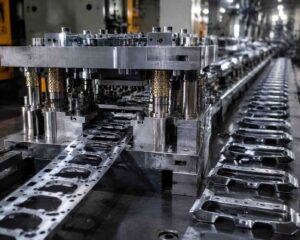
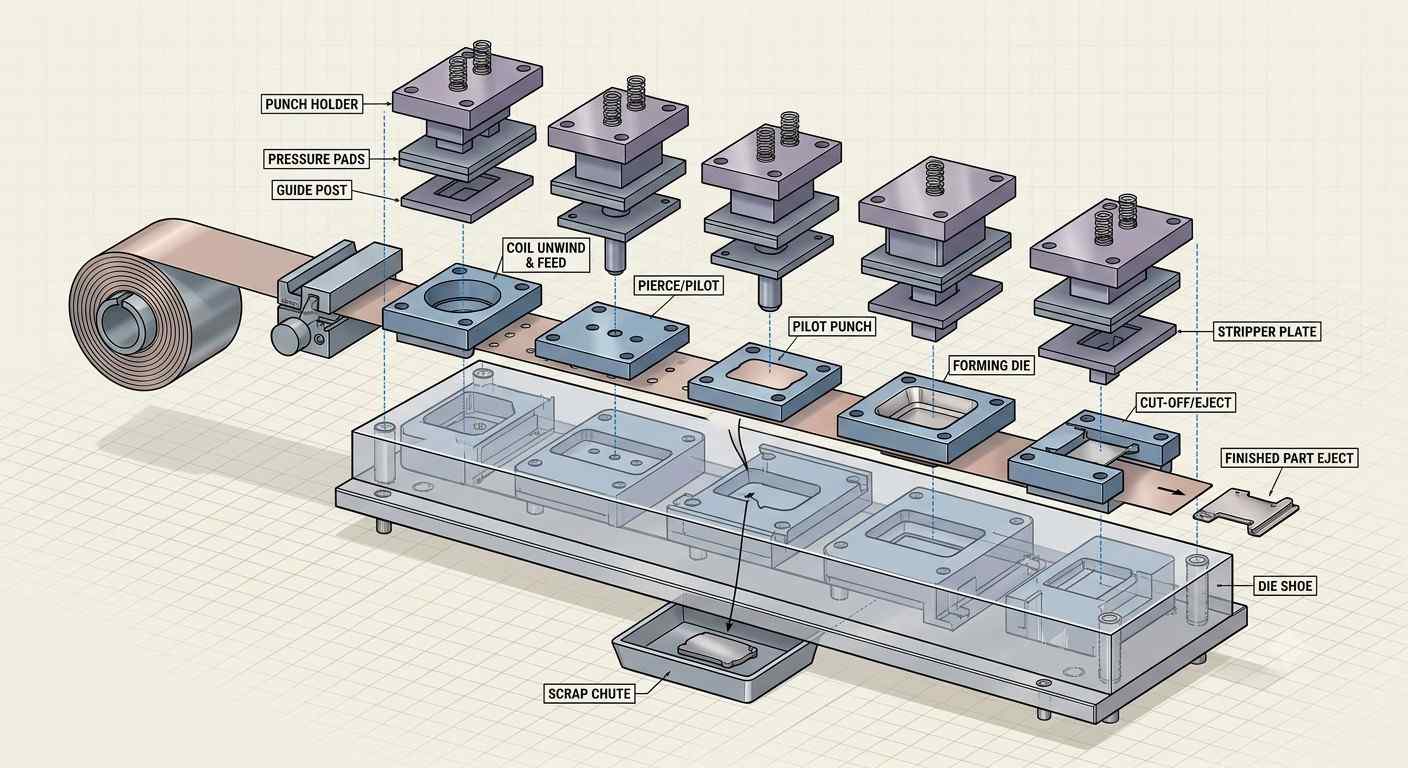
A Progressive Die Failure rarely kicks off as a big dramatic event— usually it starts kind of quietly, with a 0.01 mm drift in pierce diameter , or a faint burr showing up on a trim edge. By the time scrap starts piling up, the die has often been “aging” for thousands of strokes already. Progressive dies pass a metal strip through piercing, forming, and cutting work at multiple stations in one press cycle, so a minor offset at just one station ends up stacking problems downstream. This guide walks through common failure patterns, the maintenance records that tend to forecast them, and the shop practices that can stretch tool life, based on field experience from SS Precision (SSP), a China-based manufacturer focused on high-tolerance stamping dies, operating since 2008.
Understanding Stamping Die Issues: Root Causes Behind the Numbers
A lot of stamping die troubles can be traced to a small cluster of mechanical root causes that decide whether you need a quick tweak, or you end up doing a full rebuild. From real field data, you tend to see three groupings: strip misalignment, wear caused by the material, and thermal or lubrication problems.
1. Strip Misalignment and Feed Errors
Misalignment is the usual “first spark” for failure. When the pilot does not register the strip right, even if it’s only a fraction of a millimeter, each downstream station ends up cutting or forming in the wrong spot. Feed errors also explain a meaningful portion of unexpected stoppages, especially when the gauge is under 0.2 mm , because the tolerance room is the tightest there.
2. Progressive Tool Wear at High-Stress Zones
Punches, die buttons, and trim edges take in repeated shear and impact, so the wear seems to cluster at a small number of predictable zones instead of being spread evenly. The cutting edges and the forming radii usually start showing measurable wear long before the rest of the die looks different, or even behaves differently.
3. Thermal Buildup and Lubrication Breakdown
When high-speed presses run at something like 200–800 strokes per minute they create friction heat right at the die-material interface. If lubrication isn’t steady, the temperatures can climb enough to soften tool steel and that, in turn, makes wear accelerate. You can also get galling, where the material clings to the tool and then tears during later strip formation , leaving more defects on the next passes.
Common Failure Modes at a Glance
| Failure Mode | Typical Cause | Early Warning Sign |
| Burred edges | Dull punch / clearance drift | Burr height +0.01–0.03 mm |
| Dimensional drift | Pilot or bushing wear | Parts trending past ±0.02 mm |
| Slug pulling / jamming | Poor clearance, worn stripper | Press stalls, rising scrap rate |
| Galling / pickup | Lube breakdown, bad coating | Shiny smear on formed surfaces |
| Cracking / chipping | Fatigue, improper heat treat | Noise change, sudden rejects |
Die Maintenance Data: What the Numbers Say About Tool Life
Teams that log die performance in numbers catch failures earlier than groups that lean on visual checks alone. There are a few key metrics that matter most: strokes since the last service, the dimensional trend over time, and the scrap rate per shift.
Reference benchmarks used in SSP’s tooling programs:
- Inspection interval: the critical wear parts get checked every 50,000–100,000 strokes, using gauge readings and hardness tests.
- Tolerance drift threshold: if a shift moves beyond ±0.02 mm, it usually means re-grinding, or insert replacement.
- Scrap-rate alarm: when the scrap rate jumps over 1.5–2% on a line that is otherwise stable, it points strongly to tool degradation.
- Carbide vs. tool steel: carbide punches often handle several times more cycles, so the higher cost gets balanced out over the run length.
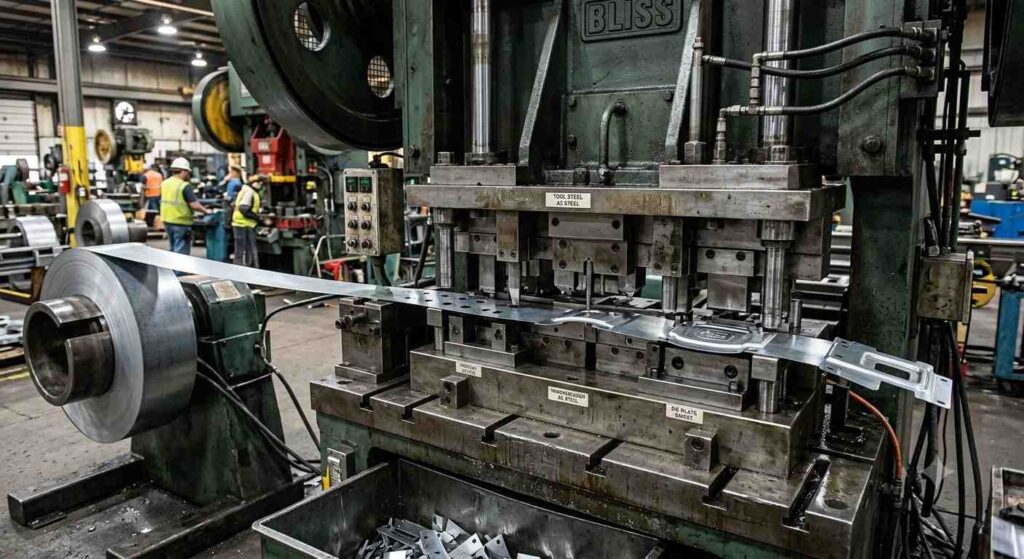
Case Example: Connector Die Running 0.15 mm Material
On a high-volume Type-C connector program, the strip thickness can be as low as 0.15 mm and that leaves almost no cushion for misalignment or minor variation. Keeping the die-button clearance within about 5–8% of material thickness is what separated a scrap rate under 1% from edge failures happening within roughly 20,000 strokes. It also highlights how thin-gauge data becomes the calendar for maintenance, whether people notice it at first or not.
Tooling Wear Analysis: Comparing Materials and Coatings
Picking the proper tool steel plus a surface treatment is probably the best move for stretching die life, even before one single stroke really runs. In a kind of tooling wear analysis you kind of weigh hardness, coating, and the expected run volume against the actual cost.
| Tool Material | Hardness (HRC) | Typical Cycle Life | Best Use Case |
| D2 Tool Steel | 58–62 | 300K–800K strokes | General piercing |
| DC53 / SKD11 | 60–62 | 500K–1.2M strokes | Fine blanking, terminals |
| Carbide (Tungsten) | 90+ (HRA) | 2M–5M+ strokes | High-volume EV/auto parts |
| PVD-Coated Steel | 70+ (surface) | 1.5–3x base life | Abrasive materials |
SSP puts that same idea into practice across automotive, electronics and industrial equipment programs. They have measurement capability down to ±0.002 mm, and their processes are IATF 16949-compliant, so the engineers can choose the tool steel, the coating, and the clearance based on the projected stroke volume — built around the maintenance data above, which helps reduce the unplanned downtime later on.
Preventive Practices That Reduce Progressive Die Failure Rates
- Scheduled checks: measuring the critical features at set stroke intervals, not only after the defects show up, and then complain later.
- Quick change inserts: using standardized punches and bushings turns changeover from “hours” into “minutes” pretty fast.
- Lubrication monitoring: keeping a steady film there helps prevent galling and the edge temperature spikes too.
- Parameter logging: tracking tonnage and cycle time can signal drift before the parts even fail inspection.
- Design for maintenance: if the wear zones are accessible from the start, servicing becomes faster, and also more consistent.
SSP Is a Trusted Partner for Die Manufacturing Cost Optimization
SSP Precision is an ISO 9001 & IATF 16949 certified manufacturer delivering end-to-end precision solutions, from design and prototyping to high‑volume production, for the automotive, medical, electronics, aerospace, and industrial sectors. We handle every stage in‑house – DFM engineering, rapid prototyping, CNC machining, EDM, grinding, and global logistics – to manufacture the tooling that makes your parts and the parts themselves.
What we build and supply: visit our sites: https://ssprecision.com.cn/
- Stamping dies manufacturing and stamping die parts – high‑precision transfer stamping dies and progressive/compound dies for volume metal stamping.
- Injection molding and injection mold – custom injection molds for plastic components, including single‑, multi‑cavity, and over‑molding & insert‑molding tools that combine metal and plastic in one part.
- Specialty molded components – eco‑friendly green mold parts and microscopic medical micro‑molded parts.
- Precision metal and plastic end‑use parts – high‑volume serial production of precision products (metal stampings, plastic moldings) with full PPAP traceability.
- Tooling spare parts manufacturing & – tooling spare parts (punches, inserts, ejector pins) and precision robotics spare parts to keep your production running.
FAQ: Progressive Die Failure, Stamping Die Issues & Tool Wear
What is a Progressive Die Failure, in simple terms?
It’s basically a point where the die starts making out-of-spec parts, or just stops, because something in the stack isn’t behaving right. Like misalignment, worn edges, cracking starting, or a jam in the feed, then production needs to pause and the die gets fixed or reset before normal output comes back.
How often should stamping die issues be inspected?
For a lot of high-volume setups, the critical wear bits are checked every 50,000 to 100,000 strokes, and then there are full inspections at planned milestones. Rather than waiting until a defect shows up, you catch the trend earlier.
What die maintenance data predicts failure best?
The most useful early warning tends to come from three things at once: stroke count since the last service, dimensional drift over time, and the scrap rate by shift. Together they usually tell you what’s changing before the failure is obvious.
How does tooling wear analysis guide material selection?
Tooling wear analysis is like matching the die material to the real job ahead. It balances cycle life, hardness, and cost across options like steels, carbide, and coatings. Then it’s judged against projected volume, so the die material doesn’t get overkill or, worse, underperform.
Does SSP support troubleshooting for existing dies?
Yes, SSP can support troubleshooting, diagnosis, and repairs on existing dies. That includes root-cause identification, replacing worn components, and die refurbishment. Plus, SSP also supports new work, like designing higher precision progressive stamping dies and the tooling parts themselves.
Read More – Intelligence That Protects Your Production Line
-
Stamping Tool Steel HRC Hardness Chart – A 2–3 HRC shift can swing die life by 20–40%—here’s the complete hardness chart for D2, SKD11, M2, and more, plus grade-specific wear data and application guidance.
-
Troubleshooting Progressive Die Failures & Tool Wear – A 0.01mm drift or a faint burr is often the first warning—here’s how to read the data, schedule maintenance, and stretch tool life before scrap piles up.
-
Micro Injection Molding: Controlling Flash on Tiny Parts – When parts weigh under 0.1 gram, even a 10-micron flash is a giant defect—here’s how to control the process on the smallest scale.
-
Conformal Cooling in Injection Molding – Cooling eats 50–70% of your cycle time—here’s how 3D-printed conformal channels cut it by up to 40%, slash scrap by 65%, and pay for themselves in under 6 months.
-
Why Injection Molds Fail: Cracking & Galling Fixes – 62% of unplanned mold downtime comes from just three failure modes—here’s the root-cause data and preventive fixes for cracking, galling, and ejection issues.
-
What Drives Metal Stamping Die Costs? – A progressive die can cost anywhere from $8,000 to over $150,000—here’s a breakdown of the 5 key cost drivers, global price comparisons, and when to repair vs. replace.
-
Injection Molding Guide: Costs, Materials, Process, and Mold Tooling – A prototype mold can cost $3,000, while a high-volume production mold runs $80,000+—here’s how to match tooling class to real production volume and avoid overpaying for steel.