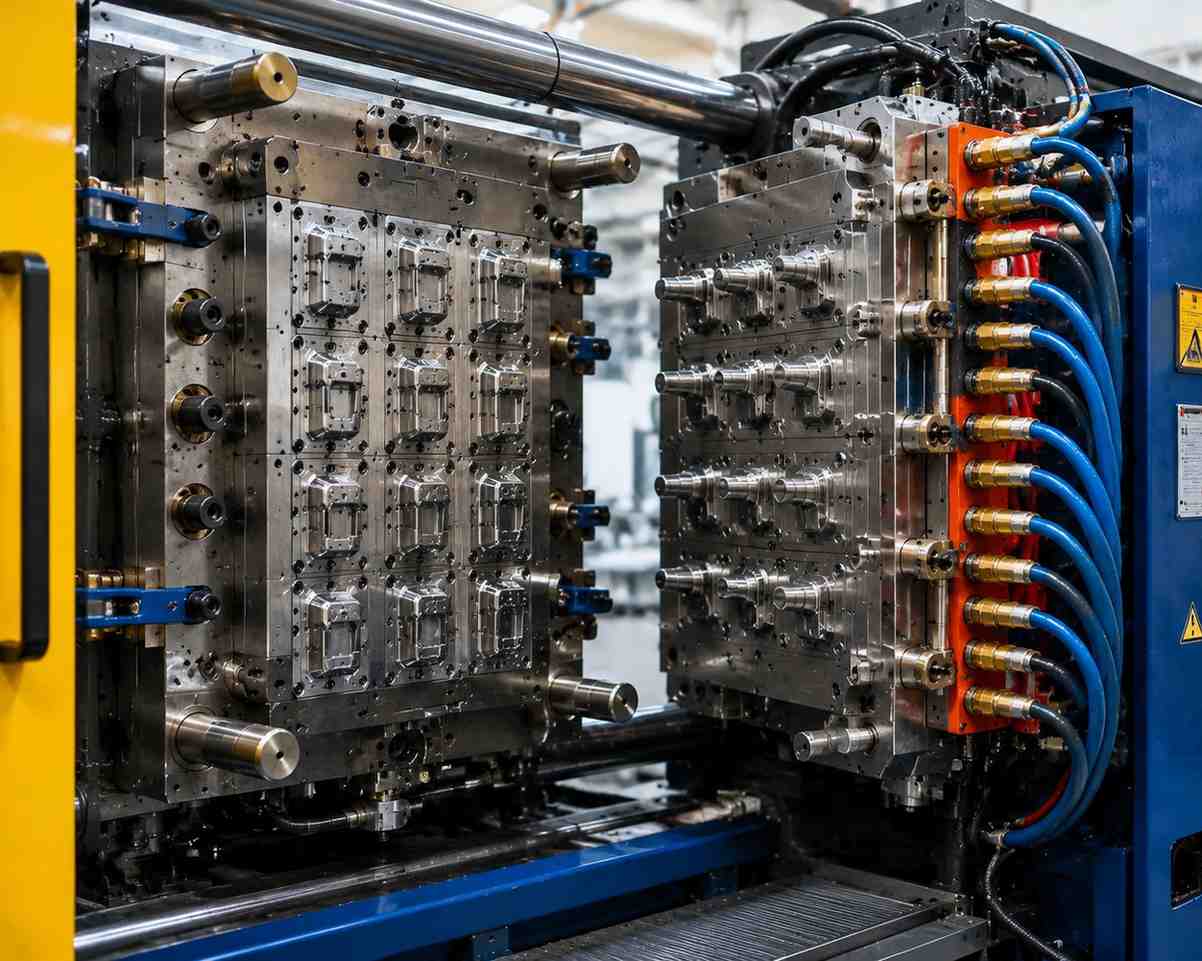
Multi-cavity injection molds cut part cost, but only with smart tooling design. See cavity layouts, cooling, and tolerance tips from a precision mold shop.
Molding a part in a single cavity is like printing one page at a time—reliable, but slow and expensive when you need thousands. Shrink the part cost and the story changes completely. Injection mold tooling design is where that decision is made: how many cavities, how they are fed, cooled, and ejected, and how precisely they repeat. Good injection mold tooling design is what makes those parts identical, cycle after cycle.
This guide covers the fundamentals of injection mold tooling design for multi-cavity injection molds and engineering plastics—cavity layouts, material behavior, the design challenges that bite, and how a precision mold maker holds tight tolerances. Whether you are quoting a new part or auditing an existing tool, this gives you the questions to ask.
Key Takeaways
- More cavities lower the per-part cost, but only if the injection mold tooling design keeps every cavity balanced and repeatable.
- Engineering plastics differ: shrinkage, flow, and molding temperature all change the cavity geometry you cut.
- Runner balance and cooling channel layout are the difference between a good multi-cavity mold and a great one.
- A precision mold maker can hold tolerances down to ±0.002 mm with the right steel, machining, and inspection.
- Multi-cavity tooling pays off most at production volume—match cavity count to volume, not to pride.
- Work with a partner who does design-for-manufacturing early, so the mold is right before the first trial.
What Is Multi-Cavity Injection Mold Tooling?
How Cavity Count Changes Your Numbers
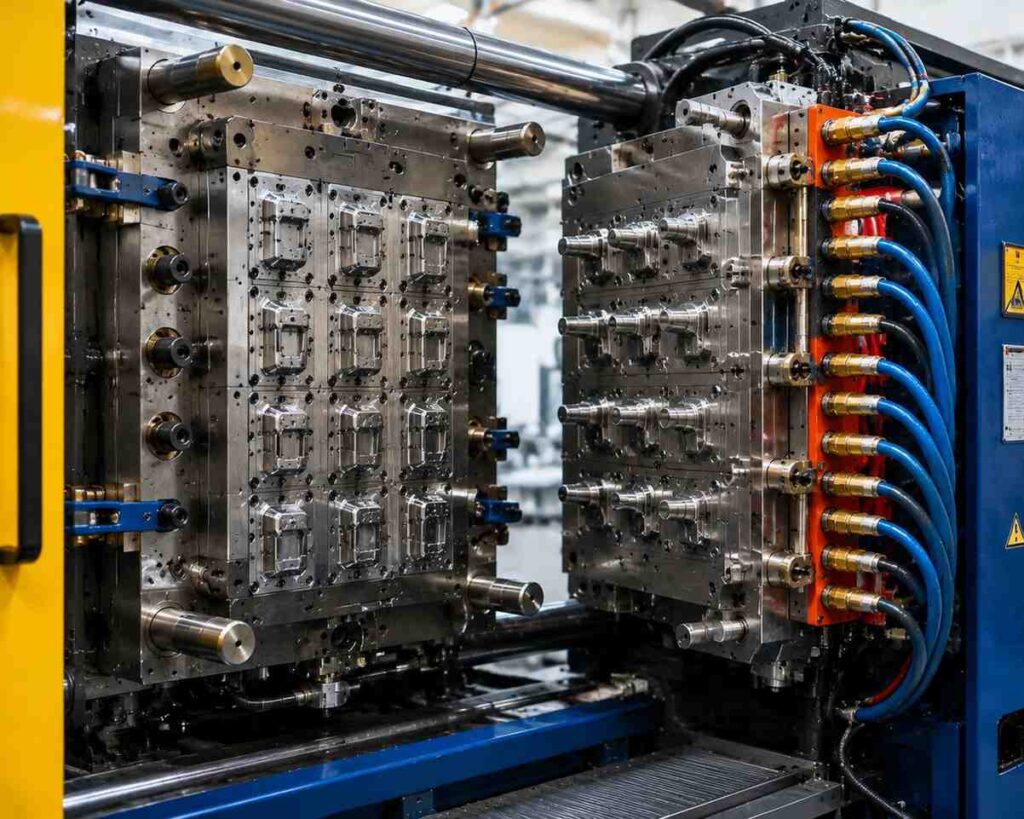
Adding cavities spreads the machine cycle, mold base, and overhead across more parts, which is why high-cavity tooling drives unit cost down so hard. The catch: more cavities mean more complexity in how plastic flows, more tool steel, and a bigger upfront investment. A sound injection mold tooling design starts by balancing part price, tooling cost, and your actual forecast.
Full vs. Family Molds
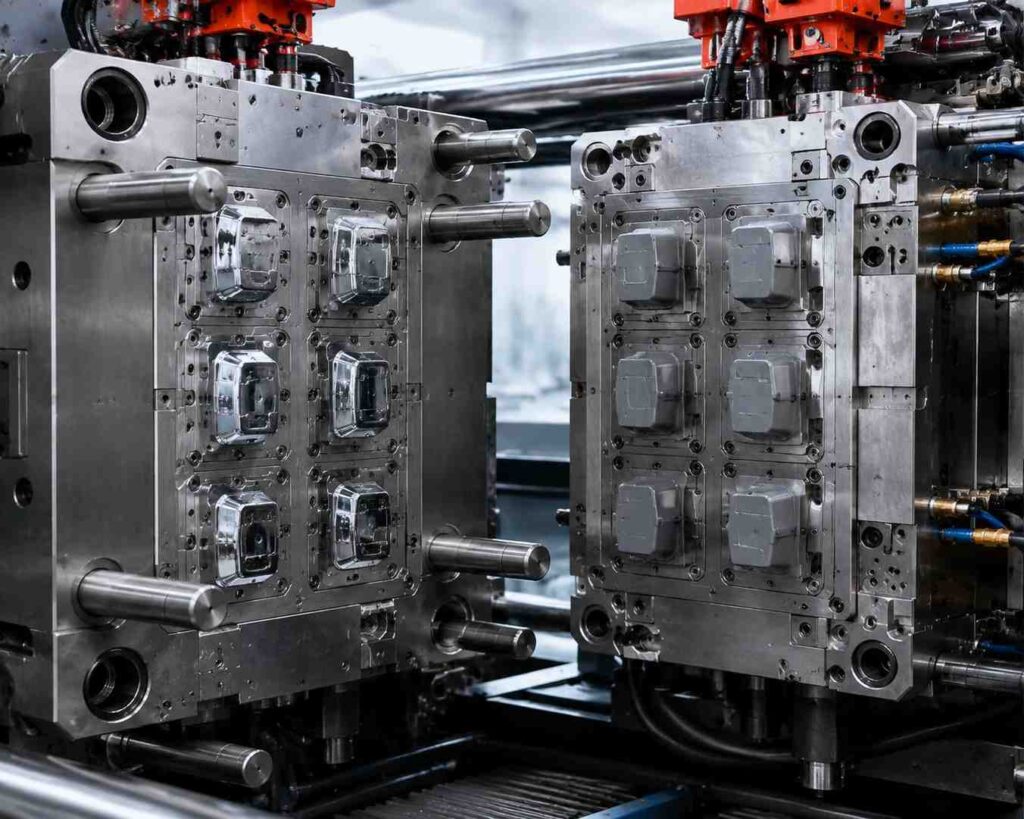
A full mold uses every cavity for the same part. A family mold combines different parts in one tool. Full molds keep flow and quality predictable; family molds save tooling cost but can be a headache when part volumes do not match. For engineering plastics, full molds are almost always the safer call in injection mold tooling design.
Injection molding shapes molten plastic by forcing it into a closed mold under pressure. A multi-cavity injection mold contains several identical cavities in one tool, so each cycle produces multiple parts at once—two, four, eight, or sixteen.
Engineering Plastics Change Everything About the Mold
Shrinkage Is the Silent Variable
Engineering plastics shrink as they cool, and the amount varies with the material, the wall thickness, and the process. Good injection mold tooling design compensates by cutting the cavity slightly oversize, then dialing it in over trial iterations. That is why material grade matters before the tool steel is ordered—switch resin after the fact and the part dimensions move with it.
Engineering plastics are chosen for strength, temperature resistance, and dimensional stability—and each one behaves differently in the mold, which is why material selection is the first move in injection mold tooling design. Shrinkage, viscosity, and required melt temperature directly set cavity dimensions, wall thickness, and cooling design.
| Material | Key behavior | Mold design impact |
| POM (acetal) | High shrinkage, good dimensional stability | Precise cavity sizing, tight cooling control |
| PA66 (nylon) | Absorbs moisture, shrinks | Account for post-mold growth in tolerances |
| PC (polycarbonate) | Tough, high melt temperature | High-temperature steel, careful gate design |
| PEEK | Very high temperature, low flow | Hot runner, hardened tooling |
| PBT / PET | Good electricals, prone to flash | Tight shutoff, balanced flow |
Core Design Considerations in Multi-Cavity Tooling
Runner Balance and Gating
Every cavity has to fill at the same rate, pressure, and temperature, or you get parts that differ from cavity to cavity. Balanced runners and carefully placed gates equalize flow; hot runner systems add control for demanding engineering plastics. It is the single biggest quality lever in high-cavity tooling, and the heart of any good injection mold tooling design.
Cooling Channel Layout
Heat must leave the mold at a steady, even rate. Conformal cooling channels that follow the part contour remove heat faster and more evenly than straight drilled lines, cutting cycle time and warpage at once. Poor cooling shows up as sink marks, shrinkage, and long cycles.
Ejection and Venting
Every cavity needs clean ejection and proper venting. Trapped air burns plastic; weak ejection marks the part. Engineering plastics with tight tolerances demand well-designed ejectors and venting at the parting line.
- Balance the runner system so every cavity fills identically.
- Put cooling where the heat is: near thick sections and the gate.
- Vent every cavity; trapped air causes burns and short shots.
- Design ejection around the part’s strongest, least-visible surfaces.
- Plan for growth: harden wear surfaces so the tool holds tolerance over millions of cycles.
Holding Tight Tolerances in Precision Injection Molding
Multi-cavity molds are only worth the investment if every cavity agrees, so precision has to be baked into the injection mold tooling design from the start. That takes hardened tool steel, precision machining of cavities and cores, and inspection that verifies each cavity, not just the first one.
| Feature | Capability (± mm) |
| Cavity-to-cavity consistency | 0.002 |
| Dimensional tolerance on part | ±0.002–0.01 depending on material |
| Surface finish (core/cavity) | Ra 0.4 µm or better |
| Parting line mismatch | < 0.005 |
Numbers like these take the right steel selection, wire EDM and high-speed machining, and CMM verification. A mold shop that quotes ±0.002 mm has to prove it on inspection reports, not just on paper.
Working with a Precision Tooling Partner
The mold is a capital asset that runs for years, so the shop behind your injection mold tooling design matters as much as the part drawing. Look for a partner who:
- Review the part drawing for draft, wall thickness, and gate location before quoting.
- Has experience with the exact resin and tolerance you need.
- Offers in-house mold design, machining, assembly, and trial.
- Provides full inspection reports and steel certifications.
- Builds tools with predictable lead times and honest communication about changes.
SSPrecision is a China-based (Dongguan) precision manufacturer of stamping dies, injection molds, and tooling spare parts since 2008, certified to ISO 9001:2015 and IATF 16949, with tolerance capability to ±0.002 mm. , serving automotive/EV, electronics, medical, aerospace, energy, and industrial sectors.
SSP Is a Trusted Partner for Die Manufacturing Cost Optimization
SSP Precision is an ISO 9001 & IATF 16949 certified manufacturer delivering end-to-end precision solutions—from DFM engineering and rapid prototyping to high-volume production—for the automotive, medical, electronics, aerospace, and industrial sectors. We handle every stage in-house to manufacture the tooling that makes your parts and the parts themselves.
Visit our to explore our full capabilities: ssprecision.com.cn
Services (tooling design & manufacturing)
- Stamping Dies Manufacturing – high-volume metal stamping with Progressive Die Stamping & Tooling spare parts manufacturing and Transfer Stamping Dies
- Injection Molding – custom plastic molds including Over Molding & Insert Molding and Liquid Silicone Rubber (LSR) Molding
- Green Mold – eco-friendly molded components, Micro Molding – microscopic medical precision parts
Products (end-use parts & spare components)
- Stamping Die – complete stamping tooling
- Injection Mold – complete injection tooling
- Tooling Spare Parts – punches, inserts, ejector pins, Robotics Spare Parts – precision automation spares , Ball Screw Repair Kits – replacement kits for motion systems
- Machine Parts – general precision machine components
Frequently Asked Questions
When should I choose a multi-cavity injection mold instead of a single-cavity tool?
When volume justifies the extra tooling cost. Injection mold tooling design usually pairs high cavity counts with forecasts in the tens of thousands and up, where per-part savings pay for the mold quickly—for low volumes, a single cavity is cheaper to build and tune.
What is the biggest mistake in multi-cavity tooling design?
Unbalanced filling. If one cavity fills and packs before another, parts vary and scrap climbs. Balanced runners, gates, and cooling are the fix—which is why experienced mold makers design flow, not just geometry.
Which engineering plastics are hardest to mold?
High-temperature, low-flow resins like PEEK and glass-filled nylons are demanding—they need hot runners, hardened tooling, and precise process control. POM and PBT are more forgiving but still require disciplined cooling.
How tight a tolerance can a precision injection mold hold?
With the right steel, machining, and inspection, mold makers can hold ±0.002 mm on cavity features. The part tolerance you can achieve also depends on the material’s shrinkage behavior and the process control.
Does cavity count affect part quality?
It can, if the tool is not designed correctly. A well-designed high-cavity mold produces parts that are indistinguishable cavity to cavity. A poorly balanced one produces eight or sixteen different parts pretending to be the same.
Read More – Intelligence That Protects Your Productio=n Line
- Top 10 Best Stamping Dies and Injection Molding Companies in the World – A data-driven ranking of the top 10 stamping die and injection molding companies globally—here’s how they compare across certifications, lead times, and cost, with a detailed China vs. rest-of-world breakdown.
- Precision Robotics Components: Spare Parts Supply Solutions – Custom robotics components and automation spare parts machined to ±0.002 mm—here’s the material selection guide, tolerance data, and why OEMs rely on precision machining for end-effectors, housings, and motion-critical parts.
- Precision Manufacturing China | IATF 16949 Certified Tooling – IATF 16949 certification isn’t just a badge—it means documented processes, defect prevention, and traceability for stamping dies and molds down to ±0.002 mm. Here’s what to look for in a certified tooling partner.
- LSR Injection Molding | Precision Liquid Silicone Rubber – LSR injection molding cures at 5 seconds per millimeter of wall thickness with tolerances to ±0.002mm—here’s the material grades guide, tooling requirements, and why OEMs choose silicone for seals, gaskets, and medical components.
- Heavy Duty Transfer Tooling: Multi-Station Transfer Dies for Deep-Drawn Components – Transfer dies handle individual blanks for deep-drawn and heavy gauge parts up to 8mm thick with tolerances to ±0.002mm—here’s how they compare to progressive dies for complex automotive and EV components.
- China Injection Mold Source: High-Cycle Multi-Cavity Production Plastic Molds – Multi-cavity molds produce 4–32+ parts per cycle with tolerances to ±0.002mm—here’s how to source high-volume tooling from China with lead times of 25–45 days.
- Stamping Dies Manufacturing: Custom Dies for OEMs – Custom stamping dies achieve ±0.002 mm tolerances for high-volume production of automotive, electronics, and medical components—here’s the steel selection guide and lead time breakdown for OEM buyers.
- Progressive Die Stamping for High-Volume OEM Parts – High-speed progressive dies run at hundreds of strokes per minute, holding tolerances to ±0.002 mm—here’s the guide to strip layout, tool steel selection
- Green Mold Technology: Eco-Conscious Mold Explainer – Sustainability starts at the tooling level—here’s how optimized gating, faster cooling, and ±0.002 mm precision reduce scrap, energy, and material waste across millions of cycles.
- Precision Ball Screw Parts: Complete Component Guide – Backlash, noise, and lost accuracy are early signs of ball screw wear—here’s when to repair vs. replace, how to measure runout, and what a complete linear motion repair kit should include for C3–C7 tolerance classes.