High-speed progressive die stamping produces high-volume OEM parts at low cost per piece. See how progressive tooling design, materials, and tolerances work.
Every car, phone, and appliance on the planet contains parts that came off a stamping press at hundreds of strokes a minute — brackets, terminals, springs, connectors, housings. Progressive die stamping is the method behind most of them: a single tool that turns a coil of metal strip into a finished part, one press stroke at a time. When volume is high and cost per piece matters, nothing beats it.
In this guide you will learn how progressive die stamping works, what goes into progressive tooling design, which materials stamp well, how presses hold tolerances at speed, and how to choose a partner for high-volume metal stamping.
Key Takeaways
- Progressive die stamping performs many operations — punching, forming, bending, tapping — in one stroke, so each part is finished as it exits the die.
- High speed progressive stamping runs at hundreds of strokes per minute on coil-fed presses.
- The die is the real engineering; progressive tooling design decides part quality, tool life, and per-part cost.
- Precision tools hold tolerances to ±0.002 mm on the right geometry and material.
- Best value lands in high-volume metal stamping, where tooling cost is amortized across millions of parts.
- Choose a partner who designs, builds, and trials the tool in-house, backed by ISO 9001:2015 and IATF 16949.
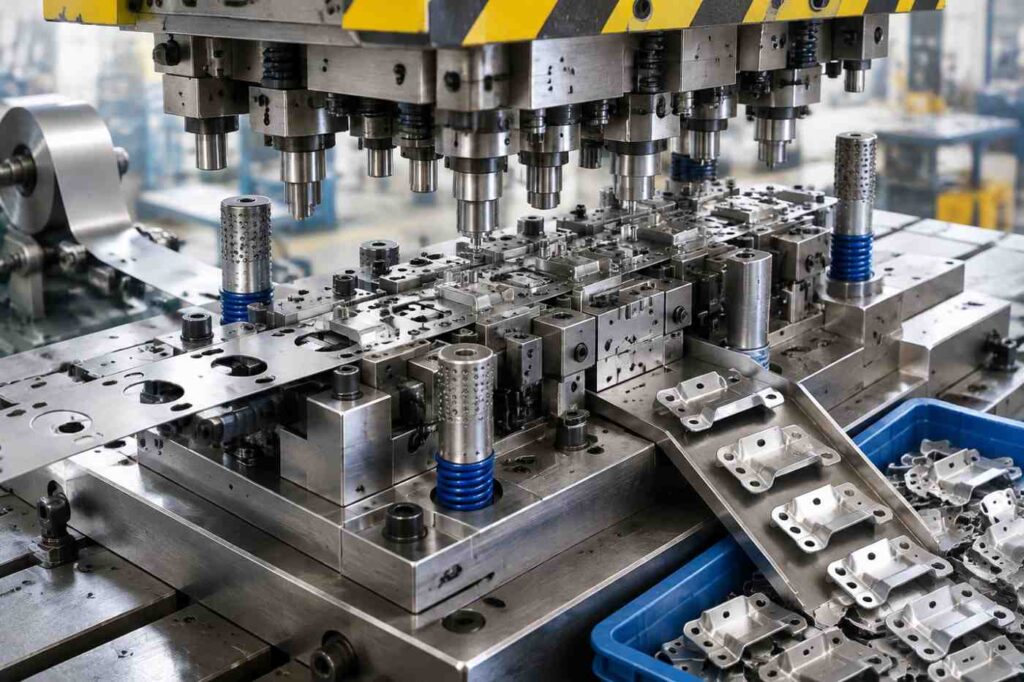
What Is Progressive Die Stamping?
How a Progressive Die Works
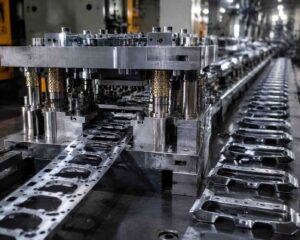
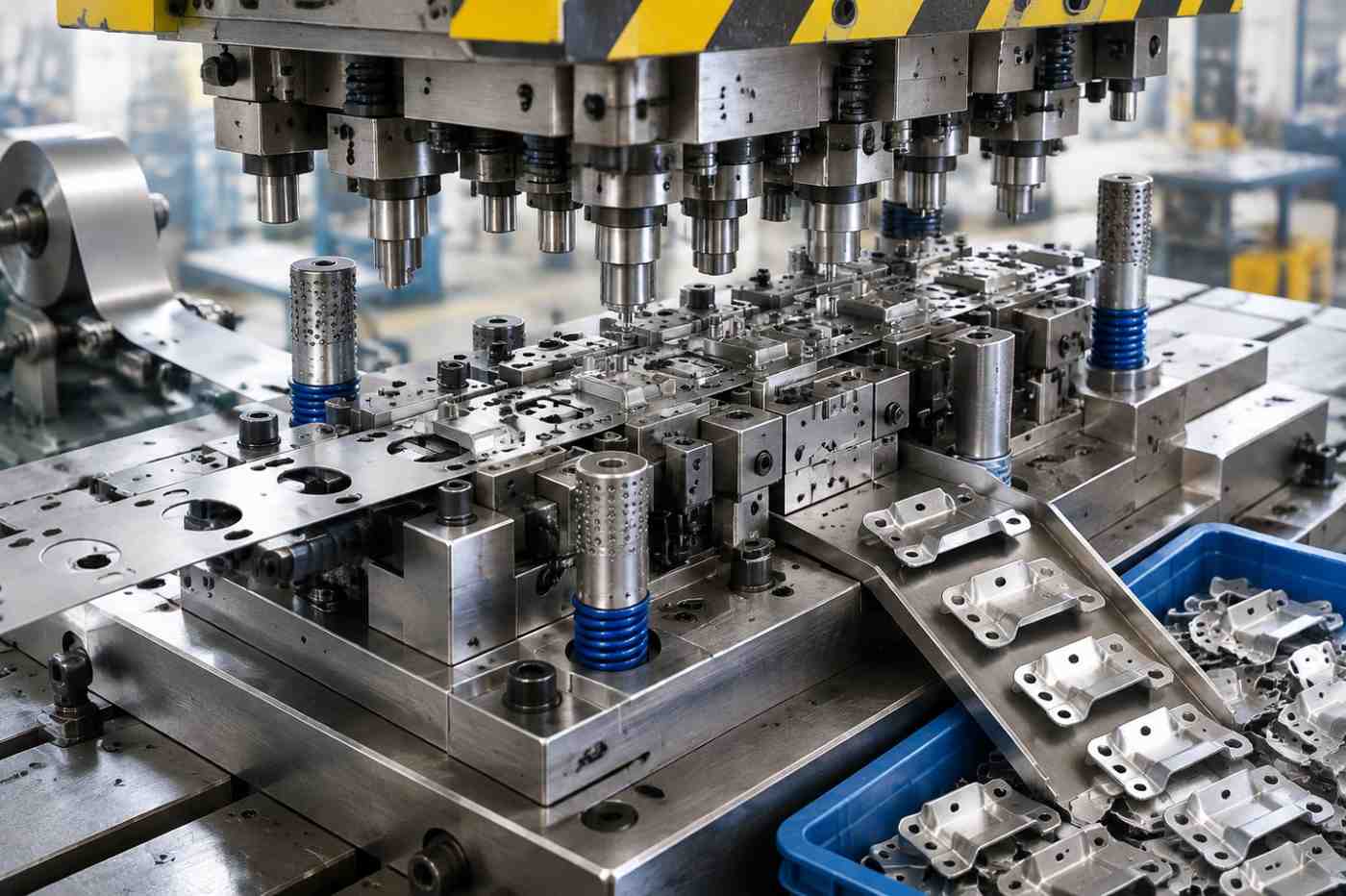
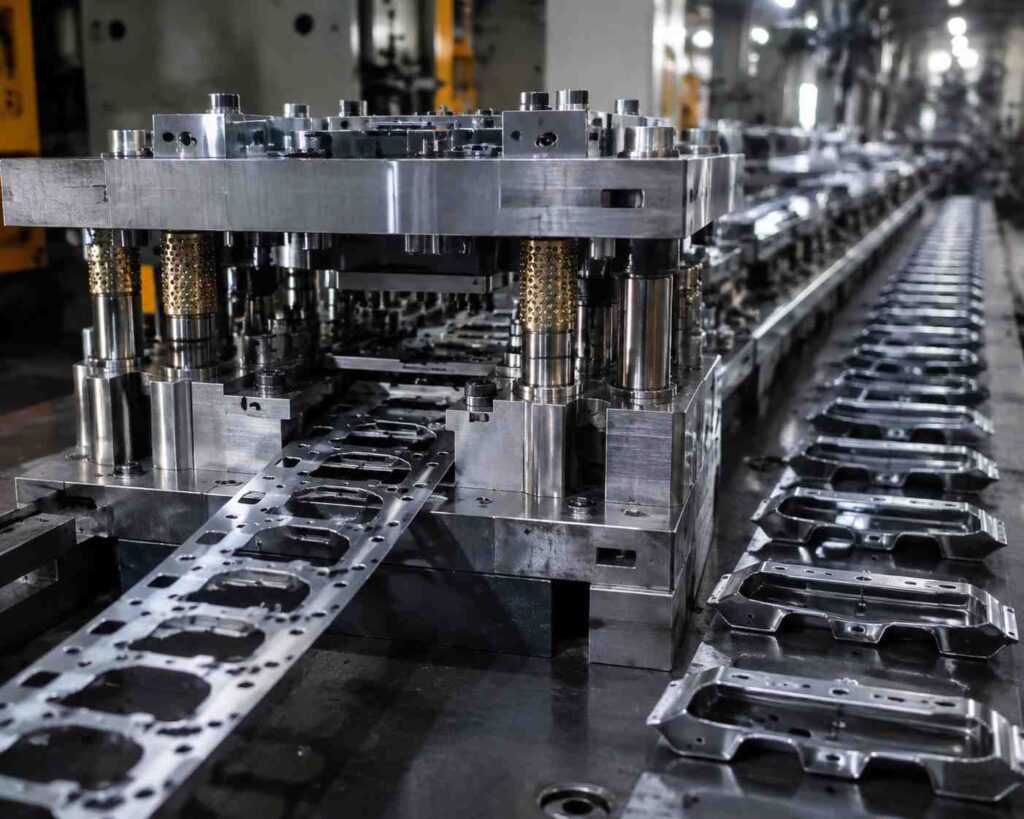
A progressive die is a multi-station tool. Coiled strip feeds through the die, and each stroke of the press carries out a different operation at a different station — pilot holes first, then trimming, then forming, then final cut-off. The part moves forward through the stations with the strip, so a whole sequence of operations happens in a single press stroke. That is the essence of progressive die stamping at high speed.
Progressive vs. Transfer and Single-Hit Stamping
A single-hit tool makes one part per stroke with a simple shape. A transfer die moves parts between stations with fingers. A progressive die keeps the part attached to the strip until the last station, which keeps it aligned without transfer mechanisms — the fastest, most reliable way to make high-volume metal stamping parts with multiple features.
Because the strip carries the part, alignment is built into the tool, and one press can produce multi-feature parts without any operator handling in between.
The Anatomy of Progressive Tooling Design
Strip Layout Is the Blueprint
Before any metal is cut, the tool designer lays out the strip: where each punch lands, how the strip is piloted, how much material carries each feature, and where the part is separated. Progressive tooling design is where cost and quality are really decided — a smart layout uses material efficiently, keeps the strip rigid, and sequences forming so the part never distorts.
Stations, Pilots, and Forming
Pilots register the strip at every step, so each station works on a precisely located position. Forming stations bend and shape progressively, so the material moves in controlled steps rather than one violent hit. Each station is a small, carefully engineered operation.
- Balance strip width against material cost and die strength.
- Sequence forming operations so the metal does not tear or spring back.
- Use pilots early and often to keep the strip registered.
- Specify tool steel that will survive millions of strokes.
Materials for High-Volume Metal Stamping
The right material stamps cleanly, holds its shape, and keeps tool wear predictable. Common choices:
| Material | Best for | Notes |
| Cold-rolled steel | Structural brackets, housings | Strong, low cost, easy to form |
| Stainless steel | Corrosion-resistant parts | Harder on tools; needs a strong die |
| Aluminum | Lightweight EV and electronics parts | Fast stamping, softer material |
| Brass and copper | Electrical contacts, terminals | Good conductivity, excellent stamping |
| Spring steel / high-carbon | Clips, springs, shims | Needs precise heat-treat control |
Material thickness, grain direction, and hardness all affect springback, which the tool designer compensates for in the die. That is why the material grade is settled before progressive die stamping tooling design starts.
How High-Speed Presses Deliver Precision
A high-speed press is not just fast. It has a stiff frame, precise guiding, and a feeder that advances strip to the same stop every stroke. Speed and accuracy work together: at hundreds of strokes per minute, a tiny timing error becomes scrap, so presses and feeders are matched as a system.
- Stiff, well-guided press frames hold better tolerances at speed.
- Servo-driven feeders advance strip to repeatable positions.
- In-die sensors catch worn punches before they make bad parts.
- Tooling steel and coatings extend die life at high stroking rates.
Tolerances and Quality in OEM Stamping Parts
With precision progressive tooling, OEM stamping parts repeat within a tight envelope. Realistic benchmarks from a well-built die:
| Capability | Typical range |
| Dimensional tolerance | ±0.002–0.01 mm depending on geometry |
| Flatness / form | 0.01 mm over small features |
| Burr height | Controlled and consistent across the strip |
| Feature repeatability | Held station to station, lot to lot |
| Tool life | Millions of strokes with proper maintenance |
These numbers come from hardened tool steel, precision grinding of punches and dies, and inspection throughout the run. A partner that quotes tight tolerances should prove them with reports.
When Is Progressive Die Stamping the Right Choice?
Progressive die stamping shines under the right conditions:
- High volumes — tens of thousands of parts and up, where tooling cost is amortized.
- Multi-feature parts — where one die does what several tools would do separately.
- Consistent geometry — parts that will not change every few months.
- Tight tolerances — where repeatability across millions of parts matters.
For very low volumes, small quantities, or parts that change constantly, progressive tooling may be overkill. Match the method to the forecast, not the other way around.
Choosing an OEM Stamping Partner
Your die is a capital asset that will run for years. The shop behind it matters as much as the press. Look for:
- In-house progressive tooling design, build, and trial — no hand-offs to subcontractors.
- ISO 9001:2015 and IATF 16949 certification for automotive-grade quality.
- Design-for-manufacturability feedback before the die is cut.
- Proven tool steel, grinding, and heat-treat capability to hold ±0.002 mm.
- Inspection reports and honest lead times.
SSPrecision is a China-based (Dongguan) precision manufacturer of stamping dies, injection molds, and tooling spare parts since 2008, certified to ISO 9001:2015 and IATF 16949, with tolerance capability to ±0.002 mm. They serve automotive/EV, electronics, medical, aerospace, energy, and industrial sectors. Start your high-speed progressive die stamping project by sending a drawing to SSP.
SSP Is a Trusted Partner for Die Manufacturing Cost Optimization
SSP Precision is an ISO 9001 & IATF 16949 certified manufacturer delivering end-to-end precision solutions—from DFM engineering and rapid prototyping to high-volume production—for the automotive, medical, electronics, aerospace, and industrial sectors. We handle every stage in-house to manufacture the tooling that makes your parts and the parts themselves.
Visit our to explore our full capabilities: ssprecision.com.cn
Services (tooling design & manufacturing)
- Stamping Dies Manufacturing – high-volume metal stamping with Progressive Die Stamping & Tooling spare parts manufacturing and Transfer Stamping Dies
- Injection Molding – custom plastic molds including Over Molding & Insert Molding and Liquid Silicone Rubber (LSR) Molding
- Green Mold – eco-friendly molded components, Micro Molding – microscopic medical precision parts
Products (end-use parts & spare components)
- Stamping Die – complete stamping tooling
- Injection Mold – complete injection tooling
- Tooling Spare Parts – punches, inserts, ejector pins, Robotics Spare Parts – precision automation spares , Ball Screw Repair Kits – replacement kits for motion systems
- Machine Parts – general precision machine components
Frequently Asked Questions
How fast is high speed progressive stamping?
High-speed presses run from a few hundred to over a thousand strokes per minute, depending on part size and tooling. The practical limit is set by the feeder, the die, and the tolerance you hold.
What parts are best made with progressive die stamping?
Small-to-medium parts with multiple features at high volume: terminals, connectors, brackets, clips, springs, and enclosures. If the part stays consistent and the volume is high, progressive tooling is usually the lowest-cost option.
How tight a tolerance can progressive die stamping hold?
A precision-built die can hold ±0.002–0.01 mm depending on geometry and material. The real strength is consistency — the same tolerance across millions of parts.
How long does a progressive die last?
With hardened tool steel, coatings, and regular maintenance, a progressive die can run for millions of strokes before punches need replacing. Die life depends on material, geometry, and maintenance.
What is the difference between progressive and transfer stamping?
A progressive die keeps the part attached to the strip until the last station, using the strip for alignment. A transfer die moves parts between stations with fingers. Progressive is typically faster and better for high-volume metal stamping; transfer handles parts that cannot stay connected to the strip.
Read More – Intelligence That Protects Your Production Line
- Injection Mold Tooling Design: Multi-Cavity Injection Molding – More cavities cut per-part cost, but only if the injection mold tooling design keeps every cavity balanced and repeatable—here’s the guide to cavity layouts, cooling, and tolerances from a precision mold shop.
- Top 10 Best Stamping Dies and Injection Molding Companies in the World – A data-driven ranking of the top 10 stamping die and injection molding companies globally—here’s how they compare across certifications, lead times, and cost, with a detailed China vs. rest-of-world breakdown.
- Precision Robotics Components: Spare Parts Supply Solutions – Custom robotics components and automation spare parts machined to ±0.002 mm—here’s the material selection guide, tolerance data, and why OEMs rely on precision machining for end-effectors, housings, and motion-critical parts.
- Precision Manufacturing China | IATF 16949 Certified Tooling – IATF 16949 certification isn’t just a badge—it means documented processes, defect prevention, and traceability for stamping dies and molds down to ±0.002 mm. Here’s what to look for in a certified tooling partner.
- LSR Injection Molding | Precision Liquid Silicone Rubber – LSR injection molding cures at 5 seconds per millimeter of wall thickness with tolerances to ±0.002mm—here’s the material grades guide, tooling requirements, and why OEMs choose silicone for seals, gaskets, and medical components.
- Heavy Duty Transfer Tooling: Multi-Station Transfer Dies for Deep-Drawn Components – Transfer dies handle individual blanks for deep-drawn and heavy gauge parts up to 8mm thick with tolerances to ±0.002mm—here’s how they compare to progressive dies for complex automotive and EV components.
- China Injection Mold Source: High-Cycle Multi-Cavity Production Plastic Molds – Multi-cavity molds produce 4–32+ parts per cycle with tolerances to ±0.002mm—here’s how to source high-volume tooling from China with lead times of 25–45 days.
- Green Mold Technology: Eco-Conscious Mold Explainer – Sustainability starts at the tooling level—here’s how optimized gating, faster cooling, and ±0.002 mm precision reduce scrap, energy, and material waste across millions of cycles.
- Precision Ball Screw Parts: Complete Component Guide – Backlash, noise, and lost accuracy are early signs of ball screw wear—here’s when to repair vs. replace, how to measure runout, and what a complete linear motion repair kit should include for C3–C7 tolerance classes.