

Understanding Stamping Die Costs: What Every Buyer Should Know
When you source precision stamped metal components, one of the most obvious upfront expenses is the die itself. Stamping Die Costs aren’t just a number pulled from thin air. They get shaped by a mix of technical details, material choices, and geographic variables that a lot of buyers, honestly, tend to underestimate. For example, one progressive die might land anywhere from $8,000 to more than $150,000 depending on how complicated the job is, what you’re stamping, and where the supplier is located. At SSPrecision, we help clients worldwide sort through these pricing frameworks, so procurement teams can buy with clarity and treat tooling investments as long term value.
Key Stamping Die Cost Factors That Affect Your Tooling Budget
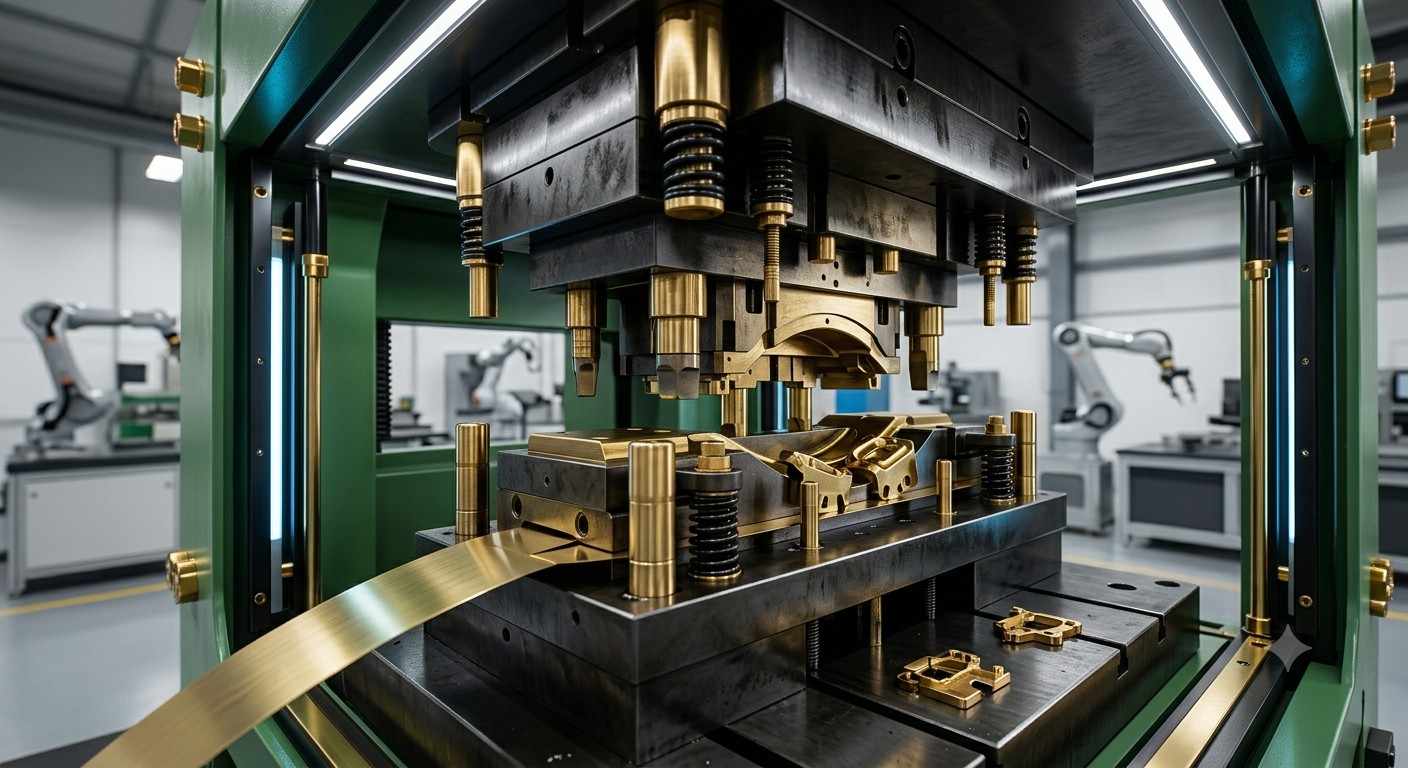
Stamping dies are precision engineered tools. Their pricing isn’t random, it mirrors the engineering depth, the material quality, and the level of manufacturing precision needed to produce millions of repeatable parts without going off-spec. Below are the main cost drivers, the ones that keep showing up in quotes, even if the wording looks slightly different:
- Die Type & Complexity: Basic blanking dies can start around $5,000–$15,000. Progressive dies, especially those with 8–14 stations, often sit in the $40,000–$120,000 range.
- Number of Cavities: When you add multi cavity tooling, the upfront expense increases by about 20–40% but per part cost typically drops at higher volumes, think 500,000+ units per year.
- Tolerances & Precision: Dies needing ±0.01 mm tolerances may cost 30–50% more than standard ±0.05 mm tooling. That extra cost usually comes from EDM and grinding steps that take more time and care, sometimes more than people expect.
- Material Selection: Tool steel like D2 or SKD11 is common. Carbide tipped inserts can push costs up roughly 25–35%, however they can also extend die life from about ~500,000 to 3+ million strokes. so there’s a trade off.
- Lead Time Pressure: If you force a rush order, meaning under 4 weeks, premiums often land around 15–25%. That compares with typical production schedules of 8–12 weeks, where pricing is usually more stable, and less tense.
| 💡 SSPrecision Insight: Most tooling disputes arise from unclear tolerance specs at the RFQ stage. Defining GD&T callouts early can reduce your total die cost by up to 18%. |
Stamping Die Comparison: Die Types vs. Cost & Application
| Die Type | Complexity | Estimated Cost (USD) | Typical Application | Stroke Life |
| Blanking Die | Low | $5,000 – $15,000 | Flat washers, simple brackets | ~300,000 strokes |
| Compound Die | Medium | $12,000 – $35,000 | Gaskets, flat complex shapes | ~500,000 strokes |
| Progressive Die | High | $40,000 – $120,000 | Terminals, connectors, clips | 1M–3M strokes |
| Transfer Die | Very High | $80,000 – $150,000+ | Auto structural parts, housings | 2M+ strokes |
| Fine Blanking Die | Specialty | $60,000 – $200,000+ | Gears, cams, safety parts | 1M–5M strokes |
Tooling Price China: Why Chinese Suppliers Offer 40–60% Cost Savings
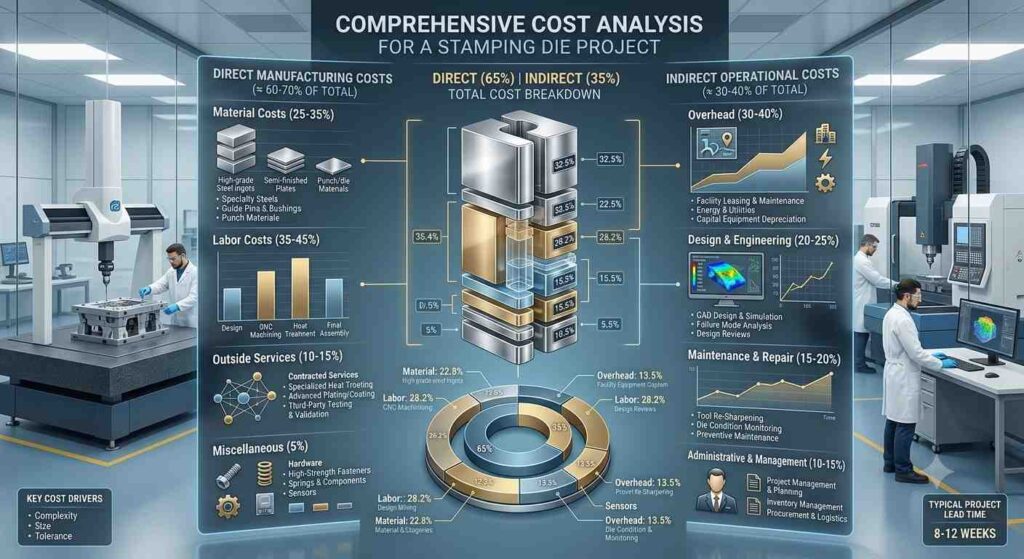
China has really turned into the big gear hub for precision die manufacturing, not only because labor rates are lower. also because the surrounding ecosystem is already fully grown, like kind of ready made. And yes, this is why the Tooling Price China deal often feels very sharp. Here’s the pieces that make competitive advantages show up:
- Labor Cost Delta: Skilled toolmakers in China may land around $8–$14/hour, while the US or Germany is closer to $35–$65/hour.
- Integrated Supply Chains: Chinese tooling areas, like Dongguan and Suzhou, tend to group steel suppliers, EDM shops, and heat treatment pretty near, say within a 30 minute radius, which keeps downtime small.
- Scale of Production: China produces more than 60% of the world’s stamping dies each year, and many plants run 3 shift schedules, so turnaround comes faster.
- Government-backed R&D: Subsidized CNC and EDM upgrades have helped Chinese die accuracy reach ±0.005 mm, so it lines up with European expectations more often than not.
SSPrecision, located in China, leans into all that while still using international quality systems (ISO 9001:2015, IATF 16949) to provide tooling that can satisfy global automotive and electronics OEM requirements.
Global Tooling Price Comparison: China vs. Other Regions
| Region | Avg. Progressive Die Cost | Lead Time | Typical Tolerance | ISO Certification Rate |
| China (Tier-1 Suppliers) | $30,000 – $80,000 | 6–10 weeks | ±0.005–0.01 mm | ~78% |
| USA | $75,000 – $150,000 | 10–16 weeks | ±0.005–0.01 mm | ~82% |
| Germany | $90,000 – $180,000 | 12–18 weeks | ±0.003–0.008 mm | ~91% |
| Mexico | $40,000 – $90,000 | 8–14 weeks | ±0.01–0.02 mm | ~55% |
| India | $20,000 – $55,000 | 8–12 weeks | ±0.01–0.03 mm | ~48% |
Die Repair China: Extending Tool Life and Protecting ROI
A stamping die isn’t some “buy once” thing, it’s more like an asset that needs care over time, right. Die Repair China expenses are often way lower than what most Western markets ask, so China becomes a common, practical destination for repair work even when the brand still produces at home.
Typical repair situations, with rough cost benchmarks, usually look like this:
- Punch & die insert swap: $300–$1,500 per station. If planned right, tool life can stretch by 200,000–500,000 more strokes, sometimes even steadier output.
- Re-grinding and re-coating: $500–$2,000 per die set. TiN or TiAlN coatings tend to add around 40–60% extra to the insert lifespan, especially when wear patterns are controlled.
- Die crash recovery: $2,000–$15,000 depending on how bad the damage is. SSPrecision runs CMM verification after repair too, to confirm dimensional accuracy rather than guessing.
- Preventive maintenance programs: annual contracts are commonly $3,000–$8,000 per active die, and clients usually report saving 3–5x compared to emergency repairs that are forced by downtime.
| 📊 Case study: A European automotive Tier-2 supplier sent 12 progressive dies to SSPrecision for refurbishment. Total repair cost came to $47,000. The replacement estimate was $380,000, so net savings reached $333,000. All dies were re-certified back to the original tolerances within about 5 weeks. |
Stamping Die Comparison: When to Invest vs. Repair vs. Replace
Choosing between fixing, tweaking, or going all in on replacement really boils down to how old the die is, how many strokes it has seen, and what your production runway looks like
- Repair: best fit when the die is under about 60% of its stroke life, and the wear is more localized, not everywhere. Cost usually lands around 5–15% of the replacement value.
- Modify & Upgrade: use this when the part geometry shifts a little. It tends to cost 20–40% of brand new tooling and it can spare you the full retooling cycle mess.
- Replace: it becomes a sensible move when cumulative wear passes 80% or the product design changes in a major way. Full clarity in quoting at SSPrecision helps avoid any unexpected re-engineering effort later
SSP Is a Trusted Partner for Die Manufacturing Cost Optimization
SSP Precision is an ISO 9001 & IATF 16949 certified manufacturer delivering end-to-end precision solutions, from design and prototyping to high‑volume production, for the automotive, medical, electronics, aerospace, and industrial sectors. We handle every stage in‑house – DFM engineering, rapid prototyping, CNC machining, EDM, grinding, and global logistics – to manufacture the tooling that makes your parts and the parts themselves.
What we build and supply: visit our sites: https://ssprecision.com.cn/
- Stamping dies manufacturing and stamping die parts – high‑precision transfer stamping dies and progressive/compound dies for volume metal stamping.
- Injection molding and injection mold – custom injection molds for plastic components, including single‑, multi‑cavity, and over‑molding & insert‑molding tools that combine metal and plastic in one part.
- Specialty molded components – eco‑friendly green mold parts and microscopic medical micro‑molded parts.
- Precision metal and plastic end‑use parts – high‑volume serial production of precision products (metal stampings, plastic moldings) with full PPAP traceability.
- Tooling spare parts manufacturing & – tooling spare parts (punches, inserts, ejector pins) and precision robotics spare parts to keep your production running.
Frequently Asked Questions (FAQ)
Q: What is the average stamping die cost for a medium-complexity part?
A: A medium-complexity progressive die typically sits in the $40,000 to $80,000 zone. For most cases this covers 6–10 station tooling made in D2 tool steel, with standard tolerances of ±0.01–0.02 mm. SSPrecision gives itemized quotes, split out by material, machining, and tryout steps
Q: How do Stamping Die Cost Factors differ between prototype and production tooling?
A: Prototype (soft) dies are often built from aluminum or P20 steel and generally cost 30–50% less than hardened production dies. They usually support around 5,000–50,000 strokes which is usually enough for design validation. Production dies, whether in D2 or carbide, are engineered for millions of cycles
Q: Why is Tooling Price China often 40–60% lower than Western markets?
A: The difference mostly comes from labor rates that are lower, plus a more integrated supply chain ecosystem, and also scale. Toolmakers like SSPrecision invest heavily in modern CNC machining centers and EDM setups so they can deliver precision at a portion of Western pricing, without skipping quality benchmarks
Q: Is Die Repair China really a viable option for dies that were originally made in Europe or the US?
A: Yes, generally. SSPrecision regularly services dies from German , US , and Japanese OEMs, so it is not like this is some random, one-off. We typically use CMM inspection and 3D scanning, plus reverse engineering when it is needed to bring the tooling back to OEM specifications, pretty close to that “as-built” feel. Most jobs end up getting done in about 3–6 weeks, sometimes a bit faster, sometimes slower depending on the condition.
Q: How can I reduce total Stamping Die Costs across the full lifecycle of a product?
A: You can lower the total die spend by being careful with tolerances, meaning: don’t over-engineer them in the first place. Another big lever is selecting carbide inserts for high-volume runs, because that helps with wear. Then add preventive maintenance in a real schedule, not just when something fails. And lastly, team up with a supplier like SSPrecision that includes integrated design-for-manufacturability (DFM) reviews at no extra cost, so issues are found early, rather than after production starts.
Read More – Intelligence That Protects Your Production Line
- Stamping Tool Steel HRC Hardness Chart – A 2–3 HRC shift can swing die life by 20–40%—here’s the complete hardness chart for D2, SKD11, M2, and more, plus grade-specific wear data and application guidance.
- Troubleshooting Progressive Die Failures & Tool Wear – A 0.01mm drift or a faint burr is often the first warning—here’s how to read the data, schedule maintenance, and stretch tool life before scrap piles up.
- Micro Injection Molding: Controlling Flash on Tiny Parts – When parts weigh under 0.1 gram, even a 10-micron flash is a giant defect—here’s how to control the process on the smallest scale.
- Conformal Cooling in Injection Molding – Cooling eats 50–70% of your cycle time—here’s how 3D-printed conformal channels cut it by up to 40%, slash scrap by 65%, and pay for themselves in under 6 months.
- Why Injection Molds Fail: Cracking & Galling Fixes – 62% of unplanned mold downtime comes from just three failure modes—here’s the root-cause data and preventive fixes for cracking, galling, and ejection issues.
- Sourcing Interchangeable Cores & Punches for Tooling – Stop stocking a warehouse of custom spares—this approach slashes downtime by over a third and keeps your press running while others scramble for replacements.
- Stamping DFM: Optimizing Strip Layouts for Less Scrap – It’s not just about nesting tighter; it’s about redesigning the entire dance of the die to shave 18–27% off your material bill every single year.
- Cheap China Molds: Where Shops Cut Corners – That “$5,000 mold” could end up costing you $45,000 in rework and scrap—here’s exactly where the savings go and how to spot the traps before you buy.
- Over-molding vs. Insert Molding: Preventing Delamination – Choosing the wrong process or resin pair can turn a bonded assembly into a delamination disaster—learn how to design for adhesion that actually lasts.
-
Injection Molding Guide: Costs, Materials, Process, and Mold Tooling – A prototype mold can cost $3,000, while a high-volume production mold runs $80,000+—here’s how to match tooling class to real production volume and avoid overpaying for steel.