Micro Injection Molding can make parts that are usually under 0.1 gram, but that kind of tiny flash, only about 10 microns thick, is sometimes enough to ruin a whole medical device or an electronic component during inspection. And since those tolerances are often kept tight at ±0.005 mm, even what looks microscopic is not really just a surface issue, it becomes a quality risk, period.
At SSPrecision (ssprecision.com.cn), our engineers based in China blend high precision tooling with vacuum assisted micro cavity venting, plus real-time process monitoring. This combo helps keep flash contained within acceptable limits, even when you run high volume production batches.
What Is Micro Injection Molding and Why Flash Occurs
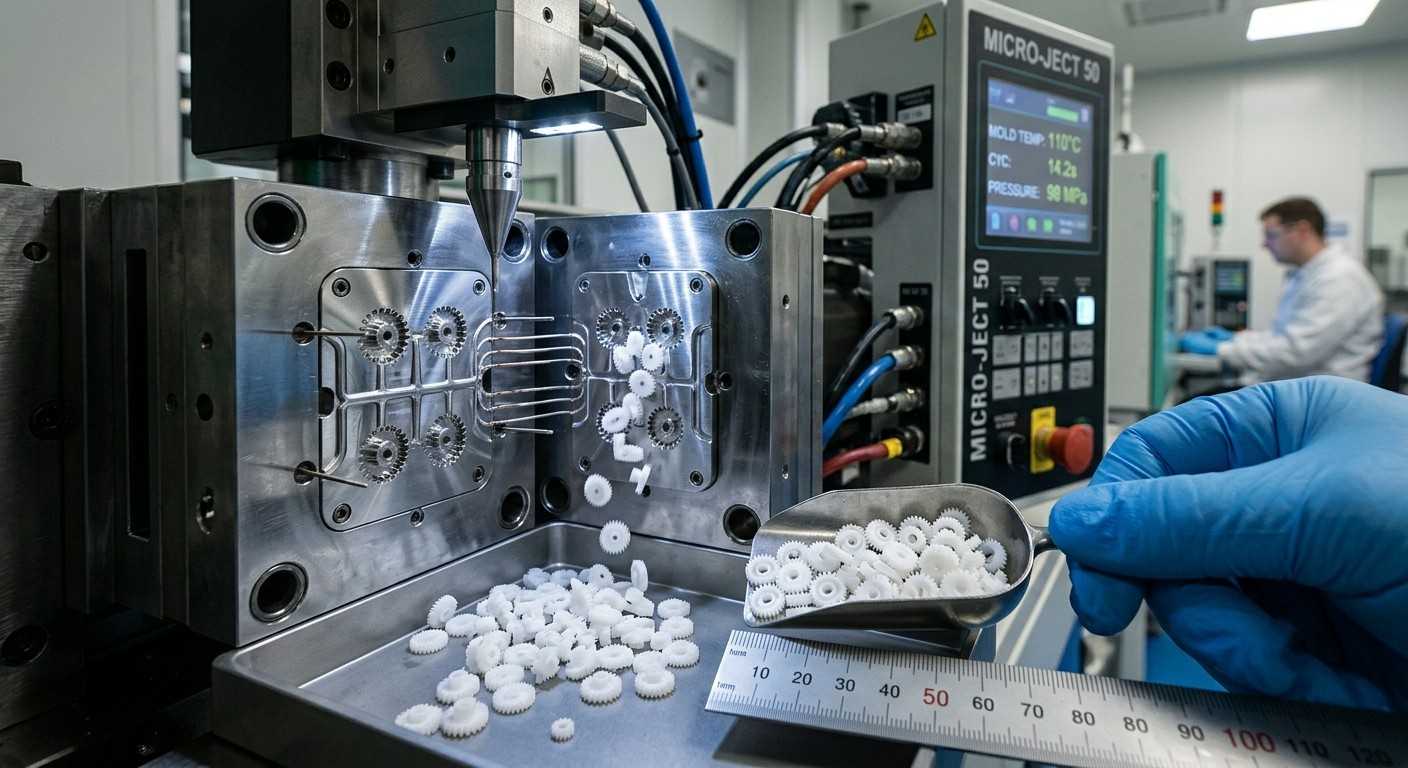
Micro injection molding is basically a shaping method for plastic parts, typically less than 1 gram. It uses specialized machines that inject resin in shot amounts as small as 0.001 cubic centimeters. When flash appears it’s because molten plastic finds its way out through small gaps in the mold. This usually happens near the parting line, around ejector pins, or along vent channels.
- Mold clamping force mismatch to the projected part area
- Worn or not quite right machined parting line surfaces (tolerance drifting past ±0.002 mm)
- Too high injection pressure for the actual cavity volume
- Venting that is lacking, trapping air, so resin gets pushed outward
- Mold temperature variation greater than 5°C across different cavities
Injection Molding Flash Control: Key Process Parameters
Flash is rarely caused by one factor alone. The table below summarizes how SSPrecision adjusts core variables during precision micro molding setup.
| Parameter | Typical Risk Range | SSPrecision Control Target |
| Clamping force | Under-clamped tooling | ±1% of calculated tonnage |
| Injection pressure | Above 1,800 bar | 800–1,500 bar, ramped profile |
| Mold temperature | Variance >5°C | ±1°C across cavities |
| Parting-line tolerance | >0.005 mm gap | ≤0.002 mm gap |
| Vent depth | Blocked or oversized | 0.003–0.008 mm engineered vents |
Micro Cavity Venting: A Core Flash-Prevention Strategy
Micro cavity venting helps the trapped air leave, without giving the resin a path to follow. Since micro parts fill in mere milliseconds, vent design ends up being one of the most effective flash control tools a mold maker can pull.
- Vent channels machined to about 0.003–0.008 mm depth, staying under the resin flow threshold
- Porous metal inserts located at deep rib, or boss areas
- Vacuum assisted venting to evacuate air before injection, often lowering the fill pressure by as much as 20%
- Scheduled vent cleaning, so residue does not build up during long runs
Medical Plastic Components: Tolerance and Quality Benchmarks
Medical plastic components like micro-needles, catheter couplings, and hearing aid housings need documented repeatability. The table below lays out common industry yardsticks that SSPrecision pushes against for medical-grade micro molding, not just “good enough” either.
| Component Type | Typical Tolerance | Flash Limit |
| Drug-delivery micro-components | ±0.005 mm | ≤0.01 mm |
| Hearing-aid shells | ±0.008 mm | ≤0.015 mm |
| Diagnostic connectors | ±0.01 mm | ≤0.02 mm |
| Surgical instrument tips | ±0.003 mm | ≤0.008 mm |
In a recent output batch of 250,000 connector housings, SSPrecision brought down flash related rejects from 4.2% to less than 0.6% after adjusting vent depth and switching to a segmented mold-temperature regulation setup. The improvement matches industry findings too, where optimized venting is reported to cut micro-molding scrap rates by roughly 70–85% . (Yeah , it’s that venting detail.)
Micro Molding China: Why SSPrecision Is a Trusted Partner
As a precision micro molding manufacturer based in China, SSPrecision serves global medical , electronics , and connector brands that expect narrow tolerances while running at scale. Our plant runs a Class 100,000 (ISO 8) cleanroom environment for medical plastic components, plus in-house mold design and 100% optical dimensional inspection on the critical geometries.
• Tooling made to ≤0.002 mm parting-line tolerance
• Shot weights from 0.001 g to 5 g supported
• Vacuum venting and real-time pressure sensing on production tooling
• Complete documentation sets for medical and electronics customers
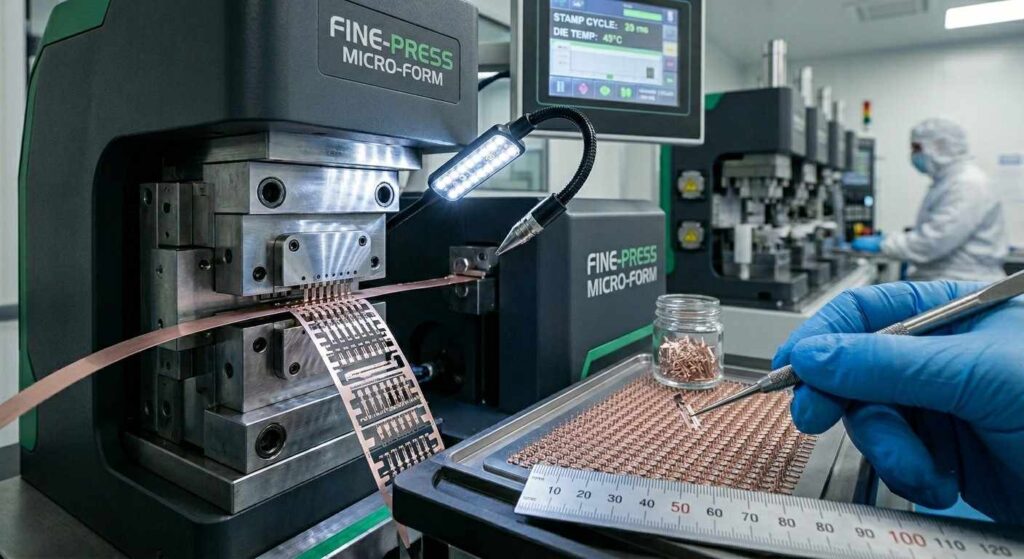
SSP Is a Trusted Partner for Die Manufacturing Cost Optimization
SSP Precision is an ISO 9001 & IATF 16949 certified manufacturer delivering end-to-end precision solutions, from design and prototyping to high‑volume production, for the automotive, medical, electronics, aerospace, and industrial sectors. We handle every stage in‑house – DFM engineering, rapid prototyping, CNC machining, EDM, grinding, and global logistics – to manufacture the tooling that makes your parts and the parts themselves.
What we build and supply: visit our sites: https://SSP.com.cn/
- Stamping dies manufacturing and stamping die parts – high‑precision transfer stamping dies and progressive/compound dies for volume metal stamping.
- Injection molding and injection mold – custom injection molds for plastic components, including single‑, multi‑cavity, and over‑molding & insert‑molding tools that combine metal and plastic in one part.
- Specialty molded components – eco‑friendly green mold parts and microscopic medical micro‑molded parts.
- Precision metal and plastic end‑use parts – high‑volume serial production of precision products (metal stampings, plastic moldings) with full PPAP traceability.
- Tooling spare parts manufacturing & – tooling spare parts (punches, inserts, ejector pins) and precision robotics spare parts to keep your production running.
FAQ: Micro Injection Molding and Flash Control
What causes flash in micro injection molding?
Flash in micro injection molding usually happens because the shot pressure is just a little too high, or the parting lines get worn out, and then there’s venting that isn’t doing its job properly—so the molten resin kind of sneaks into mold gaps, before it can cool down right.
How small can micro cavity venting channels be?
Typically engineered vents are machined to about 0.003 mm up to 0.008 mm deep, basically deep enough to bleed trapped air, but shallow enough that the resin won’t really travel through it, or at least not in a meaningful way.
Why is flash control even more critical for medical plastic components?
A lot of medical devices need regulatory level dimensional consistency, so even small slivers of flash can mess with assembly alignment, affect sterility steps, or raise patient safety concerns. That’s why sub 0.01 mm flash tolerances are often expected.
Does mold material influence flash formation?
Yes, absolutely. Tool steels that are harder tend to handle wear near the parting line longer. That helps keep the interfaces tight, and it reduces flash over long, high volume production runs, where small drift can otherwise show up fast.
How does SSPrecision verify flash-free production?
SSPrecision relies on 100% optical inspection, plus monitoring injection pressure during the process, and then routine mold upkeep on a fixed schedule—so flash stays inside the customer’s limits on every single batch, not just the first samples.
Read More – Intelligence That Protects Your Production Line
- Stamping Tool Steel HRC Hardness Chart – A 2–3 HRC shift can swing die life by 20–40%—here’s the complete hardness chart for D2, SKD11, M2, and more, plus grade-specific wear data and application guidance.
- Troubleshooting Progressive Die Failures & Tool Wear – A 0.01mm drift or a faint burr is often the first warning—here’s how to read the data, schedule maintenance, and stretch tool life before scrap piles up.
- Conformal Cooling in Injection Molding – Cooling eats 50–70% of your cycle time—here’s how 3D-printed conformal channels cut it by up to 40%, slash scrap by 65%, and pay for themselves in under 6 months.
- Why Injection Molds Fail: Cracking & Galling Fixes – 62% of unplanned mold downtime comes from just three failure modes—here’s the root-cause data and preventive fixes for cracking, galling, and ejection issues.
- What Drives Metal Stamping Die Costs? – A progressive die can cost anywhere from $8,000 to over $150,000—here’s a breakdown of the 5 key cost drivers, global price comparisons, and when to repair vs. replace.
- Injection Molding Guide: Costs, Materials, Process, and Mold Tooling – A prototype mold can cost $3,000, while a high-volume production mold runs $80,000+—here’s how to match tooling class to real production volume and avoid overpaying for steel.