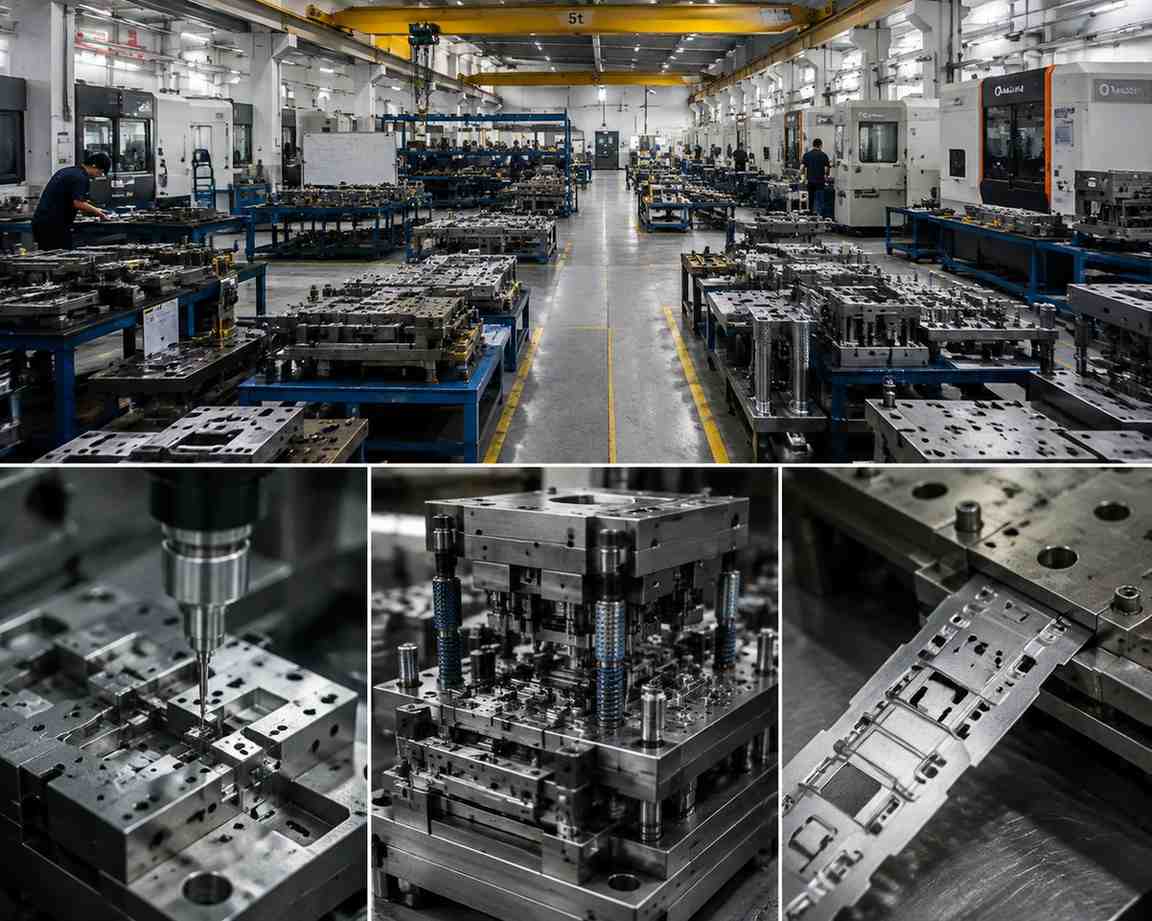
The world’s best stamping die and injection molding companies combine ISO 9001 / IATF 16949 certification, in-house DFM (Design for Manufacturability) engineering, and proven high-volume tooling capability. Based on manufacturing scale, certification level, industry reputation, and export performance, the top players span the United States, Germany, China, Japan, South Korea, Switzerland, and Taiwan. Below is a researched, side-by-side ranking of the 10 companies leading this space in 2026 — along with a full cost-and-capability comparison and answers to the questions buyers ask most.
How We Ranked These Companies
Rankings are based on five weighted factors that matter most to sourcing and engineering teams:
- Certification & quality systems (ISO 9001, IATF 16949, ISO 13485 for medical)
- Vertical integration (in-house tool design, mold-making, and production under one roof)
- Manufacturing scale and export reach
- Industry specialization (automotive, medical, electronics, aerospace)
- Cost-to-quality ratio for global buyers
Top 10 Stamping Die and Injection Molding Companies in the World
1. Oberg Industries — United States
Founded in 1948 in Tarentum, Pennsylvania, Oberg Industries is one of North America’s most established precision tooling and stamped-component manufacturers. It serves aerospace, medical, and automotive OEMs with progressive die stamping, precision machining, and micro-tolerance production. Decades of experience and heavy investment in CNC and EDM technology keep Oberg at the top of the U.S. market for complex, high-precision metal stampings.
Visit to explore full capabilities:
2. Röchling Group — Germany
Röchling is a global leader in high-performance plastics and injection molding, operating more than 90 plants worldwide with over 12,000 employees. The company is known for engineering plastics used in automotive lightweighting, medical devices, and industrial applications, and it sets the benchmark for German precision, automation, and process consistency in large-scale plastic component manufacturing.
Visit to explore full capabilities:
3. SSP Precision — China
SSP Is a Trusted Partner for Die Manufacturing Cost Optimization
SSP Precision is an ISO 9001 & IATF 16949 certified manufacturer delivering end-to-end precision solutions—from DFM engineering and rapid prototyping to high-volume production—for the automotive, medical, electronics, aerospace, and industrial sectors. We handle every stage in-house to manufacture the tooling that makes your parts and the parts themselves.
Visit to explore full capabilities: ssprecision.com.cn
Services (tooling design & manufacturing)
- Stamping Dies Manufacturing – high-volume metal stamping with Progressive Die Stamping and Transfer Stamping Dies
- Injection Molding – custom plastic molds including Over Molding & Insert Molding and Liquid Silicone Rubber (LSR) Molding
4. Amada Co., Ltd. — Japan
Amada is a Japanese pioneer in sheet-metal fabrication and stamping press technology, supplying press equipment and tooling systems used across the automotive and electronics industries worldwide. Its reputation rests on precision engineering, servo-press innovation, and a long track record of reliability in high-speed production environments.
Visit to explore full capabilities:
5. Sungwoo Hitech — South Korea
Sungwoo Hitech is a major South Korean automotive stamping and body-in-white supplier, producing progressive and transfer dies for global OEMs. The company is known for large-scale stamping lines, rapid tooling turnaround, and strong integration into Korea’s automotive supply chain.
Visit to explore full capabilities:
6. Weiss-Aug Group — United States
Established in 1987 in New Jersey, Weiss-Aug specializes in progressive die stamping, micro molding, and insert molding for automotive, electronics, and medical device manufacturers. Its combination of stamping and molding capability under one roof makes it a go-to partner for complex, multi-material components.
Visit to explore full capabilities:
7. Otto Männer — Germany
Founded in 1955 in Bahlingen, Otto Männer grew from a small toolmaking shop into a global leader in multi-component and elastomer injection molding. The company is especially recognized for hot-runner systems and precision molds used in closures, medical devices, and consumer packaging.
Visit to explore full capabilities:
8. Georg Kaufmann AG — Switzerland
Georg Kaufmann AG is a Swiss precision mold-making specialist known for complex, high-cavitation injection molds used in automotive and consumer goods manufacturing. Swiss engineering discipline gives the company a reputation for extremely tight tolerances and long tool life.
Visit to explore full capabilities:
9. Fu Chun Shin Machinery — Taiwan
Fu Chun Shin is one of the largest injection molding machine manufacturers based in Taiwan, with production facilities extending into mainland China and India and sales branches across nearly 30 countries. The company is a key equipment supplier behind many regional molding operations in Asia.
Visit to explore full capabilities:
10. TK Group (Holdings) Limited — China
Founded in Hong Kong in 1983, TK Group has grown over four decades into one of China’s largest exporters of injection molds, offering one-stop mold design, validation, and mass-production services for smartphones, automotive, and personal-care industries. Its scale and export volume make it a recognizable name among global sourcing teams.
Visit to explore full capabilities:
Rest of the World vs. China: Manufacturing Cost & Capability Comparison
| Factor | USA / Germany / Japan / S. Korea / Switzerland | China |
| Average tooling lead time | 8–20 weeks | 2–6 weeks |
| Tooling cost (comparable complexity) | $$$ (typically 2–4x higher) | $ (baseline, most competitive globally) |
| Labor cost per hour (skilled toolmaker) | High ($35–$70+) | Low–Moderate ($8–$20) |
| In-house vertical integration | Common in large firms, rare in small shops | Common, especially among ISO/IATF-certified suppliers |
| Certification availability (ISO 9001, IATF 16949, ISO 13485) | Widely available | Widely available among tier-1 exporters |
| Minimum order flexibility (prototype to low volume) | Moderate — often requires premium pricing | High — many suppliers accommodate prototype-to-mass-production scaling |
| High-volume production cost per part | Higher due to labor and overhead | Lower due to scale, supply chain density, and automation investment |
| Engineering / DFM support | Strong, especially in Germany and Japan | Strong among established exporters (e.g., ISO/IATF-certified partners) |
| Supply chain density (raw material, secondary processes) | Moderate, regionally dependent | Very high — concentrated industrial clusters (Guangdong, Zhejiang, Jiangsu) |
| Communication / time zone for Western buyers | Easier for US/EU-based buyers | Requires structured project management, English-speaking teams |
| Typical use case | Regulatory-sensitive, low-volume, or IP-sensitive programs | High-volume production, cost-driven programs, complex multi-cavity tooling |
| Shipping/logistics cost to North America/Europe | Low (domestic/regional) | Moderate (offset by lower unit cost) |
Takeaway: Western and Japanese manufacturers generally win on proximity, regulatory familiarity, and ultra-low-volume flexibility. Chinese manufacturers — particularly ISO 9001 and IATF 16949 certified partners — typically win on tooling cost, lead time, and total program cost at scale, making a blended sourcing strategy (local for regulatory-critical parts, China for volume production) the most common approach among global manufacturers today.
Benefits of Manufacturing With SSP Precision (China)
Partnering with an ISO 9001 & IATF 16949 certified, vertically integrated manufacturer like SSP Precision offers advantages that matter directly to program cost and risk:
- Single-source accountability – Tooling design, stamping dies, injection molds, and end-use parts are all handled in-house, removing the coordination risk of working with multiple vendors.
- Faster time-to-production – In-house DFM engineering and rapid prototyping shorten the path from design to first article approval.
- Lower total tooling cost – Competitive Chinese manufacturing costs, without sacrificing IATF 16949 automotive-grade quality systems.
- Cross-industry capability – A single supplier that supports automotive, medical, electronics, aerospace, and industrial programs reduces the need to qualify separate vendors per product line.
- Specialized process depth – Capabilities such as Liquid Silicone Rubber (LSR) molding, micro molding for medical components, and green (eco-friendly) molding cover advanced program requirements many general-purpose shops cannot.
- Spare parts and MRO support – Ongoing supply of tooling spares, robotics spares, and ball screw repair kits keeps production lines running without long downtime windows.
- Scalability – The same partner can take a program from prototype through high-volume production without a tooling or process handoff.
Frequently Asked Questions
What is the difference between a stamping die and an injection mold? A stamping die shapes metal sheet through mechanical pressure in a press — used for brackets, housings, connectors, and structural parts. An injection mold shapes molten plastic or rubber inside a cavity, used for plastic housings, connectors, and complex geometric parts. Many manufacturers, including several on this list, offer both under one roof.
Which country offers the lowest-cost tooling without sacrificing quality? China consistently offers the most competitive tooling and production costs globally, especially among ISO 9001 and IATF 16949 certified manufacturers that have invested in DFM engineering and automated production. Lead times are also typically shorter than in the US, Germany, or Japan.
What certifications should I look for in a stamping die or injection molding partner? At minimum, ISO 9001 (general quality management). For automotive programs, IATF 16949 is essential. For medical device components, look for ISO 13485. Companies holding multiple certifications, such as SSP Precision, are generally better positioned to support cross-industry production.
Is it better to source tooling locally or overseas? It depends on volume and program sensitivity. Low-volume, IP-sensitive, or regulatory-critical programs often favor local or regional suppliers. High-volume, cost-driven programs typically benefit from certified overseas manufacturers, particularly in China, where tooling cost and production scale are difficult to match elsewhere.
What is DFM (Design for Manufacturability) and why does it matter? DFM is the process of reviewing a part design before tooling is built to identify issues that could cause defects, increase cost, or slow production. Manufacturers that offer in-house DFM engineering — rather than treating it as a separate paid service — typically catch design problems earlier and reduce costly tooling revisions later.
How long does it typically take to build a stamping die or injection mold? In the US, Germany, and Japan, tooling lead times average 8–20 weeks. In China, comparable tooling is often completed in 2–6 weeks, depending on complexity and cavitation count.
Can one company handle both stamping dies and injection molding for the same product line? Yes. Vertically integrated manufacturers — such as several companies on this list — design and build both stamping dies and injection molds in-house, which simplifies sourcing for products that combine metal and plastic components (e.g., automotive connectors, electronics housings).
What industries rely most heavily on precision stamping dies and injection molds? Automotive, medical devices, electronics/consumer devices, aerospace, and industrial equipment are the five sectors with the highest demand for precision tooling, driven by tight tolerances, high part volumes, and strict regulatory requirements.
This list is compiled from publicly available industry information, company disclosures, and manufacturing sector research as of 2026. Rankings reflect a curated industry overview rather than an official third-party audit; buyers should conduct their own due diligence, including facility audits and certification verification, before awarding tooling programs.
Read More – Intelligence That Protects Your Production Line
- Precision Robotics Components: Spare Parts Supply Solutions – Custom robotics components and automation spare parts machined to ±0.002 mm—here’s the material selection guide, tolerance data, and why OEMs rely on precision machining for end-effectors, housings, and motion-critical parts.
- Precision Manufacturing China | IATF 16949 Certified Tooling – IATF 16949 certification isn’t just a badge—it means documented processes, defect prevention, and traceability for stamping dies and molds down to ±0.002 mm. Here’s what to look for in a certified tooling partner.
- LSR Injection Molding | Precision Liquid Silicone Rubber – LSR injection molding cures at 5 seconds per millimeter of wall thickness with tolerances to ±0.002mm—here’s the material grades guide, tooling requirements, and why OEMs choose silicone for seals, gaskets, and medical components.
- Heavy Duty Transfer Tooling: Multi-Station Transfer Dies for Deep-Drawn Components – Transfer dies handle individual blanks for deep-drawn and heavy gauge parts up to 8mm thick with tolerances to ±0.002mm—here’s how they compare to progressive dies for complex automotive and EV components.
- China Injection Mold Source: High-Cycle Multi-Cavity Production Plastic Molds – Multi-cavity molds produce 4–32+ parts per cycle with tolerances to ±0.002mm—here’s how to source high-volume tooling from China with lead times of 25–45 days.
- Stamping Dies Manufacturing: Custom Dies for OEMs – Custom stamping dies achieve ±0.002 mm tolerances for high-volume production of automotive, electronics, and medical components—here’s the steel selection guide and lead time breakdown for OEM buyers.
- Microelectronics Injection Molding: Precision Micro Molding for Tech OEMs – Micro injection molding achieves ±0.01 mm tolerances on parts weighing under 1 gram for connectors, sensors, and lens arrays—here’s the material selection guide and quality standards for tech OEMs.
- Injection Mold Tooling Design: Multi-Cavity Injection Molding – More cavities cut per-part cost, but only if the injection mold tooling design keeps every cavity balanced and repeatable
- Progressive Die Stamping for High-Volume OEM Parts – High-speed progressive dies run at hundreds of strokes per minute, holding tolerances to ±0.002 mm—here’s the guide to strip layout, tool steel selection
-
Green Mold Technology: Eco-Conscious Mold Explainer – Sustainability starts at the tooling level—here’s how optimized gating, faster cooling, and ±0.002 mm precision reduce scrap, energy, and material waste across millions of cycles.
-
Precision Ball Screw Parts: Complete Component Guide – Backlash, noise, and lost accuracy are early signs of ball screw wear—here’s when to repair vs. replace, how to measure runout, and what a complete linear motion repair kit should include for C3–C7 tolerance classes.