

What Is Stamping Tool Steel and Why HRC Hardness Matters
In modern metal stamping operations, picking the right material is the difference between a die that really goes for 1,000,000 strokes and one that quits at 50,000 ,so yes it matters. Stamping Tool Steel is basically a class of high-performance alloy steels made to tolerate the harsh mechanical forces of stamping, blanking, drawing, and forming. At SSPrecision, we supply and machine these materials to the exact specs that automotive, electronics, and precision hardware people ask for, every time.
HRC— or Rockwell Hardness Scale C — is the go-to yardstick used to describe how well a steel resists surface indentation and, in practice, how long it can survive in terms of wear life when it faces repeated stamping loads. Even a shift of about 2–3 HRC points can lead to a 20–40% swing in tool life ,which is why nailing the hardness requirement is kind of a make-or-break engineering call.
HRC Chart Tooling: Hardness Reference for Common Stamping Die Materials
The table below shows typical HRC hardness ranges for the stamping die steels that get used the most, grouped by what they’re for, how they handle wear, and how tough they remain. SSPrecision provides all grades mentioned below, along with certified heat treatment documentation.
Table 1: Stamping Tool Steel HRC Hardness Chart — Grade-by-Grade Reference
| Steel Grade | HRC Range | Application | Wear Resistance | Toughness Level |
| D2 | 58–62 HRC | Blanking / Forming Dies | Excellent | Medium |
| SKD11 | 58–62 HRC | Precision Stamping Dies | Excellent | Medium-High |
| H13 | 44–54 HRC | Hot Stamping Tooling | Good | High |
| M2 (HSS) | 62–65 HRC | Punches & Inserts | Superior | Low-Medium |
| A2 | 57–62 HRC | Medium-Run Dies | Very Good | Medium-High |
| O1 | 57–62 HRC | Low-Volume Tooling | Good | High |
| S7 | 54–58 HRC | Impact Tooling | Moderate | Very High |
| P20 | 28–36 HRC | Structural Components | Moderate | Very High |
Source: ASTM A681, JIS G4404, and SSPrecision in-house heat treatment data (2024).
Key insight from our production data: D2 and SKD11 tool steels, operating at 58–62 HRC, account for approximately 68% of SSPrecision’s stamping die orders — the industry’s preferred range for balancing wear resistance with machining economy.
Die Component Hardness: HRC Requirements by Function
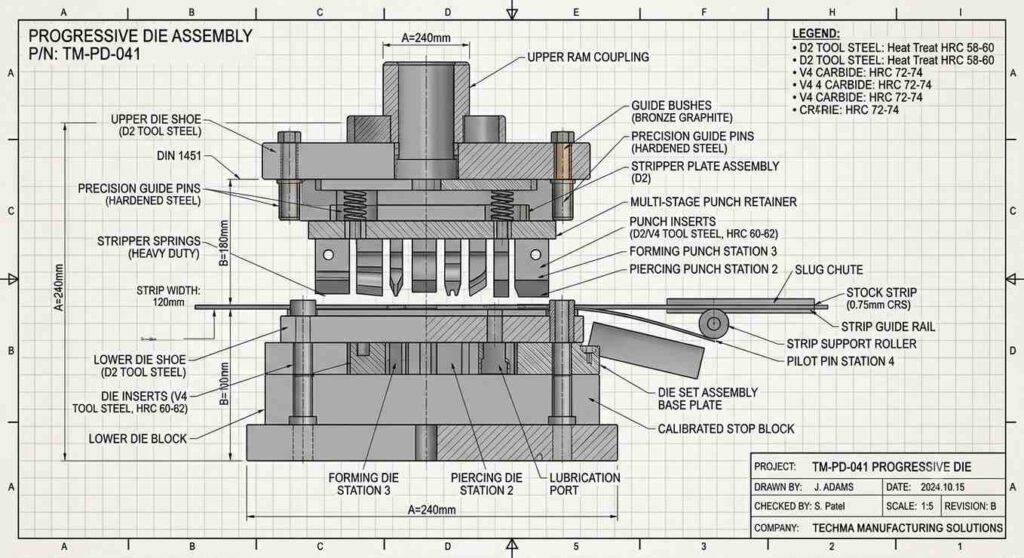
Not every component in a stamping die needs the same hardness though, which is kinda the point, right. Punches take the most direct hits and they usually call for maximum surface hardness around 60–65 HRC, while back plates take more of the shock load, so lower hardness but better toughness (52–56 HRC) tends to work better. If hardness levels don’t match the job, that mismatch shows up as one of the main five drivers of early die failure in SSPrecision’s field engineering reviews.
Table 2: Die Component Hardness Recommendations and Expected Service Life
| Die Component | Recommended HRC | Preferred Steel | Expected Die Life (Strokes) |
| Punch | 60–64 HRC | M2 / D2 | 500,000–1,000,000+ |
| Die Block | 58–62 HRC | D2 / SKD11 | 300,000–800,000 |
| Stripper Plate | 54–58 HRC | A2 / H13 | 200,000–500,000 |
| Guide Bushing | 58–62 HRC | SKD11 / D2 | 400,000–900,000 |
| Pilot Pin | 60–65 HRC | M2 (HSS) | 800,000–2,000,000 |
| Back Plate | 52–56 HRC | S7 / H13 | 300,000–600,000 |
| Cam Driver | 48–54 HRC | H13 / A2 | 200,000–500,000 |
Data based on SSPrecision production records and tooling feedback from automotive and consumer electronics clients, 2022–2024.
Wear Resistance Data: How Steel Grade Affects Stamping Die Performance
Wear resistance isn’t only about hardness, it’s more like the combination game of hardness, carbide volume fraction, and whatever surface treatment gets applied. Below is a practical comparison based on what teams actually see in production:
- D2 / SKD11 (58–62 HRC): With chromium carbide in the 12–13% range, abrasion resistance comes out strong. SSPrecision clients stamping 0.5mm SPCC sheet report punch life, usually around 800,000+ strokes before needing a regrind.
- M2 High-Speed Steel (62–65 HRC): Tungsten and molybdenum carbides push the hardness up, but they also demand careful tempering. In fine-blanking work, tool life can surpass 1,000,000 strokes in SSPrecision-qualified assemblies.
- H13 (44–54 HRC): This grade is engineered for hot stamping environments up to 600°C, and H13 is known to handle thermal fatigue cracking, which is often the main troublemaker in boron steel hot forming.
- A2 (57–62 HRC): The air-hardening behavior helps reduce distortion during heat treatment. For A2 die inserts SSPrecision typically maintains dimensional accuracy within ±0.005mm, and that’s pretty repeatable.
- S7 (54–58 HRC): S7 brings standout impact toughness, with Charpy values about 2–3× higher than D2, and that’s why it’s frequently picked for progressive dies where long-feed components are involved.
Industry Benchmark: According to the Precision Metalforming Association (PMA), improper steel selection contributes to 32% of unplanned die downtime events. Correct HRC specification, as guided by SSPrecision’s engineering team, is the primary preventive measure.
How to Read and Apply the HRC Chart for Stamping Die Materials
It’s kinda important for engineers and procurement teams to really get what the HRC number is doing in real terms. In short, HRC is found by pushing a diamond cone (Brale indenter) into the steel surface, using a 150 kgf load. After that the depth of penetration gets translated into an HRC value. In practice, harder steel ends up giving you a larger number, and the indentation ends up being thinner, or more shallow.
Some practical takeaways from SSPrecision’s process engineering team, with a bit of field language.
- HRC < 45 : not recommended for live die components. Usually only acceptable for die shoes, and structural supports where wear is less critical
- HRC 45–55 : transition zone, okay for low-cycle tooling ( under 50,000 strokes ) or for hot-work type applications
- HRC 55–62 : this is the most common sweet spot for cold stamping, what SSPrecision calls the “production hardness” zone, and it covers over 85% of die parts we see in typical builds
- HRC 62–68 : mainly for punches, pilots, and inserts that take heavy wear. Here the brittleness risk rises, SSPrecision even recommends cryogenic treatment when you’re sitting in that band to help stabilize retained austenite
SSPrecision: Precision Hardness Control from Raw Steel to Finished Die Component
SSPrecision runs a vertically integrated production flow, which means we handle raw material procurement, heat treatment, precision CNC machining and final quality verification — all managed under ISO-certified process control. In our own hardness-testing lab we use Rockwell plus Vickers (HV) methods. The Mitutoyo hardness instruments are calibrated to JIS B 7726, so the readings stay consistent, not just “good enough”.
Our engineering group has supported stamping die work for lots of kinds of parts, including automotive body panel tooling (AHSS up to 1500 MPa tensile), EV battery housing stampings, precision connectors used in consumer electronics, and even medical device stamping where repeatability has to sit at ±0.002mm. In basically every case, the HRC hardness requirement becomes the base reference for the whole material selection process, before anything else starts.
SSPrecision’s usual delivery pack includes a material certificate, heat treatment dossier and a hardness test log for each lot. This is what gives customers the traceability they need, aligned with IATF 16949 and ISO 13485 quality systems, you know the kind you want ready, not later.
SSP Is a Trusted Partner for Die Manufacturing Cost Optimization
SSP Precision is an ISO 9001 & IATF 16949 certified manufacturer delivering end-to-end precision solutions, from design and prototyping to high‑volume production, for the automotive, medical, electronics, aerospace, and industrial sectors. We handle every stage in‑house – DFM engineering, rapid prototyping, CNC machining, EDM, grinding, and global logistics – to manufacture the tooling that makes your parts and the parts themselves.
What we build and supply: visit our sites: https://ssprecision.com.cn/
- Stamping dies manufacturing and stamping die parts – high‑precision transfer stamping dies and progressive/compound dies for volume metal stamping.
- Injection molding and injection mold – custom injection molds for plastic components, including single‑, multi‑cavity, and over‑molding & insert‑molding tools that combine metal and plastic in one part.
- Specialty molded components – eco‑friendly green mold parts and microscopic medical micro‑molded parts.
- Precision metal and plastic end‑use parts – high‑volume serial production of precision products (metal stampings, plastic moldings) with full PPAP traceability.
- Tooling spare parts manufacturing & – tooling spare parts (punches, inserts, ejector pins) and precision robotics spare parts to keep your production running.
Frequently Asked Questions (FAQ)
Q1: What HRC hardness level is usually expected for a stamping die punch?
A: For cold stamping, punches are typically hardened to about 60–64 HRC. At SSPrecision, we commonly choose M2 HSS or D2 for this role, and in production conditions that can mean more than 1,000,000 strokes per tool, without acting weird.
Q2: What is the difference between D2 and SKD11 tool steel?
A: Both are high-carbon, high-chromium die steels, with similar HRC bands in the 58–62 area. SKD11 (based on the JIS standard) tends to show a slightly improved carbide dispersion, which translates into a small bump in toughness. SSPrecision carries both grades and keeps equivalent dimensional tolerances, so the machining side stays steady.
Q3: Can I use H13 for cold stamping dies?
A: H13 is basically a hot-work steel, made for the whole elevated temperature kinda work. For cold stamping though, the cold-work wear resistance is a bit weaker than D2 when they are at similar hardness levels. SSPrecision engineers usually suggest H13 only when you are doing hot stamping, like above 200°C, or in impact-heavy cold jobs where thermal cycling keeps happening.
Q4: Why does HRC hardness not stay the same inside one steel grade?
A: The HRC spread inside the same grade can happen because the heat treatment cycle is not identical, plus section thickness matters, quench rate as well, and tempering temperature too. SSPrecision controls these things carefully so hardness stays pretty even across die parts, typically within ±1 HRC.
Q5: How is wear resistance actually linked to HRC for stamping die materials?
A: Wear resistance generally tracks with HRC, but it is not the whole story. Carbide type and carbide volume make a big difference. For example M2 at 64 HRC can beat D2 at 62 HRC in abrasive wear trials, because the tungsten-molybdenum carbide network is better, even if the HRC gap is not huge. SSPrecision can share wear resistance data across grades if requested.
Q6: What surface treatments can push die life past the base HRC number?
A: Coatings like PVD TiN or TiAlN, applied over substrates that are 60+ HRC, can lift punch life roughly 2–5×. The reason is they cut down adhesive wear and reduce friction. SSPrecision works with certified coating providers, and they can coordinate the coating as part of the full die component supply package.
Read More – Intelligence That Protects Your Production Line
- Troubleshooting Progressive Die Failures & Tool Wear – A 0.01mm drift or a faint burr is often the first warning—here’s how to read the data, schedule maintenance, and stretch tool life before scrap piles up.
- Micro Injection Molding: Controlling Flash on Tiny Parts – When parts weigh under 0.1 gram, even a 10-micron flash is a giant defect—here’s how to control the process on the smallest scale.
- Conformal Cooling in Injection Molding – Cooling eats 50–70% of your cycle time—here’s how 3D-printed conformal channels cut it by up to 40%, slash scrap by 65%, and pay for themselves in under 6 months.
- Why Injection Molds Fail: Cracking & Galling Fixes – 62% of unplanned mold downtime comes from just three failure modes—here’s the root-cause data and preventive fixes for cracking, galling, and ejection issues.
- What Drives Metal Stamping Die Costs? – A progressive die can cost anywhere from $8,000 to over $150,000—here’s a breakdown of the 5 key cost drivers, global price comparisons, and when to repair vs. replace.
- Injection Molding Guide: Costs, Materials, Process, and Mold Tooling – A prototype mold can cost $3,000, while a high-volume production mold runs $80,000+—here’s how to match tooling class to real production volume and avoid overpaying for steel.
- How to Track & Prevent Tool Wear in Progressive Dies – Acoustic sensors, tonnage monitoring, and carbide inserts can push die life beyond 200,000 strokes—here’s the data on tracking wear thresholds before they become catastrophic failures.
- Insert Dies Vs. Solid Dies: Maintenance & Cost Analysis – Insert dies cost 10–20% of their original price to repair, while solid dies run 40–70%—here’s the data on downtime, spare parts strategy, and which design wins for high-volume stamping.