

What Is a Stamping Die? Understanding the Foundation
A Stamping Die is a precision tool used in metal forming to cut, bend, or shape sheet metal into a defined geometry using a punch-and-die mechanism mounted in a stamping press. The choice between a progressive die and a transfer die is not merely operational-it dictates cycle time, scrap rate, tonnage demands, and overall Stamping Tooling Cost China throughout the tool’s lifespan.
The global stamping die market, valued at $8.2 billion in 2026 (according to the Precision Metalforming Association), is significantly influenced by Chinese tooling, which comprises an estimated 38% of the total global output. SSPrecision manufactures both progressive and transfer die tooling at its facility in China, supplying stamped components to OEMs across the automotive, electronics, and appliance industries in 14 countries
Progressive vs Transfer Stamping: Core Engineering Differences
The key difference between progressive and transfer stamping lies in how the part moves through the press. With a progressive die, the metal strip advances automatically through a series of stations, with each stroke performing a specific operation (piercing, forming, blanking) until the finished part is separated at the final station. Transfer dies rely on mechanical fingers or robots to physically move individual blanks from one station to the next.
Table 1: Progressive Vs Transfer Stamping — Engineering Comparison Matrix
| Parameter | Progressive Die | Transfer Die |
| Part complexity | Low–medium (2D/shallow 3D) | High (deep draw, multi-axis form) |
| Strip material use | Carrier strip required; ~15–25% scrap | Blanked first; near-net scrap ≤8% |
| Press Tonnage Required | Lower — distributed across stations | Higher — full blank tonnage per hit |
| Cycle speed | High: 60–400 strokes/min (SPM) | Moderate: 12–60 SPM |
| Tooling cost (China, 2026) | USD $15,000–$80,000 | USD $60,000–$250,000+ |
| Ideal batch size | ≥ 500,000 pcs/year | 50,000–500,000 pcs/year |
| Die changeover time | 15–30 minutes | 45–120 minutes |
| Part size range | Up to ~300mm strip width | Up to 800mm+ individual blanks |
| SSPrecision Data Point: For a 2026 automotive bracket program, a shift from a 4-station transfer die to a 10-station progressive die resulted in a 22% decrease in per-piece cost and an increase in throughput from 180 to 310 parts/hour on a 400T press. |
Stamping Press Tonnage: How Die Type Drives Load Requirements
Stamping Press Tonnage refers to the maximum force a press can exert at bottom dead center (BDC) to complete all forming operations in a single stroke. In Chinese stamping facilities, miscalculation of tonnage is the primary cause of die cracking and press damage, as highlighted in a 2022 CIMATRON press study.
The simplified formula for tonnage is T = (Perimeter × Material Thickness × Tensile Strength) / 2,000. For progressive dies, the tonnage required at each station is calculated independently, and the sum must remain below 80% of the press’s rated capacity to protect the press’s lifespan.
- Progressive die: The total press tonnage is the sum of all individual station loads. A 10-station die forming 1.5mm HSLA steel might require 250T-400T.
- Transfer die: The dominant load is dictated by the single-station operation with the highest force requirement. A deep-draw transfer operation on 2.0mm stainless steel could demand 600T-1,200T in a single stroke.
- SSPrecision’s press fleet ranges from 80T to 1,000T, allowing for in-house die trials for both types.
- Rule of thumb: Never load a press beyond 80% of its rated tonnage; operating at 90-100% can reduce the lifespan of press bearings by up to 60% (Schuler Press Engineering Manual, 2021).
Tool Steel Wear: What Kills Dies Prematurely
Tool Steel Wear is the gradual degradation of the sharpness, dimensional accuracy, and surface finish of punch and die components. It is the most significant contributor to unplanned tooling maintenance costs for both die types.
SSPrecision’s tooling engineers track wear using a proprietary Wear Index (WI), categorized into four primary failure modes:
- Abrasive wear: Micro-cutting of the tool steel surface by hard particles in the material (e.g., silicon in aluminum alloys). This is prevalent in progressive dies cutting high-silicon Al sheets.
- Adhesive wear (galling): Material transfer from the blank to the punch. This is most common in transfer dies forming stainless steel when surface hardness falls below 58 HRC.
- Fatigue wear: Cyclic loading leading to micro-crack propagation at the cutting edges. This is a critical concern in high-SPM progressive dies operating above 200 strokes/minute.
- Thermal wear: Heat buildup at contact points softening the tool steel. This is most severe in transfer dies lacking active cooling channels.
SSPrecision typically specifies D2 tool steel (62-64 HRC) as the standard for progressive die punches and M2 HSS for high-volume progressive cutting operations (over 10 million cycles). For transfer die draw rings, DC53 or Carmo steel is preferred due to their superior toughness-to-hardness ratio.
Die Layout Design: Optimizing Station Sequence for Tonnage & Wear Balance
Effective Die Layout Design evenly distributes forming loads across stations, minimizes lateral forces that accelerate guide wear, and sequences piercing before forming to prevent material distortion. SSPrecision follows this standard station-sequencing protocol for a typical progressive die:
Table 2: SSPrecision Die Layout Design — Station Sequencing Protocol (8-Station Progressive Die Example)
| Station | Operation | Load (Est.) | Tool Steel Grade | Wear Risk Level |
| S1 | Pilot hole pierce | 18T | M2 HSS punch | Low |
| S2 | Outer profile notch | 42T | D2 die insert | Medium |
| S3 | Primary form (bend 1) | 65T | DC53 punch/die | Medium |
| S4 | Idle / strip flatten | 0T | N/A | None |
| S5 | Secondary form (bend 2) | 58T | DC53 punch/die | Medium |
| S6 | Emboss / lance | 35T | D2 insert | Low–Medium |
| S7 | Final pierce (tight tol.) | 28T | M2 HSS punch | High (fatigue) |
| S8 | Blank / cutoff | 74T | D2 + TiCN coat | High (abrasive) |
Total estimated tonnage: 320T. SSPrecision specifies this layout for operation on a 400T press, running at 80% capacity as per engineering protocol. A TiCN (Titanium Carbonitride) coating on the Station 8 blanking punch extends its life from an average of 180,000 to 620,000 hits before regrind.
SSPrecision Is a Trusted Partner for Die Manufacturing Cost Optimization
SSP Precision is an ISO 9001 & IATF 16949 certified manufacturer delivering end-to-end precision solutions, from design and prototyping to high‑volume production, for the automotive, medical, electronics, aerospace, and industrial sectors. We handle every stage in‑house – DFM engineering, rapid prototyping, CNC machining, EDM, grinding, and global logistics – to manufacture the tooling that makes your parts and the parts themselves.
What we build and supply: visit our sites: https://ssprecision.com.cn/
- Stamping dies manufacturing and stamping die parts – high‑precision transfer stamping dies and progressive/compound dies for volume metal stamping.
- Injection molding and injection mold – custom injection molds for plastic components, including single‑, multi‑cavity, and over‑molding & insert‑molding tools that combine metal and plastic in one part.
- Specialty molded components – eco‑friendly green mold parts and microscopic medical micro‑molded parts.
- Precision metal and plastic end‑use parts – high‑volume serial production of precision products (metal stampings, plastic moldings) with full PPAP traceability.
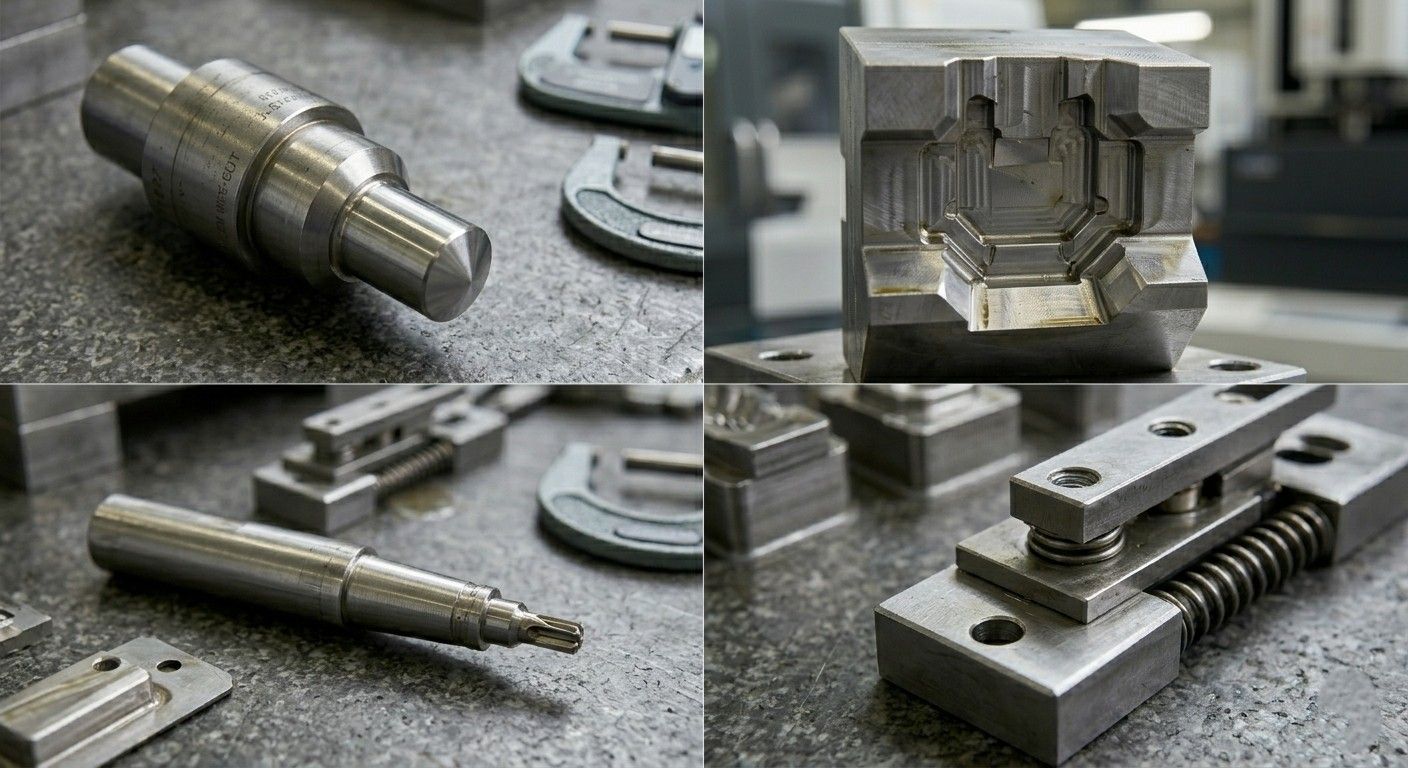
Tooling spare parts manufacturing & – tooling spare parts (punches, inserts, ejector pins) and precision robotics spare parts to keep your production running.
FAQ: Stamping Die Selection, Tonnage & Tool Steel Wear
Q1: What is the main cost difference between progressive and transfer dies for Stamping Tooling Cost China?
Progressive dies in China typically cost between $15,000 and $80,000, while transfer dies can range from $60,000 to over $250,000 due to the added complexity of transfer mechanisms, larger die sets, and increased machining time. However, for high-volume programs (over 500,000 pcs/year), the higher upfront cost of a progressive die is usually recouped within 3-6 months through lower piece prices.
Q2: How is Stamping Press Tonnage calculated for a progressive die?
Tonnage is estimated by calculating the cutting/forming load for each station based on material tensile strength, thickness, and operation type, then summing all station loads. SSPrecision engineers add a 25% safety buffer and specify a press with a rated capacity at least 20% higher than the calculated total.
Q3: Which tool steel is best for minimizing Tool Steel Wear in high-volume stamping?
For cutting operations exceeding 5 million cycles, M2 HSS with a TiCN coating offers superior wear resistance. For forming operations on stainless or HSLA steel, DC53 is preferred over D2 for its improved toughness at equivalent hardness levels, providing better galling resistance.
Q4: How does Die Layout Design affect die longevity?
A well-balanced Die Layout Design reduces off-center loading, which accelerates guide bushing wear and causes punch misalignment. SSPrecision’s optimized layout protocol decreases average die maintenance frequency by 35% compared to poorly sequenced stations.
Q5: Can SSPrecision manufacture both progressive and transfer dies?
Yes, SSPrecision designs and manufactures both progressive and transfer dies in-house, covering the entire process from DFM review through final mold trial. With 5-axis CNC machining, EDM, and wire EDM capabilities, SSPrecision can handle a wide range of die complexities, from simple 3-station progressives to 12-station transfer dies for deep-draw applications.
Read More – Intelligence That Protects Your Production Line
-
Holding ±0.001 mm: Thermal Control in Precision CNC – A 2°C temperature swing can add 7 microns of error—here’s how thermal control makes the difference between hitting tolerance and scrapping the part.
-
Over-molding vs. Insert Molding: Preventing Delamination – Choosing the wrong process or resin pair can turn a bonded assembly into a delamination disaster—learn how to design for adhesion that actually lasts.
-
Cheap China Molds: Where Shops Cut Corners – That “$5,000 mold” could end up costing you $45,000 in rework and scrap—here’s exactly where the savings go and how to spot the traps before you buy.
-
Stamping DFM: Optimizing Strip Layouts for Less Scrap – It’s not just about nesting tighter; it’s about redesigning the entire dance of the die to shave 18–27% off your material bill every single year.
-
Sourcing Interchangeable Cores & Punches for Tooling – Stop stocking a warehouse of custom spares—this approach slashes downtime by over a third and keeps your press running while others scramble for replacements.
-
Holding ±0.001 mm: Thermal Control in Precision CNC – A 2°C temperature swing can add 7 microns of error—here’s how thermal control architecture, spindle warm-up protocols, and granite bases make the difference between hitting tolerance and scrapping the part.
-
D2 vs DC53 Tool Steel: Which is Best for Stamping? – D2 has been the industry standard, but DC53 offers twice the toughness and better machinability—here’s the metallurgical data to decide which alloy delivers lower total cost of ownership for your stamping application.