

The Real Cost of Cheap Injection Molds China: An Introduction
With a global plastic molding market size valued at roughly 385 billion USD in 2023, 40-45% of the global injection mold exports originate from China. The value proposition is undeniable for US, EU, and Australian buyers, with molds that can run for $30,000 here cost $5,000 here from a low-cost Chinese vendor. But what exactly is a buyer paying for – and more importantly, what are they not paying for?
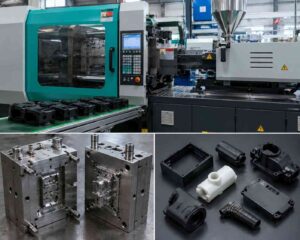
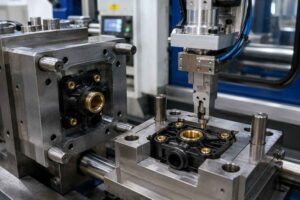
This article delves into the hidden mechanisms of Cheap Injection Molds China, from steel, machining, process control corner cuts to how SSPrecision’s precision tooling protects your investment throughout your production life cycle. An Injection Mold isn’t a block of steel, but a precision instrument designed for millions of consistent parts at extreme pressures and heat.
Tooling Cost Breakdown: What the Numbers Actually Mean
The first step in understanding the true cost of sourcing is interpreting a Tooling Cost Breakdown. Below is an overview of what typically happens in Budget, Mid-Tier and Premium-Precision supplier’s mold costs allocation to different components:
| Cost Component | Budget Supplier (China) | Mid-Tier Supplier (China) | Premium Supplier (SSPrecision) |
| Mold Base Steel | $800–$1,200 | $1,800–$2,500 | $3,000–$4,500 |
| Core & Cavity Steel | Unknown / mixed grade | P20 or H13 (claimed) | Certified H13 / S136 |
| CNC Machining Time | Minimal / rushed | Standard | High-precision |
| Surface Finish | Often skipped | Partial polishing | Full SPI A2/B1 finish |
| Mold Trials Included | 0–1 trials | 1–2 trials | 3+ trials standard |
| Total Estimated Cost | $2,500–$5,000 | $6,000–$12,000 | $15,000–$40,000+ |
| Expected Mold Life | 50,000–100,000 shots | 200,000–300,000 shots | 500,000–1,000,000+ shots |
According to AMBA, molds that operate less than 100,000 cycles before failing can drive a 300-400% per-part cost over the product lifecycle after factoring in retooling, scrap and downtime. SSPrecision’s certified tooling process follows ISO 9001:2015 and IATF 16949 and guarantees traceability for materials from receipt to finished cavity.
Mold Core Steel Quality: The Foundation That’s Often Faked
The number one cost cut in budget tooling is Mold Core Steel Quality. While Premium steel grades such as H13 (hot work tool steel) and S136 (stainless mold steel) carry significant premium of 2-3x the cost per kg versus Generic P20 or unstated “tool steel” in molds, budget mold shops will almost always use uncertified steel without informing the buyer.
Warning signs for steel selection compromise include:
- No material certification provided by the supplier.
- Hardness is unverified; what the buyer receives is rated 38-42 HRC instead of the stated 48-52 HRC.
- Visible porosity and inclusions are seen when magnifying the cavity under an optical microscope.
- Early signs of wear appear on the mold as early as 20,000-30,000 cycles, versus typically 500,000+ for H13 molds.
In a 2022 case study from a European automotive tier-1 supplier, 3 out of 7 molds purchased from Chinese low-cost suppliers used non-conforming steel, resulting in an average of 47,000 of warranty claims per mold during the first year. SSPrecision procures all certified materials with traceable material certificates to prevent any material risk for your mold.
Counterfeit Tool Steel: A Growing Risk in Budget Tooling
Counterfeit Tool Steel in low-cost mold sources is more pervasive than most procurement teams may realize. In 2021 a supply chain audit commissioned by a major injection molder uncovered that approximately 23% of “H13-Certified” steel sourced from a low-cost Chinese steel broker failed spectrometry tests.
The common counterfeiting techniques used in audits were:
- Relabelling lower-grade steel, e.g. 4140 alloy steel, as premium H13 or P20 steel.
- Mixing scrap regrind into billets without material certification.
- Providing forged mill certificates to alter chemical compositions and mechanical properties.
- Sourcing steel from secondary markets with an unverified chain of custody.
SSPrecision utilizes an in-house XRF (X-ray fluorescence) Spectrometry to verify the chemistry of each incoming steel lot. At a cost addition of approximately 3-5% to materials procurement cost, it eliminates the risk for cavity failure due to material fraud and ships each mold with its steel certification.
Plastic Injection Mold Rework: The Hidden Budget Killer
Plastic Injection Mold Rework is the unseen expenditure on cheap molds that quickly turns them into expensive burdens. Rework costs are not factored into the initial quotation, but are discovered later on when production commences and a variety of defects emerge.
Below is an example of typical frequency and cost impact of rework:
| Hidden Cost Category | Typical Industry Frequency | Average Rework / Replacement Cost |
| Flash & sink mark corrections | ~65% of budget molds | $1,500–$5,000 |
| Early core/cavity wear | ~48% within 80,000 shots | $3,000–$12,000 |
| Gate vestige & weld line issues | ~52% of budget molds | $800–$2,500 |
| Full mold replacement | ~30% within 18 months | Full retool cost + 4–8 week delay |
| Dimensional non-conformance scrap | Up to 12% scrap rate | Varies by volume |
According to Plastics Technology magazine’s 2023 survey, average unplanned rework & scrap costs for molds bought from low-cost suppliers range from $18,000-$45,000 per mold over a three-year production cycle. SSPrecision utilizes DFM (Design for Manufacturability) prior to steel cutting and this step alone reduces rework by 70-80% versus a low-cost supplier.
Where SSPrecision Stands Apart in Precision Mold Manufacturing
SSPrecision (ssprecision.com.cn) is a China-based precision tooling manufacturer focused on meeting the rigorous needs of global OEM’s and closing the gap between low-cost domestic suppliers and demanding standards. Differentiators include:
- ISO 9001:2015 & IATF 16949 certified quality management systems
- 0.002mm tolerance capability via EDM (Electrical Discharge Machining)
- Moldflow and DFM Analysis prior to commencing production
- Certified steel procurement with in-house XRF verification
- CMM inspection and 100% first article inspection on all tooling
- T1 sampling target within 4-6 weeks for standard molds
SSPrecision serves demanding industries such as Medical Device, Automotive, Consumer Electronics, and Industrial Equipment where a mold failure isn’t simply a tooling issue but an issue of production stoppage and compliance risk.
SSPrecision Is a Trusted Partner for Die Manufacturing Cost Optimization
SSP Precision is an ISO 9001 & IATF 16949 certified manufacturer delivering end-to-end precision solutions, from design and prototyping to high‑volume production, for the automotive, medical, electronics, aerospace, and industrial sectors. We handle every stage in‑house – DFM engineering, rapid prototyping, CNC machining, EDM, grinding, and global logistics – to manufacture the tooling that makes your parts and the parts themselves.
What we build and supply: visit our sites: https://ssprecision.com.cn/
- Stamping dies manufacturing and stamping die parts – high‑precision transfer stamping dies and progressive/compound dies for volume metal stamping.
- Injection molding and injection mold – custom injection molds for plastic components, including single‑, multi‑cavity, and over‑molding & insert‑molding tools that combine metal and plastic in one part.
- Specialty molded components – eco‑friendly green mold parts and microscopic medical micro‑molded parts.
- Precision metal and plastic end‑use parts – high‑volume serial production of precision products (metal stampings, plastic moldings) with full PPAP traceability.
Tooling spare parts manufacturing & – tooling spare parts (punches, inserts, ejector pins) and precision robotics spare parts to keep your production running.
FAQ: Cheap China Molds & Injection Mold Sourcing
Q1: What is the reason behind very cheap China injection molds?
Low-cost mold providers can cut corners in using non-certified or lower-quality steel, shortening machining time, skipping T1/T2 trials, excluding DFM analysis and using less skilled moldmakers. What you get is exactly what you pay for – however, this includes hidden cost factors post-delivery, with early mold failure as a common consequence.
Q2: What steel grades is a quality injection mold constructed with?
For common molds with a cycle life under 500,000: H13 (DIN 1.2344) steel is the typical choice for cores and cavities, while S136 (DIN 1.2083) stainless steel is utilized for corrosive resin types like PVC or glass-filled Nylon. A mill certificate and third-party hardness testing should always be requested.
Q3: How do I check for counterfeit tool steel prior to having the mold made?
Request the steel billet be tested for its chemistry via third party XRF or OES prior to machining. SSPrecision conducts in-house XRF analysis and will supply a certification upon request. Any vendor who will not provide a traceable mill certificate should be avoided.
Q4: What are the actual costs and definitions of Plastic Injection Mold Rework?
Rework encompasses any corrective machining, polishing, re-gating or replacing components on the mold after the first shot trial (T1) revealed defects. Typically, 40-65% of low-cost molds require at least one significant repair at a cost of $1,500 – $12,000+ per incident.
Q5: Does SSPrecision offer a design review before starting mold production?
Yes, SSPrecision performs full DFM analysis and Moldflow simulation for every mold project prior to starting production, identifying potential weld lines, sink marks, poor gate placement and shallow draft angles to mitigate expensive rework.
Q6: What is the typical lead time for a quality mold from SSPrecision?
Standard complexity single cavity molds typically take between 4-6 weeks for T1 samples with 8-12 weeks for multi-cavity and complex parts,rush service is available upon discussion. Customers gain weekly progress updates via SSPrecision’s proprietary project tracking portal.
Read More – Knowledge That Keeps Your Shop Running
- Why Injection Molds Fail: Cracking & Galling Fixes – Because mold failures don’t send a warning text—they just stop production cold, and the clock starts ticking at $14,700 per incident.
- Stamping DFM: Optimizing Strip Layouts for Less Scrap – It’s not just about nesting tighter; it’s about redesigning the entire dance of the die to shave 18–27% off your material bill every single year.
- Sourcing Interchangeable Cores & Punches for Tooling – Stop stocking a warehouse of custom spares—this approach slashes downtime by over a third and keeps your press running while others scramble for replacements.
- Micro Injection Molding: Controlling Flash on Tiny Parts – When parts weigh under 0.1 gram, even a 10-micron flash is a giant defect—here’s how to control the process on the smallest scale.
- Conformal Cooling in Injection Molding – Cooling eats 50–70% of your cycle time—here’s how 3D-printed conformal channels cut it by up to 40%, slash scrap by 65%, and pay for themselves in under 6 months.
- What Drives Metal Stamping Die Costs? – A progressive die can cost anywhere from $8,000 to over $150,000—here’s a breakdown of the 5 key cost drivers, global price comparisons, and when to repair vs. replace.
- How to Track & Prevent Tool Wear in Progressive Dies – Acoustic sensors, tonnage monitoring, and carbide inserts can push die life beyond 200,000 strokes—here’s the data on tracking wear thresholds before they become catastrophic failures.
- Insert Dies Vs. Solid Dies: Maintenance & Cost Analysis – Insert dies cost 10–20% of their original price to repair, while solid dies run 40–70%—here’s the data on downtime, spare parts strategy, and which design wins for high-volume stamping.