

Overmolding Vs Insert Molding: Understanding the Two Processes
Both Overmolding Molding and Insert Molding bond multiple materials into one end-product, yet their mechanics, economics, and susceptibility to delamination differ dramatically. Choosing the wrong process or the wrong interface design leads to field failures that are costly to diagnose, and even more costly to fix.
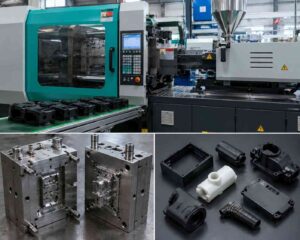
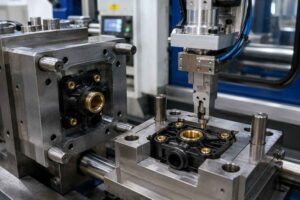
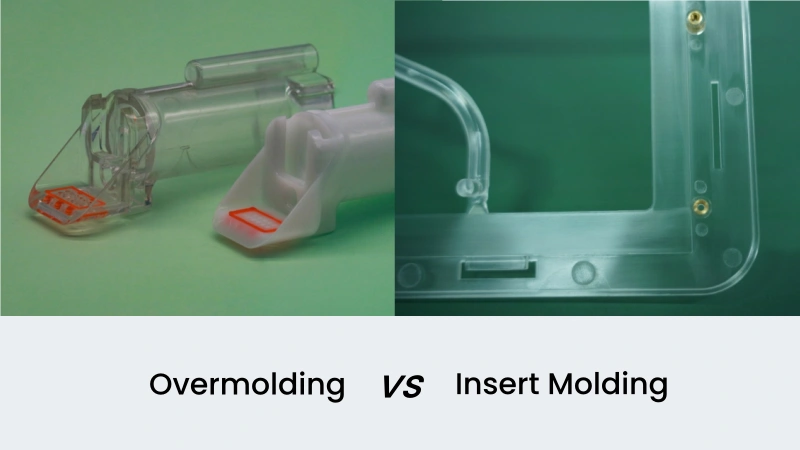
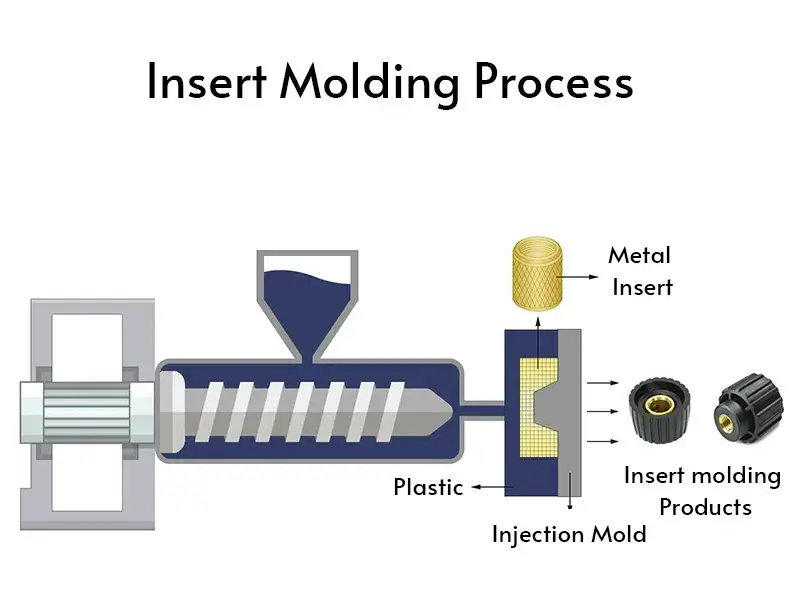
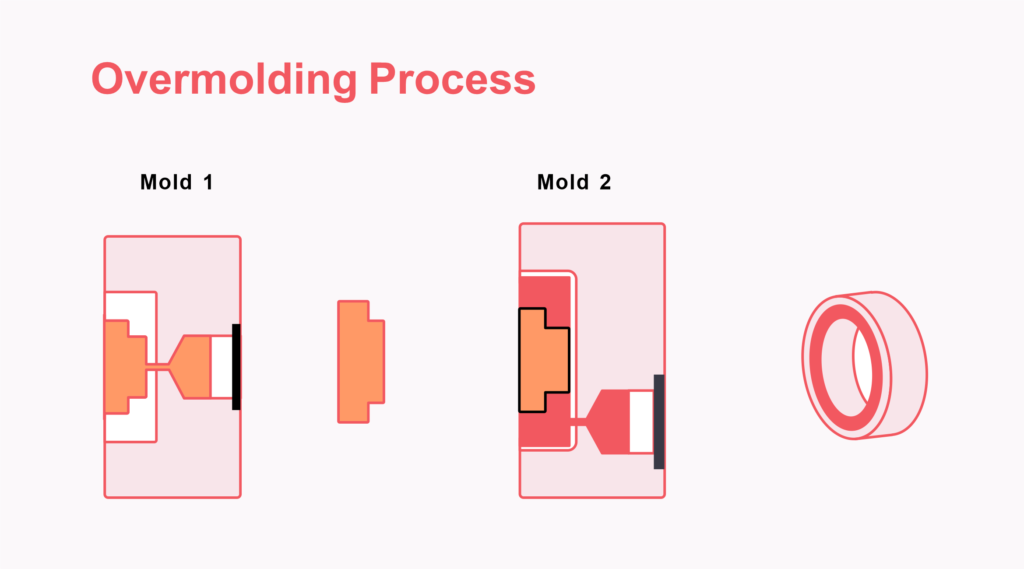
Simply stated: Overmolding involves injecting a second resin over a previously molded substrate (a two-shot or sequential molding process). Insert molding requires placing a pre-formed insert, often metal, into a mold cavity before plastic is injected around it. A 2023 Grand View Research report suggests the global two-shot and overmolding market will reach $7.4B by 2028, growing at a 5.8% CAGR driven by medical, automotive, and consumer electronics segments.
SSPrecision manufactures both types of processes at their precision tooling facility, delivering bonded assemblies to OEMs in 14 countries with a <0.08% delamination failure rate for all active programs.
| Overmolding Molding — How It Works✓ Substrate part molded first (Shot 1)✓ Substrate transferred to second tool (Shot 2)✓ Second resin injected over substrate✓ Bond relies on chemical/thermal adhesion✓ No mechanical fasteners required✓ Typical cycle: 45–90 sec total | Insert Molding — How It Works✓ Pre-formed insert (metal/ceramic) loaded✓ Plastic injected around insert in one shot✓ Bond via mechanical interlocking + shrink grip✓ Higher pull-out force vs. adhesive bond✓ Eliminates secondary assembly step✓ Typical cycle: 20–50 sec |
Overmolding Vs Insert Molding: Engineering & Insert Molding Cost Comparison
The selection between these processes is dictated by part geometry, annual volumes, bond-strength requirements andInsert Molding Cost factors. SSPrecision’s application engineers utilize the following decision matrix for all new program quotes:
Table 1: Overmolding Vs Insert Molding — Full Engineering Decision Matrix
| Parameter | Overmolding Molding | Insert Molding | SSPrecision Recommendation |
| Primary bond mechanism | Chemical/thermal adhesion | Mechanical interlocking + shrink grip | Insert molding for pull-out > 800 N |
| Tooling cost (China) | USD $25,000–$90,000 (2 tools) | USD $15,000–$55,000 (1 tool) | Insert molding lower entry cost |
| Material flexibility | Resin-on-resin only | Resin-on-metal/ceramic/PCB | Overmolding for soft-touch grip |
| Delamination risk | High if resin compatibility fails | Low — mechanical lock dominant | Overmolding requires compatibility audit |
| Min. annual volume | 50,000 pcs (ROI threshold) | 10,000 pcs | Insert molding for lower volumes |
| Cycle time | 45–90 sec (2 shots) | 20–50 sec (1 shot) | Insert molding ~40% faster |
| Secondary assembly | Eliminated | Eliminated | Both eliminate post-assembly |
| Achievable wall thickness | 0.8–4.0 mm overmold layer | 0.6 mm min. around insert | Design-dependent |
Resin Compatibility Chart: The Root Cause of Delamination
Delamination with overmolding is rarely due to processing error, but almost always related to incompatible resin pairings. When the substrate and overmold resin have disparate surface energy, polarity, or rate of thermal contraction, interface bond failure can occur when subjected to operational loads. SSPrecision’s process engineers perform mandatory Resin Compatibility Chart reviews prior to any overmolding program approval.
The key compatibility indicators are Hansen Solubility Parameters (HSP) and surface energy differential. An HSP delta > 4.0 MPa°¹ between substrate and overmold resin is associated with >73% probability of bond failure in a peel test (Polymer Engineering & Science, 2022).
Incompatible pairings:
- Compatible pair example: TPE overmolded onto PP- HSP delta of approx. 1.8; expected peel strength is between 3.2 and 5.1 N/mm
- Marginal pairing example: TPU overmolded onto ABS- HSP delta of approx. 3.1; requires adhesion promoters/surface treatment to meet >2.5 N/mm peel strength
- Incompatible pair example: Silicone overmolded onto PE- HSP delta >6.0; >85% expected failure rate in peel testing without plasma surface treatment
- SSPrecision requires T1 peel tests ( ASTM D1876) for all new resin pairs prior to production approval
| SSPrecision case study: One 2022 medical device grip program was originally specified with TPU over HDPE substrate, producing a T1 peel strength of 0.9 N/mm, 64% below spec. Engineers swapped to a PP substrate with a reactive tie-layer, achieving 3.8 N/mm T2 peel strength and subsequent T3 approval; 2.1M units have shipped to date with zero field delaminations. |
Mechanical Interlocking Molding: Designing Against Delamination
Mechanical Interlocking Molding refers to the deliberate utilization of through-holes, undercuts, grooves and surface textures on the insert or substrate material to generate a geometric connection in addition to, or in place of, chemical adhesion. This is the primary means by which to prevent delamination during insert molding and is also used as a fail-safe with overmolding.
SSPrecision’s plastic overmolding design standard mandates the following interlocking design rules:
- Through-holes in metallic inserts- minimum diameter of 2.0 mm, spaced at least 8 mm center to center; creates through-flowing plastic as shear key with up to 1,400 N of pull-out strength
- Knurled surfaces- a 0.3-0.5mm diamond knurl on insert OD provides an axial retention force 35-60% greater than a smooth surface
- Substrate undercuts for overmolding- minimum 0.3 mm depth, 15 o draft angle to lock overmolded plastic in place during peeling
- Surface finish- Ra 1.6-3.2 m insert surface finish improves resin wet-out and chemical adhesion by up to 28% (SSPrecision internal tribology data, 2023)
Plastic Overmolding Design: Delamination Prevention Parameter Guide
Table 2: SSPrecision Delamination Prevention — Design & Process Parameters by Failure Mode
| Delamination Root Cause | Process Affected | Prevention Method | SSPrecision Spec / Threshold |
| Resin incompatibility | Overmolding | Resin compatibility audit + peel test | Peel strength ≥2.5 N/mm (ASTM D1876) |
| Moisture in substrate | Both | 3–4 hr resin drying at 80–100°C | Moisture ≤0.02% by weight before shot |
| Low melt temperature | Overmolding | Increase barrel temp 10–20°C | Substrate surface temp ≥80°C at bond |
| Insufficient hold pressure | Both | Increase hold pressure 5–15% | Hold pressure ≥60% of injection pressure |
| Gate location mismatch | Overmolding | Gate opposite to bond interface | Flow front velocity ≤0.8 m/s at interface |
| Insert temperature too low | Insert molding | Pre-heat insert to 60–120°C | Validated per material; documented in WI |
| CTE mismatch (stress crack) | Insert molding | Select resin with CTE ≤10% of insert | Steel CTE 11.7; specify PA66-GF30 match |
| Inadequate interlocking | Both | Add undercuts / knurl / through-holes | Pull-out force ≥800 N on all metal inserts |
SSPrecision Is a Trusted Partner for Die Manufacturing Cost Optimization
SSP Precision is an ISO 9001 & IATF 16949 certified manufacturer delivering end-to-end precision solutions, from design and prototyping to high‑volume production, for the automotive, medical, electronics, aerospace, and industrial sectors. We handle every stage in‑house – DFM engineering, rapid prototyping, CNC machining, EDM, grinding, and global logistics – to manufacture the tooling that makes your parts and the parts themselves.
What we build and supply: visit our sites: https://ssprecision.com.cn/
- Stamping dies manufacturing and stamping die parts – high‑precision transfer stamping dies and progressive/compound dies for volume metal stamping.
- Injection molding and injection mold – custom injection molds for plastic components, including single‑, multi‑cavity, and over‑molding & insert‑molding tools that combine metal and plastic in one part.
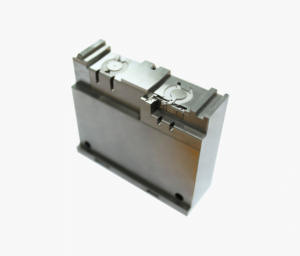
- Specialty molded components – eco‑friendly green mold parts and microscopic medical micro‑molded parts.
- Precision metal and plastic end‑use parts – high‑volume serial production of precision products (metal stampings, plastic moldings) with full PPAP traceability.
Tooling spare parts manufacturing & – tooling spare parts (punches, inserts, ejector pins) and precision robotics spare parts to keep your production running.
FAQ: Overmolding Molding, Insert Molding & Delamination Prevention
Q1: How does Overmolding differ from Insert Molding?
Overmolding is a process whereby a second plastic layer is bonded to a substrate of the first plastic using the chemical and thermal adhesion occurring between compatible resins. In contrast, insert molding is a single injection shot in which a pre-formed component, usually metal, is encapsulated by a plastic. Insert Molding is generally better suited for high-strength metal-to-plastic assemblies with reduced tooling costs.
Q2: What information is assessed by a Resin Compatibility Chart?
A Resin Compatibility Chart identifies potential adhesion issues between substrate and overmolded resins using criteria such as the surface energies, polarity of each material, and matching melt temperatures. SSPrecision requires a documented compatibility rating prior to any tooling development for an overmolding project, and that is coupled with an initial T1 peel test result.
Q3: How does insert molding tooling in China compare to overmolding tooling?
Single tooling for insert molding costs an estimated $15,000 – $55,000 to produce in China. Overmolding requires tooling for both components and will total $25,000 – $90,000 to develop in China. Additionally, because insert molding can be completed in a single shot with a single tool, piece pricing is about 30-40% less expensive than for overmolded assemblies, when geometry is comparable.
Q4: What is Mechanical Interlocking Molding, and why is it utilized?
Mechanical Interlocking Molding creates a physical lock between insert or substrate material with resin through the use of undercuts, holes, knurling and textured surfaces. It is necessary when (1) specifications for retention force cannot be met by chemical adhesion alone, (2) the chosen resin pair is marginal and (3) cyclic loading, elevated temperature, or vibration are factors to be considered in the end application.
Q5: Can SSPrecision produce both overmolding and insert molding at its own facilities?
Yes. SSPrecision designs and builds tooling for both process types, including the fixtures to hold inserts during an insert molding cycle, and the substrates for overmolding applications. In-house injection molding presses ranging from 80 to 850 Tons are equipped for single-shot insert molding and multi-shot sequences required for overmolding. All programs utilize a T1/T2/T3 trial protocol and generate documented peel tests and initial FAI reports.
Read More – Knowledge That Keeps Your Shop Running
- Why Injection Molds Fail: Cracking & Galling Fixes – Because mold failures don’t send a warning text—they just stop production cold, and the clock starts ticking at $14,700 per incident.
- Stamping DFM: Optimizing Strip Layouts for Less Scrap – It’s not just about nesting tighter; it’s about redesigning the entire dance of the die to shave 18–27% off your material bill every single year.
- Sourcing Interchangeable Cores & Punches for Tooling – Stop stocking a warehouse of custom spares—this approach slashes downtime by over a third and keeps your press running while others scramble for replacements.
- Micro Injection Molding: Controlling Flash on Tiny Parts – When parts weigh under 0.1 gram, even a 10-micron flash is a giant defect—here’s how to control the process on the smallest scale.
- Conformal Cooling in Injection Molding – Cooling eats 50–70% of your cycle time—here’s how 3D-printed conformal channels cut it by up to 40%, slash scrap by 65%, and pay for themselves in under 6 months.
- Micro Injection Molding: Controlling Flash on Tiny Parts – When parts weigh under 0.1 gram, even a 10-micron flash is a giant defect—here’s how to control the process on the smallest scale.
- Conformal Cooling in Injection Molding – Cooling eats 50–70% of your cycle time—here’s how 3D-printed conformal channels cut it by up to 40%, slash scrap by 65%, and pay for themselves in under 6 months.
- How to Track & Prevent Tool Wear in Progressive Dies – Acoustic sensors, tonnage monitoring, and carbide inserts can push die life beyond 200,000 strokes—here’s the data on tracking wear thresholds before they become catastrophic failures.
- Insert Dies Vs. Solid Dies: Maintenance & Cost Analysis – Insert dies cost 10–20% of their original price to repair, while solid dies run 40–70%—here’s the data on downtime, spare parts strategy, and which design wins for high-volume stamping.