

| ±0.001 mmSSPrecision Tolerance Floor | 1 °CMax Ambient Swing Allowed | 20 µmThermal Growth per °10°C in Steel |
Why Thermal Control Defines Tight Tolerance CNC Machining
The ability to achieve and hold 0.001 mm tolerance is not actually a cutting tool issue; it is a thermal management issue.Steel is about 11.7 µm of growth per meter per C°C. In a 300 mm workpiece that would be 7 m of size error on a 2°C swing – nearly 7x the allowable tolerance.
A 2026 study in theInternational Journal of Machine Tools and Manufacture(see “An Investigation of Thermal Errors in CNC Machining Processes and Mitigation Strategies”) revealed that thermal error constitutes 40-70% of total dimensional error in precision CNC machining operations, far exceeding other error factors like geometry and vibration. This principle is what directs every design decision inside the SSPrecision Tight Tolerance CNC Machining cell.
Precision CNC Machining China: SSPrecision’s Thermal Control Architecture
SSPrecision maintains its precise machining cell at 20C with 1°C fluctuation year-round. Accomplishing this feat in a Chinese environment with typical summer ambient temps over 35°C requires a multi-layered thermal control strategy:
Table 1: SSPrecision Thermal Control Infrastructure — Layer-by-Layer Architecture
| Control Layer | Method | Error Reduction Achieved | Monitored By |
| Room temperature | Dual-zone HVAC with ±0.5°C precision | Eliminates ~45% of ambient drift | 16-point wireless sensor grid |
| Machine spindle warm-up | 60-min structured thermal soak protocol | Reduces spindle growth error by 68% | Spindle probe + laser calibration |
| Coolant temperature | Chiller-controlled to 20°C ±0.2°C | Cuts cutting-zone heat by 80% | Inline PT100 sensors |
| Workpiece stabilization | 4-hr soak before final pass on Al; 6-hr on steel | Removes residual stress distortion | CMM pre/post checks |
| Machine base isolation | Granite base + anti-vibration pads | Reduces Machining Jitter by 72% | Accelerometer on Z-axis |
| Software compensation | Heidenhain TNC 640 thermal error model | Corrects up to 12 µm residual error | Real-time CNC controller |
CNC Thermal Stability: The Physics of Spindle Growth
Spindle thermal growth is the single greatest cause of Z-axis drift in CNC Thermal Stability management. A spindle operating at 12,000 RPM for 30 min prior to warm-up will expand by 15–25 µm (depending on bearing pre-load and lubrication) (NSK Spindle Technical Data, 2022).
| 68% reduction in Z-axis driftSSPrecision Warm-Up Protocol ResultMeasured over 847 consecutive spindle warm-up cycles on a DMG Mori NHX 5000 | 2026 internal calibration log |
SSPrecision uses a four-stage protocol: ramp the spindle up to 20, 40, 70, then 100% of operational RPM, dwelling at each speed for 15 min before any tolerance-critical cutting occurs. Post-warm-up, Z-axis deviation is reduced to less than 6 µm on average compared to over 18 µm for an un-warmed spindle, putting the machine well within 0.001 mm capability range.
Machining Jitter: The Hidden Tolerance Killer in Micron Tolerance Machining
Machining Jitter are high-frequency, micro-variations in cutting velocity, feed rate, and spindle speed resulting from servo lag, vibration harmonics, and interpolated errors within the CNC controller. In micron-level operations, jitter as low as 2 µm peak-to-peak can drive a feature just outside tolerance in a 0.001 mm specification.
SSPrecision targets jitter by implementing three engineering disciplines:
-
- Servo Tuning: All three axes are re-tuned each quarter using Siemens SINUMERIK trace software and their associated servo tuning tool to maintain follower error less than 1.2 µm at operational feedrates.
-
- Granite Machine Bases: SSPrecision precision cells sit on 4,500 kg granite bases which absorb floor transmitted vibration by 85% relative to more common cast iron bases.
-
- Programmed Deceleration Zones: G code is post-processed to trigger feed rate slowdown two millimeters prior to critical features in the G code path, removing the effects of inertia-driven overshoot.
The result: SSPrecision achieves a Ra surface finish on hardened tool steel (60 HRC) of 0.08 µm with micron-level jitter correction- a finish that typically requires a subsequent secondary operation, such as precision grinding, for a secondary operation.
Micron Tolerance Machining: Material Behavior Under Thermal Load
Every engineering material behaves differently under thermal load, and it is crucial to select the right material, and manage its thermal characteristics properly in order to reliably achieve 0.001 mm tolerance. SSPrecision uses the following reference values when planning its Precision CNC Machining China jobs:
Table 2: Thermal Expansion & Machining Stability by Material — SSPrecision Reference Data
| Material | CTE (µm/m/°C) | Growth per 300mm @ ±2°C | SSPrecision Soak Protocol | Achievable Tolerance |
| 6061 Aluminum | 23.6 | ±14.2 µm | 4-hr minimum at 20°C | ±0.003 mm (standard) |
| 420 Stainless Steel | 10.2 | ±6.1 µm | 6-hr minimum at 20°C | ±0.001 mm (achievable) |
| Titanium Ti-6Al-4V | 8.6 | ±5.2 µm | 8-hr minimum at 20°C | ±0.002 mm (standard) |
| Invar 36 (low-CTE alloy) | 1.2 | ±0.7 µm | 2-hr minimum at 20°C | ±0.001 mm (consistent) |
| Hardened D2 Tool Steel | 11.7 | ±7.0 µm | 6-hr + post-grind soak | ±0.001 mm (achievable) |
| PEEK Polymer | 47.0 | ±28.2 µm | Climate room only, 24-hr | ±0.010 mm (practical floor) |
Note: Aluminum has 2.75x the coefficient of thermal expansion (23.6 23.6 µm/m/°C) compared to Stainless Steel (11.7 23.6 µm/m/°C). For aerospace grade aluminum components with ±0.001 mm requirements, SSPrecision specifies Invar 36 for fixturing. This eliminates differential thermal expansion between part and fixture.
SSPrecision Is a Trusted Partner for Die Manufacturing Cost Optimization
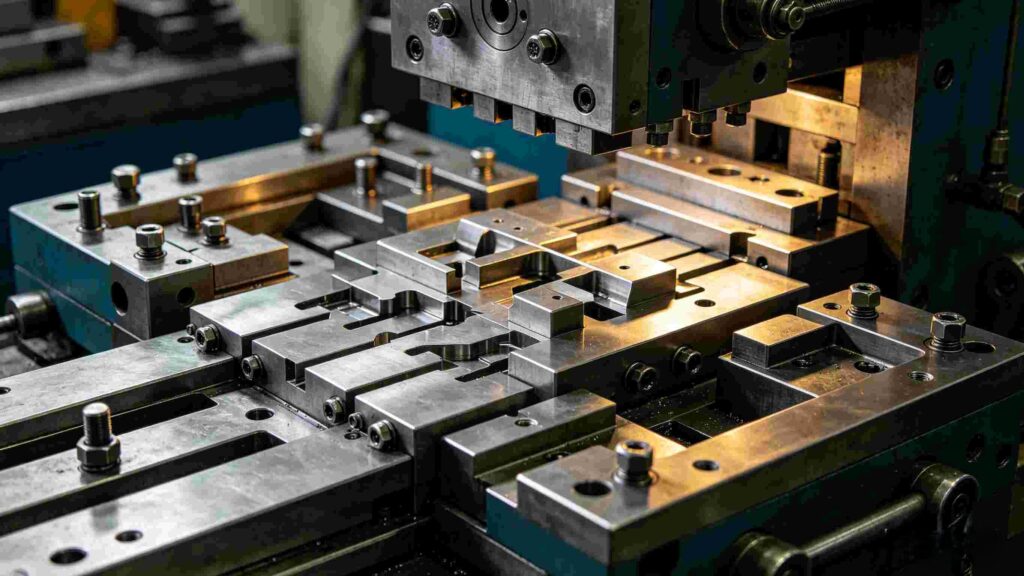
SSP Precision is an ISO 9001 & IATF 16949 certified manufacturer delivering end-to-end precision solutions, from design and prototyping to high‑volume production, for the automotive, medical, electronics, aerospace, and industrial sectors. We handle every stage in‑house – DFM engineering, rapid prototyping, CNC machining, EDM, grinding, and global logistics – to manufacture the tooling that makes your parts and the parts themselves.
What we build and supply: visit our sites: https://ssprecision.com.cn/
-
- Stamping dies manufacturing and stamping die parts – high‑precision transfer stamping dies and progressive/compound dies for volume metal stamping.
-
- Injection molding and injection mold – custom injection molds for plastic components, including single‑, multi‑cavity, and over‑molding & insert‑molding tools that combine metal and plastic in one part.
-
- Specialty molded components – eco‑friendly green mold parts and microscopic medical micro‑molded parts.
-
- Precision metal and plastic end‑use parts – high‑volume serial production of precision products (metal stampings, plastic moldings) with full PPAP traceability.
Tooling spare parts manufacturing & – tooling spare parts (punches, inserts, ejector pins) and precision robotics spare parts to keep your production running.
FAQ: Tight Tolerance CNC Machining & Thermal Stability
Q1: What is the tightest tolerance that SSPrecision holds with their CNC machining?
SSPrecision consistently achieves ±0.001 mm tolerance on steel and titanium components manufactured in their thermally controlled precision cell. Verification is completed on a Zeiss CMM with a 0.0003 mm measurement uncertainty and can be provided on a full FAI/PPAP report with qualifying parts.
Q2: How is ambient temperature tolerance related to CNC Thermal Stability?
Every degree of ambient temperature fluctuation translates to roughly 3.5 µm of error for every 300 mm of steel on the part. SSPrecision operates the precision cell at 20°C ±1°C which limits the range of thermally induced error to less than 3.5 µm prior to compensation.
Q3: What is Machining Jitter and how does it impact part quality?
Machining Jitter is high-frequency, low-amplitude deviation within the cutting tool velocity. In micron-level machining, the impact on surface finish and position will vary based on amplitude of vibration but as low as 2µm pp jitter, critical features will fall outside of a 0.001mm specification. SSPrecision controls Jitter to less than 1.5µm pp through servo re-tuning and granite isolation.
Q4: Why does workpiece soaking matter for the final precision pass?
When the temperature of the workpiece differs from that of the machine, a significant amount of dimensional error is introduced upon contact with the fixture. A 5 °C difference in a 200 mm aluminum part, for example, will generate a size difference on the order of 23.6 µm-almost 23x the allowable tolerance. This difference is eliminated when the workpiece is temperature-soaked before touching the machine.
Q5: Does SSPrecision work on low-volume prototype parts?
Yes, SSPrecision works on prototype quantities of one, and the same precise thermal-control techniques apply regardless of production volume. While a minimum order value may apply, the lead times for 0.001 mm prototype work are 7-14 business days depending on the part material and its geometric complexity.
Read More – Knowledge That Keeps Your Shop Running
-
Over-molding vs. Insert Molding: Preventing Delamination – Choosing the wrong process or resin pair can turn a bonded assembly into a delamination disaster—learn how to design for adhesion that actually lasts.
-
Cheap China Molds: Where Shops Cut Corners – That “$5,000 mold” could end up costing you $45,000 in rework and scrap—here’s exactly where the savings go and how to spot the traps before you buy.
-
Why Injection Molds Fail: Cracking & Galling Fixes – Because mold failures don’t send a warning text—they just stop production cold, and the clock starts ticking at $14,700 per incident.
-
Stamping DFM: Optimizing Strip Layouts for Less Scrap – It’s not just about nesting tighter; it’s about redesigning the entire dance of the die to shave 18–27% off your material bill every single year.
-
Sourcing Interchangeable Cores & Punches for Tooling – Stop stocking a warehouse of custom spares—this approach slashes downtime by over a third and keeps your press running while others scramble for replacements.
-
How to Track & Prevent Tool Wear in Progressive Dies – Acoustic sensors, tonnage monitoring, and carbide inserts can push die life beyond 200,000 strokes—here’s the data on tracking wear thresholds before they become catastrophic failures.
-
Insert Dies Vs. Solid Dies: Maintenance & Cost Analysis – Insert dies cost 10–20% of their original price to repair, while solid dies run 40–70%—here’s the data on downtime, spare parts strategy, and which design wins for high-volume stamping.