
What Is Stamping DFM and Why Does It Matter?
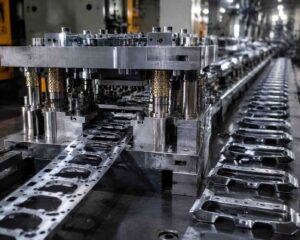
Stamping DFM — sort of Design for Manufacturing in metal stamping — is a systematic engineering way to align part geometry with real process limits before the first die gets cut. If it’s done right, it pretty much sets the tone for material utilization, cycle efficiency, and the long-run tooling life. At SSPrecision, DFM for Metal Stamping is worked into every project starting at the first design review, so the customer gets parts that are not only functional but also naturally cost optimized.
And the stakes are not vague. Industry info from the Precision Metal forming Association (PMA) indicates that plants using structured DFM reviews can lower scrap by about 18–27% and reduce first-article failures by as much as 35%. For high-volume output, above 500,000 parts each year, even a modest 5% bump in material yield can mean roughly USD $40,000–$120,000 saved per year.
Strip Layout Optimization: The Core of Design for Manufacturing Stamping
Strip layout optimization is where Design for Manufacturing Stamping shows up with its fastest, most visible payoff. A strip layout is basically how blanks are arranged on a coil or sheet, it controls part pitch, carrier width, nesting angle, and the way the die stations progress. If the layout is weak, you waste raw stock in each stroke. If it’s tuned well, you reclaim that loss every single time, across millions of hits and setups.
Key Variables in Strip Layout Optimization
- Part orientation angle: rotating the part by maybe 8–12° can reduce blank area by 6–14%
- Carrier width: minimum carrier is 1.0 × material thickness, but 1.5× tends to be standard, to prevent strip buckling
- Bridge width between parts: usually 1.2–1.5× material thickness to keep strip strength consistent, even under load
- Nesting strategy: single-row, double-row, or alternating patterns each fit different part shapes and edge conditions
- Scrap skeleton design: formed to pull out flange slugs and re-use trim web for secondary operations later
Strip Layout Types vs. Material Utilization — Comparative Data
| Layout Type | Typical Material Utilization | Best Suited For | Scrap Rate Range |
| Single-Row Straight | 55–68% | Simple symmetrical blanks | 32–45% |
| Single-Row Angled | 65–78% | Oval/irregular profiles | 22–35% |
| Double-Row Parallel | 72–84% | Small stampings <50 mm span | 16–28% |
| Double-Row Alternating | 76–88% | Irregular parts, medium volume | 12–24% |
| Multi-Row Nested | 82–92% | High-volume fine-blanked parts | 8–18% |
SSPrecision engineers usually aim for material utilization over 78% on medium complexity stampings, and over 85% for high-volume progressive die parts. Honestly, every extra percentage point you manage to recover at USD $1.80–$2.50/kg for cold-rolled steel or USD $4.50–$7.00/kg for stainless stock, it really shows up on the bottom line.
Progressive Die Progression: Stations, Sequencing & Reduce Stamping Costs
“Progressive Die Progression” is basically the sensible, logical ordering of cutting, shaping, bending, and piercing operations across the successive die stations, while the strip advances one pitch per stroke. If the station order is off, you end up with spring back buildup, feature misregistration, or strip distortion. And that turns into more scrap and rework, kind of a chain reaction.
SSPrecision follows a defined five-phase station design routine : (1) pilot/locating features early, (2) bigger interior cuts, (3) bends and forms, (4) fine trimming, and (5) the final cutoff. Before any EDM work starts on the tooling, we validate the sequence with FEA-based forming simulation, which tends to reduce die try out cycles by about 2.3 iterations per project, so you do less “going back” later.
Real-World Case Study: Automotive Bracket — From 61% to 83% Material Yield
A Tier-1 automotive supplier came to SSPrecision with a formed bracket that was coming out of a 4-station progressive die at 61% material utilization. The part ran at 420 strokes per minute on 1.8 mm HSLA steel with a 420 MPa yield strength. In the end, scrap cost was over USD $58,000 per year.
So the SSPrecision DFM team did a strip re-layout , using a 9° part rotation and switching the arrangement from a single-row setup to a double-row alternating pattern. The station count went from 4 to 6, but the pitch length was trimmed by 11 mm. After 90 days in production the results looked like this :
- Material utilization moved from 61% to 83% (so +22 percentage points)
- Annual scrap cost dropped from USD $58,000 to USD $18,700, meaning saving about USD $39,300/year
- Die try-out time cut from 14 days to 8 days due to pre validated station sequencing
- Part-to-part dimensional Cpk improved from 1.12 to 1.68, well above the 1.33 automotive benchmark
DFM for Metal Stamping: Design Factors & Their Cost Impact
| DFM Factor | Common Error | Optimized Practice | Typical Cost Saving |
| Hole-to-edge distance | < 1× thickness | ≥ 1.5× thickness | Reduces punching burr, saves 3–6% scrap |
| Bend radius | < 0.5× thickness | ≥ 1× thickness | Eliminates cracking, lowers reject rate 8–15% |
| Part orientation | Default 0° | Optimized 5–15° rotation | Improves yield 6–14% |
| Feature proximity | < 2× thickness gap | ≥ 3× thickness clearance | Prevents die deflection, extends tool life 20–40% |
| Carrier width | Undersized | 1.5× mat. thickness min. | Reduces strip mis-feed by up to 70% |
| Pilot hole placement | Ad hoc | First station, per pitch | Improves positional accuracy ±0.01 mm |
How SSPrecision Embeds Strip Layout Optimization in Every Project
SSPrecision’s DFM review process is not some checklist thing you do at the end, it is a structured gate that every part geometry has to pass before tooling gets quoted. The engineering team combines 2D DXF based nesting simulation with 3D forming FEA, to put numbers on material utilization, spot spring-back risks, and verify progressive die progression logic before they commit to tooling steel
So what happens in practice: SSPrecision customers routinely hit first run scrap rates under 9% versus an industry average of 14–22% for stampings that didn’t get DFM reviewed. (Source: SME Metal Stamping Benchmark Study, 2023). For customers making 1 million plus parts every year, that gap basically pays for the DFM engineering investment inside the first production quarter
SSPrecision Is a Trusted Partner for Die Manufacturing Cost Optimization
SSP Precision is an ISO 9001 & IATF 16949 certified manufacturer delivering end-to-end precision solutions, from design and prototyping to high‑volume production, for the automotive, medical, electronics, aerospace, and industrial sectors. We handle every stage in‑house – DFM engineering, rapid prototyping, CNC machining, EDM, grinding, and global logistics – to manufacture the tooling that makes your parts and the parts themselves.
What we build and supply: visit our sites: https://ssprecision.com.cn/
- Stamping dies manufacturing and stamping die parts – high‑precision transfer stamping dies and progressive/compound dies for volume metal stamping.
- Injection molding and injection mold – custom injection molds for plastic components, including single‑, multi‑cavity, and over‑molding & insert‑molding tools that combine metal and plastic in one part.
- Specialty molded components – eco‑friendly green mold parts and microscopic medical micro‑molded parts.
- Precision metal and plastic end‑use parts – high‑volume serial production of precision products (metal stampings, plastic moldings) with full PPAP traceability.
Tooling spare parts manufacturing & – tooling spare parts (punches, inserts, ejector pins) and precision robotics spare parts to keep your production running.
Frequently Asked Questions (FAQ)
Q1. What does DFM mean in metal stamping?
DFM (Design for Manufacturing) in metal stamping, is about designing part geometry, tolerance bands, and feature placement so they actually work with the stamping process not against it. It includes strip layout, bend radii, hole placement, carrier design, and progressive die progression, to push yield up and scrap down
Q2. How much scrap can strip layout optimization realistically eliminate?
Depending on part complexity and how efficient the current layout is, strip layout optimization often reduces scrap by 15–30%. SSPrecision’s documented case studies even show material utilization improvements of up to 22 percentage points for medium complexity progressive die parts
Q3. Does DFM for Metal Stamping require redesigning the part?
Not necessarily though. A lot of DFM wins come from changing strip layout, part orientation, or station sequence without touching the functional part geometry. And sometimes those “tiny” radius or clearance tweaks create surprisingly large tooling, plus scrap benefits
Q4. At what production volume does DFM investment make financial sense?
DFM reviews really do deliver measurable ROI even when volumes are as low as 50,000 parts per year, especially for medium-cost materials. Then once you’re at 500,000+ parts/year the material savings by itself usually covers the DFM engineering costs within something like 4–8 weeks, depending on the run and what changes are needed.
Q5. How does SSPrecision validate a strip layout before tooling?
In practice SSPrecision uses 2D nesting simulation to quantify material utilization, and follows that with 3D FEA forming analysis to anticipate spring back and thinning, before any die steel is touched. This sort of validation, tends to cut down die try-out iterations by 2–3 cycles per project, which in turn lowers the tooling cost and shortens lead times.
Read More – Knowledge That Keeps Your Shop Running
- Why Injection Molds Fail: Cracking & Galling Fixes – Because mold failures don’t send a warning text—they just stop production cold, and the clock starts ticking at $14,700 per incident.
- Sourcing Interchangeable Cores & Punches for Tooling – Stop stocking a warehouse of custom spares—this approach slashes downtime by over a third and keeps your press running while others scramble for replacements.
- Micro Injection Molding: Controlling Flash on Tiny Parts – When parts weigh under 0.1 gram, even a 10-micron flash is a giant defect—here’s how to control the process on the smallest scale.
- Conformal Cooling in Injection Molding – Cooling eats 50–70% of your cycle time—here’s how 3D-printed conformal channels cut it by up to 40%, slash scrap by 65%, and pay for themselves in under 6 months.
- Micro Injection Molding: Controlling Flash on Tiny Parts – When parts weigh under 0.1 gram, even a 10-micron flash is a giant defect—here’s how to control the process on the smallest scale.
- Conformal Cooling in Injection Molding – Cooling eats 50–70% of your cycle time—here’s how 3D-printed conformal channels cut it by up to 40%, slash scrap by 65%, and pay for themselves in under 6 months.
- Stamping Tool Steel HRC Hardness Chart – A 2–3 HRC shift can swing die life by 20–40%—here’s the complete hardness chart for D2, SKD11, M2, and more, plus grade-specific wear data and application guidance.
- What Drives Metal Stamping Die Costs? – A progressive die can cost anywhere from $8,000 to over $150,000—here’s a breakdown of the 5 key cost drivers, global price comparisons, and when to repair vs. replace.
- Injection Molding Guide: Costs, Materials, Process, and Mold Tooling – A prototype mold can cost $3,000, while a high-volume production mold runs $80,000+—here’s how to match tooling class to real production volume and avoid overpaying for steel.