

Green mold technology for sustainable manufacturing. Eco-conscious mold engineering and green injection molding, from an ISO 9001-certified Dongguan shop.
Sustainability used to mean recycling bins and lower energy bills. In manufacturing, it means something deeper: designing the way you make things so that less material is wasted, less energy is burned, and fewer defective parts ever reach the scrap pile. For plastic and metal products, a big share of that impact is decided long before production begins – inside the mould or die. Green mold technology tackles sustainability at the tooling level, where the biggest gains are actually won. In this guide, we’ll look at what it involves, why precision matters more than you might think, and how a certified manufacturer can help you build greener from the very first part.
Key Takeaways
- Green mold technology cuts waste, energy, and emissions at the tooling stage, not just on the factory floor.
- Smart design for manufacturability reduces material use and scrap from day one.
- Precise, repeatable tooling means fewer defective parts and far less rework.
- An ISO 9001 and IATF 16949 certified partner keeps the whole process auditable.
What Is Green Mold Technology?
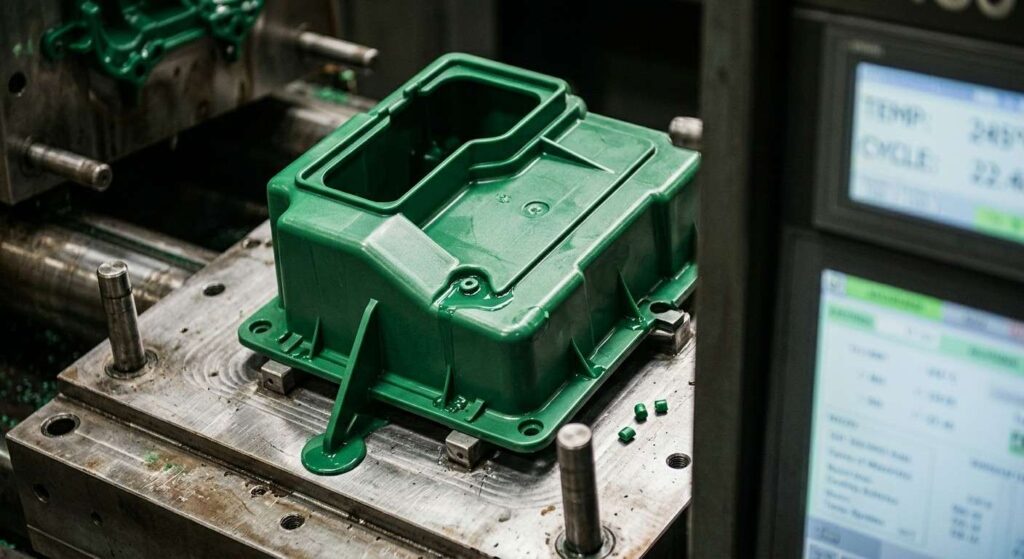
Green mold technology is a broad approach to mould and die engineering that lowers the environmental footprint of production. It combines thoughtful design, efficient machining, durable materials, and tight process control so that every part made is right the first time. The philosophy is simple: the greenest part is the one you never have to remake.
Where the savings actually come from
Sustainability claims sound vague until you put numbers on them. In practice, the gains show up in four places:
- Less raw material per part, through optimized gating and cavity design.
- Lower energy use, thanks to efficient cooling and shorter cycle times.
- Fewer rejects, which means less scrap and less energy per usable part.
- Longer tool life, so replacements and their embedded energy come later.
None of these require exotic technology – just the discipline to get the design, the steel, and the process right the first time.
Eco-Conscious Green Mold Engineering Starts at the Design Stage
The most sustainable decisions are made before the first chip is even cut. Engineers who review a part for manufacturability can often suggest small changes – wall thickness adjustments, draft angles, gate placement – that make the tool simpler, the cycle faster, and the part lighter. None of these changes cost the customer anything, but together they shrink the footprint of every component that follows.
- Design for manufacturability reduces complex features that slow cycles down.
- Optimized cooling channels cut cycle time and energy consumed per part.
- Fewer moving components mean less wear and a longer tool life.
- Standardized components speed up maintenance and replacement.
Good eco-conscious mold engineering also looks beyond the tool itself. Cooling water is often reused and treated on site, machining waste is segregated for recycling, and tool steel offcuts go back to the mill. When a supplier treats these details as normal practice rather than a selling point, you know the mindset runs through the whole company.
Sustainable Manufacturing Through Smarter Tooling
Tooling is where sustainability and precision finally meet. A mould that runs repeatably at tolerance keeps scrap rates low. A well-designed die produces clean parts with minimal flash. And a durable tool keeps producing for hundreds of thousands of cycles instead of failing early. Each of these outcomes reduces the energy and material embedded in every good part you ship – which is why sustainable manufacturing and disciplined tooling turn out to be the same project.
The role of high-tolerance machining
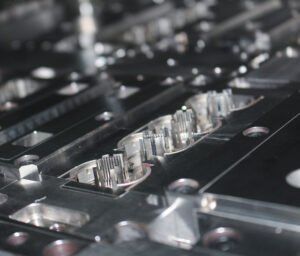
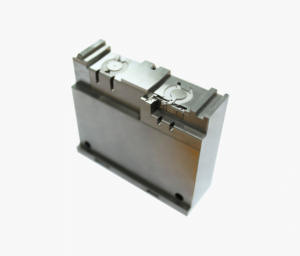
SSPrecision machines stamping dies and injection molds to a tolerance capability of ±0.002mm. That level of precision might sound like overkill, but it’s exactly what keeps parts consistent. When the tool holds its geometry shot after shot, every part comes out the same, and the number of rejected parts trends toward zero.
The table below summarizes where the biggest green wins come from in practice.
| Source of savings | How it works | Typical benefit |
| Optimized gating | Less material in runners and sprues | Lower material cost, less scrap |
| Faster cooling | Better heat transfer, shorter cycles | Lower energy per part |
| Consistent tolerance | Fewer rejects, less rework | Higher yield, less waste |
| Longer tool life | Durable steels and coatings | Fewer replacements, lower embodied energy |
Injection Green Molding: Materials and Processes
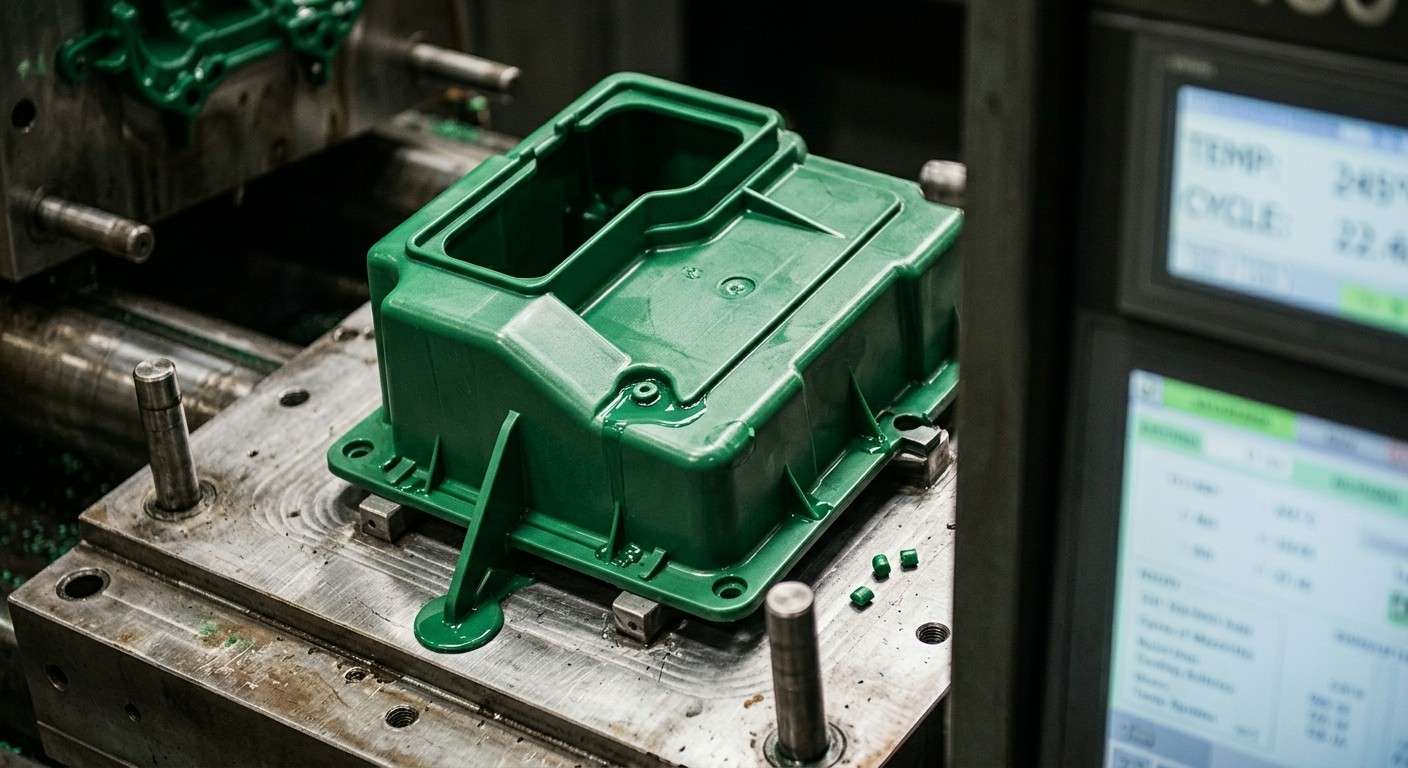
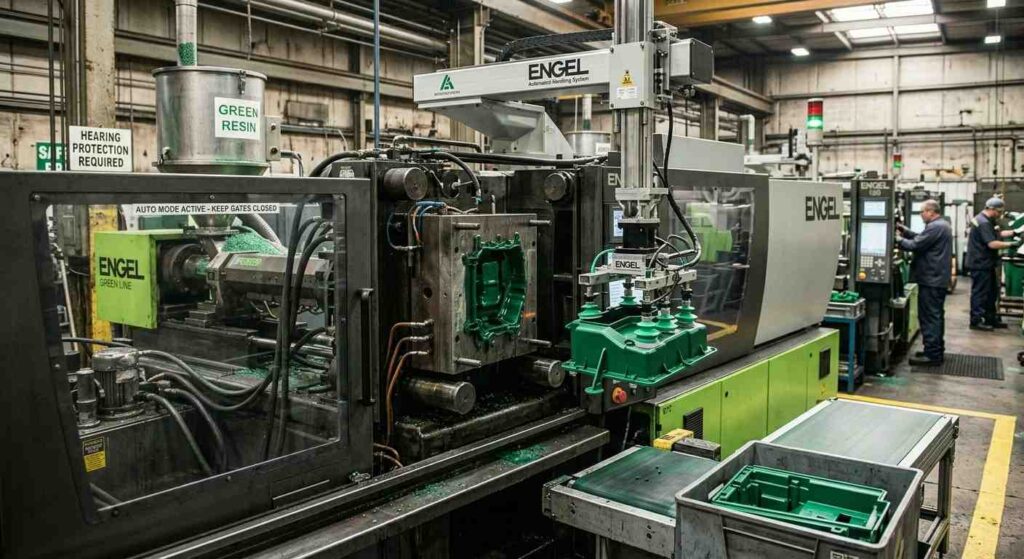
The material you mould matters just as much as the tool. Recycled and bio-based resins are increasingly viable, but they bring their own quirks – they can be less consistent or more sensitive to process settings. That’s exactly where good tooling earns its keep: a precise, well-designed mould compensates for variation and keeps quality stable even when the resin behaves a little differently.
- Use recycled or bio-based resins wherever the application allows.
- Right-size the machine to the part so you are not overspending on energy.
- Recover and reuse runner scrap instead of sending it to landfill.
- Choose water-based cooling and eco-friendly release agents.
Environmentally friendly molding is also about reducing the energy conversation – smaller machines, more efficient heaters, and process monitoring all add up. A good supplier will be honest about which material changes help and which ones risk your quality targets.
Green thinking applies to stamping, too
For metal parts, eco-conscious mold engineering applies just as much to dies. Efficient blank layout reduces sheet waste, and progressive dies produce complete parts in a single pass, cutting handling and energy. Small decisions in die design compound into large savings across a long production run.
Precision That Pays Off Long Term
A cheap tool can look appealing until you start counting the rejects. Precision tooling costs more upfront, but the return shows up in every good part that comes out of the press or the injection machine. For automotive and electronics suppliers, where volumes run high and margins are tight, that consistency is what makes sustainability actually sustainable – in every sense of the word, including the financial one.
| Capability | Standard tooling | ±0.002mm precision tooling |
| Part-to-part consistency | Good | Excellent |
| Scrap and rework | Moderate | Low |
| Tool life | Standard | Extended |
| Energy per good part | Higher | Lower |
Getting Started With Green molding
Start where the data is: look at your current scrap rate, cycle time, and material usage. Then bring a tooling partner into the conversation early – ideally before the part design is frozen, when the best improvements are still cheap to make.
- Share your part file and production targets for a manufacturability review.
- Ask for an energy and waste comparison, not just a price.
- Choose materials and surface finishes with longevity in mind.
- Verify your partner’s certifications: ISO 9001:2015 and IATF 16949.
SSP Is a Trusted Partner for Green molding
SSP Precision is an ISO 9001 & IATF 16949 certified manufacturer delivering end-to-end precision solutions—from DFM engineering and rapid prototyping to high-volume production—for the automotive, medical, electronics, aerospace, and industrial sectors. We handle every stage in-house to manufacture the tooling that makes your parts and the parts themselves.
Visit our to explore our full capabilities: ssprecision.com.cn
Services (tooling design & manufacturing)
- Stamping Dies Manufacturing – high-volume metal stamping with Progressive Die Stamping & Tooling spare parts manufacturing and Transfer Stamping Dies
- Injection Molding – custom plastic molds including Over Molding & Insert Molding and Liquid Silicone Rubber (LSR) Molding
- Green Mold – eco-friendly molded components, Micro Molding – microscopic medical precision parts
Products (end-use parts & spare components)
- Stamping Die – complete stamping tooling
- Injection Mold – complete injection tooling
- Tooling Spare Parts – punches, inserts, ejector pins, Robotics Spare Parts – precision automation spares , Ball Screw Repair Kits – replacement kits for motion systems
- Machine Parts – general precision machine components
Frequently Asked Questions
What exactly is green mold technology?
It’s a set of design and manufacturing practices that reduce waste, energy, and emissions in moulding and stamping – from optimized part design to durable, high-precision tooling.
Does green molding cost more?
Precision tools usually cost more upfront, but lower scrap, faster cycles, and longer tool life typically repay the difference many times over.
Can recycled resins be used with precision molds?
Yes. A tight, well-designed mould handles the natural variation in recycled materials while keeping product quality consistent.
How do I know if my supplier is genuinely sustainable?
Look for measurable commitments: certification, documented quality systems, low scrap rates, and engineering input that actively reduces waste.
Does precision really change the environmental impact?
Absolutely. A tool that holds ±0.002mm produces far fewer rejects, and every part you don’t have to remake saves the material, energy, and labour that a repeat run would have consumed.
Read More – Intelligence That Protects Your Production Line
- Progressive Die Stamping for High-Volume OEM Parts – High-speed progressive dies run at hundreds of strokes per minute, holding tolerances to ±0.002 mm—here’s the guide to strip layout, tool steel selection, and why OEMs choose progressive stamping for terminals, brackets, and connectors.
- Injection Mold Tooling Design: Multi-Cavity Injection Molding – More cavities cut per-part cost, but only if the injection mold tooling design keeps every cavity balanced and repeatable—here’s the guide to cavity layouts, cooling, and tolerances from a precision mold shop.
- Top 10 Best Stamping Dies and Injection Molding Companies in the World – A data-driven ranking of the top 10 stamping die and injection molding companies globally—here’s how they compare across certifications, lead times, and cost, with a detailed China vs. rest-of-world breakdown.
- Precision Robotics Components: Spare Parts Supply Solutions – Custom robotics components and automation spare parts machined to ±0.002 mm—here’s the material selection guide, tolerance data, and why OEMs rely on precision machining for end-effectors, housings, and motion-critical parts.
- Precision Manufacturing China | IATF 16949 Certified Tooling – IATF 16949 certification isn’t just a badge—it means documented processes, defect prevention, and traceability for stamping dies and molds down to ±0.002 mm. Here’s what to look for in a certified tooling partner.
- LSR Injection Molding | Precision Liquid Silicone Rubber – LSR injection molding cures at 5 seconds per millimeter of wall thickness with tolerances to ±0.002mm—here’s the material grades guide, tooling requirements, and why OEMs choose silicone for seals, gaskets, and medical components.
- Heavy Duty Transfer Tooling: Multi-Station Transfer Dies for Deep-Drawn Components – Transfer dies handle individual blanks for deep-drawn and heavy gauge parts up to 8mm thick with tolerances to ±0.002mm—here’s how they compare to progressive dies for complex automotive and EV components.
- Precision Ball Screw Parts: Complete Component Guide – Backlash, noise, and lost accuracy are early signs of ball screw wear—here’s when to repair vs. replace, how to measure runout, and what a complete linear motion repair kit should include for C3–C7 tolerance classes.
- Applied Proof: Insert Molding Manufacturer Metal Insert – Insert molding fuses metal inserts into plastic in a single step, replacing secondary assembly and improving reliability—here’s how the process works,
References & standards
- ISO 9000 family — Quality management (ISO) — The quality management system standard SSP is certified to.