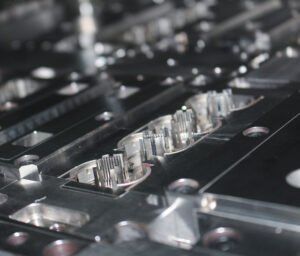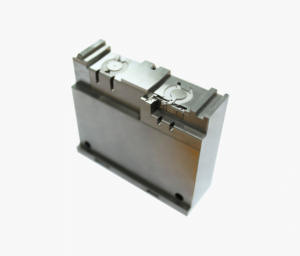


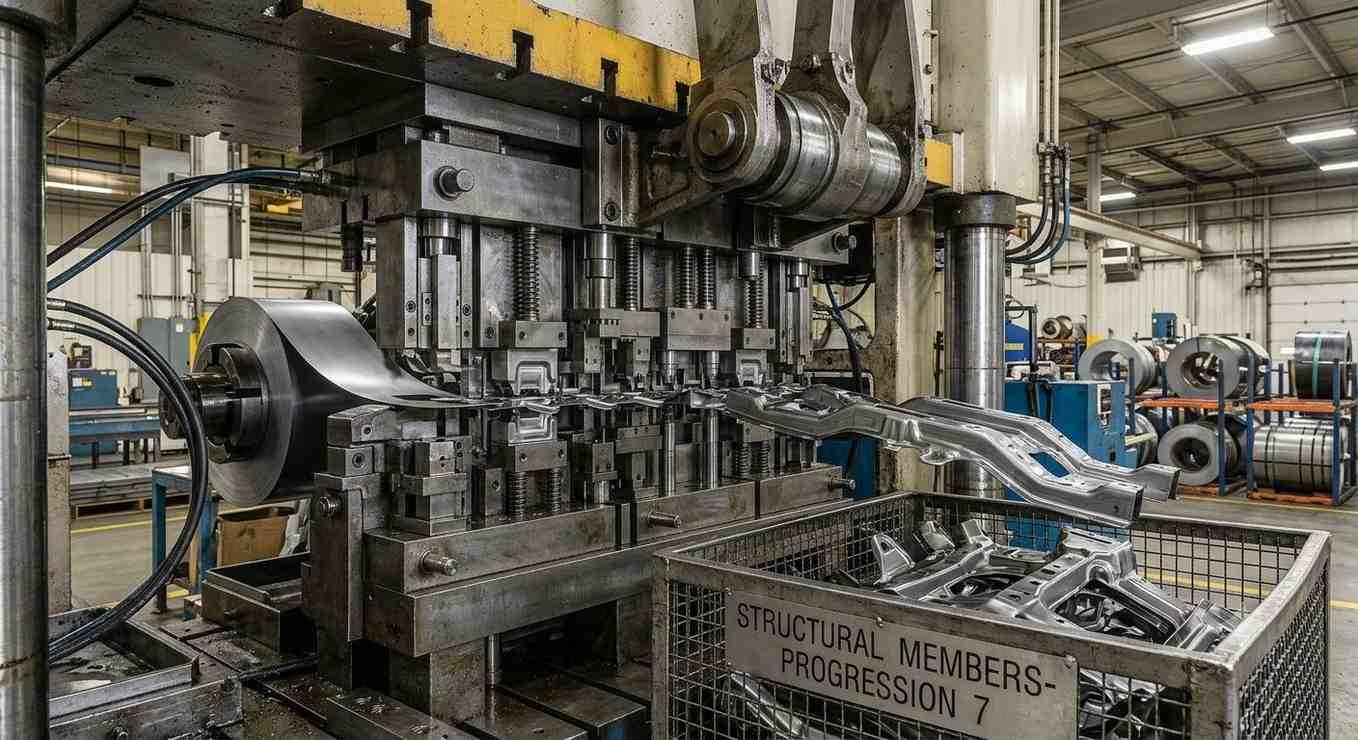
Keeping track of tool wear in progressive dies kind a means you need nonstop acoustic emission monitoring, and you also have to keep super sharp tonnage signatures plus strict stroke-count baselines. If you don’t catch the drift early, the results get rough, like severe galling , extra burr buildup , and then punch snapping that turns catastrophic really fast. If a plant uses proactive data tracking alongside smarter metallurgy choices, it can push tooling life spans out maybe up to 35%, and supposedly wipe out that annoying unplanned production downtime problem all together. @ wiki info
-
- Stop Quality Rejections: figure out how to spot micro-abrasions before they cause dimensional wander, so every stamped part stays inside a 0.01 mm tolerance range.
-
- Improve Press Uptime: move away from repairs only after failure , and go into predictive maintenance, using tonnage monitors to halt the press by milliseconds before the tool breaks down.
-
- Lower Tooling Costs: use SS Precision’s approach for advanced PVD coatings and carbide inserts to extend the life cycle of high-impact cutting spots , potentially even doubling it.
Diagnosing Common Stamping Die Issues: Wear Threshold Matrix
But to avoid those sudden “production halt” moments, operators can’t just look around. They need to physically track, and sort, the degradation patterns of the die components. Plain visual checks are really not enough. Modern stamping basically demands measuring exact physical thresholds to classify critical Stamping Die Issues, before they go and ruin an entire production run.
| Wear Category | Physical Manifestation | Engineering Rejection Threshold | Primary Cause |
| Abrasive Wear | Rounding of punch and die matrix edges. | Burr height exceeds 10% of material thickness. | High friction from hard materials (e.g., HSLA steel). |
| Adhesive Wear (Galling) | Strip material micro-welds onto the punch. | Deep scoring or scratching on the drawn part. | Insufficient lubrication; improper clearance. |
| Fatigue & Chipping | Micro-cracks along the cutting edge. | Any visible spalling under 10x magnification. | Misalignment; excessive impact shock; dull edges. |
The Procedural Workflow for Tooling Wear Analysis
To make sure die life stays, like really, as long as possible, plant engineers have to run a kind of structured three phase checks, during live production runs, so they can do a proper Tooling Wear Analysis without skipping steps.
1. Initial parameter identification & phase 1 data collection
First, log the real time tonnage baselines. The operator needs to note the active press tonnage curve across roughly the first 1,000 strokes when a die is new or recently sharpened. This sets up the “best” signature for forming plus piercing operations , basically that reference pattern.
2. Core system execution & formula application
Then apply tonnage variance algorithms. Engineers configure the press monitoring system to watch peak tonnage readings. If the cutting force climbs by more than 5% to 8% beyond the baseline, the system algorithm will automatically flag the punches for abrasive wear, which suggests the cutting edges already lost their optimal shear angle.
3. Compliance verification & safety sign off
Cross check burr measurements against the quality codes. Confirm the stamped parts still meet ISO 9001 quality thresholds. Also, the quality control team signs off on the strip layout, to confirm the part geometry and hole positions did not slowly drift, due to die shifting, even a small drift matters.
Deep-Dive Technical Variable & Risk of Progressive Die Failure
High speed stamping includes serious hazards, including brutal friction, thermal growth, and mechanical shock. When sourcing or maintaining tooling, ignoring punch-to-die clearances—especially by misunderstanding material tensile strength—can speed up progressive die failure in a big way. For example, trying to stamp stainless steel using clearances that were designed for aluminum will often cause immediate tooling fracture and then severe press overload, which is not a “maybe” situation.
Key Engineering Compliance Standard
-
- Standard Code: ISO 11469 / Precision Stamping Guidelines
-
- Critical Threshold: Die clearance must be maintained at 8% to 12% of the material thickness for standard carbon steel.
-
- Operational Impact: Violating this precise clearance threshold causes premature punch snapping, immense stripping force requirements, and catastrophic damage to the die block.
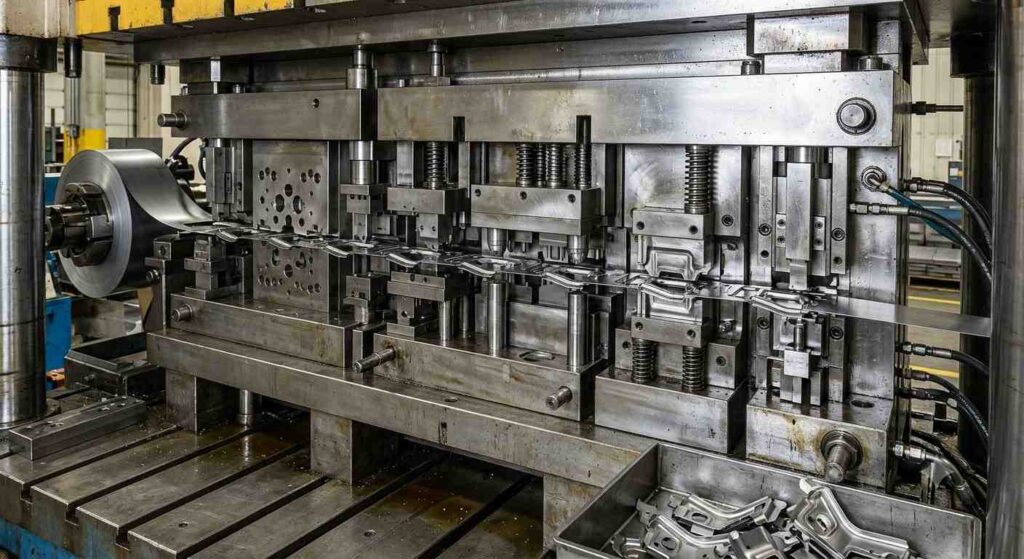
Anatomy of Tool Wear: Material Science and Optimization
Yeah so, the life of a stamping die mostly hangs on the metallurgy, and the surface treatments, of all those inner sub-components. SS Precision kind of bridges the whole gap between what people budget for tooling up front and that long-term reliability that actually matters, by pushing advanced material sciences into every critical spot where wear likes to start.
-
- Substrate Metallurgy: For high wear cutting, and piercing punches you want specialized powder metallurgy steels (like CPM 10V) or Tungsten Carbide. These basically deliver 3 to 4x the wear resistance compared with standard D2 tool steel, which is a big deal in real production.
-
- PVD Surface Coatings: When Titanium Carbonitride (TiCN) or Aluminum Titanium Nitride (AlTiN) coatings are applied, the coefficient of friction drops a lot. In practical terms it will nearly remove adhesive wear, or galling, especially when you’re stamping galvanized or stainless steels.
-
- Nitrogen Gas Springs: Switching to high-pressure nitrogen gas springs instead of traditional coil springs keeps stripping pressure steady. This stops the strip material from dragging against the punches during that upstroke, which is where you start seeing ugly wear patterns.
Finite Element Analysis (FEA) & Mechanical Stress Tolerances
Structural failure shows up when a component can’t handle the active system vibrations, or the high tonnage environment. SS Precision runs rigorous Finite Element Analysis (FEA) testing across the structural boundaries, to make sure the die shoes and punch retainers survive high-speed factory floor conditions without mechanical deformation, or excessive movement.
| Structural Vector | Performance Metric | Testing Protocol / Consequence of Failure |
| Deflection Limits | Maximum 0.02 mm deflection per meter. | Verified via digital stress mapping. Exceeding causes punch misalignment. |
| Compressive Yield Strength | Must exceed 2,200 MPa at cutting stations. | FEA simulation. Failure results in punch mushrooming. |
| Shock Load Capacity | Capable of 500+ strokes per minute (SPM). | Dynamic frequency testing to prevent resonance-induced shattering. |
Sensor Architecture & In-Die PLC Integration
Modern dies must interface flawlessly with the facility’s centralized control framework to prevent catastrophic smash-ups.
-
- Piezoelectric Tonnage Monitors: sensors embedded directly into the die shoe measure the precise force of every stroke, and they can instantly flag if a slug gets pulled back onto the die matrix, or if something is just not aligned like it should be.
-
- Acoustic Emission Sensors: high-frequency microphones catch the specific acoustic “ping” that shows up when a micro-fracture starts, and they shut down the press before the punch fully breaks through.
-
- Laser Strip Pitch Sensors: optical sensors verify the feed progression, sometimes you’ll hear people say “pitch” only , but it’s that exact movement to within 0.01 mm, so the strip is perfectly piloted before the press reaches bottom dead center.
Operational Matrix: Leveraging Die Maintenance Data
To keep Total Cost of Ownership (TCO) low, facilities need a preventative maintenance routine that’s driven by die maintenance data, plus hit count milestones, not guesses.
-
- Daily / Continuous Diagnostics: validate peak tonnage limits, check automatic lubrication spray patterns, and audit acoustic signatures for unusual mechanical grinding , or that “off” resonance you only notice when something’s already drifting.
-
- Quarterly Intervention Matrix (Approx. 250,000 Strokes): inspect and flip cutting inserts, verify nitrogen gas spring pressures , and polish galling out of forming stations before it compounds.
-
- Annual System Refit Protocols (Approx. 1,000,000+ Strokes): do full sharpening of all cutting matrices, perform wire EDM replacement of worn pilots, and re-grind the die shoe to restore near perfect parallelism.
Tool Wear Prevention in Practice: SS Precision Case Study
-
- The Industrial Challenge: a Tier-1 automotive supplier was dealing with really bad galling and fast punch wear while stamping the complex structural brackets made from 2.5 mm High-Strength Low-Alloy (HSLA) steel. In practice the tool basically failed every 40,000 strokes, which was not great at all.
-
- The Custom Engineering Response: SS Precision stepped in with a tooling overhaul that was tuned to the situation. We retrofitted the piercing areas using carbide inserts, put a proprietary AlTiN PVD coating on the drawing punches and we also added in-die piezoelectric sensors. Those sensors were there to catch friction spikes, in real time, so we’re not just guessing later.
-
- The Quantifiable Outcome: with the new setup, the die’s usable lifecycle grew to more than 200,000 strokes before sharpening had to happen again. At the same time, dimensional rejection rates went to 0%, that meant the client avoided about $45,000 per year tied to replacement tooling and also lost press time.
SSP Is a Trusted Partner for Die Manufacturing Cost Optimization
SSP Precision is an ISO 9001 & IATF 16949 certified manufacturer delivering end-to-end precision solutions, from design and prototyping to high‑volume production, for the automotive, medical, electronics, aerospace, and industrial sectors. We handle every stage in‑house – DFM engineering, rapid prototyping, CNC machining, EDM, grinding, and global logistics – to manufacture the tooling that makes your parts and the parts themselves.
What we build and supply: visit our sites: https://ssprecision.com.cn/
-
- Stamping dies manufacturing and stamping die parts – high‑precision transfer stamping dies and progressive/compound dies for volume metal stamping.
-
- Injection molding and injection mold – custom injection molds for plastic components, including single‑, multi‑cavity, and over‑molding & insert‑molding tools that combine metal and plastic in one part.
-
- Specialty molded components – eco‑friendly green mold parts and microscopic medical micro‑molded parts.
-
- Precision metal and plastic end‑use parts – high‑volume serial production of precision products (metal stampings, plastic moldings) with full PPAP traceability.
-
- Tooling spare parts manufacturing & – tooling spare parts (punches, inserts, ejector pins) and precision robotics spare parts to keep your production running.
Optimizing Your Tooling RFQ: Technical Sourcing Checklist
Before you submit an engineering inquiry for either fresh dies or replacement components, use this checklist so the data package is complete. That way the commercial response stays accurate and consistent:
-
- Press Specifications: Provide the exact press tonnage capacity, stroke length, shut height, and the maximum strokes per minute (SPM).
-
- Material Profile: List the precise chemical composition of the strip material, tensile strength, thickness, and width.
-
- Required Tooling Life: State the total expected output, like 5 million parts, so the team can decide if standard tool steel is enough or if carbide is needed.
-
- Sensor Integration Needs: Specify any in-die sensors, whether tonnage monitoring has to be supported, and what PLC connection type is required, if applicable.
Frequently Asked Sourcing/Procurement Questions
-
- What lead time should I expect for custom progressive die manufacturing?
-
- In most cases, it’s about 8 to 12 weeks starting from the first strip layout signoff. That window is meant to cover a bunch of steps, like locating raw materials, doing the wire EDM precision cut, then heat treatment, PVD coating, and finally those careful physical try out runs. I mean, nothing moves too fast because the whole point is to keep everything within spec.
-
- What lead time should I expect for custom progressive die manufacturing?
-
- How do I figure out if the die needs sharpening?
-
- A good rule of thumb is when the burr height goes over 10% of the material thickness, or if the tonnage climbs by around 8%. Using tonnage monitors and doing hourly quality spot checks on burr heights gives you hard, measurable evidence that the cutting edge has worn beyond the engineering limits you agreed to.
-
- How do I figure out if the die needs sharpening?
-
- Can SS Precision make dies that work with our existing sensor systems?
-
- Yes, they can build dies that integrate smoothly with standard automated press lines. If you share your exact sensor preferences plus your wiring schematics during the RFQ stage, SS Precision makes sure the tooling is ready to plug directly into your press PLC system, without the usual extra back and forth.
-
- Can SS Precision make dies that work with our existing sensor systems?
Read More – Intelligence That Protects Your Production Line
-
- Insert Dies Vs. Solid Dies: Maintenance & Cost Analysis – Insert dies cost 10–20% of their original price to repair, while solid dies run 40–70%—here’s the data on downtime, spare parts strategy, and which design wins for high-volume stamping.
-
- Injection Molding Guide: Costs, Materials, Process, and Mold Tooling – A prototype mold can cost $3,000, while a high-volume production mold runs $80,000+—here’s how to match tooling class to real production volume and avoid overpaying for steel.
-
- What Drives Metal Stamping Die Costs? – A progressive die can cost anywhere from $8,000 to over $150,000—here’s a breakdown of the 5 key cost drivers, global price comparisons, and when to repair vs. replace.
-
- Stamping Tool Steel HRC Hardness Chart – A 2–3 HRC shift can swing die life by 20–40%—here’s the complete hardness chart for D2, SKD11, M2, and more, plus grade-specific wear data and application guidance.
-
- Troubleshooting Progressive Die Failures & Tool Wear – A 0.01mm drift or a faint burr is often the first warning—here’s how to read the data, schedule maintenance, and stretch tool life before scrap piles up.
-
- Micro Injection Molding: Controlling Flash on Tiny Parts – When parts weigh under 0.1 gram, even a 10-micron flash is a giant defect—here’s how to control the process on the smallest scale.
-
- Conformal Cooling in Injection Molding – Cooling eats 50–70% of your cycle time—here’s how 3D-printed conformal channels cut it by up to 40%, slash scrap by 65%, and pay for themselves in under 6 months.
-
- Why Injection Molds Fail: Cracking & Galling Fixes – 62% of unplanned mold downtime comes from just three failure modes—here’s the root-cause data and preventive fixes for cracking, galling, and ejection issues.
-
Holding ±0.001 mm: Thermal Control in Precision CNC – A 2°C temperature swing can add 7 microns of error—here’s how thermal control architecture, spindle warm-up protocols, and granite bases make the difference between hitting tolerance and scrapping the part.
-
D2 vs DC53 Tool Steel: Which is Best for Stamping? – D2 has been the industry standard, but DC53 offers twice the toughness and better machinability—here’s the metallurgical data to decide which alloy delivers lower total cost of ownership for your stamping application.
-
China Fiber Optic Connectors | Injection Molding Precision Parts Manufacturer Company – Fiber optic connector housings demand ±0.01 mm tolerances on critical alignment features—here’s the material selection guide, cavity configuration data, and quality control protocols for precision optical components.
-
Reducing Cycle Time Through Better Mold Cooling – Cooling eats 50–70% of your cycle time—here’s how conformal cooling channels, turbulent flow design, and high-conductivity inserts can slash cooling time by 20–50% and cut overall cycle time by 15–35%.
References & standards
- ASTM A681-08(2022) — Standard Specification for Tool Steels Alloy — Chemical, mechanical and physical requirements for the alloy tool steels referenced here.