

Some of the strongest parts in your car or kitchen start as a flat circle of steel. Fuel tanks, compressor housings, battery cans, sinks and fire extinguisher bodies are all deep drawn: pushed, in stages, into a hollow shape that is stronger than anything welded from pieces. The tooling that makes this possible is often overlooked. Deep drawn transfer dies are the machines inside the machine, moving the part through a series of stations that progressively turn flat metal into a finished, seamless shell. This walkthrough explains how those dies are built, what each station does, and the engineering decisions that separate parts that draw clean from parts that tear on the first try.
Key Takeaways
- Transfer dies move a loose blank between stations, unlike progressive dies that carry the strip.
- Deep drawing is a metal-flow problem: material must flow into the cavity without wrinkling or tearing.
- Draw ratio and blank-holder pressure control whether a deep draw succeeds.
- Heavy-gauge and large parts often favor transfer dies for space and cost reasons.
- A DFM review before steel is cut prevents the most expensive deep-draw failures.
What Makes a Part Deep Drawn
The classic rule is simple: if a part is deeper than its diameter, it is deep drawn. But the real definition is about how it is made, not how it looks. A punch pushes a flat blank into a die cavity, and the material is forced to flow inward and stretch into a hollow shape rather than being cut. The result is seamless, work-hardened and often lighter and stronger than an assembly of welded pieces.
- Automotive and EV: fuel tanks, oil pans, exhaust components and battery housings.
- Home and industry: sinks, cookware, fire extinguisher bodies and compressor shells.
- Electronics and medical: sensor housings, battery cans and instrument cases.
The strength advantage is the reason deep drawing survives alongside stamping and casting. Drawing aligns the grain structure with the part shape, so a drawn shell resists pressure and impact better than a seam-welded equivalent. Weight drops too, because walls are thinned to exactly what the part needs instead of carrying a weld flange. For pressure vessels, fuel tanks and structural housings, that combination is hard to beat, and deep drawn transfer dies make this seamless result routine across thousands of parts.
Inside a Transfer Die: Stage by Stage
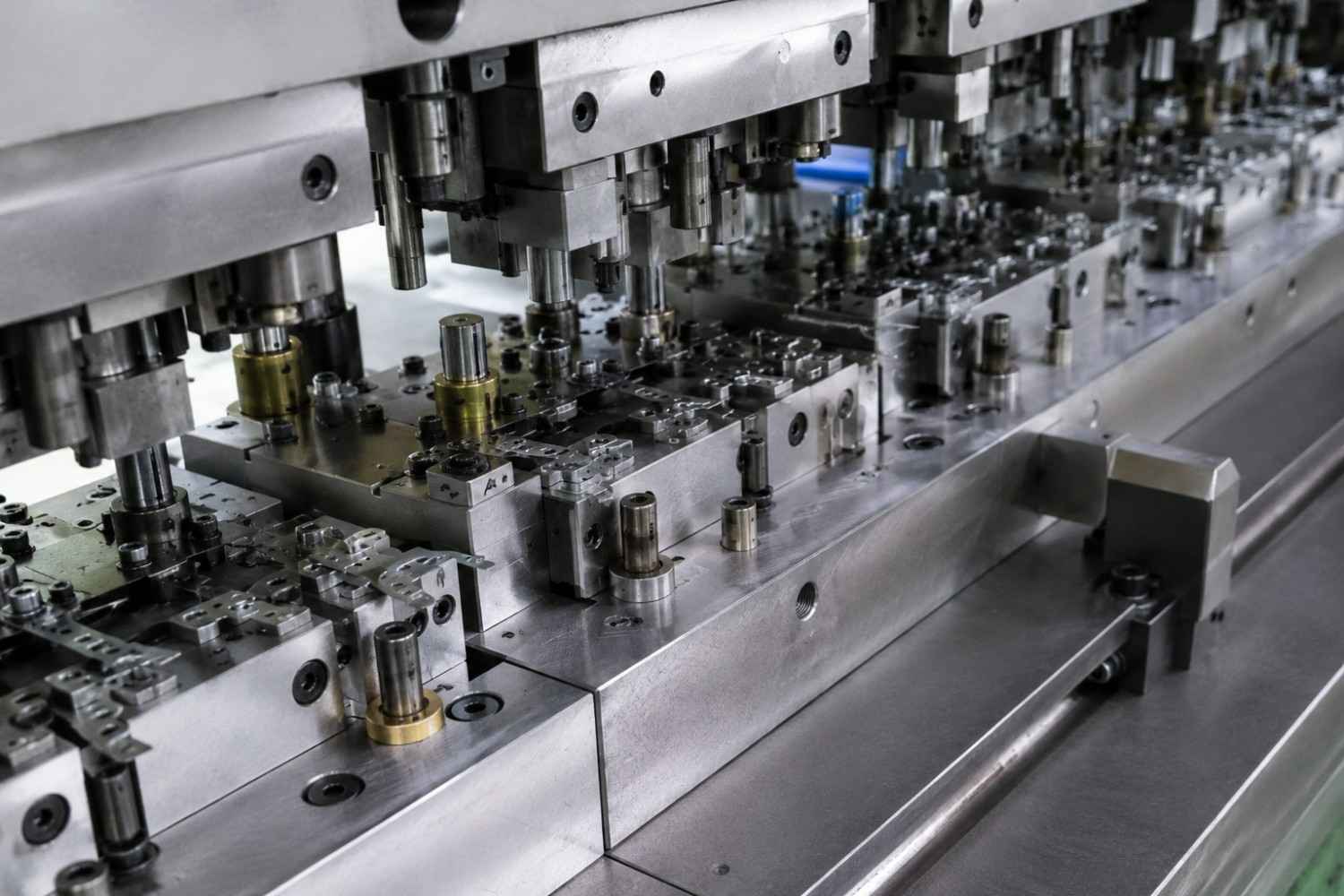
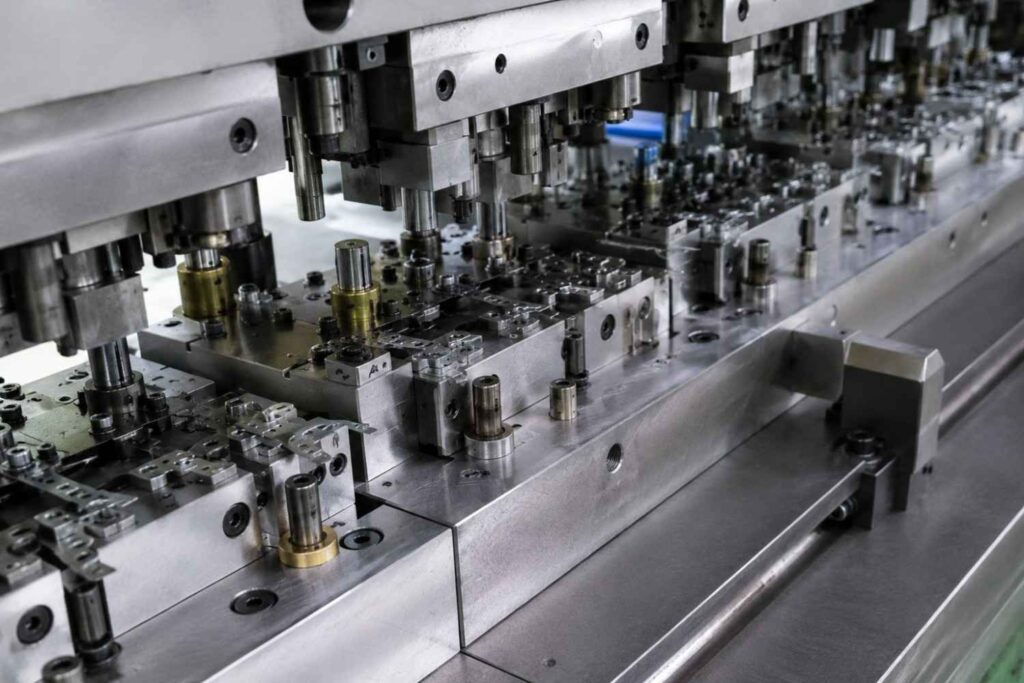
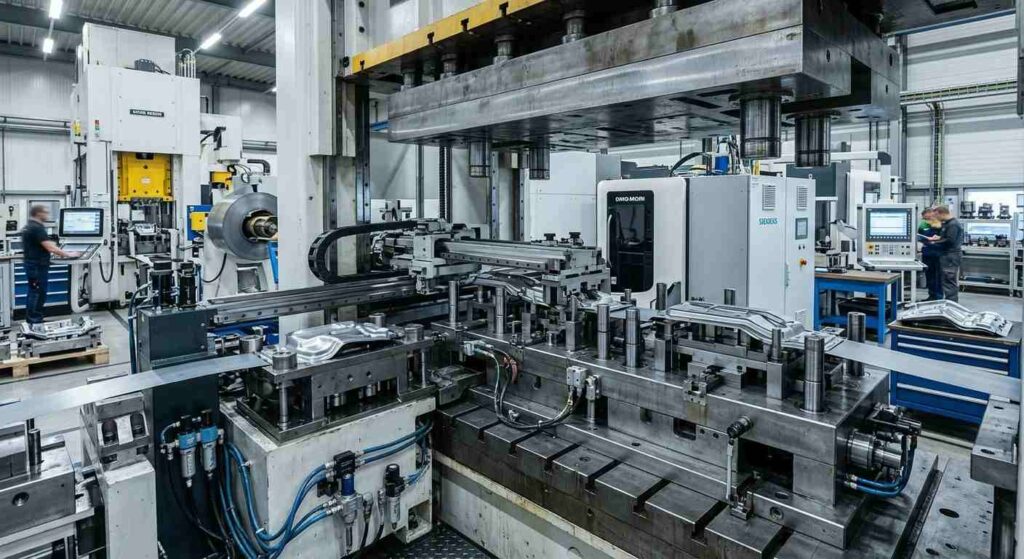
A transfer die looks like a small production line bolted into one press. In transfer die stamping, a mechanical gripper, fingers or a transfer system picks up the blank and moves it through each station in sequence. Following one part through the die makes the whole concept clear.
- Blank: a flat disc is cut from coil or sheet, often in the first station.
- Draw: the punch forces the blank into the cavity while the blank holder controls material flow.
- Redraw: a second, smaller punch deepens the shell in one or more steps.
- Ironing and sizing: the walls are thinned to final thickness and the shape is refined.
- Trim and flange: excess metal is cut away and edges are formed.
- Final form: embosses, ribs and details are added before the part exits.
Each stage handles only part of the total deformation, and that is the whole point. Stretch metal too far in a single step and it necks and tears. Breaking the draw into stages keeps the strain inside what the material can survive, and that is the core engineering skill in deep draw tooling.
The Blank Holder and Draw Beads
Two features quietly decide whether a draw succeeds. The blank holder presses the outer edge of the blank against the die while the punch moves, and its force controls how freely material flows into the cavity. Too little pressure and the edge wrinkles; too much and the wall thins and tears. Draw beads, small raised ribs on the blank-holder surface, add friction deliberately to slow material in specific zones. Getting the holder force and bead layout right is where deep draw experience shows, and it is almost always tuned during tryout, not calculated perfectly the first time.
Transfer Die vs Progressive Die Stamping
Transfer and progressive dies both do multi-step stamping, but deep drawn transfer dies differ in how the part moves, and that difference decides which is the right answer.
| Feature | Transfer die | Progressive die |
| Part feed | Loose blank moved between stations | Strip carries the part through |
| Station spacing | Wide, room for deep draws | Tight, limited by strip width |
| Part size | Large and heavy-gauge | Smaller parts |
| Tool cost | Higher to build, easier to maintain | Complex but cheaper to build |
| Best fit | Deep draws, thick material | High-volume small parts |
Heavy-gauge forming and deep draws quickly outgrow a progressive layout, because the strip simply cannot supply the blank area a deep draw consumes. Transfer designs give each station room, which is why large metal stamping dies for automotive and energy parts are almost always transfer dies.
That does not make progressive dies obsolete. For small, high-volume parts like terminals, brackets and fasteners, the strip carries the part cheaply from station to station with no separate transfer mechanism to maintain. The decision comes down to part size, draw depth and volume, and an experienced tooling partner will recommend the layout rather than push whichever they build fastest.
Materials, Draw Ratio and Heavy-Gauge Forming
Not every metal draws the same way, and the drawing schedule has to be designed around the material. Two numbers matter most for deep drawn transfer dies: the draw ratio, which is the blank diameter divided by the punch diameter, and the limit to which the material can be stretched before it fails.
| Material | Typical draw behavior | What to watch |
| Low-carbon steel | Deep, forgiving | Easiest to draw; work-hardens predictably |
| Stainless steel | Moderate | Work-hardens fast; needs extra redraws |
| Aluminum | Moderate | Galling and wrinkling; lubrication critical |
| Copper and brass | Moderate to deep | Form well but soften and mark easily |
| High-strength steel | Shallow | High springback; heavy-gauge risks cracking |
- A draw ratio above about 2.0 on low-carbon steel usually needs a redraw stage rather than one aggressive punch.
- Heavy-gauge material is more forgiving about tearing but demands more press tonnage and robust blank holding.
- Lubricant type and coverage change the outcome of a deep draw more than most engineers expect.
Heavy-Gauge Forming in Practice
Heavy-gauge work, typically 3 mm and above, changes the tooling conversation. Press tonnage climbs quickly because more material must be moved, and the blank holder needs stiffer construction and often a hydraulic cushion for precise pressure control. Tool steels must stand up to higher unit pressures, and clearances open up to match the thicker stock. The payoff is structural parts that need no secondary reinforcement: chassis brackets, frame components and housings that carry real loads come off the press ready to assemble.
The Four Failure Modes Deep Draw Tooling Must Prevent
When a deep draw fails, it fails in one of four recognizable ways, and each one is a tooling decision rather than bad luck.
- Wrinkling: the blank ripples under compression. Solved with correct blank-holder pressure and draw beads.
- Tearing: the wall necks and splits under tension. Solved with staged draws and lower strain per step.
- Springback: the part relaxes out of shape. Solved with overbend allowances and material-specific compensation.
- Galling: metal transfers to the die surface. Solved with surface finish, coatings and lubrication.
Modern simulation software catches most of these before steel is cut. A good tooling partner runs a forming analysis on the part, models the draw stages and shows you the predicted thinning and springback, then builds the tool to match. That front-end work is why DFM review and deep draw expertise are inseparable: the tooling decisions that prevent defects happen before the first cavity is machined.
SSP Is a Trusted Partner for Die Manufacturing Cost Optimization
SSP Precision is an ISO 9001 & IATF 16949 certified manufacturer delivering end-to-end precision solutions—from DFM engineering and rapid prototyping to high-volume production—for the automotive, medical, electronics, aerospace, and industrial sectors. We handle every stage in-house to manufacture the tooling that makes your parts and the parts themselves.
Visit our to explore our full capabilities: ssprecision.com.cn
Services (tooling design & manufacturing)
- Stamping Dies Manufacturing – high-volume metal stamping with Progressive Die Stamping & Tooling spare parts manufacturing and Transfer Stamping Dies
- Injection Molding – custom plastic molds including Over Molding & Insert Molding and Liquid Silicone Rubber (LSR) Molding
- Green Mold – eco-friendly molded components, Micro Molding – microscopic medical precision parts
Products (end-use parts & spare components)
- Stamping Die – complete stamping tooling
- Injection Mold – complete injection tooling
- Tooling Spare Parts – punches, inserts, ejector pins, Robotics Spare Parts – precision automation spares , Ball Screw Repair Kits – replacement kits for motion systems
- Machine Parts – general precision machine components
Deep Drawn Transfer Dies: Frequently Asked Questions
- What are deep drawn transfer dies used for?
They produce seamless hollow parts like fuel tanks, compressor housings, sinks, battery cans and cookware by moving a blank through successive draw stations in one press.
- How deep can a transfer die draw a part?
Practically unlimited with enough redraw stages, as long as the draw ratio stays within the material’s limit. Depth is a matter of staging, not a fixed ceiling.
- Transfer die or progressive die: which is better?
Transfer dies win for deep draws, large parts and heavy-gauge material. Progressive dies win for high-volume, smaller parts where the strip can carry them.
- Why does my deep-drawn part keep tearing?
Usually the strain per draw step is too high, the blank-holder pressure is wrong, or lubrication is insufficient. A DFM review of the draw schedule usually finds it before steel is cut.
Read More – Intelligence That Protects Your Production Line
- Performance Audit: Precision Die Manufacturer Sheet Forming – Die suppliers look similar on paper—here’s the 7-point audit checklist that separates real capability from marketing: Cpk data, tool life, repeatability, documentation, and how they respond when something goes wrong.
- Applied Proof: Insert Molding Manufacturer Metal Insert – Insert molding fuses metal inserts into plastic in a single step, replacing secondary assembly and improving reliability—here’s how the process works, how it compares to overmolding, and what a custom insert molding partner needs to get right.
- Precision Ball Screw Parts: Complete Component Guide – Backlash, noise, and lost accuracy are early signs of ball screw wear—here’s when to repair vs. replace, how to measure runout, and what a complete linear motion repair kit should include for C3–C7 tolerance classes.
- Green Mold Technology: Eco-Conscious Mold Explainer – Sustainability starts at the tooling level—here’s how optimized gating, faster cooling, and ±0.002 mm precision reduce scrap, energy, and material waste across millions of cycles.
- Progressive Die Stamping for High-Volume OEM Parts – High-speed progressive dies run at hundreds of strokes per minute, holding tolerances to ±0.002 mm—here’s the guide to strip layout, tool steel selection, and why OEMs choose progressive stamping for terminals, brackets, and connectors.
- Injection Mold Tooling Design: Multi-Cavity Injection Molding – More cavities cut per-part cost, but only if the injection mold tooling design keeps every cavity balanced and repeatable—here’s the guide to cavity layouts, cooling, and tolerances from a precision mold shop.
- Top 10 Best Stamping Dies and Injection Molding Companies in the World – A data-driven ranking of the top 10 stamping die and injection molding companies globally—here’s how they compare across certifications, lead times, and cost, with a detailed China vs. rest-of-world breakdown.
- Technical Framework: Multi-Station Progressive die Metal Forming – Progressive dies stack blanking, piercing, bending, and forming into one tool running at 1,200 SPM with ±0.002 mm tolerance—here’s the technical framework for multi-station die design, station sequencing, and automation integration.
- Margin Optimization: Sustainable Injection Mold Design OEM – Conformal cooling, hot runners, all-electric machinery, and closed-loop recycling cut energy use 52%, material waste to under 3%, and per-part cost by 22%—here’s the sustainable mold design framework for margin protection.
- Quality Assurance Review: Stamping Die Products Tooling – A stamping die is only as reliable as the quality system behind it—here’s the 6-stage QA framework covering DFM, material verification, ±0.002 mm machining, CMM inspection, and PPAP documentation that delivers 99.7% quality acceptance and 2M+ cycle tool life.