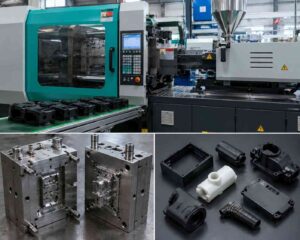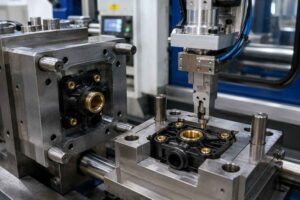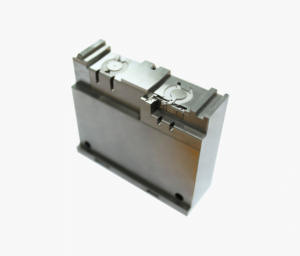


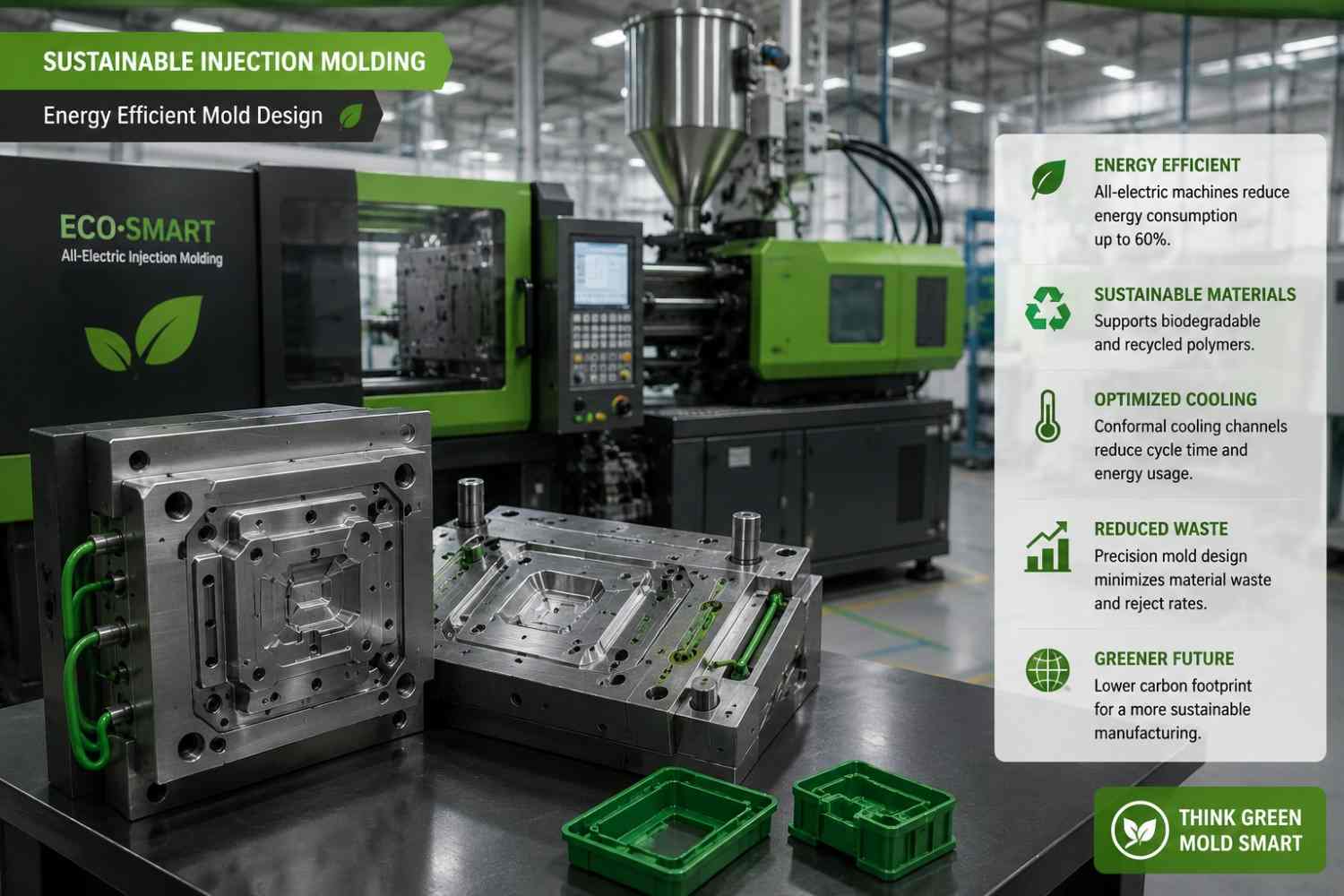
The Challenge: Margin Compression in a Volatile Market
In 2026, injection molders and OEMs are caught in a perfect storm. Energy prices keep swinging, material costs keep climbing, and regulators in every major market—from the EU’s Carbon Border Adjustment Mechanism (CBAM) to China’s dual-carbon goals and the U.S. SEC’s climate disclosure rules—are pushing hard on carbon footprints.
For manufacturers producing high-volume plastic components, automotive interior parts, medical device housings, electronics enclosures, the math is unforgiving. A typical injection molding operation spends 20–30% of total production cost on energy and 50–70% on raw materials. Every second of cycle time, every gram of material waste, and every kilowatt-hour of electricity erodes margin directly.
A mold designed purely for part quality and tool life is no longer sufficient. OEMs now demand sustainable injection molding, solutions that bring down cost, energy use, and environmental impact at the same time. The question is not whether to adopt it, but how quickly and how effectively.
A leading automotive OEM hit exactly this wall. Their existing 16-cavity mold for an EV battery connector housing used too much energy, scrapped too many parts, and needed constant maintenance, and they could not relax the ±0.01 mm tolerances that high-voltage parts demand. They brought the problem to SSPrecision.
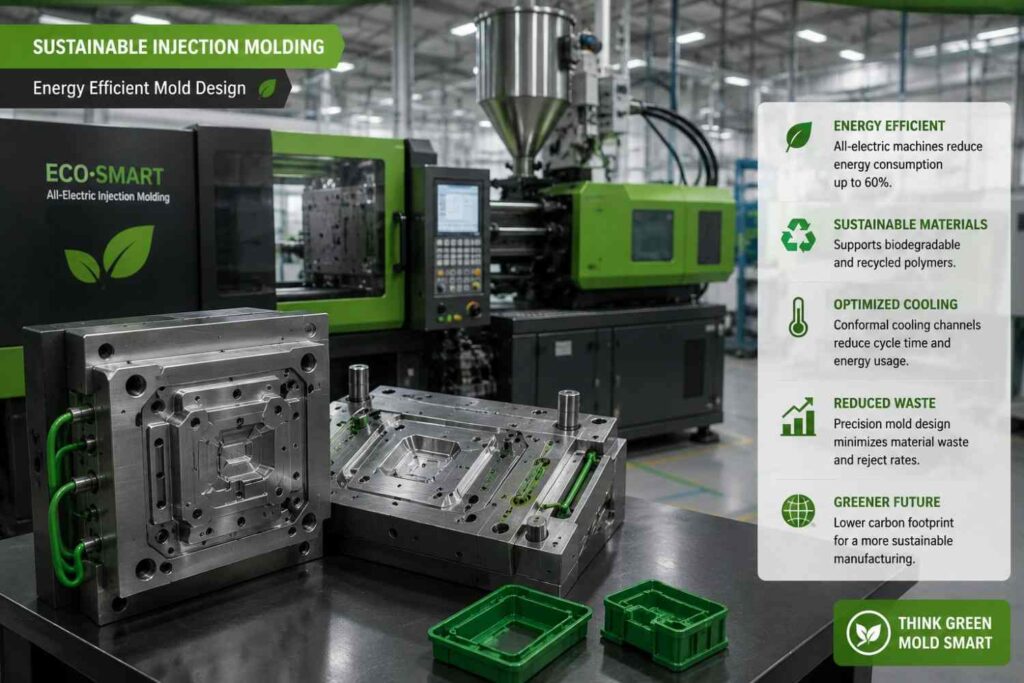
The Solution: Energy-Efficient Mold Design from SSP
SSPrecision (ssprecision.com.cn), a Dongguan-based precision manufacturer since 2008, attacked the challenge from four angles at once. Operating from a 9,000 m² ISO 9001:2015 and IATF 16949 certified facility, SSPrecision deployed four interconnected levers to optimize margin:
Lever 1: Conformal Cooling Channels
Cooling alone accounts for 60–80% of total injection molding cycle time. Conventional molds rely on straight-drilled cooling lines that follow simple paths, which leaves hot spots, uneven cooling, and extended cycle times.
SSPrecision’s answer is conformal cooling: cooling lines precision-CNCed to follow the exact contour of the cavity. The geometry follows the part shape, pulling heat out uniformly across the entire molding surface. In production trials, conformal cooling cut cooling time by 20–40%, and independent case studies show reductions beyond 50% on complex geometry.
The margin math is easy to follow. On a 3-million-part annual run, every 10% reduction in cycle time is worth $20,000–$50,000 a year in machine time.
Lever 2: Hot Runner Systems
Cold runner molds throw material away with every shot, sprue and runner scrap that has to be reground or discarded. Hot runner systems eliminate that waste entirely.
SSPrecision uses energy-efficient hot runner designs that hold precise melt temperature while minimizing heat loss. In one documented conversion, switching from a cold runner to a hot runner system cut cycle time by 53%, worth $47,000 a year in machine time alone over a 3-million-part run.
Eliminating runner waste reduces material consumption by 15–30%, depending on part geometry. At today’s resin prices, that is a direct, recurring saving.
Lever 3: All-Electric Molding Machinery
The molding floor runs all-electric and servo-hydraulic injection presses that use 50–60% less electricity than conventional hydraulic machines, verified by ISO 14001 energy audits. They also deliver superior repeatability, tighter process control, and lower maintenance requirements.
On a high-volume line, that 50–60% energy reduction translates to 5–10% of total production cost, straight to the bottom line.
Lever 4: Closed-Loop Recycling & Material Optimization
A closed-loop recycling system regrinds sprues, runners, and rejected parts and feeds them back into production, reaching up to 95% material reuse, validated by third-party lifecycle assessments. The company also processes recycled and bio-based materials, including rPET, recycled PP, rABS, PLA, and PHA, so clients hit their sustainability targets without compromising part performance.
Reusing material and recycled content cuts virgin resin consumption, which insulates clients from raw material price volatility.
The Result: Measurable Margin Improvement
The automotive OEM’s EV battery connector housing project came back with quantifiable results:
| Metric | Before (Conventional Mold) | After (SSPrecision Sustainable Design) | Improvement |
| Cycle Time | 32 seconds | 22 seconds | 31% reduction |
| Cooling Time | 18 seconds | 11 seconds | 39% reduction |
| Energy Consumption per Shot | Baseline | 52% reduction | All-electric + conformal cooling |
| Material Waste | 18% (runner/scrap) | <3% | Hot runner + closed-loop recycling |
| Per-Part Cost | Baseline | 22% reduction | Direct margin improvement |
| Annual Cost Savings (3M parts) | — | $127,000 | Machine time + energy + material |
The mold now produces identical parts across all 16 cavities with ±0.005 mm dimensional consistency, verified on CMM inspection. The client achieved their sustainability targets while improving margin by over 20%, a win-win that would have been impossible with conventional mold design.
The Technical Framework: How SSP Delivers
Certifications That Matter
- ISO 9001:2015, Quality Management System
- IATF 16949:2016, Automotive Quality Management
- ISO 14001, Environmental Management
- Tolerance Capability, ±0.002 mm on critical mold features
- CMM Verification, Full dimensional data with every mold shipment
Sustainable Mold Design Services
| Service | SSPrecision Capability |
| Conformal Cooling Design | Precision CNCed channels following cavity contour; 20–40% cooling time reduction |
| Hot Runner Systems | Energy-efficient manifolds; up to 53% cycle time reduction |
| Multi-Cavity Tooling | 2 to 32+ cavities per mold; per-part cost reduction at scale |
| Bioplastic & Recycled Material Processing | PLA, PHA, Bio-PP, rPET, recycled PP, rABS |
| Mold Flow Simulation | Autodesk Moldflow predicts fill, warp, and sink marks before steel is cut |
| LSR & 2K Overmolding | Precision liquid silicone rubber with ±0.002 mm tooling |
Why Sustainable Mold Design Is a Margin Multiplier
The business case for sustainable injection mold design extends well beyond environmental compliance:
1. Direct Cost Reduction
- Conformal cooling cuts cycle time by 20–40%, increasing throughput without additional capital
- Hot runners eliminate runner waste, reducing material consumption by 15–30%
- All-electric machinery reduces energy consumption by 50–60%
2. Regulatory Readiness
- ISO 14001 certification demonstrates environmental management commitment
- Recycled and bio-based materials reduce carbon footprint for CBAM and ESG reporting
3. Competitive Differentiation
- OEMs increasingly prioritize suppliers with verified sustainability credentials
- Lower per-part cost enables competitive pricing while maintaining margin
4. Future-Proofing
- As energy and material costs continue to rise, efficiency gains compound over time
- Lifecycle assessment shows sustainable molds achieve break-even around 68.5% of mold lifespan, with energy recovery during the use phase delivering long-term savings
SSP Is a Trusted Partner for Die Manufacturing Cost Optimization
SSP Precision is an ISO 9001 & IATF 16949 certified manufacturer delivering end-to-end precision solutions—from DFM engineering and rapid prototyping to high-volume production—for the automotive, medical, electronics, aerospace, and industrial sectors. We handle every stage in-house to manufacture the tooling that makes your parts and the parts themselves.
Visit our to explore our full capabilities: ssprecision.com.cn
Services (tooling design & manufacturing)
- Stamping Dies Manufacturing – high-volume metal stamping with Progressive die Die Stamping & Tooling spare parts manufacturing and Transfer Stamping Dies
- Injection Molding – custom plastic molds including Over Molding & Insert Molding and Liquid Silicone Rubber (LSR) Molding
- Green Mold – eco-friendly molded components, Micro Molding – microscopic medical precision parts
Products (end-use parts & spare components)
- Stamping Die – complete stamping tooling
- Injection Mold – complete injection tooling
- Tooling Spare Parts – punches, inserts, ejector pins, Robotics Spare Parts – precision automation spares , Ball Screw Repair Kits – replacement kits for motion systems
- Machine Parts – general precision machine components
FAQ
Q: What is sustainable injection mold design?
Sustainable injection mold design integrates energy-efficient technologies such as conformal cooling and hot runners, recycled and bio-based materials, and closed-loop recycling to reduce energy consumption, material waste, and carbon footprint, while lowering per-part cost.
Q: How much cycle time can conformal cooling save?
SSPrecision’s conformal cooling channels achieve 20–40% cooling time savings. Independent studies have documented reductions exceeding 50% for complex geometries.
Q: What tolerances can SSPrecision achieve on injection molds?
SSPrecision achieves ±0.002 mm on critical mold features, verified on CMM. Production parts are held to ±0.005 mm.
Q: What sustainable materials does SSPrecision process?
PLA, PHA, Bio-PP, rPET, recycled PP, rABS, and PBAT, all processed without compromising mechanical performance.
Q: What certifications does SSPrecision hold?
ISO 9001:2015, IATF 16949:2016, and ISO 14001.
Q: How quickly can SSPrecision deliver a sustainable injection mold?
T1 samples in 7–15 working days; full production tooling in 25–45 days, depending on complexity.
Conclusion
Margin optimization in injection molding is no longer about cutting corners. It is about intelligent design that reduces energy consumption, eliminates waste, and accelerates cycle times, while meeting the regulatory and ESG demands that now define modern manufacturing.
SSPrecision brings 15+ years of precision tooling expertise, ISO 9001:2015 and IATF 16949 certifications, and a proven track record of delivering sustainable injection molds that reduce per-part cost by 20% or more. From conformal cooling to hot runners, all-electric machinery to closed-loop recycling, every element of the approach is engineered to protect, and expand, your margin.
Ready to optimize your injection molding margin? Visit ssprecision.com.cn or contact our engineering team for a free DFM analysis and sustainability assessment within 24 hours.
Read More – Intelligence That Protects Your Production Line
- Technical Framework: Multi-Station Progressive die Metal Forming – Progressive dies stack blanking, piercing, bending, and forming into one tool running at 1,200 SPM with ±0.002 mm tolerance—here’s the technical framework for multi-station die design, station sequencing, and automation integration.
- Engineering Walkthrough: Deep Drawn Transfer Dies Stamping – Deep drawing turns flat metal into seamless shells—here’s a stage-by-stage walkthrough of transfer dies, blank holder forces, draw ratios, and how to prevent wrinkling, tearing, and springback on heavy-gauge parts.
- Performance Audit: Precision Die Manufacturer Sheet Forming – Die suppliers look similar on paper—here’s the 7-point audit checklist that separates real capability from marketing: Cpk data, tool life, repeatability, documentation, and how they respond when something goes wrong.
- Applied Proof: Insert Molding Manufacturer Metal Insert – Insert molding fuses metal inserts into plastic in a single step, replacing secondary assembly and improving reliability—here’s how the process works, how it compares to overmolding, and what a custom insert molding partner needs to get right.
- Precision Ball Screw Parts: Complete Component Guide – Backlash, noise, and lost accuracy are early signs of ball screw wear—here’s when to repair vs. replace, how to measure runout, and what a complete linear motion repair kit should include for C3–C7 tolerance classes.
- Green Mold Technology: Eco-Conscious Mold Explainer – Sustainability starts at the tooling level—here’s how optimized gating, faster cooling, and ±0.002 mm precision reduce scrap, energy, and material waste across millions of cycles.
- Progressive Die Stamping for High-Volume OEM Parts – High-speed progressive dies run at hundreds of strokes per minute, holding tolerances to ±0.002 mm—here’s the guide to strip layout, tool steel selection, and why OEMs choose progressive stamping for terminals, brackets, and connectors.
- Quality Assurance Review: Stamping Die Products Tooling – A stamping die is only as reliable as the quality system behind it—here’s the 6-stage QA framework covering DFM, material verification, ±0.002 mm machining, CMM inspection, and PPAP documentation that delivers 99.7% quality acceptance and 2M+ cycle tool life.
- Field Implementation: Tooling Manufacturer in Dongguan – A struggling EV supplier cut scrap from 12% to under 1%, boosted tool life from 500K to 2M+ cycles, and eliminated unplanned downtime—here’s the field data on strip layout optimization
References & standards
- ISO 9000 family — Quality management (ISO) — The quality management system standard SSP is certified to.