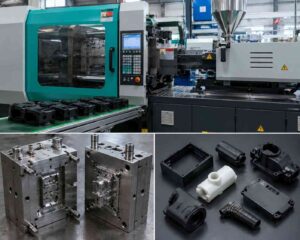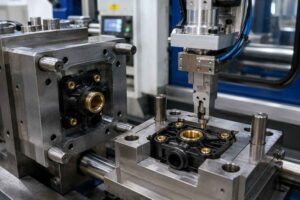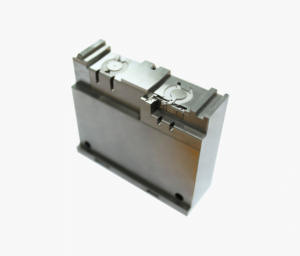


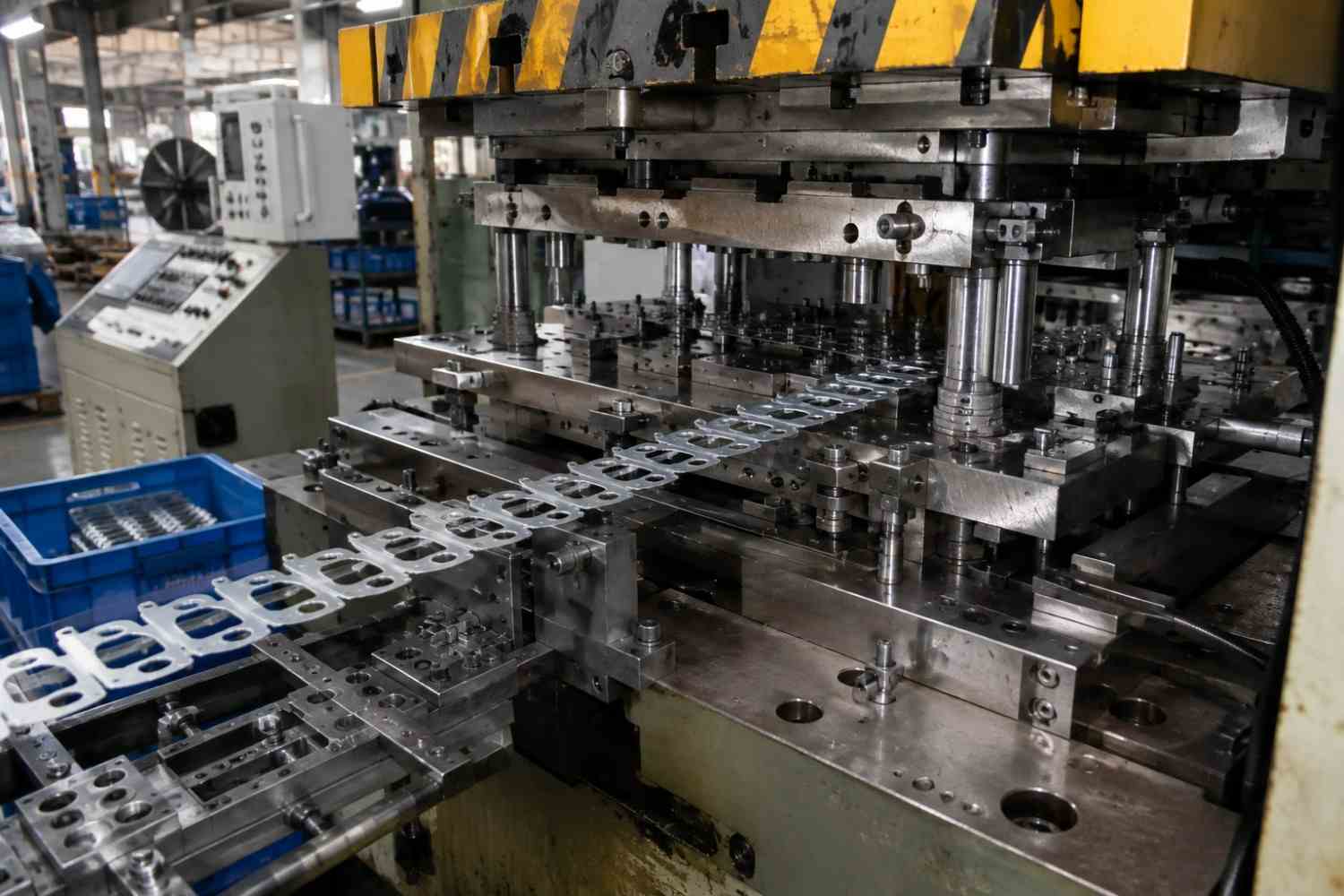
Precision manufacturing is being asked for more complex metal components, at higher volumes, with repeatability that never wavers. Whether it’s a powertrain bracket for an automotive line, a connector terminal for electronics, or a structural part for a medical device, the demand is the same: speed, precision, and cost efficiency, all from one continuous process.
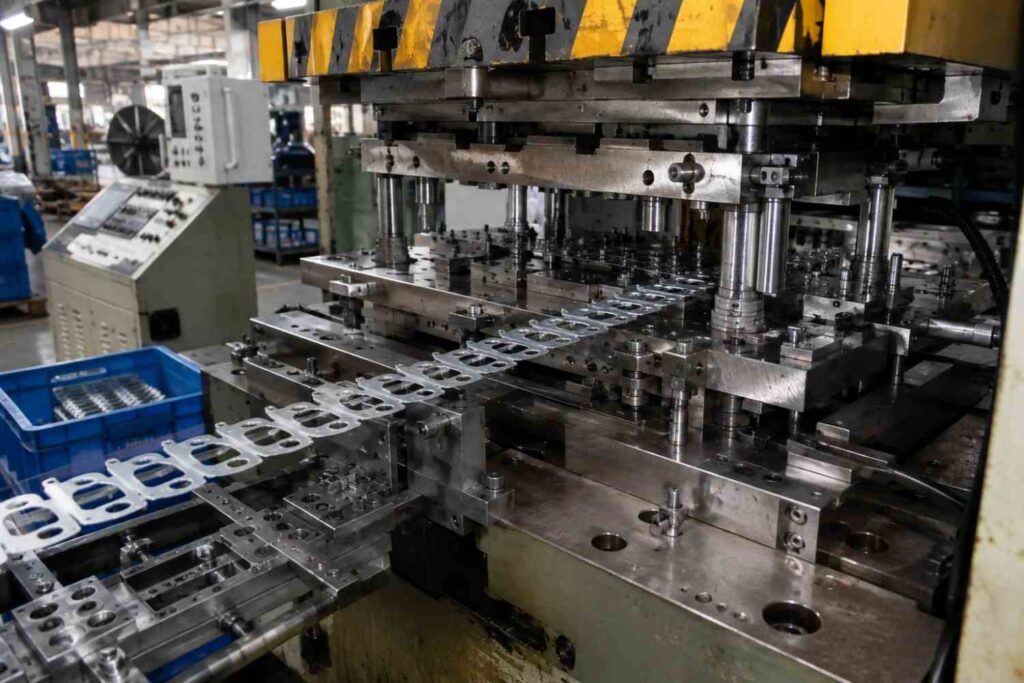
That process is multi-station Progressive die metal forming, done with multi-station Progressive die dies. A Progressive die die stacks several stamping, forming, and cutting operations into one tool. The metal strip advances through a sequence of stations, and at the final stage the finished part is cut free. Each station does its own job — blanking, drawing, bending, piercing, or flanging — so the part takes shape step by step on every press stroke.
At SSPrecision (SSP), we’ve been designing, building, and validating multi-station Progressive die dies since 2008. From our 9,000 m² facility in Dongguan — the heart of China’s precision manufacturing industry — we deliver tooling that holds ±0.002 mm tolerances, verified on Zeiss and Mitutoyo CMMs. With ISO 9001:2015 and IATF 16949 certification, we serve automotive/EV, electronics, medical, aerospace, energy, and industrial OEMs in 50+ countries.
This guide walks through the fundamentals of multi-station Progressive die die design, what they give you, and why SSPrecision is the partner most high-volume programs come back to.
What Is a Multi-Station Progressive die Die?
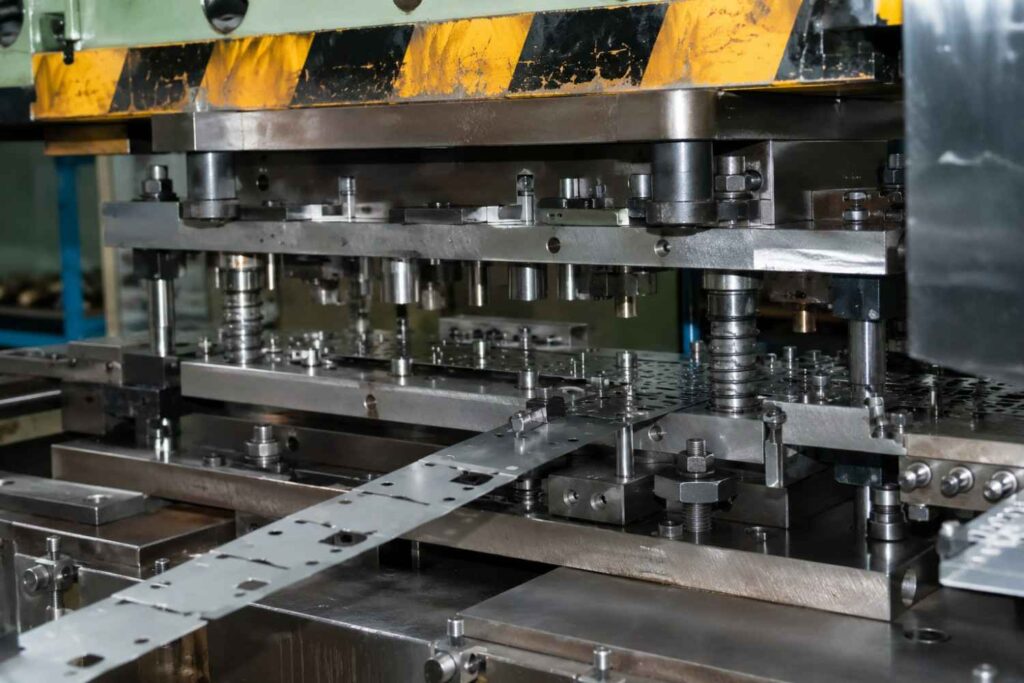
A Progressive die die is a tooling system that carries out several processing steps one after another inside a single press cycle. The strip, fed from a coil, moves through the die on every stroke. Conical pilots drop into pre-pierced holes to keep the alignment exact as the part travels from station to station.
The Process Flow
| Stage | Operation | Description |
| 1 | Material Feeding | Metal coil or strip is fed into the die via an automatic feeder |
| 2 | Sequential Stamping | The strip advances through stations; each performs a specific operation (piercing, blanking, bending, drawing, forming) |
| 3 | Part Progression | The strip moves incrementally with each press stroke, building the part step-by-step |
| 4 | Final Blanking | At the last station, the completed part is cut free from the strip |
| 5 | Waste Removal | Scrap is ejected; finished parts are collected for inspection |
One die can combine blanking, drawing, local forming, bending, and more — in some cases 13 or more operations in a single tool. Advanced designs run at 7 to 1,500 parts per minute. SSPrecision’s Progressive die dies hit 1,200 strokes per minute, with documented tool life past 2 million cycles.
Progressive die vs. Transfer: Choosing the Right Approach
| Criterion | Progressive die Die Stamping | Transfer Die Stamping |
| Material Form | Continuous coil strip | Individual blanks |
| Part Transfer | Strip advances through stations | Mechanical fingers or robotic arms move blanks |
| Best For | Small to medium parts, flat or mildly formed | Large, complex, deep-drawn parts |
| Production Speed | Very high (>30 SPM) | Moderate |
| Tooling Cost | Lower for simple geometries | Higher due to transfer mechanism |
| Tolerance Capability | ±0.002 mm achievable | ±0.005 mm standard |
We build both Progressive die and transfer dies — and even Progressive die-transfer hybrid dies that combine strip-fed progression with a transfer section for secondary forming. That flexibility means there’s a right answer for every part geometry and production volume, not just the one we happen to build.
The Technical Advantages of Multi-Station Progressive die Dies
1. Unmatched Production Efficiency
Because multiple operations live in one die, Progressive die stamping does away with separate presses, extra setups, and manual part handling between steps. One operator can supervise the machine, and the continuous strip feed keeps runs going without interruption. The payoff is a lower cost per part and shorter overall cycle times.
2. Superior Dimensional Consistency
The part stays attached to the carrier strip while it’s formed, so alignment never drifts. Pilots and high-precision guiding keep conditions consistent at every station, which cuts defect rates and makes quality data traceable. SSPrecision checks every critical dimension with CMM inspection and ships a full dimensional report with every die.
3. Minimal Material Waste
Optimized strip layout and nesting — like double-row patterns with a center carrier — keep scrap to a minimum. That matters most when the material is an expensive alloy or a high-strength steel.
4. Rapid Changeover & Modular Flexibility
Traditional dies have to be fully disassembled and recalibrated during a line changeover. Progressive die dies don’t: modular designs and quick-positioning structures let you switch products fast, which keeps small-batch production economical.
5. Integration with Automation & Smart Manufacturing
Modern Progressive die dies can carry in-die inspection and data collection modules, which is where smart manufacturing starts. Add sensors for real-time monitoring, quick-change mechanisms, and custom pilots, and you can push capability well beyond a basic die.
SSPrecision: Engineering Excellence in Multi-Station Progressive die Dies
Who We Are
Dongguan Shuangshun Precision Tooling Co., Ltd. (SSP), operating as SSPrecision (ssprecision.com.cn), was founded in 2008 in Dongguan, Guangdong. We specialize in high-precision stamping dies, die parts, injection molds, and CNC machined components.
| Capability | SSP Standard |
| Facility | 9,000 m² in Dongguan |
| Precision Team | 300+ precision machining professionals |
| Tolerance Capability | ±0.002 mm on die components |
| CNC Milled Parts | ±0.005 mm |
| Surface Finish | Ra 0.4 μm on ground surfaces |
| Max Die Speed | 1,200 strokes per minute |
| Tool Life | 2+ million cycles |
| On-Time Delivery | 99% |
| Global Reach | 50+ countries |
Certifications That Matter
- ISO 9001:2015 — Quality Management System
- IATF 16949:2016 — Automotive Quality Management
- CMM Dimensional Reports — Zeiss & Mitutoyo CMM with full measurement traceability
- SPC Statistical Process Control — Real-time monitoring on all critical machining features
- Material Certifications — Mill certs, RoHS, hardness & chemical composition reports
Our Integrated Approach
From tooling design to CMM-verified final inspection, everything is produced under one roof:
| Service | SSP Capability |
| Tooling Design & DFM | In-house CAD/CAM engineering with Design for Manufacturability analysis |
| Progressive die Stamping Dies | Multi-stage Progressive die and transfer dies for high-volume precision components |
| Injection Mold Making | Plastic injection molds for complex geometries and tight tolerances |
| Multi-Axis CNC Machining | 5-axis CNC milling and turning |
| Surface Treatment | Heat treatment, hard chrome, PVD coating, nitriding |
| Assembly & Die Try-Out | Full die assembly, press try-out, and first-article validation before shipment |
Applications Across Industries
Multi-station Progressive die dies are used in nearly every precision manufacturing sector:
| Industry | Typical Components | SSP Capability |
| Automotive / EV | Brackets, clips, connectors, powertrain parts, high-strength steel structural components | IATF 16949 certified |
| Electronics | Connector terminals, heat sinks, terminal strips, high-speed transmission springs | ±0.002 mm tolerance on fine features |
| Medical Devices | Surgical instrument components, device brackets, precision structural parts | ISO 9001 certified; full traceability |
| Aerospace | Lightweight alloy parts, tight-tolerance structural components | CMM-verified GD&T |
| Energy / Industrial | Heavy-duty brackets, frames, connectors | High-strength material capability |
SSP Is a Trusted Partner for Die Manufacturing Cost Optimization
SSP Precision is an ISO 9001 & IATF 16949 certified manufacturer delivering end-to-end precision solutions—from DFM engineering and rapid prototyping to high-volume production—for the automotive, medical, electronics, aerospace, and industrial sectors. We handle every stage in-house to manufacture the tooling that makes your parts and the parts themselves.
Visit our to explore our full capabilities: ssprecision.com.cn
Services (tooling design & manufacturing)
- Stamping Dies Manufacturing – high-volume metal stamping with Progressive die Die Stamping & Tooling spare parts manufacturing and Transfer Stamping Dies
- Injection Molding – custom plastic molds including Over Molding & Insert Molding and Liquid Silicone Rubber (LSR) Molding
- Green Mold – eco-friendly molded components, Micro Molding – microscopic medical precision parts
Products (end-use parts & spare components)
- Stamping Die – complete stamping tooling
- Injection Mold – complete injection tooling
- Tooling Spare Parts – punches, inserts, ejector pins, Robotics Spare Parts – precision automation spares , Ball Screw Repair Kits – replacement kits for motion systems
- Machine Parts – general precision machine components
Frequently Asked Questions
Q: What is a multi-station Progressive die die?
A die that carries out several stamping, forming, and cutting operations in sequence across multiple stations within one press cycle, producing finished parts straight from a continuous metal strip.
Q: What tolerances can SSPrecision hold on Progressive die dies?
±0.002 mm on die components, verified on Zeiss and Mitutoyo CMMs, and ±0.005 mm on CNC milled parts.
Q: What industries does SSPrecision serve?
Automotive/EV, electronics, medical devices, aerospace, energy, and industrial sectors.
Q: What certifications does SSPrecision hold?
ISO 9001:2015 and IATF 16949, plus full CMM inspection, SPC monitoring, and material certification traceability.
Q: How does Progressive die stamping compare with transfer stamping?
Progressive die dies run on a continuous strip and suit small-to-medium parts made in high volume. Transfer dies move individual blanks with robotic arms and fit large, complex, deep-drawn components better.
Q: What’s the typical lead time for a Progressive die die from SSPrecision?
It depends on complexity. Simple dies (3–5 stations) run 3–5 weeks; complex dies (13–20 stations) run 8–12 weeks.
Conclusion
Multi-station Progressive die metal forming is the backbone of high-volume precision manufacturing. It gives modern industries the speed, consistency, and cost efficiency they need, whether the push is automotive electrification or the next medical device.
SSPrecision brings 16+ years of experience, ISO 9001:2015 and IATF 16949 certification, and a 300+ person engineering team to every project. With ±0.002 mm tolerance capability, 1,200 SPM die speed, and 2+ million cycle tool life, we run level with German and Japanese toolmakers — at 60–78% lower investment cost.
Whether you need a 5-station terminal die or a 20-station automotive structural die, SSPrecision delivers precision you can measure and reliability you can trust.
Ready to discuss your next Progressive die die project?
Visit ssprecision.com.cn or contact our engineering team for a free DFM analysis
Read More – Intelligence That Protects Your Production Line
- Engineering Walkthrough: Deep Drawn Transfer Dies Stamping – Deep drawing turns flat metal into seamless shells—here’s a stage-by-stage walkthrough of transfer dies, blank holder forces, draw ratios, and how to prevent wrinkling, tearing, and springback on heavy-gauge parts.
- Performance Audit: Precision Die Manufacturer Sheet Forming – Die suppliers look similar on paper—here’s the 7-point audit checklist that separates real capability from marketing: Cpk data, tool life, repeatability, documentation, and how they respond when something goes wrong.
- Applied Proof: Insert Molding Manufacturer Metal Insert – Insert molding fuses metal inserts into plastic in a single step, replacing secondary assembly and improving reliability—here’s how the process works, how it compares to overmolding, and what a custom insert molding partner needs to get right.
- Precision Ball Screw Parts: Complete Component Guide – Backlash, noise, and lost accuracy are early signs of ball screw wear—here’s when to repair vs. replace, how to measure runout, and what a complete linear motion repair kit should include for C3–C7 tolerance classes.
- Green Mold Technology: Eco-Conscious Mold Explainer – Sustainability starts at the tooling level—here’s how optimized gating, faster cooling, and ±0.002 mm precision reduce scrap, energy, and material waste across millions of cycles.
- Progressive Die Stamping for High-Volume OEM Parts – High-speed progressive dies run at hundreds of strokes per minute, holding tolerances to ±0.002 mm—here’s the guide to strip layout, tool steel selection, and why OEMs choose progressive stamping for terminals, brackets, and connectors.
- Margin Optimization: Sustainable Injection Mold Design OEM – Conformal cooling, hot runners, all-electric machinery, and closed-loop recycling cut energy use 52%, material waste to under 3%, and per-part cost by 22%—here’s the sustainable mold design framework for margin protection.
- Quality Assurance Review: Stamping Die Products Tooling – A stamping die is only as reliable as the quality system behind it—here’s the 6-stage QA framework covering DFM, material verification, ±0.002 mm machining, CMM inspection, and PPAP documentation that delivers 99.7% quality acceptance and 2M+ cycle tool life.
References & standards
- ISO 286-1:2010 — ISO code system for tolerances on linear sizes — The international basis for the tolerance and fit classes quoted in this article.
- ASTM A681-08(2022) — Standard Specification for Tool Steels Alloy — Chemical, mechanical and physical requirements for the alloy tool steels referenced here.