

Choosing mold steel is the one decision in an injection mold that you cannot fix later. Gates can be re-cut, cooling can be re-drilled and a parting line can be re-fitted, but a cavity machined from the wrong grade will wear, rust, crack or refuse to polish for as long as the tool runs.
This guide explains how our engineers in Dongguan choose mold steel for production tools. It compares the seven grades we specify most often, P20, 718H, NAK80, S136H, S136 ESR, H13 ESR and D2, and shows the questions that decide between them: shot volume, resin chemistry, fillers, surface finish and heat transfer. The numbers are typical values from mill data and our own toolroom, not marketing ranges.
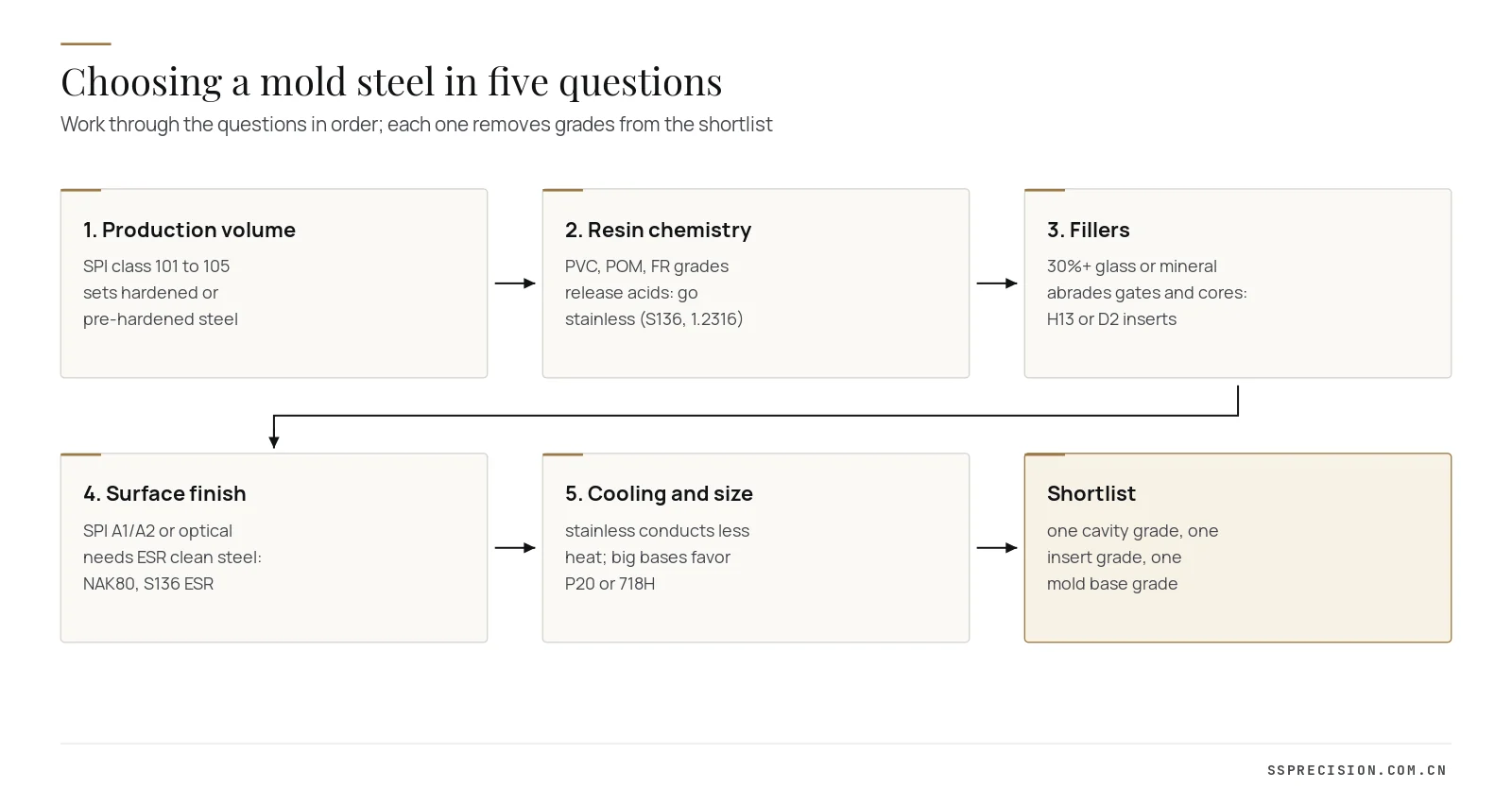
- Start with the SPI class. Tools above 500,000 shots need hardened cavities (48 to 52 HRC); below that, pre-hardened mold steel such as P20 or 718H is usually the better value.
- Corrosive resins (PVC, POM, flame-retardant grades) and medical or food parts call for stainless mold steel: S136 or 1.2316.
- Glass fiber above roughly 30% wears P20 fast. Use hardened H13 or D2 inserts at gates and thin cores.
- Mirror and optical finishes (SPI A1, A2) need clean, electro-slag remelted steel: NAK80 or S136 ESR.
- Stainless grades transfer heat about 40% less well than P20, so the cooling layout must be designed around the steel, not the other way round.
What mold steel has to do in an injection mold
A cavity and core see a harsh duty cycle. Every shot, melt at 200 to 330 °C is packed against the steel at 50 to 150 MPa cavity pressure, cooled, and ejected, often in under 20 seconds. Over a million shots that becomes a million thermal cycles, a million pressure pulses and a million sliding contacts at the ejector pins and shut-offs.
A good mold steel therefore has to balance six properties that pull against each other:
- Hardness and wear resistance, so gates, shut-offs and thin cores keep their size.
- Toughness, so sharp corners and thin ribs do not crack under clamp and injection pressure.
- Polishability, which depends on steel cleanliness and uniform structure more than on hardness.
- Corrosion resistance, against acidic gases from the resin and against condensation from chilled water.
- Thermal conductivity, which sets how fast heat leaves the part and therefore the cycle time.
- Machinability and EDM behaviour, which drive tool cost and lead time.
No single mold steel wins all six. High hardness costs toughness and machinability; stainless chemistry costs heat transfer; ultra-clean remelted steel costs money. Selection is the art of paying only for the properties the part actually needs.
The seven mold steel grades compared
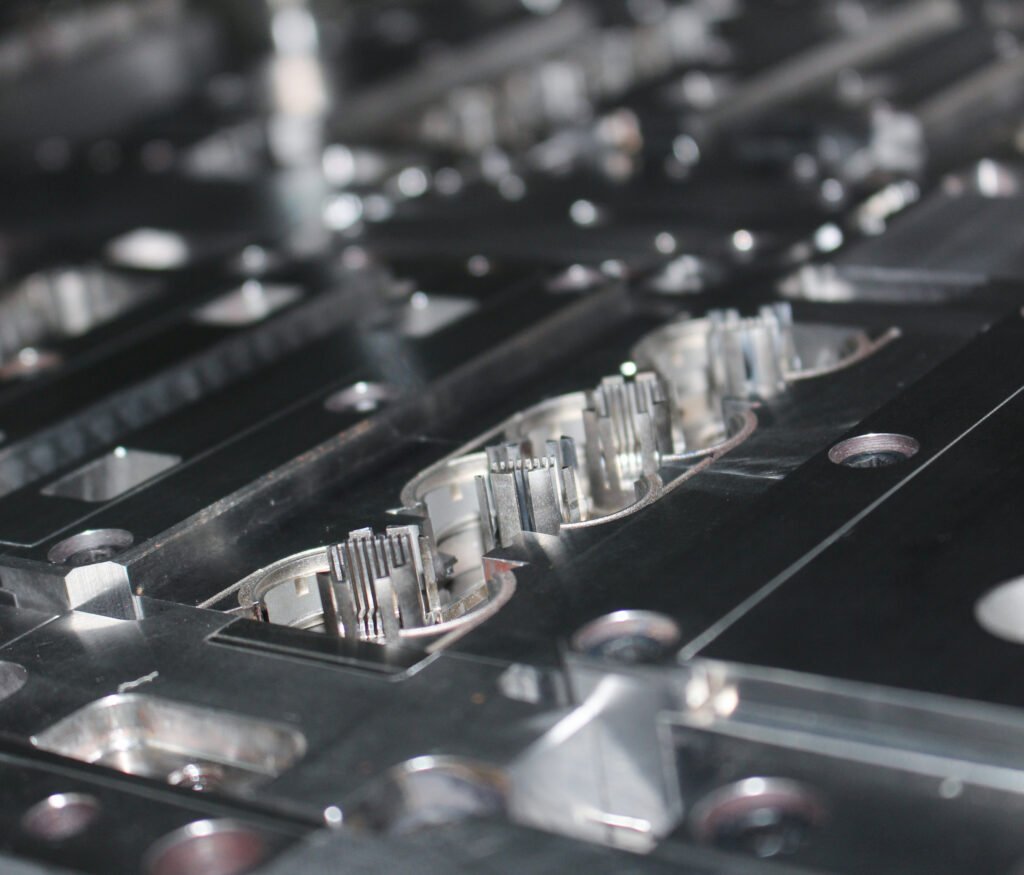
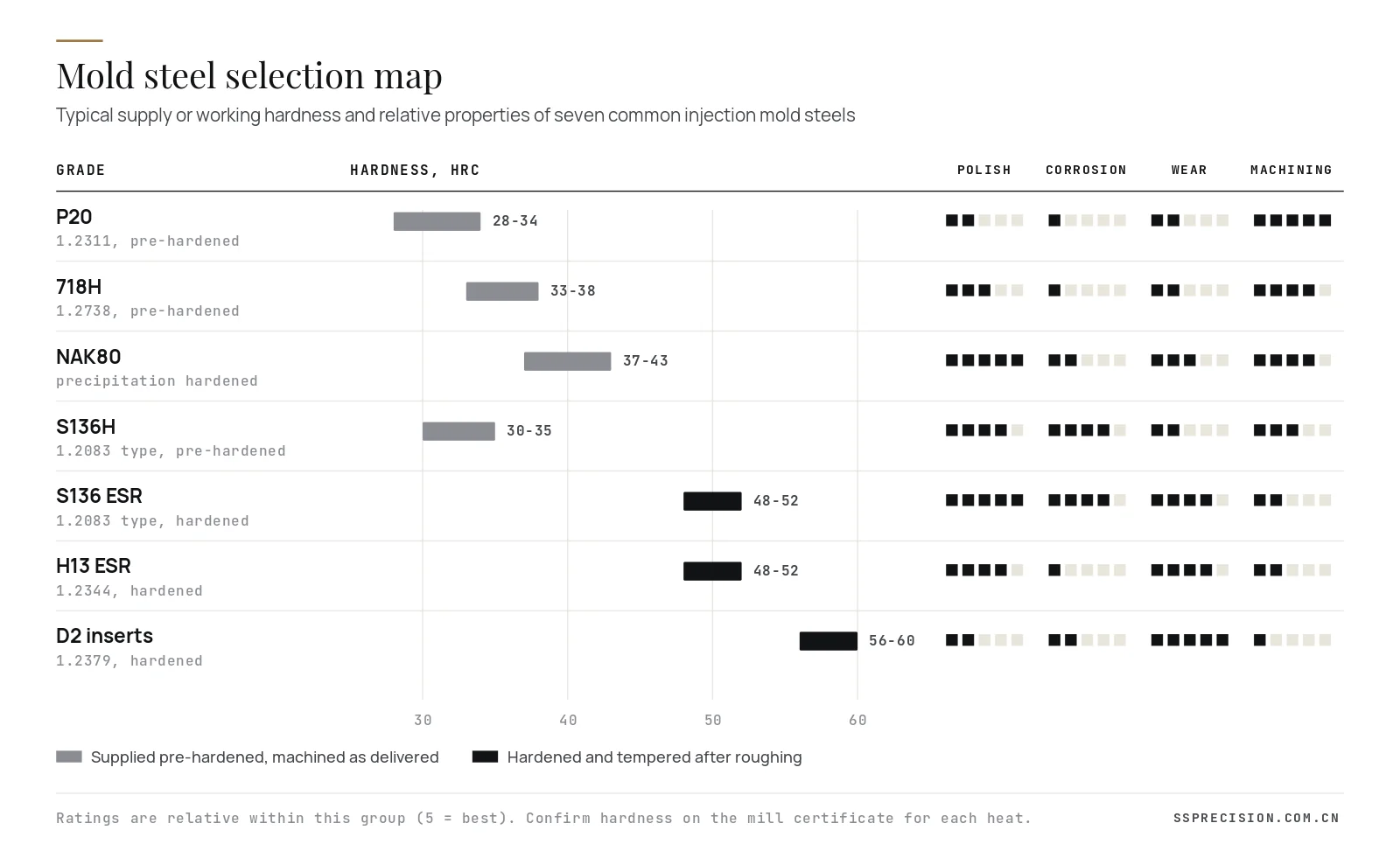
The map below places each grade by its supply or working hardness and rates it against the others on polish, corrosion, wear and machining. Grey bars are pre-hardened steels that we machine as delivered. Black bars are through-hardened steels that are roughed, heat treated and then finished.
| Grade | Equivalents | Hardness | Best for | Watch out for |
|---|---|---|---|---|
| P20 | 1.2311, 3Cr2Mo | 28 to 34 HRC, pre-hardened | General purpose cavities, large molds, mold bases, SPI 103 | Pits under PVC or POM; limited mirror polish |
| 718H | 1.2738, P20+Ni | 33 to 38 HRC, pre-hardened | Deep cavities, large automotive parts, more uniform hardness than P20 | Not for abrasive or corrosive resins |
| NAK80 | 10Ni3MnCuAl | 37 to 43 HRC, age hardened | High gloss cosmetic parts, textured surfaces, clean EDM finish | Wears under glass fiber; costs more than P20 |
| S136H | 1.2083 type, 4Cr13 | 30 to 35 HRC, pre-hardened | Corrosive resins at medium volume, humid shops | Lower heat transfer; softer than hardened S136 |
| S136 ESR | 1.2083 ESR, Stavax type | 48 to 52 HRC, hardened | Medical, optical and food contact parts, PVC, SPI 101 | Longer lead time; cooling must compensate |
| H13 ESR | 1.2344, SKD61, 4Cr5MoSiV1 | 48 to 52 HRC, hardened | High volume engineering resins, glass-filled nylon, hot runner plates | Rusts without care; needs vacuum heat treatment |
| D2 | 1.2379, SKD11, Cr12Mo1V1 | 56 to 60 HRC, hardened | Gate inserts and thin cores in highly filled materials | Brittle; polish limited by coarse carbides |
Equivalents are the closest common matches; chemistry and cleanliness vary by mill, so always check the certificate.
P20 and 718H: the pre-hardened workhorses
P20 is the default mold steel for good reason. It arrives at around 30 HRC, machines quickly, welds for repairs and polishes to SPI B1 or A3 without drama. For consumer housings, caps and industrial parts in PP, PE or ABS it gives an excellent cost per part up to about 500,000 shots.
718H is P20 with about 1% nickel. The nickel gives more even hardness through thick blocks, which matters when a cavity is cut 200 mm deep into a 400 mm block. For large automotive trim and appliance parts we usually prefer 718H to P20 because the hardness at the bottom of the cavity matches the surface.
NAK80: gloss and texture without heat treatment
NAK80 is a precipitation-hardening mold steel supplied at about 40 HRC. Because it is aged rather than quenched, it does not move during heat treatment, and its very clean structure takes a mirror polish and a uniform chemical texture. Wire and sinker EDM leave a fine, even recast layer that polishes out quickly. It is our first choice for transparent covers, gloss-black cosmetic parts and fine grain textures that must match across several tools.
S136H and S136 ESR: the stainless options
S136 is a 13% chromium stainless mold steel. In the pre-hardened S136H condition it protects against corrosive resins and sweating cooling lines at moderate volume. Hardened to 48 to 52 HRC as S136 ESR, it combines corrosion resistance, wear resistance and the best polish of any grade here. That is why medical device, lens and food packaging molds are almost always stainless. For PVC, 1.2316 is a close alternative with extra molybdenum.
H13 ESR and D2: wear and heat
H13 is a hot-work steel that, once hardened to 48 to 52 HRC, resists wear, pressure and thermal fatigue. It is our standard cavity steel for high volume tools running glass-filled PA66, PBT and PPS, and for hot runner manifolds. D2 goes further on wear at 56 to 60 HRC, but it is brittle, so we use it only for small replaceable inserts at gates and in thin cores, never for a whole cavity.
Question one: how many shots will the mold steel see?
Shot volume is the first filter because it decides between pre-hardened and hardened steel. The SPI mold classification, used across the industry, links rated life to minimum cavity hardness.
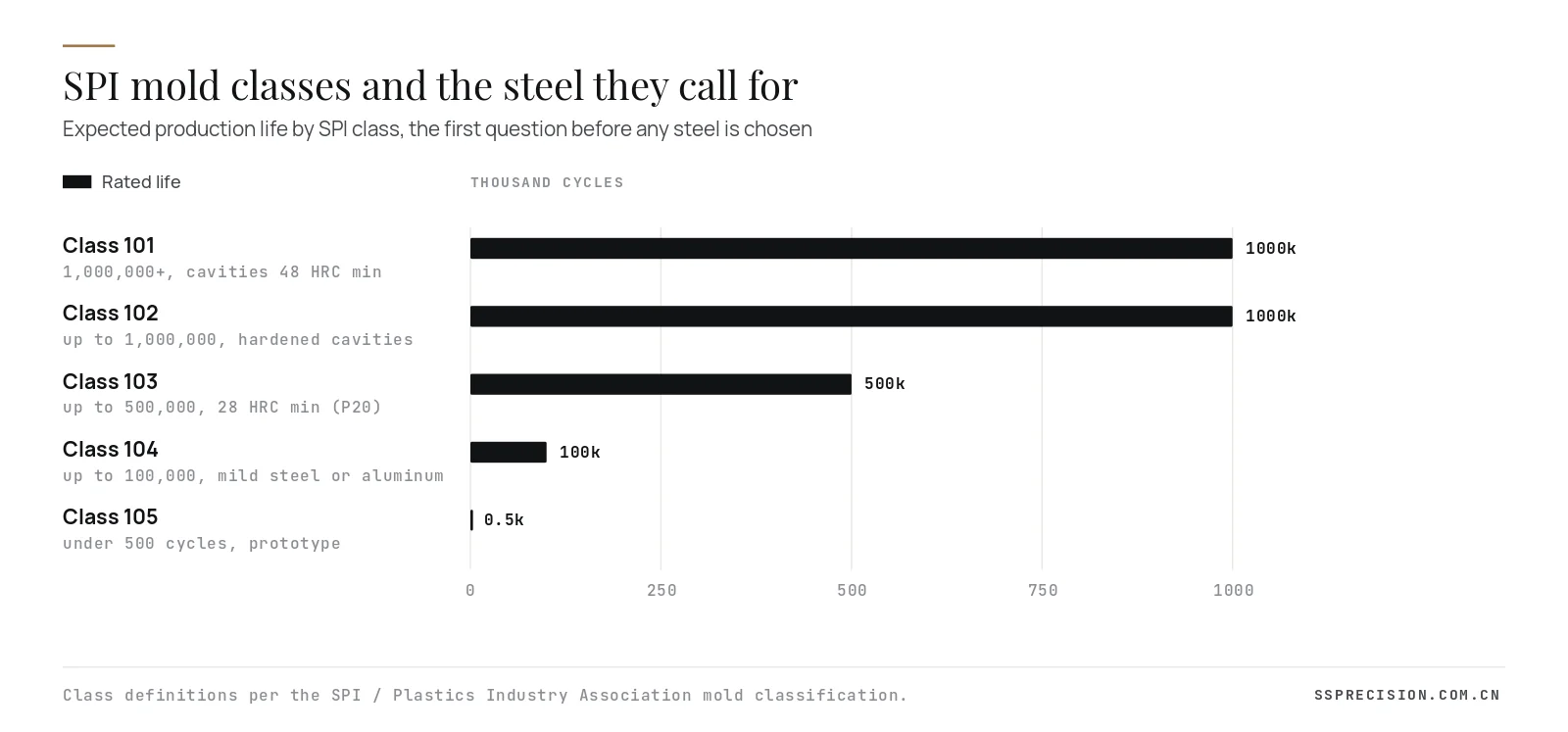
As a rule of thumb from our quoting data: below 100,000 shots, aluminum or P20 is enough; between 100,000 and 500,000, P20 or 718H; above 500,000, hardened H13 or S136 ESR. Tools that must run several million shots, such as closures and medical disposables, also get hardened inserts at every wear point so they can be replaced without re-cutting the cavity. Our aluminum versus steel mold data covers the low volume end in more detail.
Question two: is the resin corrosive to mold steel?
Some polymers release acidic gases as they degrade in the barrel or hot runner. PVC releases hydrochloric acid, POM can release formaldehyde and formic acid, and many flame-retardant compounds carry halogen or phosphorus additives. On P20 or H13 these gases etch the cavity within weeks, leaving a dull, pitted surface that transfers to every part.
Condensation is the other enemy. Molds running with chilled water below the dew point, or stored in a humid shop, rust on the parting line and in cooling channels. Stainless mold steel solves both problems. If the budget cannot carry a full stainless cavity, nickel plating or a PVD coating on P20 is a partial fix, but coatings wear through at shut-offs and gates.
We see more rusted cavities from cooling water than from resin. If your plant uses open cooling towers, specify stainless or at least stainless inserts around the cooling circuits, and ask for the cooling channels to be flushed and protected before shipping.
Question three: will fillers wear the mold steel?
Glass fiber, glass beads and mineral fillers act like a fine grinding paste moving at high speed. Wear concentrates where flow is fastest: gates, thin cores, sharp flow corners and vents. On a P20 gate running PA66 with 30% glass, we typically see visible erosion within 50,000 to 100,000 shots. The same gate in hardened H13 runs several hundred thousand shots, and in a D2 or powder metallurgy insert it runs longer still.
The practical answer is rarely to build the whole cavity in the hardest mold steel. It is to identify the wear points in design review and make them replaceable inserts. That keeps the main cavity in a tougher, cheaper grade and turns a future re-cut into a quick insert swap from stock. We machine these inserts to drawing as part of our tooling spare parts service.
Question four: what surface finish does the part need?
Polish quality depends on inclusions more than on hardness. Each non-metallic inclusion becomes a pinhole or a comet tail under a diamond compound. Electro-slag remelting (ESR) and vacuum degassing reduce inclusions, which is why ESR grades and NAK80 reach SPI A1 while standard P20 usually stops at A3 or B1.
| SPI finish | Method | Typical Ra, µm | Suitable mold steel |
|---|---|---|---|
| A1 | Grade 3 diamond buff | 0.012 to 0.025 | S136 ESR, NAK80 |
| A2 | Grade 6 diamond buff | 0.025 to 0.05 | S136 ESR, NAK80, H13 ESR |
| A3 | Grade 15 diamond buff | 0.05 to 0.10 | 718H, S136H, P20 (selected) |
| B1 to B3 | 600 to 320 grit paper | 0.05 to 0.40 | All grades |
| C1 to C3 | 600 to 320 grit stone | 0.35 to 0.80 | All grades |
| D1 to D3 | Dry blast, glass bead or oxide | 0.8 to 4.5 | All grades |
Ra ranges are typical toolroom values for each SPI finish and depend on the polisher as much as the steel.
Textured parts have their own rule: every insert that shows on one visible surface should come from the same heat of the same mold steel. Different grades, or even different heats, etch at different rates and produce a visible gloss mismatch across the parting line.
Question five: heat transfer, cycle time and mold steel
Thermal conductivity is the property most often forgotten. At room temperature P20 conducts roughly 29 to 34 W/m·K, H13 about 25 W/m·K and 13% chromium stainless grades only about 16 to 20 W/m·K. Cooling time scales with the square of wall thickness and inversely with how fast heat escapes, so a stainless cavity with an unchanged cooling layout can add 5 to 15% to the cycle.
The fix is design, not a different grade. With stainless mold steel we move cooling channels closer to the cavity surface, add baffles and bubblers in cores, and use beryllium-free copper alloy inserts in hot spots that cannot be reached. For the hardest cases, conformal cooling recovers most of the lost cycle time.
Heat treatment and verification
Through-hardened mold steel is only as good as its heat treatment. H13 and S136 should be vacuum hardened with a controlled gas quench and double or triple tempered, never salt-bath hardened for precision cavities. We rough-machine with 0.3 to 0.5 mm stock per side, stress relieve large blocks, harden, then finish by hard milling, grinding and EDM.
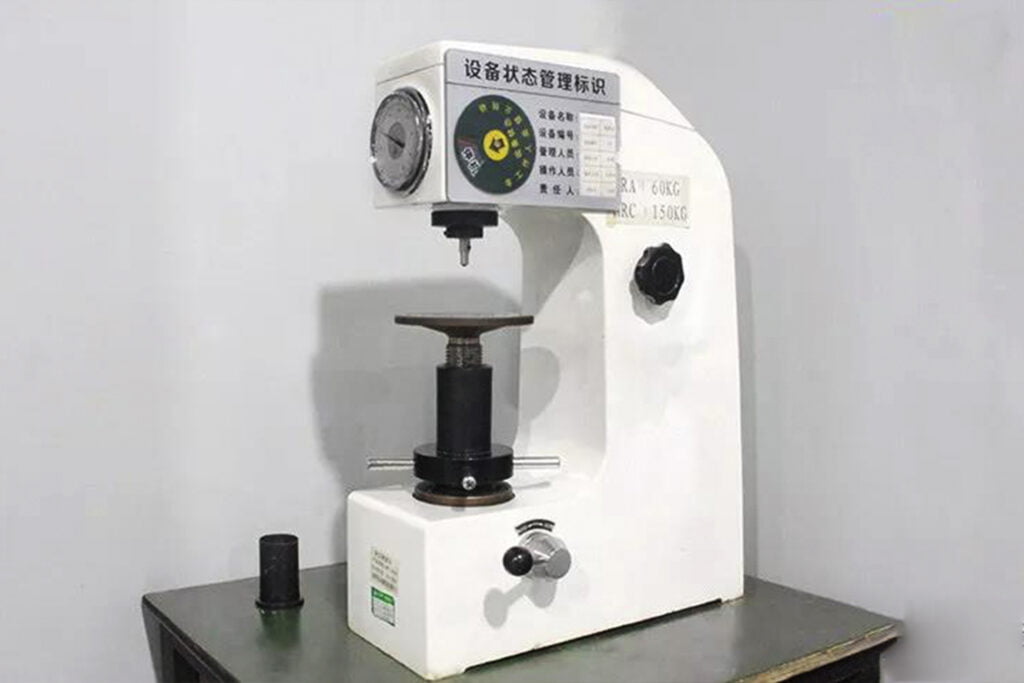
Every hardened component is checked on a Rockwell tester before finishing, at a location that will be machined away, and the result goes into the mold report with the mill certificate. When a supplier cannot show both documents, you do not know which mold steel you have bought.
Worked examples from our toolroom
Three recent requests show how the questions combine in practice:
- PP household container, 300,000 shots per year: a single-cavity tool in 718H cavity and core with a P20 base. No corrosive resin, no fillers, SPI B2 finish. Pre-hardened steel kept tool cost and lead time low.
- PA66 GF30 connector housing, 2 million shots: H13 ESR cavities at 50 HRC, D2 inserts at each gate and across the thinnest cores, stocked as spares. Wear points were identified before steel was ordered.
- Medical luer component in PC, cleanroom molding: S136 ESR hardened to 50 HRC, SPI A2 on the cavity, cooling channels 8 mm from the surface to hold the cycle. Stainless was required for corrosion, cleaning and polish together.
For silicone parts the logic changes again, because LSR is injected cold into a hot tool; our LSR molding page explains the steel and venting choices for those molds.
Not sure which steel your part needs?Send the part drawing, resin and annual volume. Our engineers reply with a steel recommendation and tool concept within one business day.
Request a quoteFive mold steel mistakes that shorten tool life
- Choosing hardened steel for a 50,000 shot tool, and paying for lead time and cost you never use.
- Building a whole cavity in D2 or another very hard grade, then losing it to a crack at a sharp corner.
- Mixing grades or heats on a textured surface and getting a gloss mismatch.
- Moving to stainless without redesigning cooling, and losing the cycle time the tool was quoted on.
- Accepting a mold without mill certificates and hardness records, so the steel cannot be verified.
Most of these come from quotes that list only a steel name. Ask your toolmaker for the grade of every cavity, core, insert, slide and base plate, plus the hardness and heat treatment route. Our analysis of why injection molds fail shows how often the root cause traces back to that list.
How SSP specifies mold steel on a new tool
On every injection mold we quote, the steel schedule is part of the DFM report, not a line at the bottom of the price. It lists each component, its grade, supplier, hardness, heat treatment and finish, and explains any trade-off against cycle time or cost. We buy mold steel from mills that supply full certificates, verify hardness in house and keep offcuts from each heat for texture and repair matching.
If you already have a tool and want to know whether a different grade would extend its life, we can review the wear pattern from photos or samples. For new projects, our injection molding team can also sample the tool and run it at production volume. More background on the history and chemistry of these alloys is available in the tool steel overview on Wikipedia.
Mold steel FAQ
What is the best mold steel for injection molding?
There is no single best grade. P20 or 718H suits most general parts up to about 500,000 shots. Hardened H13 ESR suits high volume and glass-filled resins. S136 ESR suits corrosive, medical and optical parts. NAK80 suits high gloss cosmetic parts at medium volume.
Is P20 or H13 better for a mold?
P20 is cheaper and faster to machine and is the better value below about 500,000 shots in unfilled resins. H13, hardened to 48 to 52 HRC, lasts much longer in high volume and filled resins and resists thermal fatigue, but costs more and adds heat treatment time.
Why is S136 used for medical and optical molds?
S136 is a clean, electro-slag remelted stainless mold steel. It resists corrosion from resins, cleaning agents and condensation, and it takes an SPI A1 mirror polish. Those three properties together are what medical and lens molds require.
How hard should injection mold steel be?
Pre-hardened cavities typically run at 28 to 43 HRC depending on grade. Hardened cavities for SPI Class 101 and 102 tools run at 48 to 52 HRC. Wear inserts in highly filled resins can go to 56 to 60 HRC.
Does stainless mold steel slow the cycle time?
It can. Stainless grades conduct heat about 40% less well than P20, so an unchanged cooling layout can add 5 to 15% to the cycle. Moving channels closer to the surface, adding bubblers or using copper alloy inserts recovers most of that time.