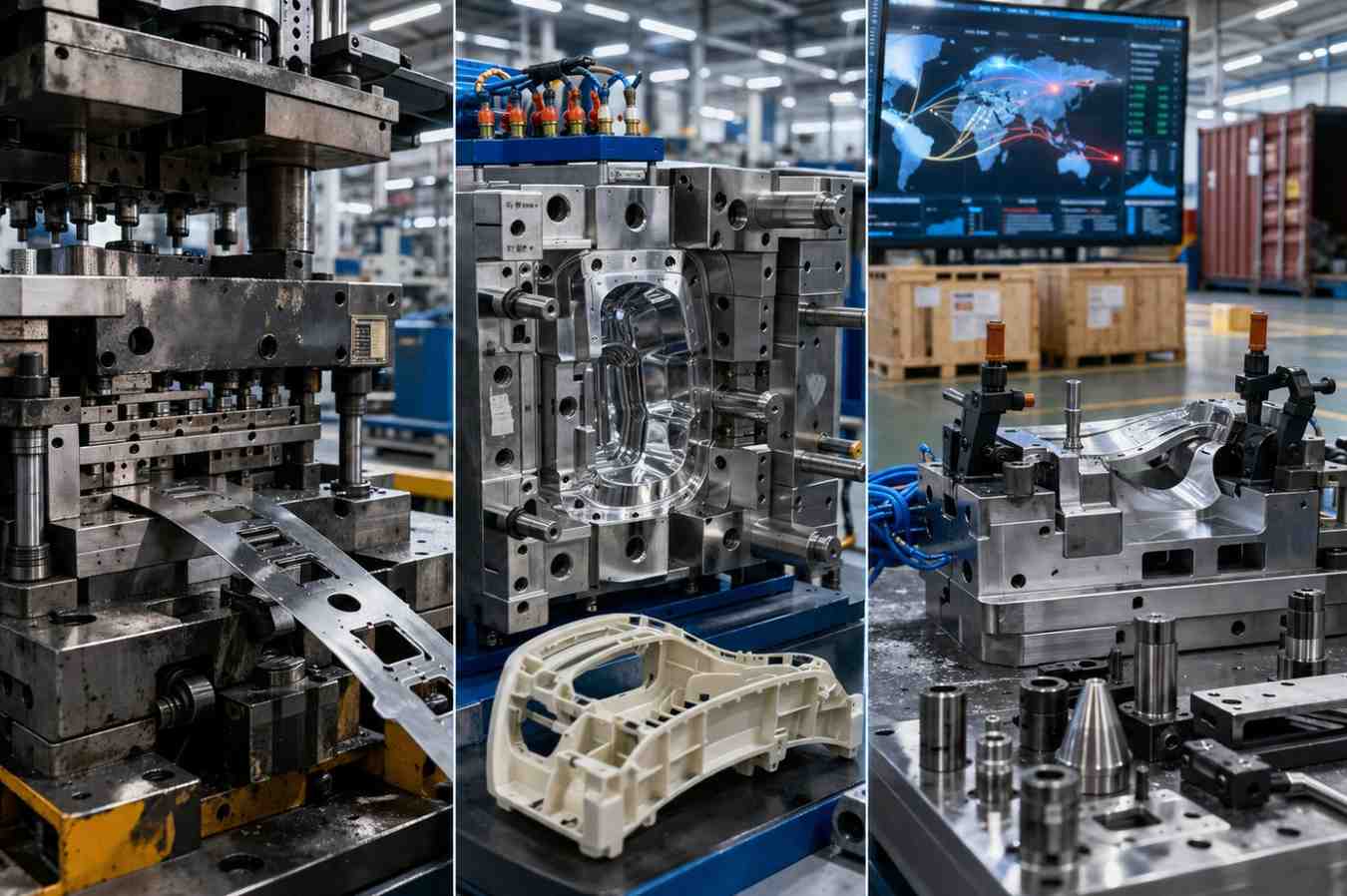
An OEM tooling manufacturer kind of builds, custom stamping dies , injection molds , and also tooling spare parts, based on what a customer specifies for use inside that customer’s own production line s. Stamping dies are the go to for high volume sheet metal parts shaped by press force ; injection molds work best for plastic parts that need complex 3D geometry, and custom tooling / fixtures are usually the right fit for helping , supporting or even repairing existing production equipment. Picking the right category — and, also the right supplier — isn’t just a simple choice , it mostly depends on the part material, how many units are actually going to be produced, and how closely the tooling must integrate with an existing global supply chain. SSP (SSPrecision) , based in Dongguan China, makes all three under one IATF 16949 certified system for exporters and OEM buyers.
Quick Comparison: Stamping Dies vs. Injection Molds vs. Tooling Spare Parts
| Attribute | Stamping Dies | Injection Molds | Tooling Spare Parts / Fixtures |
| Best for | High-volume metal stamping | Complex plastic parts | Maintaining/repairing existing tooling |
| Typical tolerance | ±0.02–0.05 mm [verify] | ±0.02–0.05 mm [verify] | Matched to original tooling spec |
| Relative tooling cost | High upfront | High upfront | Low–moderate |
| Lead time | Weeks (design + build) [verify] | Weeks (design + build) [verify] | Days–weeks [verify] |
| Tool life | Hundreds of thousands–millions of hits [verify] | Hundreds of thousands of cycles [verify] | Varies by part |
What Is an OEM Tooling Manufacturer, and What Do They Produce?
An OEM tooling manufacturer designs and builds the dies, molds and fixtures that other companies use inside their own manufacturing lines, instead of making finished consumer goods itself. This usually covers stamping dies for sheet metal shaping , injection molds for plastic part production , and tooling spare parts that help keep the equipment already in service running.
Buyers go to an OEM tooling manufacturer when they need engineered tooling matched to their exact part drawings, material requirements and production volumes, rather than grabbing standardized, off-the-shelf tooling that’s more or less generic.
What Is Industrial Die Manufacturing?
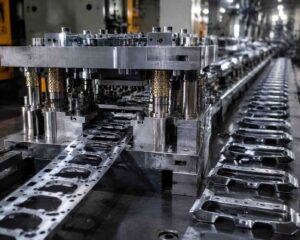
Industrial die manufacturing is basically about how companies design and build metal forming tools, like progressive dies, transfer dies, and also single-stage dies. These tools are used to cut, bend or draw sheet metal into a finished parts, or sometimes semi-finished parts, depending on what the process needs. The key thing is that they work under repeated press strokes, over and over. It’s sort of the whole setup, from the fabrication step to the final tool use in production runs.
Stamping Dies vs. Injection Molds: What’s the Core Difference?
Stamping dies for sheet metal, use press force to cut, bend, or draw the material into some kind of form, while injection molds do the opposite sorta— molten plastic or even metal is injected into a cavity then it solidifies into the final part. The main idea is basically what the input material is, and how it’s formed, and that whole thing ends up pushing tool design in wildly different directions, like steel selection, and what kind of maintenance is really needed.
Stamping dies usually fit products that want high strength for the mass ratio in metal, say automotive brackets or enclosures. Injection molds fit parts that need tricky 3D geometry, snap-fits, or inside features that are hard to pull off with stamped metal, so they do better when you need those deeper details.
When Progressive Dies Make Sense.
Progressive dies can do several forming moves, like piercing, bending, and drawing , in one press stroke while the strip just keeps moving through the stations. In practice it is often more efficient for high volume parts with lots of features, than a one stage setup, because it’s kind of a sequential operation across that tool.
What Are Tooling Spare Parts and Custom Fixtures Used For?
Tooling spare parts are replacement components, punches inserts guide pins ejector pins, made to match the existing die or mold. in other words they’re used so worn or damaged tooling can get restored without basically rebuilding the whole tool. Custom tooling and fixtures are purpose-built jigs and holding devices, used to position parts accurately during machining assembly, or inspection, when things have to line up just right.
These categories matter most to buyers who already have tooling in production and they need to extend service life, or add some new fixturing for a modified part, not really commission an entirely new die or mold, from scratch.
What Certifications Should an Automotive Tool and Die Supplier Hold?
An automotive tool and die supplier should generally have IATF 16949 in place, that quality management standard meant for automotive production and supply chain realities, plus some baseline ISO 9001 certification for the wider quality systems. Together, these signals say the supplier keeps documented process controls, traceability habits, and defect-prevention needs aligned with what automotive OEMs expect.
SSP actually holds both ISO 9001:2015 and IATF 16949, so its stamping die and tooling work is organized around automotive-grade documentation plus process-control expectations not only the more generic manufacturing quality rules.
Why IATF 16949 Certified Stamping Matters for Buyers
Having IATF 16949 certification for stamping signals that the die making and the actual stamping process, not just the final part, is handled under a written quality system, and that kind of control is what a lot of automotive buyers want. They need to prove traceability back through their own supply chain, so the whole chain of records , and not only the “end” piece, gets shown.
Cost and Lead Time: What Are the Tradeoffs?
Stamping dies, and injection molds, both come with big upfront tooling costs because the engineering work, steel selection, and machining hours needed to build a production grade tool, are not cheap. Tooling spare parts and fixtures on the other hand tend to cost less, they only replace , or support a piece of what is already there in the system. Lead time looks a lot like that too: a full die, or full mold build usually takes weeks to design, machine, and validate, [verify], but spare parts can often be made quicker, since the design already exists.
So buyers really should balance tooling cost with the expected production volume. A high tooling cost can still end up being the better total-cost choice, if it gets spread or amortized across a large, long running production run.
Which Option Fits Your Part Complexity and Volume?
Stamping dies tend to work best for high-volume metal parts where the cost per unit basically rules over how much money you drop on the tooling investment. Injection molds work best for plastic parts, especially when the geometry is kind of complex, even if metal forming limitations would be a factor. And then tooling spare parts, fixtures , well they fit best when the goal is extending or tweaking tooling that is already in production, not starting from zero. Picking the option that actually matches the expected production volume helps you avoid over-investing in tooling for a part that might not ever really hit that high-volume status.
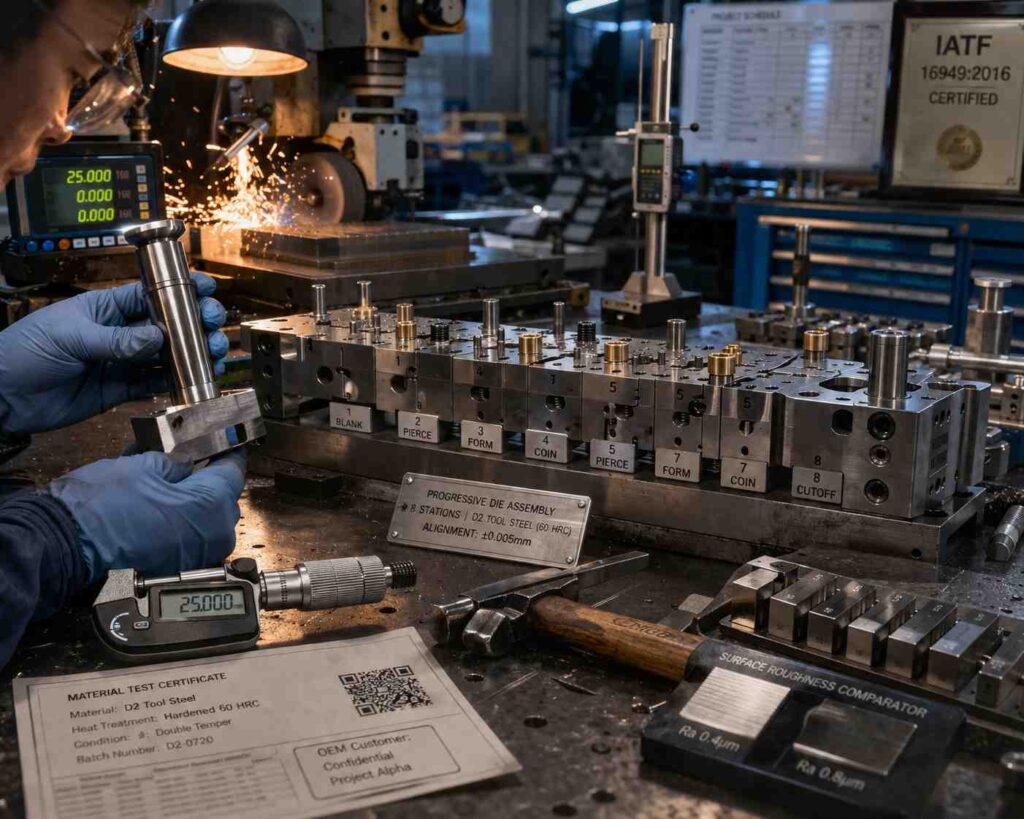
A Simple Decision Framework
- New metal part, high volume → stamping die.
- New plastic part, complex geometry → injection mold.
- Existing tooling wearing out or needing modification → tooling spare parts or custom fixtures.
What Industries Use OEM Tooling and Dies?
OEM tooling and dies support industries where consistent, repeatable part production is critical to downstream assembly and quality. Common industries include:
- Automotive/EV — stamped brackets, enclosures, and structural components under IATF 16949-aligned control.
- Electronics — precision stamped connectors and injection-molded housings.
- Industrial equipment — custom fixtures and tooling spare parts for maintaining production lines.
- Consumer products — injection-molded components requiring complex surface detail.
Detailed Spec Comparison: Stamping Dies vs. Injection Molds vs. Tooling Spare Parts
The table below compares the three tooling categories across the factors procurement teams typically weigh when deciding what to commission and from whom.
| Factor | Stamping Dies | Injection Molds | Tooling Spare Parts / Fixtures |
| Primary material formed | Sheet metal (steel, aluminum) | Thermoplastics/thermosets | N/A (replacement/support parts) |
| Design complexity | Multi-station progressive designs possible | High geometric freedom (undercuts, snap-fits) | Matched to existing tool design |
| Typical tooling cost | High | High | Low–moderate |
| Best production volume | Medium–high | Medium–high | N/A (maintenance-driven) |
| Tool maintenance need | Periodic sharpening/replacement of wear parts | Periodic cavity/cooling maintenance | Ongoing, as-needed |
| Common certifying standard | IATF 16949 (automotive) | ISO 9001 / IATF 16949 | ISO 9001 |
This comparison shows that stamping dies and injection molds, kind of have the same early cost and similar certification expectations upfront, but they go different ways real fast when it comes to the material and the geometry they can create or form. Tooling spare parts and fixtures on the other hand, are more of a lower cost quicker turnaround type of thing, and they focus on staying centered on keeping the current production tooling running reliably, not really on kicking off a brand new part.
How Do You Decide Between Domestic and Export Mold Makers in China?
Buyers usually end up choosing export mold makers in China rather than domestic suppliers, specially when they are chasing lower tooling cost, plus a wider capacity across die and mold varieties, or they want one certified provider that can cover multiple part families. But the trade off you have to look at is the communication and logistics side, like double-checking English-language technical support , shipping schedules, and what after-sales service actually looks like before you commit.
An established China-based OEM tooling manufacturer with export background, for example SSPrecision, tends to have clearly documented routines for international shipping, customs paperwork, and even remote design reviews, so the whole distance problem isn’t hanging over you.
Common Mistakes When Sourcing Tooling Overseas
- Skipping a first article inspection before full production approval.
- Not confirming which certifications (ISO 9001, IATF 16949) are current and facility-specific.
- Underestimating tool maintenance and spare parts lead time after the initial build.
- Failing to lock in material specifications in the purchase agreement.
Why Source Tooling From SSP (SSPrecision)?
SSPrecision has produced stamping dies , injection molds and tooling spare parts from Dongguan, China since 2008, and it runs under ISO 9001:2015 plus IATF 16949 certification. Since SSP builds all three tooling categories inside one quality system , buyers can grab a new stamping die , the matching injection mold, and the continuing spare parts from one certified supplier instead of having to split orders across different vendors.
For automotive and industrial customers in particular, SSP’s IATF 16949 certification helps with the paperwork and traceability needs that are usually asked for by automotive OEM quality teams.
Frequently Asked Questions
Is a stamping die or injection mold cheaper to build? Both carry high upfront tooling costs driven by design and machining time; neither is inherently cheaper, since cost depends on part size, steel grade, and geometric complexity [verify].
Can one supplier make both stamping dies and injection molds? Yes — manufacturers like SSP produce both categories, plus tooling spare parts, under a single quality management system, which simplifies sourcing for buyers needing multiple tooling types.
What does IATF 16949 certified stamping actually guarantee? It indicates the stamping and die-making process operates under a documented, automotive-specific quality management system with defined traceability and process controls, not that every part is defect-free.
How long does it take to build a production stamping die? Lead time depends on die complexity and number of stations, typically spanning several weeks from design approval to tryout [verify].
When should I order tooling spare parts instead of a new die? Order spare parts when the existing die or mold design is still valid and only specific wear components — punches, pins, inserts — need replacement rather than a full tool rebuild.
Should I choose a domestic or export mold maker in China? Choose based on total cost including tooling price, shipping, and communication overhead; export mold makers in China often offer lower tooling cost and broader capacity, provided the supplier has documented export and quality processes.
ReadingReading
Read More – Intelligence That Protects Your Production Line
- Multi-Cavity Injection Molds: Cost & Efficiency Breakdown – A 4-cavity hot runner mold costs 2.5–4x a single-cavity tool but delivers proportionally larger per-part cost savings at volume.
- Sourcing Ejector Pins & Mold Components in China – DIN 1530 ejector pins at $5.80–$8.60 per piece with ±0.002mm grinding precision and 7–15 day lead times.
- China Fiber Optic Connectors | Injection Molding Precision Parts Manufacturer Company – Fiber optic connector housings demand ±0.01 mm tolerances on critical alignment features.
- Reducing Cycle Time Through Better Mold Cooling – Cooling eats 50–70% of your cycle time—conformal channels can slash it by 20–50%.
- Stamping Die Cost Drivers: What Impacts Your Price – A single-station die costs $3,000–$8,000, while a progressive die can hit $120,000+.
- Injection molding: Hot Runner Vs Cold Runner – Hot runners add 30–50% to upfront cost but can slash cycle times by 40%.
- Injection Molding Tolerances (With Precision Chart) – Tightening a tolerance from IT7 to IT3 can triple your mold cost.
- How Much Does an Injection Mold Cost in China? – A Class 101 production mold runs $15,000–$60,000+, while a prototype tool can cost under $4,000.
- Holding ±0.001 mm: Thermal Control in Precision CNC – A 2°C temperature swing can add 7 microns of error.
-
Complete Plastic Shrinkage Chart (ABS, PC, PA66, POM) – ABS shrinks 0.4–0.7%, PC 0.5–0.7%, PA66 1.0–2.0%, and POM 0.6–1.4%—here’s how to adjust your mold design for each material.
-
How to Prevent Flash, Warpage & Sink Marks – Flash, warpage, and sink marks account for 35–40% of plastic part rejects—here’s how to eliminate them with precision tooling and process control.
- Should You Source Molds in China or Locally? – China molds cost 40–60% less with 3–6 week lead times, while local sourcing offers tighter tolerances and faster design iterations
-
Average Lead Times for China Tooling Production – Stamping dies take 4–12 weeks and injection molds 3–14 weeks depending on complexity, steel grade, and tolerance requirements.