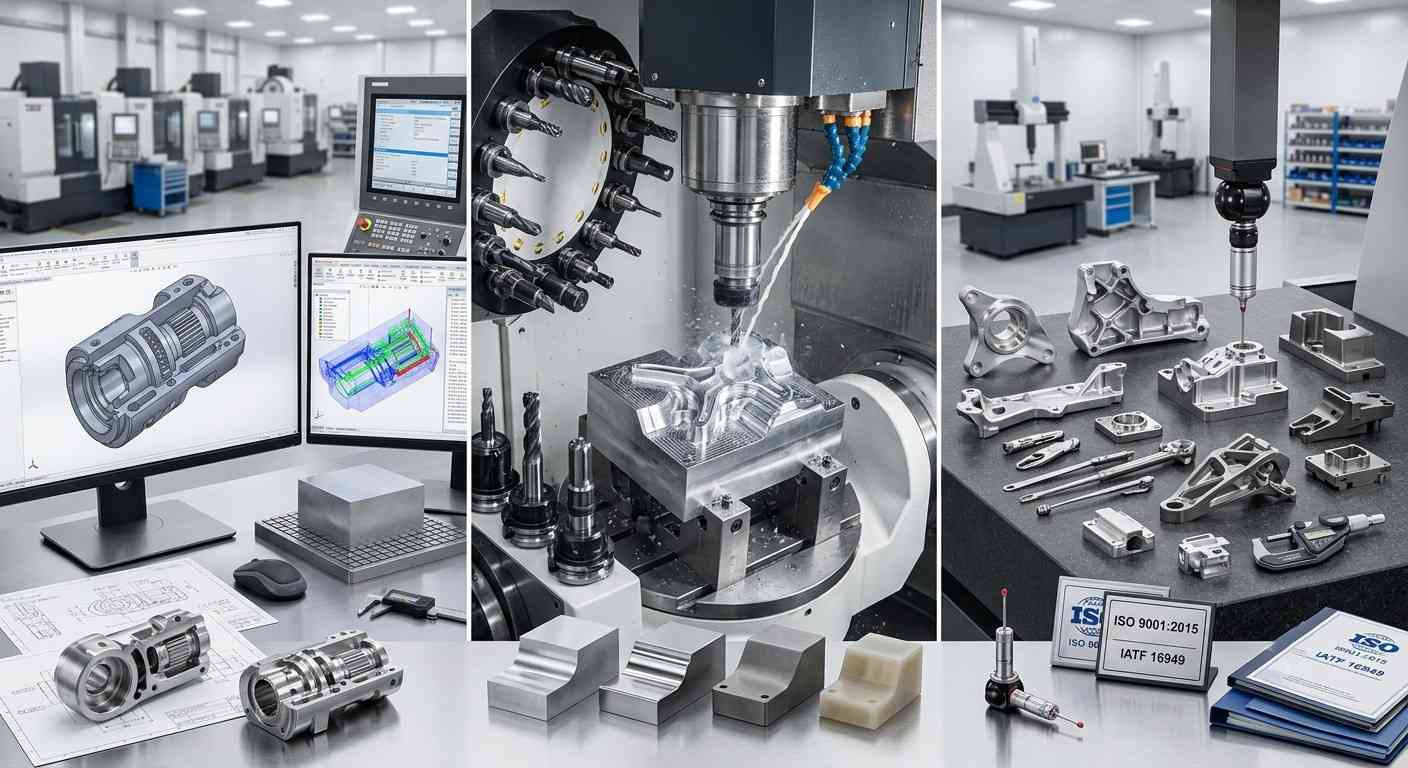
Custom machine parts manufactured in China with precision CNC machining. Custom metal parts for automotive, medical, aerospace, and industrial use.
Custom machine parts are precision components manufactured to a customer’s design specifications rather than off-the-shelf catalog items. The process starts with a CAD model, which is programmed into CNC mills, lathes, or multi-axis machining centers that cut the part from solid metal, plastic, or composite material. The result is a component matched exactly to the application, with tight tolerances and specified surface finishes.
SSPrecision (ssprecision.com.cn), an ISO 9001:2015 / IATF 16949 certified manufacturer in Dongguan, China, produces custom machine parts for automotive/EV, electronics, medical, aerospace, energy, and industrial sectors. With CNC machining capability to ±0.002 mm, they deliver precision CNC machined components from prototypes through full production runs.
| Quick Facts | Details |
| Process | CNC milling, turning, 5-axis, Swiss-type, EDM, grinding |
| Tolerance Capability | ±0.002 mm (precision), ±0.01 mm (standard) |
| Materials | Aluminum, steel, stainless, titanium, brass, PEEK, engineering plastics |
| Certifications | ISO 9001:2015, IATF 16949 |
| Quantities | 1–10 (prototype), 50–100,000+ (production) |
| Typical Lead Time | 5–10 days prototypes, 15–25 days production |
What Precision Can You Expect from CNC Machining in China?
SSPrecision achieves ±0.002 mm on critical dimensions for precision CNC machined components. Standard production tolerances range from ±0.01 to ±0.05 mm for general features. Surface finishes from Ra 0.4 to 1.6 µm are standard, with finer finishes achievable through grinding or polishing.
The achievable tolerance depends on material, part geometry, and the specific machine used. Multiaxis CNC centers and CMM inspection ensure that tight tolerances are held consistently across the production run. A DFM review identifies which features need precision and which can relax to standard, reducing cost without sacrificing quality.
Which Materials Are Available for Custom CNC Machined Parts?
A capable manufacturer offers a broad material selection so customers can match mechanical properties to the application:
- Aluminum — 6061, 6063, 7075, 2024 for lightweight structural and aerospace parts
- Steel — 1018, 1045, 4140, A2 tool steel, D2 for high-strength and wear-resistant components
- Stainless steel — 303, 304, 316, 17-4 PH for corrosion-resistant medical, food, and marine parts
- Titanium — Grade 2, Grade 5 (Ti-6Al-4V) for aerospace, medical implants, and high-performance applications
- Engineering plastics — PEEK, PTFE, Delrin, Nylon, Ultem for electrical insulation, chemical resistance, and FDA compliance
- Brass and copper — electrical conductivity, decorative hardware, valve components
How Are Custom Machine Parts Manufactured?
The production flow for custom machine parts follows a proven sequence:
- Design review — engineers analyze the CAD model for manufacturability, tolerances, and material selection
- CAM programming — toolpaths are generated in Mastercam or NX CAM, optimized for cycle time and finish
- CNC machining — material is cut on 3-axis or 5-axis mills, Swiss lathes, or multitasking machines
- First article inspection — the first-off part is fully measured against the drawing before production release
- Secondary operations — deburring, heat treatment, surface finishing, thread rolling, or assembly as specified
- Final QC and packing — dimensional report, material cert, and secure packaging for shipment
How Does CNC Machining Compare to Other Manufacturing Methods?
For quantities under 10,000 units, CNC machining offers the best combination of precision, material flexibility, and lead time. The table below compares common production methods.
| Factor | CNC Machining | 3D Printing (Metal) | Die Casting | Sheet Metal Fab |
| Tolerance | ±0.002–0.1 mm | ±0.1–0.3 mm | ±0.1–0.5 mm | ±0.2–0.5 mm |
| Surface Finish | Ra 0.4–1.6 µm | Ra 3–10 µm | Ra 1–5 µm | Ra 1.6–6.3 µm |
| Material Range | Very wide (metals, plastics, composites) | Limited (specific alloys) | Limited (castable alloys) | Moderate (sheet alloys) |
| Setup Cost | Low–medium | None | High (tooling) | Low |
| Lead Time | 5–25 days | 3–10 days | 45–90 days | 7–20 days |
| Quantity Range | 1–100,000+ | 1–100 | 10,000+ (high volume) | 50–50,000 |
| Complexity Limit | Tool access dependent | Very high (internal channels) | Draft angles required | Constant wall thickness |
CNC machining remains the most versatile method for custom machine parts because it supports virtually any material, achieves the tightest tolerances, and works economically at both prototype and production quantities. It is the default choice for functional components where mechanical properties cannot be compromised.
Which Industries Use Precision CNC Machined Components?
- Automotive & EV — Motor housings, battery terminal plates, sensor brackets, transmission valves
- Medical — Surgical instruments, implantable device components, diagnostic equipment parts
- Aerospace — Structural brackets, avionics housings, engine components, seat track hardware
- Electronics — Heat sinks, connector housings, enclosure panels, precision shields
- Energy — Valve bodies, heat exchanger plates, connector hardware, pump components
- Industrial Equipment — Manifolds, fittings, shafts, bearing housings, custom actuators
What Quality Inspections Apply to Custom Metal Parts?
Quality assurance for custom machine parts typically includes:
- First article inspection (FAI) — full dimensional measurement of the first production part
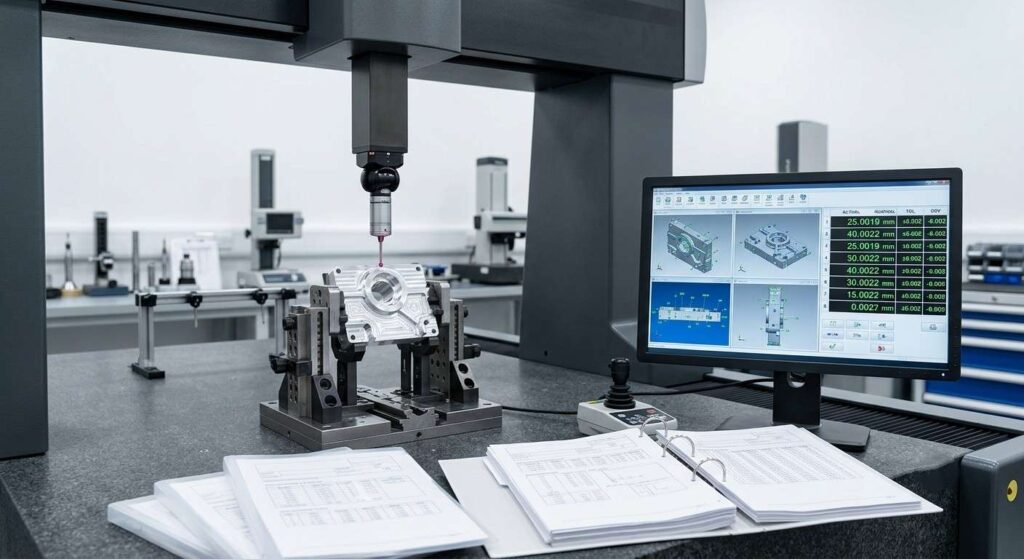
- CMM inspection — coordinate measuring machine verification of critical features
- Material certification — mill test reports traceable to the original batch
- Surface finish measurement — Ra profilometer readings on specified surfaces
- Dimensional report — complete measurement data for all called-out dimensions
- PPAP documentation — for IATF 16949 automotive programs, if required
SSPrecision provides full quality documentation with every shipment, including CMM reports and material certs as standard for production orders.
Why Choose SSPrecision for CNC Machining China?
SSPrecision combines precision manufacturing with cost-effective production in Dongguan, China. Key advantages include:
- CNC capability to ±0.002 mm on 3-axis, 5-axis, and Swiss-type machining centers
- IATF 16949 and ISO 9001:2015 certified quality systems covering all processes
- In-house CMM inspection and material verification for full traceability
- Experienced engineering team providing DFM feedback during quoting
- Flexible quantities from single prototypes to volume production with consistent quality
Whether you need a single prototype bracket or ongoing production of complex precision components, SSP delivers custom machine parts that meet your specifications on time and within budget.
SSP Is a Trusted Partner for Die Manufacturing Cost Optimization
SSP Precision is an ISO 9001 & IATF 16949 certified manufacturer delivering end-to-end precision solutions—from DFM engineering and rapid prototyping to high-volume production—for the automotive, medical, electronics, aerospace, and industrial sectors. We handle every stage in-house to manufacture the tooling that makes your parts and the parts themselves.
Visit our to explore our full capabilities: ssprecision.com.cn
Services (tooling design & manufacturing)
- Stamping Dies Manufacturing – high-volume metal stamping with Progressive Die Stamping & Tooling spare parts manufacturing and Transfer Stamping Dies
- Injection Molding – custom plastic molds including Over Molding & Insert Molding and Liquid Silicone Rubber (LSR) Molding
- Green Mold – eco-friendly molded components, Micro Molding – microscopic medical precision parts
Products (end-use parts & spare components)
- Stamping Die – complete stamping tooling
- Injection Mold – complete injection tooling
- Tooling Spare Parts – punches, inserts, ejector pins, Robotics Spare Parts – precision automation spares , Ball Screw Repair Kits – replacement kits for motion systems
- Machine Parts – general precision machine components
Frequently Asked Questions
- What are custom machine parts?
- They are components manufactured to a customer’s unique design via CNC machining, as opposed to standard catalog parts. Every dimension, material, and finish is specified in the drawing.
- What tolerances can SSPrecision achieve?
- SSPrecision holds ±0.002 mm on critical features, with standard tolerances of ±0.01–0.05 mm for general dimensions.
- What file formats do you accept for custom parts?
- STEP, IGES, STP, and STL for 3D geometry, plus PDF drawings with GD&T callouts. SSP also works directly with SolidWorks and NX files.
- What is the typical lead time?
- Prototype quantities of 1–10 parts ship in 5–10 business days. Production runs of 100+ parts range from 15–25 business days.
- Can you handle both prototypes and production?
- Yes. SSP offers prototyping, bridge tooling, and full production runs from 1 to 100,000+ parts with consistent quality and traceability.
- What certifications does SSPrecision hold?
- SSPrecision is ISO 9001:2015 and IATF 16949 certified, covering quality management for general industrial and automotive production programs.
Read More – Intelligence That Protects Your Production Line
- Heavy Duty Transfer Tooling: Multi-Station Transfer Dies for Deep-Drawn Components – Transfer dies handle individual blanks for deep-drawn and heavy gauge parts up to 8mm thick with tolerances to ±0.002mm.
- China Injection Mold Source: High-Cycle Multi-Cavity Production Plastic Molds – Multi-cavity molds produce 4–32+ parts per cycle with tolerances to ±0.002mm—here’s how to source high-volume tooling from China.
- How to Prevent Flash, Warpage & Sink Marks – Flash, warpage, and sink marks account for 35–40% of plastic part rejects—here’s how to eliminate them with precision tooling and process control.
- Complete Plastic Shrinkage Chart (ABS, PC, PA66, POM) – ABS shrinks 0.4–0.7%, PC 0.5–0.7%, PA66 1.0–2.0%, and POM 0.6–1.4%—here’s how to adjust your mold design for each material.
- Export-Ready Tooling & Dies: OEM Manufacturing for Global Supply Chains – IATF 16949-certified stamping dies, injection molds, and tooling spare parts under one roof for automotive and industrial OEM buyers.
- Multi-Cavity Injection Molds: Cost & Efficiency Breakdown – A 4-cavity hot runner mold costs 2.5–4x a single-cavity tool but delivers proportionally larger per-part cost savings at volume.
- Sourcing Ejector Pins & Mold Components in China – DIN 1530 ejector pins at $5.80–$8.60 per piece with ±0.002mm grinding precision and 7–15 day lead times.
- China Fiber Optic Connectors | Injection Molding Precision Parts Manufacturer Company – Fiber optic connector housings demand ±0.01 mm tolerances on critical alignment features.
- Reducing Cycle Time Through Better Mold Cooling – Cooling eats 50–70% of your cycle time—conformal channels can slash it by 20–50%.
-
Precision Manufacturing China: IATF 16949 Certified OEM Tooling Solutions – IATF 16949-certified stamping dies and injection molds with full quality management systems and tolerances down to ±0.002mm.
-
Precision Robotics Components: Spare Parts Supply Solutions – Custom robotics components and automation spare parts machined to ±0.002 mm—here’s the material selection guide, tolerance data, and why OEMs rely on precision machining for end-effectors, housings, and motion-critical parts.
- Top 10 Best Stamping Dies and Injection Molding Companies in the World – A data-driven ranking of the top 10 stamping die and injection molding companies globally—here’s how they compare across certifications, lead times, and cost, with a detailed China
- Injection Mold Tooling Design: Multi-Cavity Injection Molding – More cavities cut per-part cost, but only if the injection mold tooling design keeps every cavity balanced and repeatable