

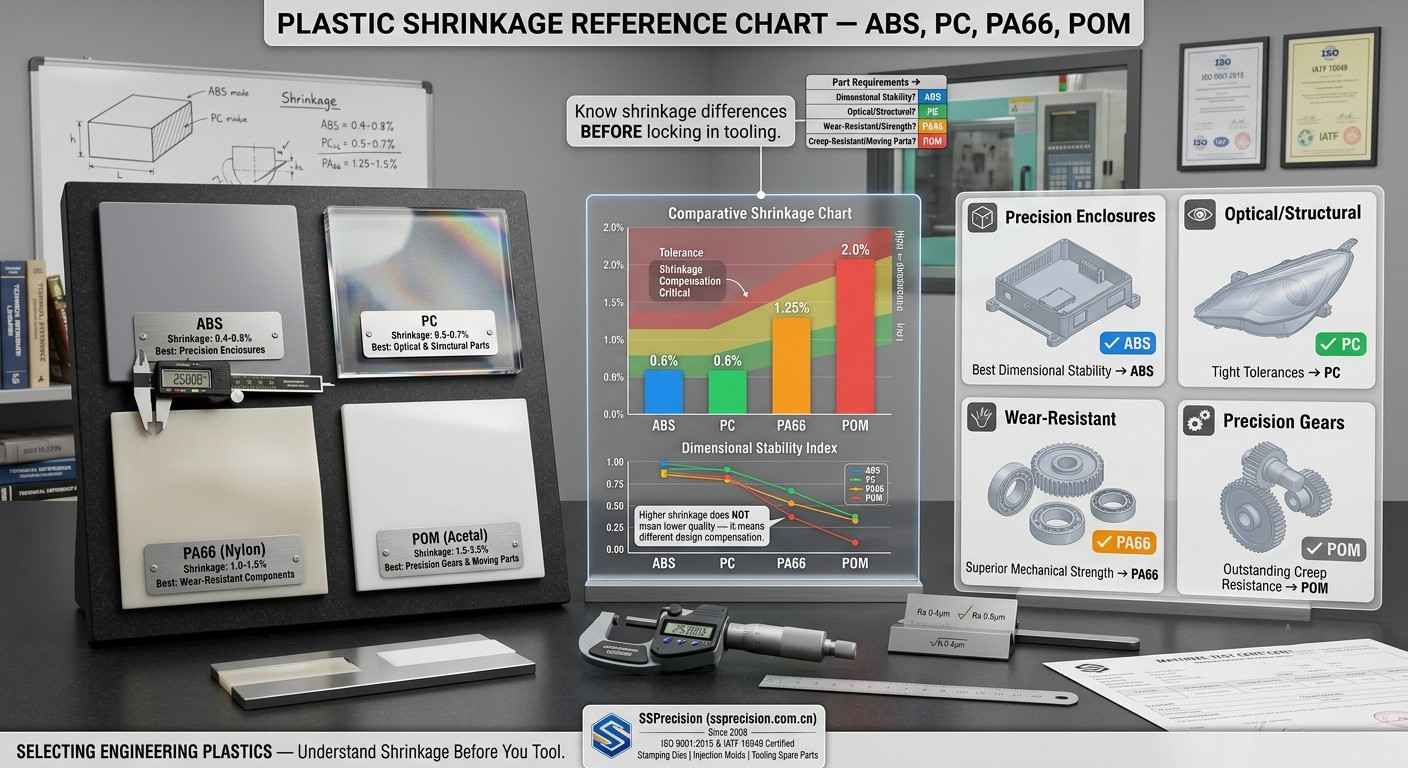
When selecting engineering plastics for injection molding, shrinkage rate is kinda the most critical dimension control thing, like really. ABS gives the most balanced shrinkage overall with solid dimensional stability , so it is often the best pick for precision enclosures. The PC usually delivers tight tolerances with a moderate shrinkage , which makes it good for optical or structural parts. PA66 actually has the highest shrinkage, but it also brings superior mechanical strength , so it fits wear-resistant components. And then POM has low shrinkage that stays consistent, plus outstanding creep resistance , which is why precision gears and moving parts tend to like it. Knowing these differences first matters before you lock in tooling.
SSPrecision (ssprecision.com.cn) has been doing that kind of work since 2008 with ISO 9001:2015 and IATF 16949 certification , and they focus on factoring these material behaviors into stamping dies, injection molds, and even tooling spare parts.
Quick Comparison: ABS vs PC vs PA66 vs POM
| Factor | ABS | PC | PA66 | POM |
| Best For | Enclosures, consumer goods, automotive interiors | Optical lenses, automotive exteriors, structural parts | Gears, bearings, automotive under-hood components | Precision gears, pump components, sliding parts |
| Shrinkage Range | 0.4–0.7% | 0.5–0.7% | 1.0–2.0% | 0.6–1.4% |
| Dimensional Stability | Excellent | Very Good | Moderate (hygroscopic) | Excellent |
| Relative Tooling Cost | Low–Medium | Medium–High | Medium | Medium |
| Lead Time Impact | Standard | Standard (+ mold flow analysis) | Standard (+ drying requirements) | Standard |
| Typical Tool Life | 500K–1M shots | 500K–1M shots | 300K–800K shots (abrasive) | 500K–1M shots |
| Moisture Sensitivity | Low | Moderate | High (must dry) | Low |
What Is Plastic Shrinkage and Why Does It Matter?
Plastic shrinkage (people also call it mold shrinkage or 缩水率) is the dimensional reduction that happens when molten polymer cools down and turns solid inside the injection mold. Basically, every engineering plastic shrinks in its own way because of molecular structure, crystallinity, fillers , and also the processing conditions.
For toolmakers and procurement buyers, shrinkage directly sets the cavity dimensions. If you build a mold without accounting for the right ABS shrinkage number or proper PC molding data , the final part comes out either undersized or oversized. That then turns into rework, extra labor, or straight-up scrap. SSPrecision’s engineering team uses material-specific shrinkage data to size cavities correctly, aiming for first-shot dimensional accuracy.
ABS Shrink Rate: The Balanced Performer
ABS (Acrylonitrile Butadiene Styrene) looks like a mostly amorphous thermoplastic, with a usual shrinkage band around 0.4–0.7% . Because it’s amorphous, its structure tends to show minimal anisotropic shrinkage, so the part usually tightens up fairly in all directions, not so much one way or another.
Key ABS Molding Data
- Shrinkage Range: 0.4–0.7% (typically 0.5% for general-purpose grades)
- Melt Temperature: 210–250°C
- Mold Temperature: 40–80°C
- Moisture Content: <0.1% (drying at 80°C for 2–4 hours recommended)
ABS is also the most forgiving material out of the four, if you’re thinking about plastic shrinkage chart rules and the usual “what if” scenarios. That relatively low and steady shrink rate makes it a decent pick for consumer electronics shells, automotive interior accents, and appliance pieces, where the appearance matters, but the dimensions still need to stay consistent.
PC Molding Data: The Optical-Grade Contender
PC (Polycarbonate) is another amorphous polymer, and its shrinkage range is typically 0.5–0.7% , a touch higher than ABS at the high end. PC is known for clarity, impact toughness, and strong heat deflection, so it often shows up in optical lenses, automotive glazing, and medical device enclosures.
Key PC Molding Data
- Shrinkage Range: 0.5–0.7% (typically 0.6%)
- Melt Temperature: 280–320°C
- Mold Temperature: 70–120°C
- Moisture Content: <0.02% (must dry at 120°C for 3–4 hours)
From SSPrecision’s PC molding side, shrinkage can land close to ABS, but the bigger differences are the melt temperature and the viscosity. Those mean you generally need tougher tooling steel , plus a more considered gate design. If the filling process is off, internal stresses can build and then warpage happens or stress cracking can appear and yes, that’s exactly the kind of thing SSPrecision tries to prevent using advanced mold flow analysis before steel is even cut.
PA66 Shrinkage: The High-Shrinkage Workhorse
PA66 (Nylon 66) is a semi-crystalline engineering plastic, with a noticeably higher shrinkage range of 1.0–2.0% . In comparison with the other materials here, it lands at the top, mainly because of its crystalline arrangement and that it’s kind of hygroscopic in everyday conditions.
Key PA66 Molding Data
- Shrinkage Range: 1.0–2.0% (typically 1.2–1.5% for unfilled grades)
- Melt Temperature: 260–290°C
- Mold Temperature: 40–90°C
- Moisture Content: <0.2% (must dry at 80°C for 4–6 hours)
The high shrink behavior of PA66 brings some special tool design hurdles. The polymer tends to take up moisture from the surrounding air, and that can lead to post-molding dimensional shifts, up to about 0.3–0.5% extra swell. So you really can’t treat PA66 shrinkage as “just” a molding-time parameter only, it has to be thought about alongside the part’s service environment too.
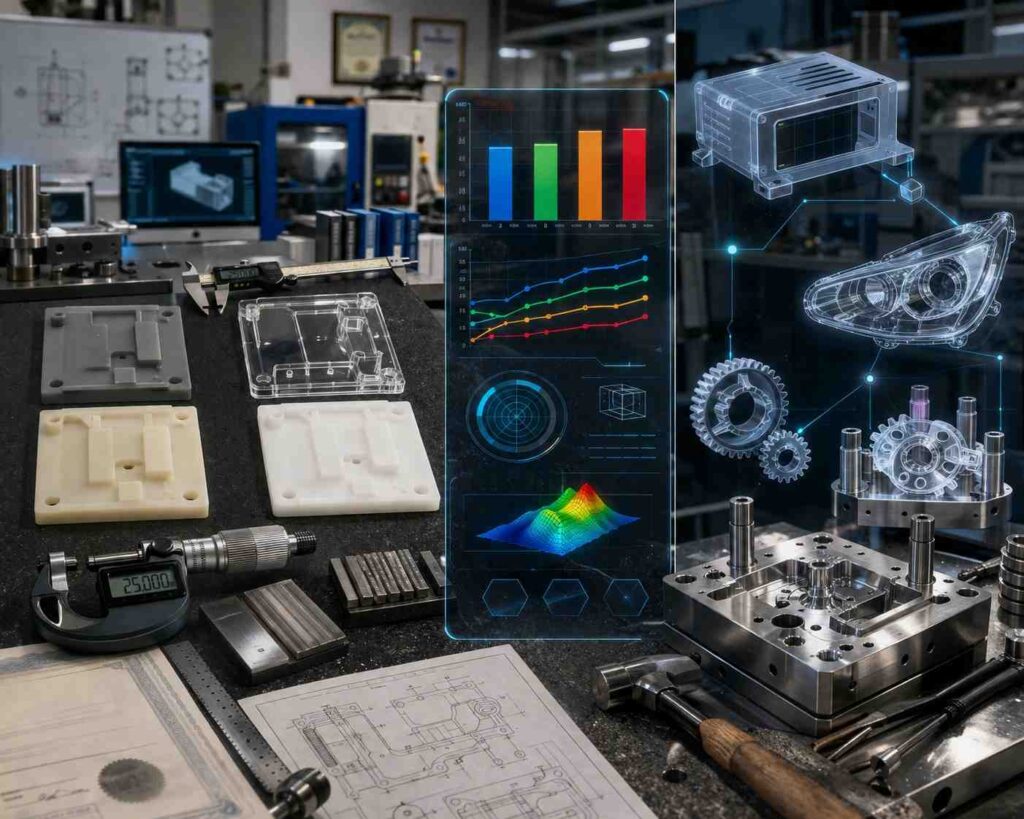
POM (Acetal) Shrinkage: The Precision Choice
POM (Polyoxymethylene, or acetal) is also semi-crystalline, and its shrinkage is typically around 0.6–1.4% . What makes it appealing is the pretty even mix of low friction, high stiffness, and solid dimensional stability, so it’s commonly selected for precision moving parts where tight tolerances matter.
Key POM Molding Data
- Shrinkage Range: 0.6–1.4% (typically 0.8–1.0% for homopolymer grades)
- Melt Temperature: 190–230°C
- Mold Temperature: 60–120°C
- Moisture Content: <0.2% (drying at 80°C for 2–4 hours)
POM’s shrinkage is more anisotropic than ABS or PC parts can come out a little smaller depending on how the melt was flowing, and also across that transverse direction. So yeah a plastic shrinkage chart for POM really has to account for both directions, and mold designers usually work with shrinkage factors around 0.8% for the flow direction and about 1.2% for the transverse direction for homopolymer grades.
Cost Tradeoffs
Tooling Cost Comparison
- ABS: generally the lowest tooling cost, like using standard P20 or H13 steel, fairly simple gating setup, and cooling that’s moderate.
- PC: usually medium to high, because you need higher-grade steel (H13/S136) for the hotter melt temperature. you also end up with a more detailed cooling design, to handle warpage in a more controlled way.
- PA66: more in the middle range, though abrasive fillers may push you toward wear-resistant coatings. It also has higher shrinkage so draft and ejection timing ends up needing a bit more generosity than usual.
- POM: also in the medium lane, kind of like ABS, but with more focus on gating and venting. mainly because formaldehyde gas release during processing needs to be treated carefully.
Part Complexity and Volume Fit
| Material | Simple Parts | Complex Parts | High-Volume | Low-Volume |
| ABS | Excellent | Excellent | Excellent | Excellent |
| PC | Good | Good (requires careful gating) | Good | Good |
| PA66 | Good | Moderate (shrinkage/warpage risk) | Good | Moderate |
| POM | Good | Good (requires directional shrinkage planning) | Excellent | Good |
Industries and Common Use Cases
- ABS: interior automotive trim, appliance casings, consumer electronics parts, toys, medical device housings.
- PC: exterior automotive lenses, headlamp covers, medical sterilization trays, electronic display panes, safety goggles.
- PA66: engine covers, intake manifolds, gears, bearings, electrical connectors, cable ties.
- POM: precise gears, cam linkages, pump impellers, valve elements, conveyor components, zipper parts.
How to Decide: Selection Framework
- If dimensional stability is your #1 priority → ABS or PC (low, predictable shrinkage).
- If mechanical strength and heat resistance are critical → PA66 (account for 1.0–2.0% shrinkage).
- If wear resistance and low friction are essential → POM (plan for anisotropic shrinkage).
- If optical clarity is required → PC (the only transparent option among these four).
- If cost is the primary constraint → ABS (lowest material and tooling cost).
SSP Is a Trusted Partner for Die Manufacturing Cost Optimization
SSP Precision is an ISO 9001 & IATF 16949 certified manufacturer delivering end-to-end precision solutions, from design and prototyping to high‑volume production, for the automotive, medical, electronics, aerospace, and industrial sectors. We handle every stage in‑house – DFM engineering, rapid prototyping, CNC machining, EDM, grinding, and global logistics – to manufacture the tooling that makes your parts and the parts themselves.
What we build and supply: visit our sites: https://SSP.com.cn/
- Stamping dies manufacturing and stamping die parts – high‑precision transfer stamping dies and progressive/compound dies for volume metal stamping.
- Injection molding and injection mold – custom injection molds for plastic components, including single‑, multi‑cavity, and over‑molding & insert‑molding tools that combine metal and plastic in one part.
- Specialty molded components – eco‑friendly green mold parts and microscopic medical micro‑molded parts.
- Precision metal and plastic end‑use parts – high‑volume serial production of precision products (metal stampings, plastic moldings) with full PPAP traceability.
- Tooling spare parts manufacturing & – tooling spare parts (punches, inserts, ejector pins) and precision robotics spare parts to keep your production running.
FAQ
Q1: Which plastic ends up with the lowest shrinkage, like ABS , PC, PA66 , or POM?
From what’s typical, ABS and PC share the lowest shrinkage band ( ABS around 0.4–0.7% and PC around 0.5–0.7% ) , but ABS is often the steadier and more predictable one in real runs.
Q2: So why does PA66 show such high shrinkage compared with ABS?
It’s because PA66 is semi-crystalline. During cooling its molecules sort of arrange into more ordered crystal regions, and that ordered packing makes a bigger volumetric drop than the amorphous type behavior you usually see in ABS or PC.
Q3: Does POM shrink the same in every direction or it has quirks?
Yes, POM is anisotropic. So it does not shrink equally: for homopolymer grades you’ll commonly see about 0.8% in the flow direction and closer to 1.2% in the transverse direction.
Q4: Can I just use the same mold for ABS and PC since their shrinkage looks similar?
Not really. Even if the shrinkage ranges overlap a bit, PC runs hotter in melt processing ( roughly 280–320°C ) while ABS is lower ( about 210–250°C ). That usually means different tool steels, and different cooling logic, so a mold tuned for one may not be happy with the other.
Read More – Intelligence That Protects Your Production Line
- Export-Ready Tooling & Dies: OEM Manufacturing for Global Supply Chains – IATF 16949-certified stamping dies, injection molds, and tooling spare parts under one roof for automotive and industrial OEM buyers.
- Multi-Cavity Injection Molds: Cost & Efficiency Breakdown – A 4-cavity hot runner mold costs 2.5–4x a single-cavity tool but delivers proportionally larger per-part cost savings at volume.
- Sourcing Ejector Pins & Mold Components in China – DIN 1530 ejector pins at $5.80–$8.60 per piece with ±0.002mm grinding precision and 7–15 day lead times.
- China Fiber Optic Connectors | Injection Molding Precision Parts Manufacturer Company – Fiber optic connector housings demand ±0.01 mm tolerances on critical alignment features.
- Reducing Cycle Time Through Better Mold Cooling – Cooling eats 50–70% of your cycle time—conformal channels can slash it by 20–50%.
- Stamping Die Cost Drivers: What Impacts Your Price – A single-station die costs $3,000–$8,000, while a progressive die can hit $120,000+.
- Injection molding: Hot Runner Vs Cold Runner – Hot runners add 30–50% to upfront cost but can slash cycle times by 40%.
- Injection Molding Tolerances (With Precision Chart) – Tightening a tolerance from IT7 to IT3 can triple your mold cost.
- How Much Does an Injection Mold Cost in China? – A Class 101 production mold runs $15,000–$60,000+, while a prototype tool can cost under $4,000.
-
How to Prevent Flash, Warpage & Sink Marks – Flash, warpage, and sink marks account for 35–40% of plastic part rejects—here’s how to eliminate them with precision tooling and process control.
- Should You Source Molds in China or Locally? – China molds cost 40–60% less with 3–6 week lead times, while local sourcing offers tighter tolerances and faster design iterations
-
Average Lead Times for China Tooling Production – Stamping dies take 4–12 weeks and injection molds 3–14 weeks depending on complexity, steel grade, and tolerance requirements.
-
Microelectronics Injection Molding: Precision Micro Molding for Tech OEMs – Micro injection molding achieves ±0.01 mm tolerances on parts weighing under 1 gram for connectors, sensors, and lens arrays.