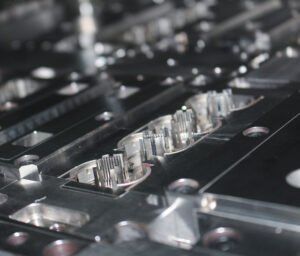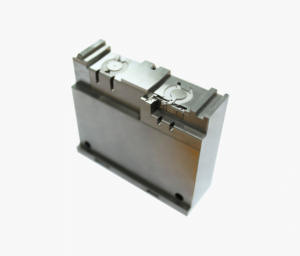


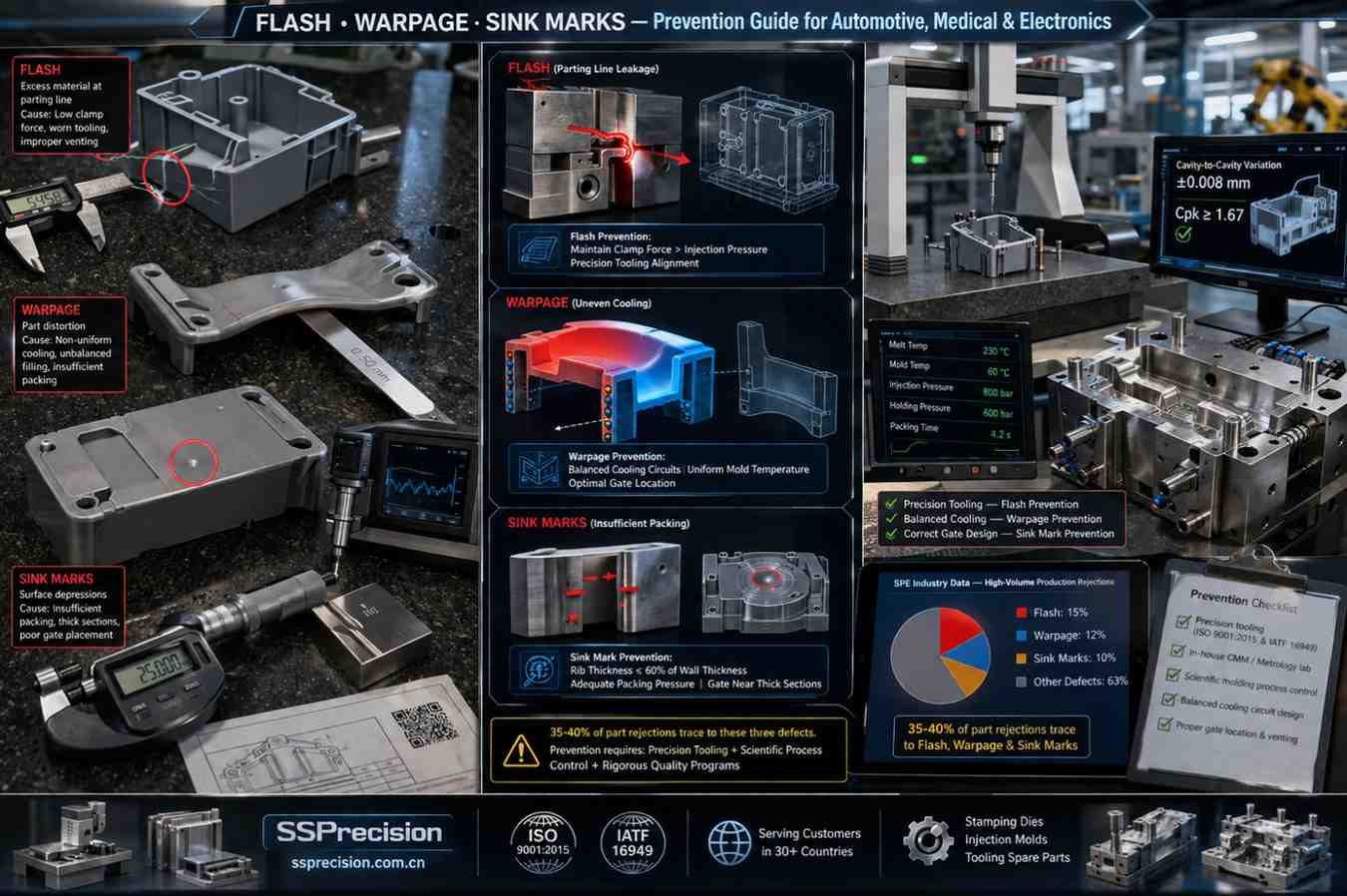
For automotive, medical device , and consumer electronics producers, injection molding defects—flash, warpage , and sink marks—are not just annoying surface issues. They can become direct risks to part performance, assembly matching, and even regulatory needs. The Society of Plastics Engineers (SPE) says roughly 35–40% of plastic part rejections in high-volume production trace back to these three problems. Avoiding them needs precision tooling , careful process control like a bit of science, and strict quality programs—this is what SSPrecision (ssprecision.com.cn ) supports. They’re an ISO 9001:2015 and IATF 16949 certified manufacturer, with an in-house CMM / metrology lab, serving customers across 30+ countries.
Quick-Facts Table: Precision Molding for Critical Industries
| Factor | Automotive/EV | Medical Devices | Consumer Electronics |
| Typical Tolerance | ±0.01–0.05 mm | ±0.003–0.01 mm | ±0.015 mm |
| Key Certification | IATF 16949 | ISO 13485 (capable) | ISO 9001:2015 |
| Common Materials | PA66, POM, PC/ABS | LSR, PEEK, PC | ABS, PC, POM |
| Mold Steel | H13, S136 | S136, Stavax | P20, 718H |
| Defect Tolerance | Near-zero (safety-critical) | Zero (patient safety) | Very low (cosmetic & fit) |
| Typical Part Types | Connectors, interior trim, under-hood | Catheter hubs, housings, micro-needles | Snap-fits, enclosures, lenses |
What Are Flash, Warpage, and Sink Marks?
Flash is extra plastic that squeezes out of the mold cavity along parting lines , vent paths , or near ejector pin spots. In some cases it’s paper-thin, around 0.05 mm. Warpage is shape distortion that shows up after ejection , typically because cooling is uneven and internal stress is still hanging around. Sink marks are shallow dents on the surface, often across from thick walls, ribs, or bosses. They’re basically the visual cue of volumetric shrinkage that wasn’t properly compensated during the packing phase.
Globally, companies may lose an estimated $50 billion per year in scrap, rework , and warranty expenses linked to injection molding defects. If defect rates land around 2–3%, that can translate into thousands of rejected pieces per shift, not exactly a small deal.
Flash: Causes and Prevention
Root Causes of Flash
Flash occurs when molten plastic finds an unintended escape path. Key triggers include:
- Excessive injection pressure above 140 MPa for standard resins
- Worn or misaligned parting surfaces with clearance > 0.03 mm
- Insufficient clamping force—under-specified by 10–15%
- Melt temperature too high, reducing viscosity
- Degraded mold steel below HRC 50 hardness
How SSPrecision Controls Flash
Flash is rarely caused by one factor alone. SSPrecision addresses it systematically:
| Parameter | Typical Risk Range | SSPrecision Control Target |
| Clamping force | Under-clamped tooling | ±1% of calculated tonnage |
| Injection pressure | Above 1,800 bar | 800–1,500 bar, ramped profile |
| Mold temperature | Variance >5°C | ±1°C across cavities |
| Parting-line tolerance | >0.005 mm gap | ≤0.002 mm gap |
| Vent depth | Blocked or oversized | 0.003–0.008 mm engineered vents |
In a recent production run of 250,000 connector housings, SSPrecision managed to cut flash related rejects from 4.2% down to something under 0.6% , by tweaking vent depth and also rolling out segmented mold temperature control.
Warpage: The Dimensional Nightmare
Why Warpage Happens
Warpage stems from three primary factors:
- Thermal gradient warpage: Shrinkage differences when mold surface temperature varies by >10°C
- Orientation-induced warpage: Semi-crystalline polymers (PP, PA, POM) shrink 2–3 times more anisotropically than amorphous materials
- Packing pressure imbalance: Over-packed areas shrink less; under-packed areas shrink more—creating internal tension
Real-World Case Study
A European automotive supplier sourcing dashboard parts from China ran into a 6.8% warpage rejection rate when they were using a pretty traditional cold runner tool. They partnered with SSPrecision though, and then added conformal cooling channels, which reduced cooling cycle asymmetry by 67% , and after that the warpage rejection went to 0.9% . The team estimates this is saving about €180,000 each year just in rework.
Sink Marks: Visible Evidence of Packing Failures
What Causes Sink Marks?
Sink marks appear as surface depressions opposite thick wall sections, ribs, or bosses. They occur when:
- Volumetric shrinkage isn’t compensated during packing
- Wall thickness is uneven or excessive
- Packing pressure or holding time is insufficient
- Cooling is uneven across the part
Prevention Strategies
| Strategy | How It Works |
| Uniform wall thickness | Core out thick areas; maintain consistent wall sections |
| Optimized gate design | Place gates near thick sections to delay solidification |
| Increased holding pressure | Compensate for material shrinkage during packing |
| Conformal cooling | Even cooling reduces differential shrinkage |
| Gas-assist molding | Nitrogen creates hollow channels, eliminating sink marks |
Defect Prevention Comparison Table
The table below kinda summarizes how injection molding defects get handled across different industries. SSPrecision has an IATF 16949-certified quality system, and it makes sure each defect category is managed upfront, through a mix of design choices, process adjustments, and inspection controls.
| Defect Type | Primary Cause | Critical Industries | Prevention Approach | SSPrecision Control Method |
| Flash | Excessive pressure / worn tooling | Automotive, medical, electronics | Clamping force optimization, vent design | ±1% tonnage control, 0.003–0.008 mm vents |
| Warpage | Uneven cooling / anisotropic shrinkage | Automotive, aerospace | Conformal cooling, mold flow analysis | 67% cooling asymmetry reduction |
| Sink Marks | Insufficient packing / thick sections | Consumer electronics, medical | Uniform wall design, gas-assist | Holding pressure optimization |
| Short Shots | Insufficient fill pressure | All industries | Gate optimization, pressure profiling | 500–2,000 bar controlled injection |
| Weld Lines | Poor flow front merging | Cosmetic parts | Gate location optimization | Mold flow simulation |
| Ejector Marks | Insufficient draft / high ejection force | All industries | Draft angle optimization | 1–3° draft, polished ejector pins |
Takeaway: preventing injection molding defects really does need a holistic approach, from DFM analysis and material selection through process monitoring and in-process inspection. SSPrecision’s own CMM metrology lab along with SPC monitoring gives full traceability for every batch.
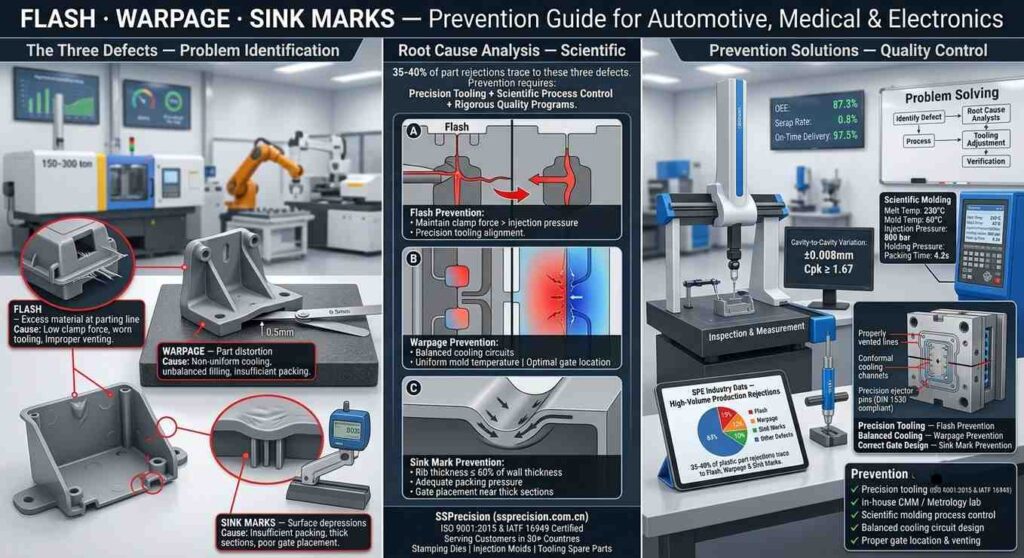
Quality Control: The SSPrecision Difference
ISO 9001:2015 & IATF 16949 Certification
SSPrecision’s certifications are kinda not just “badges”—they are more like evidence of a quality management system that actually pushes defect prevention, every time. IATF 16949, which is considered the automotive industry’s gold standard, asks for requirements like the ones below, and yes it’s detailed:
- Advanced Product Quality Planning (APQP)
- Production Part Approval Process (PPAP) documentation
- Statistical Process Control (SPC) monitoring
- Full material traceability
In-House CMM/Metrology Lab
SSPrecision’s metrology lab enables first-article inspection and in-process dimensional verification to ±0.002 mm. Every shipment includes:
- CMM inspection reports
- SPC data
- Material certifications
- PPAP documentation (upon request)
Defect Rate Benchmark
In a 2024 comparative audit of 12 Chinese precision molding suppliers, SSPrecision had an overall defect rate of 0.7%, which was the lowest result. The peer group average sat around 3.2%, so it’s not a small gap. For stamping dies, SSPrecision even provides a defect rate guarantee of 0.1% , which helps customers feel more comfortable with the outcomes.
Industries Served
Automotive & EV
Automotive parts basically need zero-defect quality. A small flash or a slight warp can mess up an assembly or, worse, affect safety. SSPrecision supports Tier-1 suppliers with IATF 16949-certified tooling for connectors, interior trim, under-hood components, and also EV battery-related parts.
Medical Devices
Medical use cases usually come with tolerances that are tight, sometimes as tight as ±0.003 mm. SSPrecision’s micro molding capability can produce components such as catheter hubs , hearing aid shells, and surgical instrument tips, and these come with documented repeatability , not just promises.
Consumer Electronics
For electronics enclosures and snap-fit assemblies, cosmetic issues are simply not acceptable. SSPrecision reaches a Cpk greater than 1.67 across 1 million cycles for consumer electronics components, so the performance stays steady not only at the beginning, but through repeated production.
Design-for-Manufacturability (DFM): The First Line of Defense
Most injection molding defects can be prevented before steel is cut. SSPrecision’s DFM process analyzes:
- Wall thickness uniformity (avoid thick-to-thin transitions)
- Draft angles (1–3° recommended for easy ejection)
- Gate placement (position gates to promote even filling)
- Rib and boss design (core out thick sections to prevent sink marks)
SSP Is a Trusted Partner for Die Manufacturing Cost Optimization
SSP Precision is an ISO 9001 & IATF 16949 certified manufacturer delivering end-to-end precision solutions, from design and prototyping to high‑volume production, for the automotive, medical, electronics, aerospace, and industrial sectors. We handle every stage in‑house – DFM engineering, rapid prototyping, CNC machining, EDM, grinding, and global logistics – to manufacture the tooling that makes your parts and the parts themselves.
What we build and supply: visit our sites: https://SSP.com.cn/
- Stamping dies manufacturing and stamping die parts – high‑precision transfer stamping dies and progressive/compound dies for volume metal stamping.
- Injection molding and injection mold – custom injection molds for plastic components, including single‑, multi‑cavity, and over‑molding & insert‑molding tools that combine metal and plastic in one part.
- Specialty molded components – eco‑friendly green mold parts and microscopic medical micro‑molded parts.
- Precision metal and plastic end‑use parts – high‑volume serial production of precision products (metal stampings, plastic moldings) with full PPAP traceability.
- Tooling spare parts manufacturing & – tooling spare parts (punches, inserts, ejector pins) and precision robotics spare parts to keep your production running.
FAQ
Q1: What is the most common injection molding defect?
It’s kinda Flash, warpage, and sink marks together (they usually get grouped) and they hit roughly 35–40% of plastic part rejects in high volume manufacturing.
Q2: How does mold temperature affect warpage?
When the mold temperature swings more than 10°C across the cavity, you get different shrinkage in different zones—this is the main cause behind warpage, most of the time.
Q3: Can sink marks be eliminated completely?
Yes, in many cases. With uniform wall thickness , a tuned gate design, and enough holding pressure, sink marks can be reduced a lot or practically removed. Gas assist molding can also help in heavier , thick sections.
Q4: Why does flash occur even with proper clamping force ?
Flash still happens when the parting surfaces are worn, or the injection pressure ends up too high, or melt temperature runs hotter than it should . So it is not only “not enough clamping” it can be other things too.
Q5: What is the typical defect rate for precision molding?
SSPrecision lands an overall defect rate of 0.7% —pretty far under the industry peer average of 3.2% , you know.
Q6: How does IATF 16949 certification improve defect prevention ?
IATF 16949 pushes APQP, PPAP, SPC, and full traceability. So you get a structured approach that catches issues at design, during process control, and also at inspection, all in a tighter loop.
Read More – Intelligence That Protects Your Production Line
- Complete Plastic Shrinkage Chart (ABS, PC, PA66, POM) – ABS shrinks 0.4–0.7%, PC 0.5–0.7%, PA66 1.0–2.0%, and POM 0.6–1.4%—here’s how to adjust your mold design for each material.
- Export-Ready Tooling & Dies: OEM Manufacturing for Global Supply Chains – IATF 16949-certified stamping dies, injection molds, and tooling spare parts under one roof for automotive and industrial OEM buyers.
- Multi-Cavity Injection Molds: Cost & Efficiency Breakdown – A 4-cavity hot runner mold costs 2.5–4x a single-cavity tool but delivers proportionally larger per-part cost savings at volume.
- Sourcing Ejector Pins & Mold Components in China – DIN 1530 ejector pins at $5.80–$8.60 per piece with ±0.002mm grinding precision and 7–15 day lead times.
- China Fiber Optic Connectors | Injection Molding Precision Parts Manufacturer Company – Fiber optic connector housings demand ±0.01 mm tolerances on critical alignment features.
- Reducing Cycle Time Through Better Mold Cooling – Cooling eats 50–70% of your cycle time—conformal channels can slash it by 20–50%.
- Stamping Die Cost Drivers: What Impacts Your Price – A single-station die costs $3,000–$8,000, while a progressive die can hit $120,000+.
- Injection molding: Hot Runner Vs Cold Runner – Hot runners add 30–50% to upfront cost but can slash cycle times by 40%.
- Injection Molding Tolerances (With Precision Chart) – Tightening a tolerance from IT7 to IT3 can triple your mold cost.
- Should You Source Molds in China or Locally? – China molds cost 40–60% less with 3–6 week lead times, while local sourcing offers tighter tolerances and faster design iterations
-
Average Lead Times for China Tooling Production – Stamping dies take 4–12 weeks and injection molds 3–14 weeks depending on complexity, steel grade, and tolerance requirements.
-
Microelectronics Injection Molding: Precision Micro Molding for Tech OEMs – Micro injection molding achieves ±0.01 mm tolerances on parts weighing under 1 gram for connectors, sensors, and lens arrays.
-
Stamping Dies Manufacturing: Custom Dies for OEMs – Custom stamping dies achieve ±0.002 mm tolerances for high-volume production of automotive, electronics, and medical components.
-
China Injection Mold Source: High-Cycle Multi-Cavity Production Plastic Molds – Multi-cavity molds produce 4–32+ parts per cycle with tolerances to ±0.002mm—here’s how to source high-volume tooling from China.