Stamping dies manufacturing: custom metal stamping dies produce high-volume precision parts to ±0.002mm for automotive, electronics, and medical.
Stamping dies manufacturing is the engineering discipline of creating precision tooling that transforms flat metal coil stock into finished components through high-speed mechanical presses. Custom metal stamping dies combine progressive die design, precision machining of tool steel components, and rigorous tryout to produce consistent, high-volume metal parts for industries from automotive to medical devices. This article explores how stamping dies are designed, built, and qualified, and explains why working with an experienced die maker like SSPrecision delivers faster ramp-up, longer tool life, and lower cost per part for OEM procurement teams.
Key Takeaways
- Precision & Volume: Produces high-volume parts with tight tolerances down to ±0.002 mm.
- Progressive Die Capabilities: Combines multiple operations (blanking, forming, piercing, and tapping) in a single press stroke.
- Served Industries: Supports automotive/EV, electronics, medical, aerospace, and energy sectors.
- Quality Certifications: Backed by ISO 9001:2015 and IATF 16949 certification.
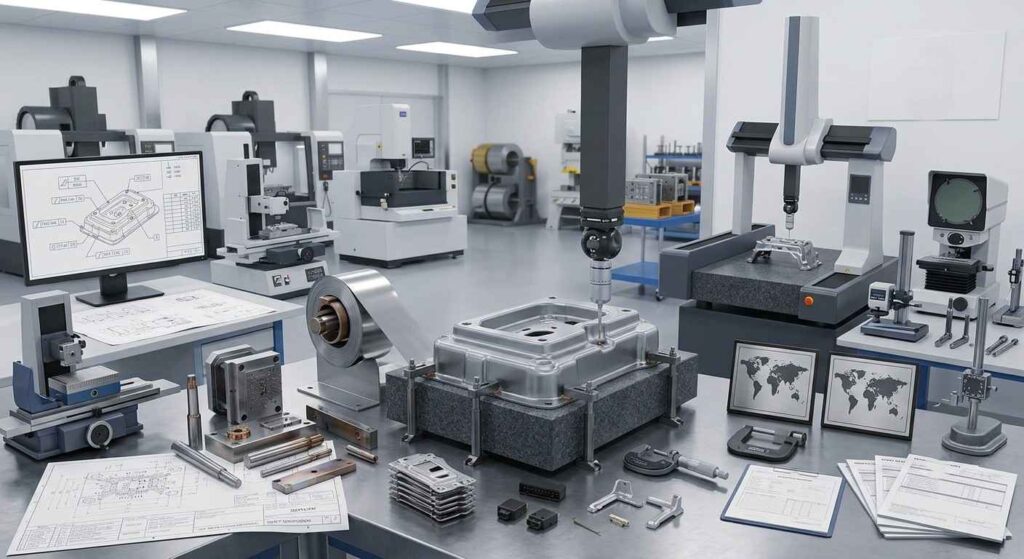
- Quality Assurance: Features in-house CMM (coordinate measuring machine) metrology for precise inspection.
Stamping Dies at a Glance
| Parameter | Typical Information |
| Typical tolerance | ±0.002 – 0.05 mm |
| Common die materials | D2, A2, M2 HSS, Carbide, 1.2379 |
| Maximum part size | Up to 600 × 600 mm (press-dependent) |
| Certifications | ISO 9001:2015 / IATF 16949 |
| Typical lead time | 6–12 weeks per die |
| Industries served | Automotive/EV, electronics, medical, aerospace, energy |
What Is Stamping Dies Manufacturing?
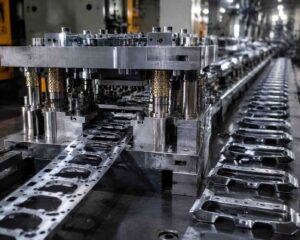
Stamping dies manufacturing refers to the design and fabrication of tooling used in mechanical and hydraulic presses to cut, form, and shape sheet metal into finished parts. Each die consists of precision-machined steel components — punches, die inserts, strippers, and pilots — that work together in a controlled sequence to produce parts at speeds of hundreds of strokes per minute.
Dies are classified by their operation. Progressive dies move coil-fed strip through multiple stations, performing one operation per station. Transfer dies move individual blanks between stations using mechanical fingers. Compound dies perform multiple operations at a single station. The selection depends on part geometry, volume, and material.
What Are the Main Types of Metal Stamping Dies?
- Progressive Dies (Most Common): Used for high-volume production; perform multiple operations (blanking, piercing, forming, coining, and cutting off) in sequence as the strip advances through stations.
- Benefits of Progressive Dies: Eliminate secondary operations and reduce labor costs.
- Transfer Dies: Preferred for larger or asymmetrical parts that cannot be carried on a coil strip.
- Compound Dies: Best suited for simple, flat parts produced in moderate volumes.
- Expert Recommendation: Experienced die makers (e.g., SSP) recommend the optimal die type during the Design for Manufacturability (DFM) review.
What Steel Grades Are Used in Stamping Dies?
The table below compares common die steel grades used in stamping dies manufacturing, along with their hardness ranges, wear resistance, toughness, and typical applications. Choosing the right steel directly affects tool life and part consistency.
| Steel Grade | Hardness (HRC) | Wear Resistance | Toughness | Best Application |
| D2 / 1.2379 | 58–62 | High | Moderate | Blanking, forming dies, general purpose |
| A2 / 1.2363 | 57–62 | Moderate | High | Cold forming, trim dies, intricate details |
| M2 HSS | 62–65 | Very high | Low | High-wear cutting edges, punches |
| Carbide (WC) | 78–82 | Extremely high | Very low | Ultra-high volume inserts, long-run dies |
| 1.2343 (H11) | 48–54 | Moderate | High | Hot stamping dies, high-temp forming |
| O1 / 1.2510 | 58–62 | Moderate | High | Short-run prototype dies, low-volume production |
Selecting the right material is a balance between required tool life and cost. D2 tool steel is the default for many stamping applications. For ultra-high volume runs exceeding 1 million parts, carbide inserts at critical wear points can significantly extend die life between maintenance intervals.
What Tolerances Can Precision Stamping Dies Achieve?
- Die Manufacturing Capabilities: Modern CNC and EDM machining enable stamping dies to hold tolerances to ±0.002 mm on critical dimensions (punch-to-die clearance, station pitch, and form profiles).
- SSPrecision’s Approach: Achieves this precision through a combination of precision wire EDM, jig grinding, and temperature-controlled machining.
- Part Tolerances by Material:
- Thin-gauge stainless steel (0.1–0.3 mm): Can hold ±0.01 mm in production.
- Thicker structural steel (2–4 mm): Typically achieves ±0.05 mm.
- Validation & Quality Control: Tolerances are validated using in-house CMM and vision measurement systems before the die ships.
How Are Custom Stamping Dies Designed and Built?
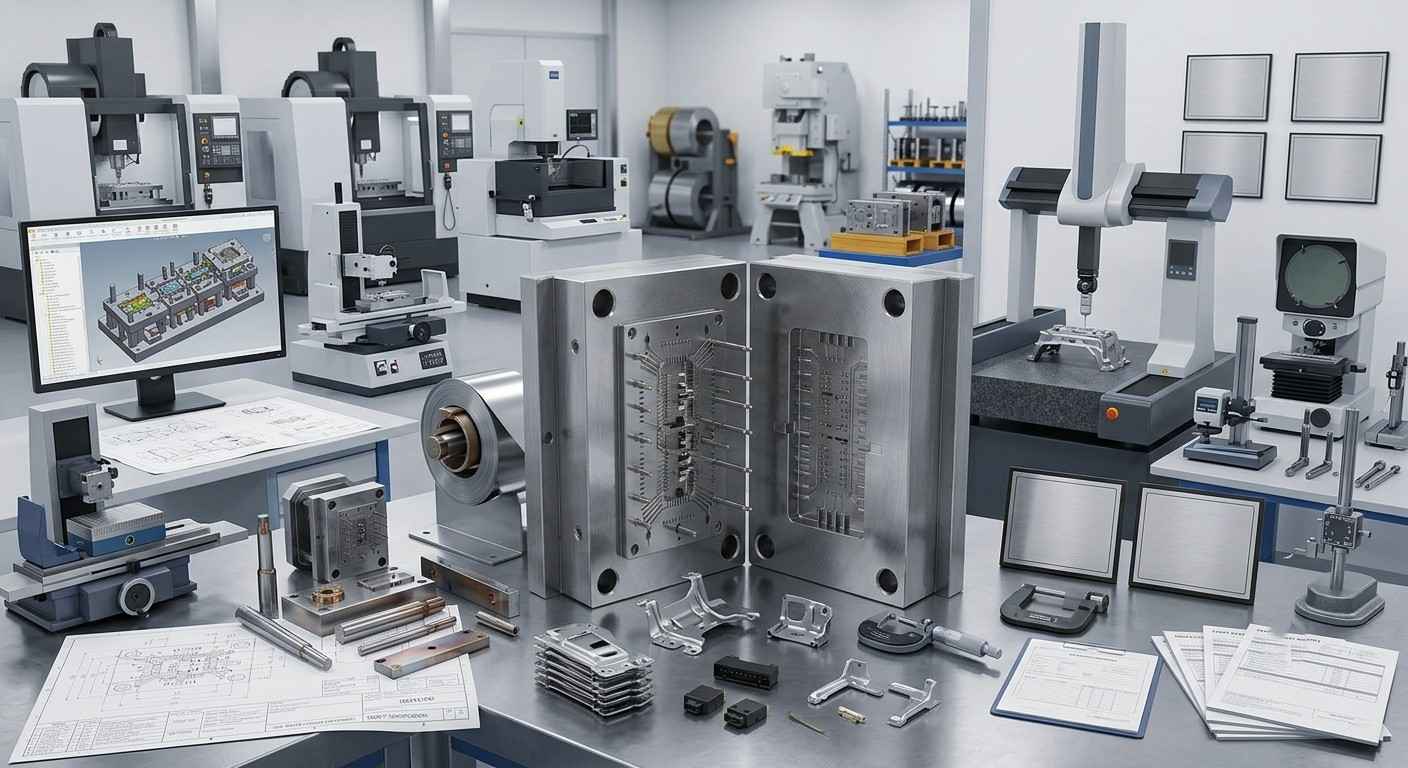
The die manufacturing process follows a structured workflow. It begins with a design for manufacturing (DFM) review where part geometry, material, volume, and press specifications are evaluated. The strip layout is optimized to minimize scrap and distribute forces evenly.
Steel is selected and rough-machined, then heat-treated to the specified hardness. Finish machining combines high-speed CNC milling and wire EDM for internal contours. After fitting and assembly, the die undergoes tryout on a production press, where sample parts are measured and adjustments are made until the output meets specification. SSP provides first-article inspection reports (FAIR) with every new die.
Which Industries Rely on Custom Metal Stamping Dies?
The automotive and EV sector is the largest consumer of stamping dies, using them for brackets, mounting plates, busbars, connectors, and structural reinforcements. Electronics applications include EMI shields, contact springs, connector terminals, and heat sink frames.
In medical device manufacturing, stamping produces surgical instrument components, implant blanks, and diagnostic device parts from stainless steel and titanium. The aerospace and energy sectors use custom dies for clips, clamps, heat exchanger plates, and battery interconnects. SSP has built tooling for all these industries, shipping to 30+ countries since 2008.
How Does Die Quality Affect Production Performance?
Die quality directly determines part consistency, press uptime, and tool maintenance frequency. A well-designed die with correctly specified clearances and steel grades can run millions of strokes between maintenance events. A poorly built die produces inconsistent parts, causes press downtime, and wears rapidly.
IATF 16949 certification adds automotive-grade requirements for risk assessment (FMEA), process control plans, and gauge repeatability studies. For OEMs sourcing tooling from Asia, a certified die builder reduces the qualification burden and provides the documentation trail that global procurement requires.
How to Select a Stamping Die Manufacturer for Your Project?
When evaluating a die maker, start with tolerance capability and certification. A manufacturer holding ISO 9001:2015 and IATF 16949 has documented quality systems for design review, material traceability, and inspection. In-house metrology — CMM, vision, and surface measurement — is a strong indicator of quality focus.
Experience in your specific industry matters. Die designs for automotive structural parts differ significantly from those for microelectronic contacts. SSPrecision brings over 15 years of cross-industry stamping die experience, with engineers who understand the nuances of each application. Request a DFM review to evaluate fit.
SSP Is a Trusted Partner for Die Manufacturing Cost Optimization
SSP Precision is an ISO 9001 & IATF 16949 certified manufacturer delivering end-to-end precision solutions—from DFM engineering and rapid prototyping to high-volume production—for the automotive, medical, electronics, aerospace, and industrial sectors. We handle every stage in-house to manufacture the tooling that makes your parts and the parts themselves.
Visit our to explore our full capabilities: ssprecision.com.cn
Services (tooling design & manufacturing)
- Stamping Dies Manufacturing – high-volume metal stamping with Progressive Die Stamping & Tooling spare parts manufacturing and Transfer Stamping Dies
- Injection Molding – custom plastic molds including Over Molding & Insert Molding and Liquid Silicone Rubber (LSR) Molding
- Green Mold – eco-friendly molded components, Micro Molding – microscopic medical precision parts
Products (end-use parts & spare components)
- Stamping Die – complete stamping tooling
- Injection Mold – complete injection tooling
- Tooling Spare Parts – punches, inserts, ejector pins, Robotics Spare Parts – precision automation spares , Ball Screw Repair Kits – replacement kits for motion systems
- Machine Parts – general precision machine components
Frequently Asked Questions
- What is the typical tolerance for a stamping die?
Die components can be machined to ±0.002 mm. Parts in production achieve ±0.01 to ±0.05 mm depending on material and thickness.
- How long does it take to build a custom stamping die?
Typical lead times range from 6 to 12 weeks, depending on die complexity, cavity count, and material availability.
- What is the difference between progressive and transfer dies?
Progressive dies feed coil strip through sequential stations for high-volume small-to-medium parts. Transfer dies move individual blanks between stations for larger or more complex geometries.
- What steel is best for stamping dies in high-volume production?
D2 (1.2379) is the standard general-purpose steel. For ultra-high volumes, carbide inserts at wear points extend tool life by 5–10×.
- How many parts can a stamping die produce before needing maintenance?
Well-maintained progressive dies produce 500,000 to several million parts between sharpening cycles, depending on material, steel grade, and coatings.
- What is IATF 16949 and why does it matter for stamping dies?
IATF 16949 is the automotive quality management standard requiring FMEA, control plans, and gauge R&R. It ensures the die builder follows rigorous defect-prevention processes required by automotive and medical OEMs.
Read More – Intelligence That Protects Your Production Line
- Microelectronics Injection Molding: Precision Micro Molding for Tech OEMs – Micro injection molding achieves ±0.01 mm tolerances on parts weighing under 1 gram for connectors, sensors, and lens arrays.
- Average Lead Times for China Tooling Production – Stamping dies take 4–12 weeks and injection molds 3–14 weeks depending on complexity, steel grade, and tolerance requirements.
- Should You Source Molds in China or Locally? – China molds cost 40–60% less with 3–6 week lead times, while local sourcing offers tighter tolerances and faster design iterations.
- Export-Ready Tooling & Dies: OEM Manufacturing for Global Supply Chains – IATF 16949-certified stamping dies, injection molds, and tooling spare parts under one roof for automotive and industrial OEM buyers.
- Multi-Cavity Injection Molds: Cost & Efficiency Breakdown – A 4-cavity hot runner mold costs 2.5–4x a single-cavity tool but delivers proportionally larger per-part cost savings at volume.
- Sourcing Ejector Pins & Mold Components in China – DIN 1530 ejector pins at $5.80–$8.60 per piece with ±0.002mm grinding precision and 7–15 day lead times.
- China Fiber Optic Connectors | Injection Molding Precision Parts Manufacturer Company – Fiber optic connector housings demand ±0.01 mm tolerances on critical alignment features.
-
China Injection Mold Source: High-Cycle Multi-Cavity Production Plastic Molds – Multi-cavity molds produce 4–32+ parts per cycle with tolerances to ±0.002mm—here’s how to source high-volume tooling from China.
-
Heavy Duty Transfer Tooling: Multi-Station Transfer Dies for Deep-Drawn Components – Transfer dies handle individual blanks for deep-drawn and heavy gauge parts up to 8mm thick with tolerances to ±0.002mm.
-
Custom Machine Parts: High-Precision CNC Machined Components China – CNC machining delivers custom metal and plastic parts to ±0.002mm from prototypes to production runs of 100,000+ units.
- LSR Injection Molding | Precision Liquid Silicone Rubber – LSR injection molding cures at 5 seconds per millimeter of wall thickness with tolerances to ±0.002mm
-
Precision Manufacturing China: IATF 16949 Certified OEM Tooling Solutions – IATF 16949-certified stamping dies and injection molds with full quality management systems and tolerances down to ±0.002mm.