Choosing the best tooling setup for a high-volume injection molding program really comes down to weighing initial cash outlay against the slower, quieter wins of long-term operating efficiency. Still, if you do not run a careful Mold Runner Comparison, procurement folks and product designers can end up paying twice, once up front and then again later in day to day production time. At SS Precision (SSP), we focus on reviewing tricky component shapes so we can propose high-performance tooling solutions that hold very tight tolerances of up to ±0.002mm, all while shrinking your total manufacturing footprint. @wiki info
- Tooling architecture is basically the bedrock for your production economics, it impacts both cycle speed and part uniformity.
- Upgraded thermal manifolds reduce post-production manual work by making parts that come out clean and typically need zero mechanical degating.
- Working with a vetted precision toolmaker helps you preserve full traceability , from raw steel certifications to automated machining routes.
Fundamental Definitions: Hot Runner Vs Cold Runner
For procurement teams, you need a clear starting point, so it helps to understand how a runner system behaves inside an injection mold. In simple terms , a runner system is the set of engineered passageways that move molten polymer from the injection molding machine nozzle into each cavity.
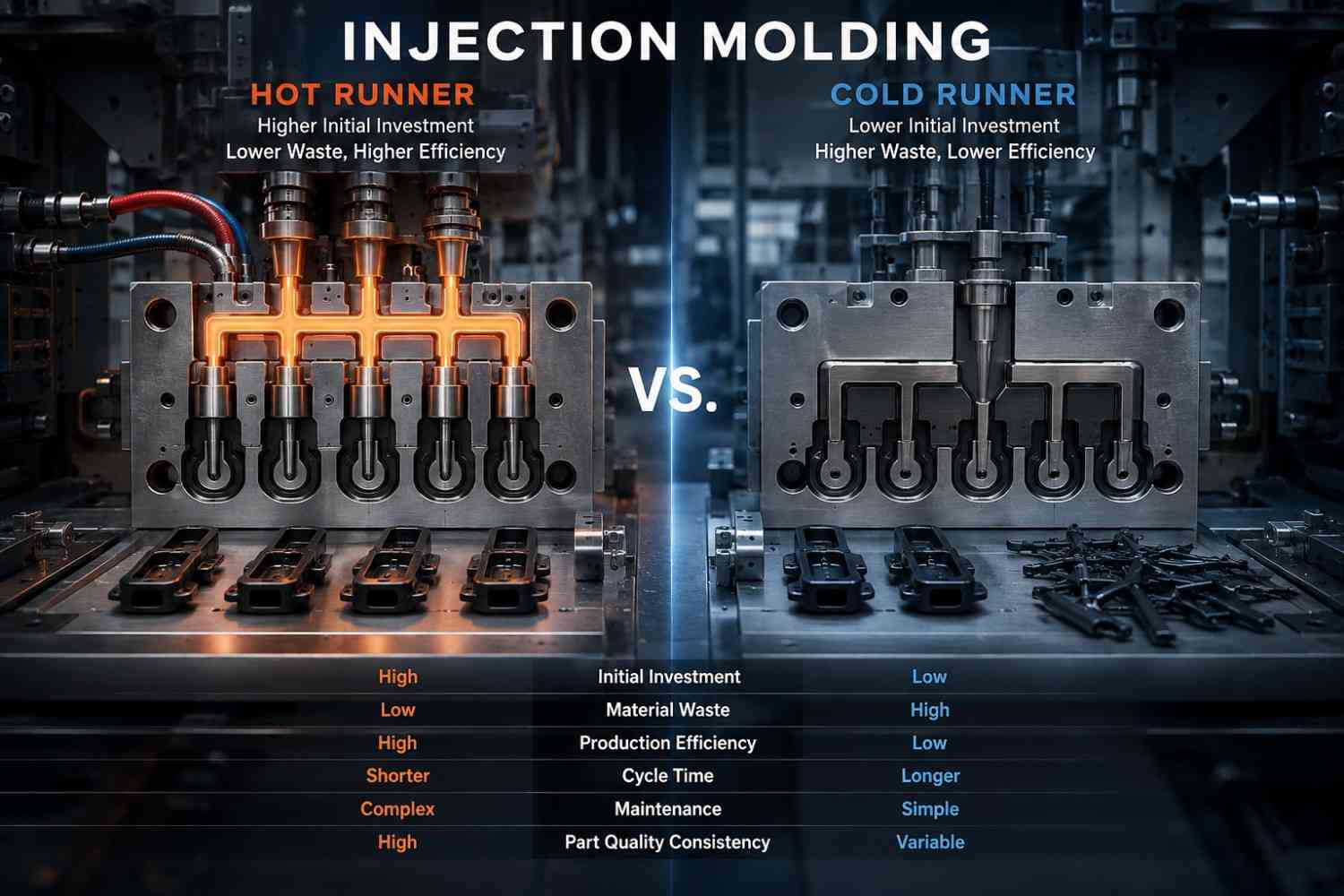
With a cold runner arrangement, the melt inside those passages cools and turns solid along with the part itself, so the runner typically must be ejected every press cycle. On the other hand, a hot runner system uses an internally or externally heated manifold to keep the polymer continuously in a molten state within the channels, which means only the finished molded part is released when the tool opens.
Analyzing Initial Mold Runner System Cost
When you evaluate where the money actually starts in these systems, you need a pretty clear breakdown of the engineering difficulty, not just a quick guess. For example, a cold runner mold is mechanically pretty plain, it generally uses normal tool steels and run of the mill CNC milling, so the first Mold Runner System Cost stays low, and the initial buy is quite economical overall.
If you upgrade to a hot runner configuration the initial cost goes up a lot. That Mold Runner System Cost increase mostly comes from putting in specialized heated manifolds, adding electrical nozzle tips, and also building separate external digital temperature regulation zones. So that upfront premium should be treated like a capital asset investment, it’s not “just expense” , it’s more like something that later changes the way output behaves and how smoothly production moves.
| System Parameter Metric | Standard Cold Runner Tool | Advanced Hot Runner Tool | Tooling Cost and Asset Impact |
| Upfront Tooling Cost | Low baseline capital expense | 30% to 50% premium increase | Hot runners require specialized heated manifolds. |
| Design Engineering Hours | Standard layout overhead | High complexity planning | Manifold flow balancing requires advanced simulation. |
| Ancillary Equipment Needs | None / Standard press setup | External temperature controller | Requires dedicated electrical wiring integration. |
| Spare Parts Inventory | Minimal / Standard ejector pins | Heater bands, thermocouples, tips | High-precision hot components require stocking. |
Maximizing Cycle Time Efficiency and Throughput
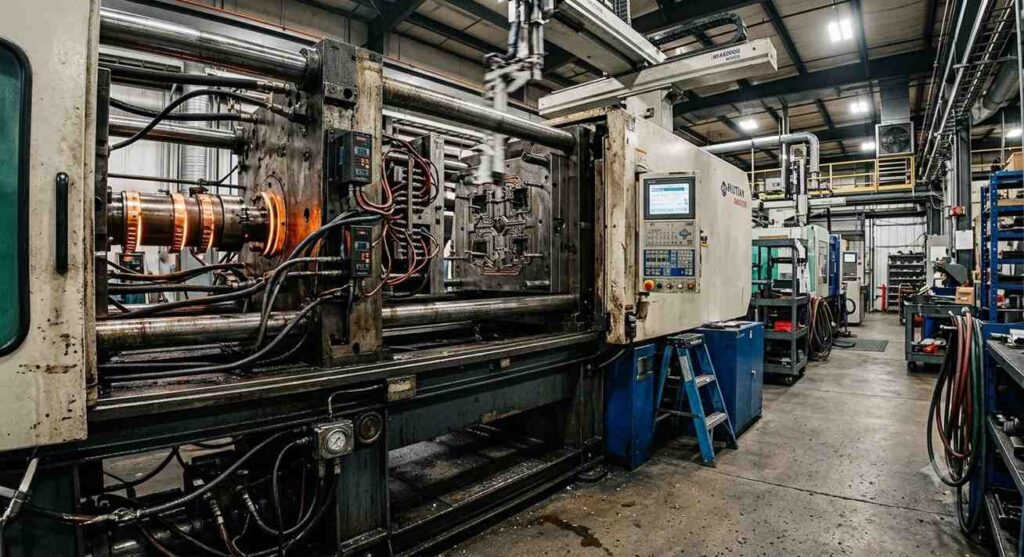
In mass production, speed is basically the main profitability lever. With a hot runner layout, you can drastically improve cycle time efficiency because you remove the biggest slowdown in injection molding, which is simply waiting for those bulky plastic passages to cool down enough. Thick cold runners typically need about double the cooling time compared with the thin-walled section, so the machine ends up running a longer cycle than you really want. Hot runners, on the other hand, remove the runner cooling window entirely, meaning the press can open as soon as the real part wall stabilizes.
For a concrete example, cutting the cycle time from 30 seconds to 18 seconds translates into an immediate 40% jump in daily production output.
Material Waste Mitigation and Injection Molding Savings
Getting raw plastic resin is a major recurring operational cost for any shop. With a cold runner system, every single cycle tends to create a good amount of scrap, because the solidified runner has to be trimmed off the part afterward.
While some materials can be reground and reused , this whole thing brings contamination concerns, plus it tends to weaken the polymer’s physical traits over time. Hot runners avoid that material waste completely, so you can unlock significant Injection Molding Savings since 100% of the injected resin actually goes right into making saleable components, not leftovers or scrap.
Thermal Uniformity and Rheological Balancing in Tooling
Getting consistent structural uniformity on a multi-cavity tool means you really have to nail balanced thermal and pressure behavior across every square millimeter of the mold. With hot runners, each heating zone is independently managed, so the molten plastic stays right at its exact optimum processing temperature, all the way to the gate. That tight thermal control reduces premature cooling, which helps keep packing pressure essentially identical in every cavity , and it helps remove the usual defects such as sink marks, short shots, and dimensional distortion.
Maintenance Milestones and Operational Overhead
For long-term tool dependability you need to match what your facility can maintain with how mechanically involved the asset really is. Hot runners do provide top tier production benefits, though they do call for more technical know-how to keep things stable across millions of cycles, so planning matters.
| Maintenance Vector | Cold Runner Protocol | Hot Runner Protocol |
| Daily Cleaning Cycle | Simple plate wiping and lubrication | Checking electrical connections and heater resistance |
| Unexpected Downtime Risk | Low; rare mechanical blockage | Moderate; potential gate freeze-off or heater failure |
| Refit Complexity | Low; standard toolroom benchwork | High; requires specialized wiring and seals |
| Tool Lifespan Standard | Dependent on steel selection | Enhanced due to reduced overall clamping tonnage |
Processing Complex and High-Performance Resins
The selection of plastic resin really sets the stage for which runner setup is even sorta technically possible. With normal everyday commodity plastics like polypropylene , PP or polyethylene , PE, both runner approaches can work without too much trouble, and they can run reliably too.
But once you move into the high temperature engineering resins , or the very abrasive types with glass reinforcement, cold runners start feeling it. Think PA66 with around 30% glass fiber, cold runners can show big pressure drops, and then the gate region wears down quickly, like faster than expected. In those cases hot runner valve gates give that clean positive mechanical shut-off that you need, so you can process the tricky material classes without ending up with cosmetic stringing, or worse flashing.
Technical Sourcing Resources
SSP Precision is an ISO 9001 & IATF 16949 certified manufacturer delivering end-to-end precision solutions, from design and prototyping to high‑volume production, for the automotive, medical, electronics, aerospace, and industrial sectors. We handle every stage in‑house – DFM engineering, rapid prototyping, CNC machining, EDM, grinding, and global logistics – to manufacture the tooling that makes your parts and the parts themselves.
What we build and supply: visit our sites: https://ssprecision.com.cn/
- Stamping dies manufacturing and stamping die parts – high‑precision transfer stamping dies and progressive/compound dies for volume metal stamping.
- Injection molding and injection mold – custom injection molds for plastic components, including single‑, multi‑cavity, and over‑molding & insert‑molding tools that combine metal and plastic in one part.
- Specialty molded components – eco‑friendly green mold parts and microscopic medical micro‑molded parts.
- Precision metal and plastic end‑use parts – high‑volume serial production of precision products (metal stampings, plastic moldings) with full PPAP traceability.
- Tooling spare parts manufacturing & – tooling spare parts (punches, inserts, ejector pins) and precision robotics spare parts to keep your production running.
Real-World Performance: SS Precision Case Study
- The Industrial Challenge : An automotive tier-1 manufacturer was cranking out high-volume nylon electrical housings with a 4-cavity cold runner tool. The chunky plastic runner waste was sitting at about 45% of the total shot weight, and the longer cool-down time really put a lid on the production rate .
- The Custom Engineering Response : SS Precision basically rebuilt the whole approach , putting in an 8-cavity hot runner tool with an internally heated manifold plus dedicated valve gates to manage the sensitive nylon resin .
- The Quantifiable Outcome : With the new hot runner setup, the cycle time dropped from 26 seconds to 14 seconds, so the output volume climbed. Cutting the runner scrap meant saving 1,200 kilograms of raw resin each week , which led to an immediate return on investment , right inside the first five months of active production.
Procurement Sourcing Checklist for Tooling Engineers
Before you lock in your next injection molding tooling order, use this engineering checklist so your system design actually matches your production ambitions:
- Get a handle on your total estimated lifetime production volume, to check whether the hot runner’s material savings truly outweigh the upfront equipment premium.
- Make sure your molding floor has presses already running with the relevant integrated temperature control cards , so the heated manifold can be used properly .
- Review the resin’s shear sensitivity plus its workable processing temperature range, to avoid scorching or burning while material travels through a hot manifold.
- Call out global standard parts, like DME or HASCO, so replacement heater bands and tips stay easy to source without annoying lead-time gaps .
Frequently Asked Sourcing Questions
Can a cold runner mold be retrofitted into a hot runner system later?
In theory yes but in reality, doing that kind of switch later is highly complex and often just not very cost-effective. You usually have to re-machine the main die shoes again to fit the heated manifold, add wiring channels for the electrical side, and redo the entire gating layout so it behaves right. At that point it s often way more efficient to just build a dedicated hot runner tool from the beginning, even if it feels like more work upfront.
What is a hot runner gate freeze-off, and how do you fix it?
A freeze-off happens when the temperature down at the hot runner tip drops too far, so the plastic inside the gate starts to solidify. Once that gate turns “blocked” it won’t allow the next injection cycle to feed cleanly. Most of the time you fix it by tweaking the digital temperature controller zone settings. If it still keeps happening then replacing a worn thermocouple tip in the manifold assembly is usually the next step.
Which system is better for low-volume prototype manufacturing?
For low-volume production runs that are under about 20,000 total parts, a cold runner system is typically the better pick. Since the tool fabrication cost is much lower, the extra material waste is generally the tradeoff you can live with. That way you can get prototypes out into the market with a smaller initial financial commitment, rather than paying for hot runner tooling too early.
Read More – Intelligence That Protects Your Production Line
-
Injection Molding Tolerances (With Precision Chart) – Tightening a tolerance from IT7 to IT3 can triple your mold cost—here’s the precision grade chart, material-specific shrinkage data, and how to specify only what your design actually needs.
-
How Much Does an Injection Mold Cost in China? – A Class 101 production mold runs $15,000–$60,000+, while a prototype tool can cost under $4,000—here’s the SPI classification breakdown and the 5 key cost drivers that shape your final quote.
-
Holding ±0.001 mm: Thermal Control in Precision CNC – A 2°C temperature swing can add 7 microns of error—here’s how thermal control architecture, spindle warm-up protocols, and granite bases make the difference between hitting tolerance and scrapping the part.
-
D2 vs DC53 Tool Steel: Which is Best for Stamping? – D2 has been the industry standard, but DC53 offers twice the toughness and better machinability—here’s the metallurgical data to decide which alloy delivers lower total cost of ownership for your stamping application.
-
How to Track & Prevent Tool Wear in Progressive Dies – Acoustic sensors, tonnage monitoring, and carbide inserts can push die life beyond 200,000 strokes—here’s the data on tracking wear thresholds before they become catastrophic failures.
-
China Fiber Optic Connectors | Injection Molding Precision Parts Manufacturer Company – Fiber optic connector housings demand ±0.01 mm tolerances on critical alignment features—here’s the material selection guide, cavity configuration data, and quality control protocols for precision optical components.
-
Reducing Cycle Time Through Better Mold Cooling – Cooling eats 50–70% of your cycle time—here’s how conformal cooling channels, turbulent flow design, and high-conductivity inserts can slash cooling time by 20–50% and cut overall cycle time by 15–35%.
-
Sourcing Ejector Pins & Mold Components in China – DIN 1530 ejector pins at $5.80–$8.60 per piece with ±0.002mm grinding precision and 7–15 day lead times.