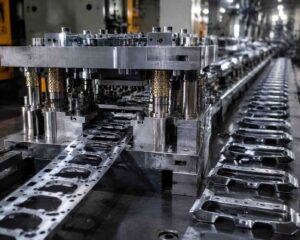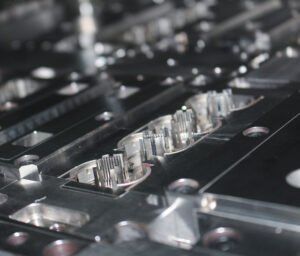
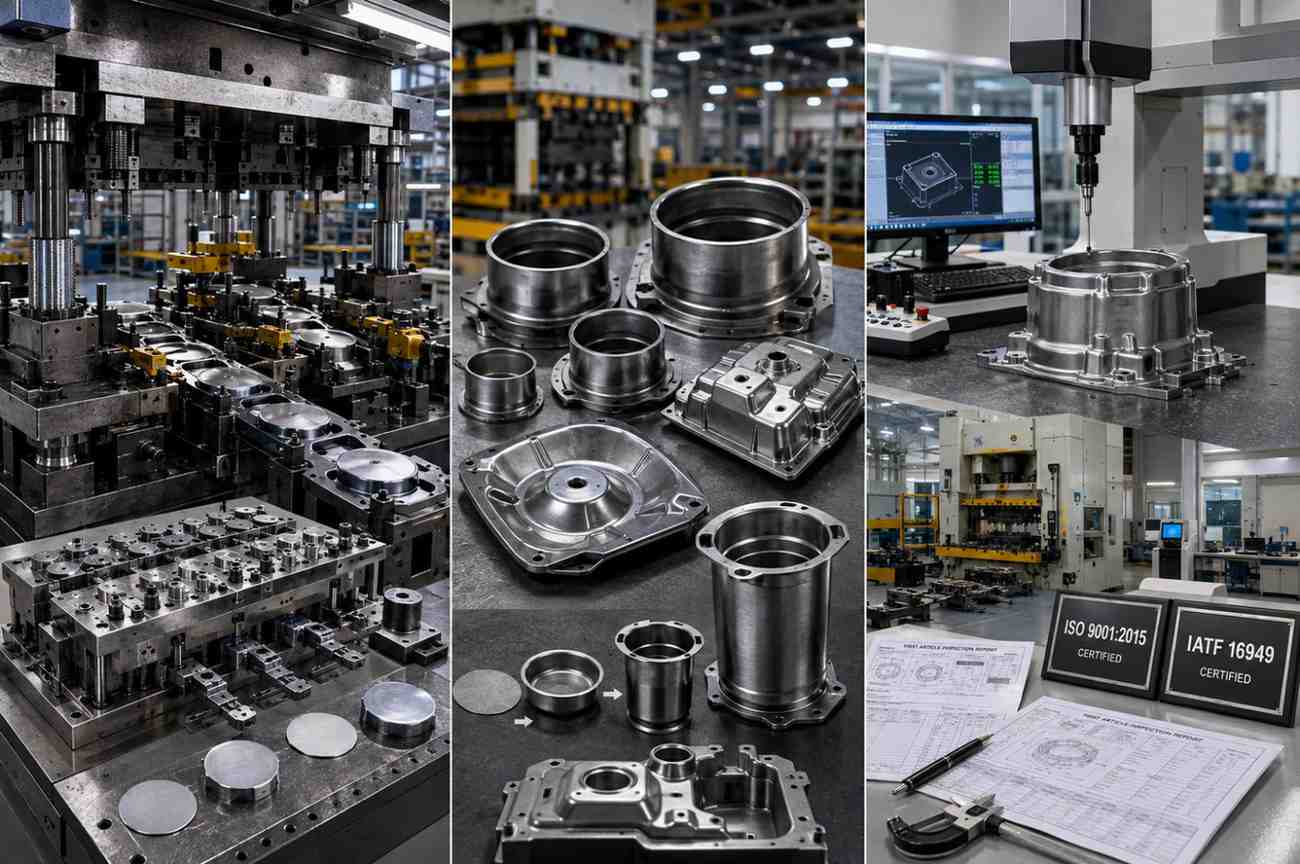
Heavy duty transfer tooling is a stamping die system that moves metal workpieces through multiple forming stations using mechanical fingers, robots, or servo transfers. Unlike progressive dies where the part stays attached to a strip, transfer dies handle individual blanks — making them ideal for deep-drawn components, heavy gauge parts, and complex geometries that require aggressive forming in multiple axes.
SSPrecision (ssprecision.com.cn), an ISO 9001:2015 / IATF 16949 certified toolmaker in Dongguan, China, specializes in designing and building multi-station transfer dies for the automotive, electronics, medical, and energy sectors. With tolerance capability to ±0.002 mm, their transfer tooling produces deep-drawn and heavy gauge metal components for demanding production environments.
Key Takeaways
- Heavy duty transfer tooling handles deep-drawn and complex geometries that progressive dies cannot produce
- Transfer die stamping achieves tolerances down to ±0.002 mm for precision metal components
- Ideal for automotive structural parts, EV battery components, and heavy gauge industrial stampings
- Multi-station designs enable complex forming sequences with individual blank handling
| Quick Facts | Details |
| Process | Multi-station transfer die stamping |
| Tolerance Capability | ±0.002 mm (precision), ±0.01–0.05 mm (standard) |
| Material Thickness | 0.5–8 mm+ (heavy gauge capability) |
| Certifications | ISO 9001:2015, IATF 16949 |
| Industries Served | Automotive/EV, Electronics, Medical, Aerospace, Energy, Industrial |
| Typical Lead Time | 8–20 weeks for design, build, and tryout |
What Is Heavy Duty Transfer Tooling?
Heavy duty transfer tooling refers to a stamping die set where individual sheet metal blanks are transferred between consecutive forming stations by an external mechanism. Each station performs one operation — drawing, piercing, trimming, flanging, or restriking — until the part is complete.
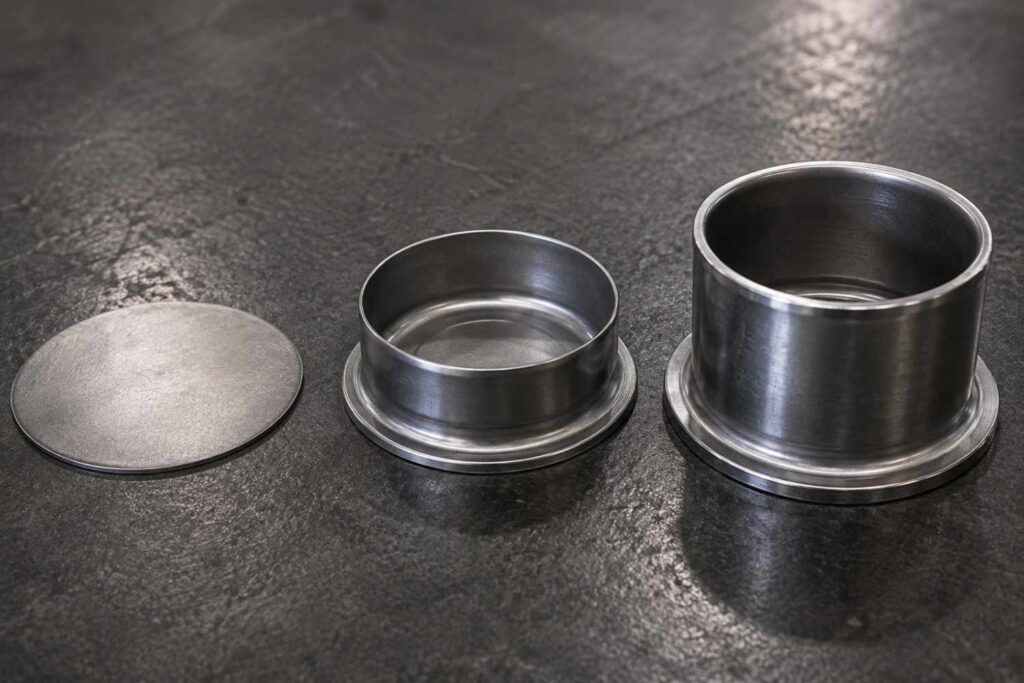
Unlike progressive dies that rely on a carrier strip to move parts, transfer tooling handles each blank independently. This allows deeper draws, heavier material gauges, and more complex part geometries without the constraints of strip feeding.
How Do Multi-Station Transfer Dies Work?
Transfer dies operate through a coordinated sequence:
- Blank is cut from coil or fed as a precut blank into the first station
- Mechanical fingers, vacuum cups, or servo-driven arms grip the part and move it between stations
- Each station performs a progressive forming operation — draw, trim, pierce, flange, form
- The finished part exits the final station and is ejected or picked by an unloader
The transfer mechanism can be integrated into the press (tri-axis transfer) or use independent servo units for flexible timing and longer transfer distances. Modern CNC servo transfers allow independent control of each axis, enabling complex part handling sequences.
What Tolerances Can You Expect for Transfer Die Stamping?
SSPrecision achieves ±0.002 mm on critical dimensions for precision transfer tooling. Standard production tolerances range from ±0.01 to ±0.05 mm depending on material type, thickness, and part geometry. Deep-drawn components typically hold ±0.03–0.08 mm in the draw wall thickness and ±0.05 mm on flange dimensions.
Tolerance capability depends on the die design, press alignment, material consistency, and the number of forming stages. A DFM review at the quoting stage identifies critical dimensions and ensures the tool design can hold them in production.
Which Materials Are Used in Heavy Gauge Metal Forming?
Transfer die stamping accommodates a wide range of materials and thicknesses:
- Steel — mild steel, HSLA, DP (dual-phase), TRIP, boron steel, spring steel up to 8 mm
- Stainless steel — 304, 316, 409, 430 for corrosion-resistant components
- Aluminum — 5000, 6000, and 7000 series for lightweight structural and EV parts
- Copper and brass — electrical terminals, connectors, and heat exchanger components
- Special alloys — Inconel, titanium, and high-temperature alloys for aerospace and energy
How Does Transfer Die Stamping Compare to Progressive Die Stamping?
Choosing between transfer and progressive die stamping depends on part geometry, volume, and material. The table below compares the two approaches across key factors.
| Factor | Transfer Die Stamping | Progressive Die Stamping | Deep Draw Transfer Dies |
| Part Complexity | High — deep draws, complex forms | Moderate — simpler geometries | Very high — multi-stage draws |
| Typical Tolerance | ±0.002–0.05 mm | ±0.01–0.1 mm | ±0.005–0.03 mm |
| Material Thickness | 0.5–8 mm+ | 0.1–4 mm | 0.5–6 mm |
| Tooling Cost | Moderate–high | High (more stations) | Highest (complex stages) |
| Tooling Lead Time | 8–20 weeks | 6–16 weeks | 12–26 weeks |
| Production Speed | 15–40 SPM | 50–400+ SPM | 8–25 SPM |
| Best For | Deep-drawn, heavy gauge, complex parts | High-volume, small–medium simple parts | Deep draws, tight tolerances |
| Blanks | Individual (sheet or precut) | Coil-fed strip (carrier web) | Individual precut blanks |
Transfer dies excel where part geometry exceeds the forming limits of a progressive die — particularly for deep draws, heavy gauge material, and parts requiring forming from both sides. Progressive dies remain the better choice for very high volumes of simpler parts where speed outweighs forming flexibility.
Which Industries Use Multi-Station Transfer Dies?
- Automotive & EV — Chassis brackets, control arms, motor housings, battery tray components, seat parts
- Electronics — Shield enclosures, connector housings, heat sink bases, precision brackets
- Medical — Surgical instrument handles, implantable device casings, diagnostic equipment frames
- Aerospace — Structural brackets, duct components, seat track parts, engine mount supports
- Energy — Substation hardware, heat exchanger plates, solar panel frames, wind turbine brackets
- Industrial Equipment — Hydraulic components, pump housings, valve bodies, transmission parts
What Quality and Inspection Standards Apply to Transfer Tooling?
Precision transfer dies require rigorous quality assurance throughout the tool build and production run. Key standards include:
- Die tryout and sample approval — first-off and first-run samples measured against part drawing
- CMM inspection — dimensional verification of critical features to ±0.002 mm
- Gauge R&R — measurement system capability studies for process control
- PPAP (Production Part Approval Process) — required for IATF 16949 automotive programs
- In-process SPC — statistical process control during production runs
SSPrecision follows IATF 16949 quality procedures for all automotive and EV transfer die programs, including full PPAP documentation when required.
SSP Is a Trusted Partner for Die Manufacturing Cost Optimization
SSP Precision is an ISO 9001 & IATF 16949 certified manufacturer delivering end-to-end precision solutions—from DFM engineering and rapid prototyping to high-volume production—for the automotive, medical, electronics, aerospace, and industrial sectors. We handle every stage in-house to manufacture the tooling that makes your parts and the parts themselves.
Visit our to explore our full capabilities: ssprecision.com.cn
Services (tooling design & manufacturing)
- Stamping Dies Manufacturing – high-volume metal stamping with Progressive Die Stamping & Tooling spare parts manufacturing and Transfer Stamping Dies
- Injection Molding – custom plastic molds including Over Molding & Insert Molding and Liquid Silicone Rubber (LSR) Molding
- Green Mold – eco-friendly molded components, Micro Molding – microscopic medical precision parts
Products (end-use parts & spare components)
- Stamping Die – complete stamping tooling
- Injection Mold – complete injection tooling
- Tooling Spare Parts – punches, inserts, ejector pins, Robotics Spare Parts – precision automation spares , Ball Screw Repair Kits – replacement kits for motion systems
- Machine Parts – general precision machine components
Why Source Heavy Duty Transfer Tooling from SSPrecision?
SSPrecision combines precision toolmaking with cost-effective manufacturing in Dongguan, China. Key advantages include:
- CNC machining and EDM capability for die components to ±0.002 mm
- In-house tryout presses with force monitoring for tool validation
- IATF 16949 quality system covering design, build, and production support
- Experienced die designers with automotive, electronics, and medical program backgrounds
- Competitive lead times and pricing vs. European and North American toolmakers
Whether you need a single deep-draw transfer die or a family of tools for a complete assembly, SSP provides end-to-end engineering support — from DFM review through production sample approval.
Frequently Asked Questions
What is heavy duty transfer tooling used for?
It produces deep-drawn, heavy gauge, and complex metal parts that cannot be made in a progressive die — such as automotive chassis components, EV battery parts, and industrial housings.
What is the difference between transfer and progressive die stamping?
Transfer dies move individual blanks between stations with external fingers or robots, allowing deeper draws and heavier material. Progressive dies carry the part on a strip and are faster for simpler, high-volume parts.
What tolerances can transfer die stamping achieve?
SSPrecision achieves ±0.002 mm on critical features, with standard production tolerances of ±0.01–0.05 mm depending on material and geometry.
Which industries use multi-station transfer dies?
Automotive/EV, electronics, medical, aerospace, energy, and industrial equipment sectors all use transfer dies for structural and precision components.
What is the typical lead time for a transfer die?
Design, build, and tryout typically ranges from 8 to 20 weeks depending on die complexity, number of stations, and material requirements.
Can transfer dies handle high-strength steel?
Yes. Transfer tooling can form DP, TRIP, boron, and other high-strength steels up to 8 mm thick, making it ideal for lightweight automotive structural parts.
Heavy duty transfer tooling delivers the forming capability needed for deep-drawn, complex, and heavy gauge metal components that exceed the limits of progressive dies. With multi-station designs and precision tolerances down to ±0.002 mm, transfer die stamping is the preferred process for automotive, EV, and industrial parts requiring aggressive forming in multiple axes.
If you are developing a deep-drawn or complex stamped part, contact SSPrecision or request a quote on their transfer die services. Their engineering team provides a free DFM review to optimize your part for cost-effective production.
Read More – Intelligence That Protects Your Production Line
- China Injection Mold Source: High-Cycle Multi-Cavity Production Plastic Molds – Multi-cavity molds produce 4–32+ parts per cycle with tolerances to ±0.002mm—here’s how to source high-volume tooling from China.
- How to Prevent Flash, Warpage & Sink Marks – Flash, warpage, and sink marks account for 35–40% of plastic part rejects—here’s how to eliminate them with precision tooling and process control.
- Complete Plastic Shrinkage Chart (ABS, PC, PA66, POM) – ABS shrinks 0.4–0.7%, PC 0.5–0.7%, PA66 1.0–2.0%, and POM 0.6–1.4%—here’s how to adjust your mold design for each material.
- Export-Ready Tooling & Dies: OEM Manufacturing for Global Supply Chains – IATF 16949-certified stamping dies, injection molds, and tooling spare parts under one roof for automotive and industrial OEM buyers.
- Multi-Cavity Injection Molds: Cost & Efficiency Breakdown – A 4-cavity hot runner mold costs 2.5–4x a single-cavity tool but delivers proportionally larger per-part cost savings at volume.
- Sourcing Ejector Pins & Mold Components in China – DIN 1530 ejector pins at $5.80–$8.60 per piece with ±0.002mm grinding precision and 7–15 day lead times.
- China Fiber Optic Connectors | Injection Molding Precision Parts Manufacturer Company – Fiber optic connector housings demand ±0.01 mm tolerances on critical alignment features.
- Reducing Cycle Time Through Better Mold Cooling – Cooling eats 50–70% of your cycle time—conformal channels can slash it by 20–50%.
- Stamping Die Cost Drivers: What Impacts Your Price – A single-station die costs $3,000–$8,000, while a progressive die can hit $120,000+.
-
Custom Machine Parts: High-Precision CNC Machined Components China – CNC machining delivers custom metal and plastic parts to ±0.002mm from prototypes to production runs of 100,000+ units.
- LSR Injection Molding | Precision Liquid Silicone Rubber – LSR injection molding cures at 5 seconds per millimeter of wall thickness with tolerances to ±0.002mm
-
Precision Manufacturing China: IATF 16949 Certified OEM Tooling Solutions – IATF 16949-certified stamping dies and injection molds with full quality management systems and tolerances down to ±0.002mm.