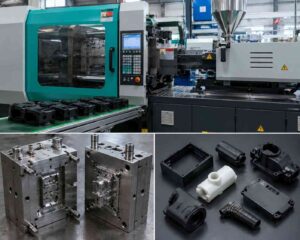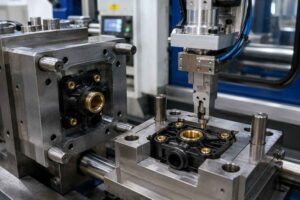


Multi-Cavity Injection Molds: Cost & Efficiency Breakdown
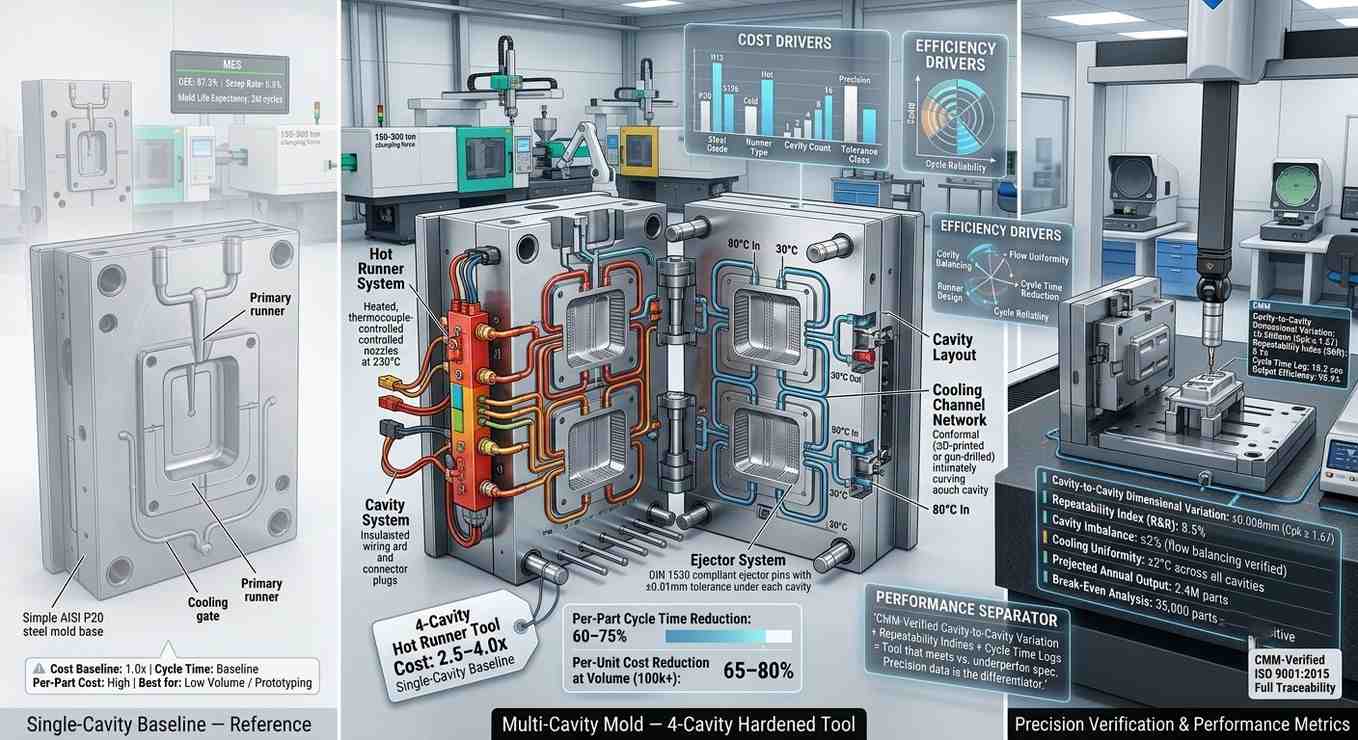
Injection mold cost in China for a multi-cavity tool scales with cavity count, steel grade, runner system type, and tolerance class — a 4-cavity hardened steel mold with a hot runner system typically costs 2.5–4x a comparable single-cavity cold runner tool, but delivers a proportionally larger reduction in per-part cycle time and per-unit cost at volume. Mold efficiency in China is driven primarily by cavity balancing, cooling channel layout, and runner design, while precision mold data — CMM-verified cavity-to-cavity dimensional variation, repeatability indices, and cycle time logs — is what separates a tool that hits its rated output from one that underperforms its design spec.
Key Takeaways
-
- Injection mold cost in China rises roughly linearly per additional cavity for mold base and cavity insert machining, but rises non-linearly for hot runner systems, since each additional drop adds a heated nozzle, manifold channel, and independent temperature-control zone.
-
- Mold efficiency in China depends most heavily on cavity balancing — unbalanced flow paths between cavities cause some cavities to pack out before others, producing dimensional variation and requiring longer hold time to compensate, which erodes cycle time gains.
-
- Cycle time reduction on multi-cavity tools comes primarily from cooling system design, since cooling time typically accounts for 50–70% of total cycle time on standard thermoplastics — conformal cooling channels can cut cooling time 20–40% versus straight-drilled channels on complex geometry.
-
- Precision mold data — CMM cavity-to-cavity comparison reports, first-article inspection (FAI) results, and Cpk values — is the objective basis for verifying that a multi-cavity mold actually delivers uniform part quality across every cavity, not just the nominal average.
-
- Hot runner systems increase upfront injection mold cost in China by 30–60% over cold runner equivalents but eliminate runner scrap and reduce cycle time by removing the need to eject and separate a runner system every cycle.
-
- Steel selection (P20, NAK80, H13, S136) is a major cost and cycle-time driver, since higher hardness and better thermal conductivity steels cost more per kilogram but sustain tighter tolerances over higher shot counts and often support faster cooling.
-
- Cavity count is not simply a multiplier of output — beyond 8–16 cavities, mold complexity, cooling uniformity, and injection pressure balancing become significantly harder to engineer, and the marginal cost per added cavity increases.
Understanding Multi-Cavity Injection Mold Cost in China
Cavity Count and Tooling Cost Scaling
Injection mold cost in China for a multi-cavity tool is not a simple linear multiple of a single-cavity mold’s price. Mold base cost (the steel plates, guide pins, ejector system, and clamping structure) scales relatively slowly with cavity count, since a larger mold base spreads its fixed machining and material cost across more cavities. Cavity and core insert machining cost, however, scales close to linearly, since each cavity requires its own CNC-machined or EDM-finished steel insert.
As a general rule for precision mold data benchmarking in China:
-
- 1-cavity to 2-cavity: cost increase of roughly 40–60%, since mold base, hot runner (if used), and cooling system must be re-engineered for balanced flow to two cavities.
-
- 2-cavity to 4-cavity: cost increase of roughly 60–90%, driven mainly by additional cavity/core inserts and runner or hot-drop complexity.
-
- 4-cavity to 8-cavity: cost increase of roughly 70–100%, with cavity balancing and cooling uniformity becoming a larger share of engineering time relative to raw steel machining.
Precision Mold Data: Tolerance Classes and Their Cost Impact
Precision mold data begins with the tolerance class specified for the part. Standard commercial tolerance (comparable to SPI Class 3 or ISO 22916 general tolerance) costs meaningfully less than tight precision tolerance (SPI Class 1/2 or equivalent, often ±0.02–0.05 mm on critical dimensions), because tighter tolerance classes require:
-
- Higher-grade pre-hardened or through-hardened steel (NAK80, S136, H13) to resist wear-induced dimensional drift over the mold’s service life
-
- Finer EDM and CNC finishing passes on cavity surfaces
-
- More frequent CMM verification cycles during mold build (first-article, mid-build, and final acceptance inspection)
-
- Tighter cavity-to-cavity variation control across all cavities in a multi-cavity mold, since a single out-of-tolerance cavity can fail an entire production lot’s dimensional audit
Tolerance Class Quick Reference
| Tolerance Class | Typical Dimensional Tolerance | Relative Mold Cost Impact |
| Commercial (general) | ±0.10–0.20 mm | Baseline |
| Precision | ±0.05–0.10 mm | +15–25% |
| High Precision | ±0.02–0.05 mm | +30–50% |
Injection Mold Cost China vs. Other Regions: Comparative Data Breakdown
| Program Element | China (Typical Range) | North America / Western Europe (Typical Range) | Relative China Cost Advantage |
| 4-cavity cold runner mold, commercial tolerance, P20 steel | $8,000–$15,000 USD | $20,000–$35,000 USD | 50–60% lower |
| 4-cavity hot runner mold, precision tolerance, S136/H13 steel | $18,000–$32,000 USD | $45,000–$70,000 USD | 50–55% lower |
| 8-cavity hot runner mold, precision tolerance, NAK80/S136 | $35,000–$60,000 USD | $80,000–$130,000 USD | 50–55% lower |
| Mold lead time (design to T1 sample) | 4–7 weeks typical | 8–14 weeks typical | Faster in most cases |
| Engineering change turnaround (post-T1) | 3–7 days typical | 1–3 weeks typical | Faster in most cases |
| Typical mold steel life (shot count before major maintenance) | 300,000–1,000,000+ shots depending on steel grade | Comparable, when equivalent steel grade specified | Dependent on steel spec, not region |
Mold Efficiency in China: What Drives Output Per Hour
Cavity Balancing and Flow Path Design
Mold efficiency in China’s tooling shops is judged primarily on how evenly molten plastic fills every cavity in a multi-cavity mold. An unbalanced runner system — where cavities closer to the sprue fill faster and pack out sooner than cavities farther away — forces the molder to either overpack the near cavities (risking flash and internal stress) or extend cycle time to let the far cavities fully pack (sacrificing throughput).
Naturally balanced runner layouts (symmetric, equal-length flow paths to every cavity) are the default efficiency strategy for cavity counts up to 8. Beyond that, artificially balanced systems — where runner diameters are deliberately varied to equalize fill time despite unequal physical distances — become necessary, and require flow simulation (Moldflow or equivalent) to validate before steel is cut.
Runner System Design: Cold Runner vs. Hot Runner Efficiency
| Factor | Cold Runner System | Hot Runner System |
| Upfront mold cost | Lower | 30–60% higher |
| Material waste per cycle | Runner scrap generated every shot | Near-zero runner waste |
| Cycle time impact | Longer (runner must cool and eject) | Shorter (no runner cooling/ejection step) |
| Best cavity count range | 1–4 cavities, cost-sensitive programs | 4+ cavities, high-volume programs |
| Maintenance complexity | Lower (fewer heated components) | Higher (heater bands, thermocouples, manifold) |
| Typical use case | Prototype and low-volume production | High-volume automotive, consumer, and industrial OEM production |
Cycle Time Reduction Strategies for Multi-Cavity Tools
Cooling Channel Design and Cycle Time Reduction
Cooling time is typically the largest single component of total injection molding cycle time, often 50–70% of the total cycle on standard engineering thermoplastics. Cycle time reduction efforts on multi-cavity molds therefore concentrate heavily on cooling channel layout:
-
- Straight-drilled cooling channels: the standard, lowest-cost approach, effective when part wall thickness is uniform and geometry is simple.
-
- Baffle and bubbler inserts: used to cool deep core pins and ribs that straight channels cannot reach directly.
-
- Conformal cooling channels (produced via metal 3D printing/DMLS on the mold insert): follow the part’s 3D geometry rather than running in straight lines, and can reduce cooling time 20–40% on parts with complex, non-uniform wall sections — at a materially higher insert manufacturing cost.
Cycle Time Reduction by Cooling Strategy (Illustrative Data)
On a mid-complexity engineering plastic part (2.5 mm nominal wall, PC/ABS blend), typical cooling time reduction achieved by cooling strategy, relative to a straight-drilled baseline:
-
- Straight-drilled channels: baseline (0% reduction)
-
- Optimized straight-channel layout with reduced channel-to-surface distance: 8–15% reduction
-
- Baffle/bubbler supplementation in problem areas: 10–20% reduction in localized hot-spot cooling time
-
- Full conformal cooling: 20–40% reduction in total cooling time
Material and Wall Thickness Effects on Cycle Time
Cycle time reduction strategies must also account for material thermal properties and part wall thickness, since cooling time scales approximately with the square of wall thickness for a given material’s thermal diffusivity. Halving wall thickness (where the part design allows it) can reduce cooling time by roughly 75%, making early-stage design-for-manufacturability (DFM) review — before mold steel is cut — one of the highest-leverage cycle time reduction opportunities available on any multi-cavity program.
Precision Mold Data: Tolerance, Repeatability, and Quality Control
CMM Verification and SPC for Multi-Cavity Molds
Precision mold data for a multi-cavity tool should include, at minimum:
-
- First-article inspection (FAI) reports for parts from every individual cavity, not a single sampled cavity
-
- CMM dimensional reports comparing each cavity’s output against the CAD model on all critical-to-function dimensions
-
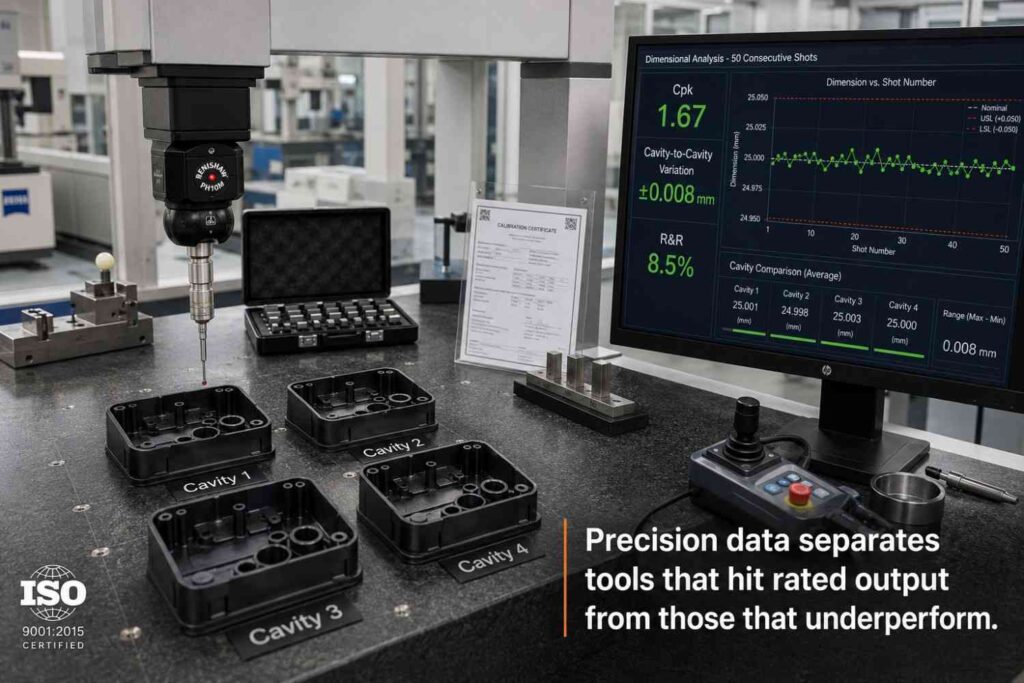
- Process capability indices (Cpk) calculated per cavity, with a Cpk of 1.33 or higher generally considered the minimum acceptable threshold for automotive and precision industrial applications
-
- Cavity-to-cavity variation reports, quantifying the dimensional spread across all cavities for the same feature, since a mold can average within tolerance while individual cavities drift outside acceptable limits
Cavity-to-Cavity Variation and Precision Mold Data Benchmarks
A well-balanced, well-machined multi-cavity mold should show cavity-to-cavity variation on critical dimensions within roughly 30–50% of the total tolerance band. A mold showing cavity-to-cavity variation approaching or exceeding the full tolerance band indicates either flow imbalance, uneven cavity cooling, or machining variation between cavity inserts — any of which should trigger mold rework before full production release.
SSP Is a Trusted Partner for Die Manufacturing Cost Optimization
SSP Precision is an ISO 9001 & IATF 16949 certified manufacturer delivering end-to-end precision solutions, from design and prototyping to high‑volume production, for the automotive, medical, electronics, aerospace, and industrial sectors. We handle every stage in‑house – DFM engineering, rapid prototyping, CNC machining, EDM, grinding, and global logistics – to manufacture the tooling that makes your parts and the parts themselves.
What we build and supply: visit our sites: https://SSP.com.cn/
-
- Stamping dies manufacturing and stamping die parts – high‑precision transfer stamping dies and progressive/compound dies for volume metal stamping.
-
- Injection molding and injection mold – custom injection molds for plastic components, including single‑, multi‑cavity, and over‑molding & insert‑molding tools that combine metal and plastic in one part.
-
- Specialty molded components – eco‑friendly green mold parts and microscopic medical micro‑molded parts.
-
- Precision metal and plastic end‑use parts – high‑volume serial production of precision products (metal stampings, plastic moldings) with full PPAP traceability.
-
- Tooling spare parts manufacturing & – tooling spare parts (punches, inserts, ejector pins) and precision robotics spare parts to keep your production running.
Common Mistakes That Undermine Mold Efficiency and Cycle Time Reduction
-
- Specifying cavity count without validating flow balance through simulation — adding cavities without Moldflow analysis often produces exactly the fill imbalance that erodes the throughput gain the extra cavities were meant to deliver.
-
- Choosing cold runner systems for high-volume programs to save upfront injection mold cost in China, without accounting for the long-run cycle time and material waste penalty versus a hot runner system.
-
- Skipping per-cavity CMM data in favor of a single sampled cavity report, which can mask cavity-to-cavity variation that only surfaces once full production volume is running.
-
- Treating cooling channel design as an afterthought rather than a primary cycle time reduction lever, particularly on parts with variable wall thickness or deep ribs/bosses.
Frequently Asked Questions
-
- What drives injection mold cost in China for multi-cavity tools?
-
- Injection mold cost in China for multi-cavity tools is driven primarily by cavity count, steel grade, tolerance class, and runner system type (cold runner vs. hot runner). Hot runner systems and higher precision tolerance classes both add significant cost but generally improve mold efficiency and long-term cycle time performance.
-
- What drives injection mold cost in China for multi-cavity tools?
-
- How much does adding cavities reduce per-part cost?
-
- Adding cavities reduces per-part cost by spreading the mold’s fixed tooling cost and cycle time across more parts per shot, but the relationship is not perfectly linear — mold cost, cooling complexity, and cavity balancing difficulty all increase with cavity count, so the marginal cost benefit per added cavity diminishes, particularly beyond 8–16 cavities.
-
- How much does adding cavities reduce per-part cost?
-
- What is the biggest lever for cycle time reduction on a multi-cavity mold?
-
- Cooling channel design is typically the single biggest lever, since cooling time often accounts for 50–70% of total cycle time. Conformal cooling channels, optimized straight-drilled layouts, and reduced part wall thickness are the primary cycle time reduction strategies.
-
- What is the biggest lever for cycle time reduction on a multi-cavity mold?
-
- How is mold efficiency in China measured for a multi-cavity tool?
-
- Mold efficiency in China is generally measured through cavity balance (uniform fill and pack across all cavities), actual cycle time versus design cycle time, scrap rate, and precision mold data such as per-cavity CMM reports and process capability (Cpk) values.
-
- How is mold efficiency in China measured for a multi-cavity tool?
-
- What precision mold data should be requested before accepting a multi-cavity mold?
-
- Buyers should request first-article inspection reports from every cavity, CMM dimensional reports against the CAD model, cavity-to-cavity variation data, and Cpk values for critical-to-function dimensions — not just a single averaged or sampled-cavity report.
-
- What precision mold data should be requested before accepting a multi-cavity mold?
-
- Is a hot runner or cold runner system better for reducing cycle time?
-
- Hot runner systems generally reduce cycle time compared to cold runner systems because they eliminate the runner cooling and ejection step required every cycle, though they carry a higher upfront injection mold cost in China and added maintenance complexity from heated components.
-
- Is a hot runner or cold runner system better for reducing cycle time?
🔍 Read More – Intelligence That Protects Your Production Line
-
Sourcing Ejector Pins & Mold Components in China – DIN 1530 demands ±0.01mm and 45–50 HRC—here’s the technical checklist to verify ejector pins, guide bushings, and slides against material certifications, CMM reports, and supply chain KPIs.
-
China Fiber Optic Connectors | Injection Molding Precision Parts Manufacturer Company – Fiber optic connector housings demand ±0.01 mm tolerances on critical alignment features—here’s the material selection guide, cavity configuration data, and quality control protocols for precision optical components.
-
Reducing Cycle Time Through Better Mold Cooling – Cooling eats 50–70% of your cycle time—here’s how conformal cooling channels, turbulent flow design, and high-conductivity inserts can slash cooling time by 20–50% and cut overall cycle time by 15–35%.
-
Stamping Die Cost Drivers: What Impacts Your Price – A single-station die costs $3,000–$8,000, while a progressive die can hit $120,000+—here’s the breakdown of 7 key cost drivers, from material selection to EDM hours, with real China vs. Western pricing data.
-
Injection molding: Hot Runner Vs Cold Runner – Hot runners add 30–50% to upfront tooling cost but can slash cycle times by 40% and eliminate material waste—here’s how to weigh the trade-off for your production volume.
-
Injection Molding Tolerances (With Precision Chart) – Tightening a tolerance from IT7 to IT3 can triple your mold cost—here’s the precision grade chart, material-specific shrinkage data, and how to specify only what your design actually needs.
-
How Much Does an Injection Mold Cost in China? – A Class 101 production mold runs $15,000–$60,000+, while a prototype tool can cost under $4,000—here’s the SPI classification breakdown and the 5 key cost drivers that shape your final quote.
-
Calculating Plastic Injection Molding Unit Costs: Complete Pricing Breakdown – Unit Price = Material Cost + Processing Cost + (Mold Cost ÷ Total Parts)—here’s the complete formula with real cost ranges, showing how a $22,000 mold drops from $0.37/part at 30,000 units to just $0.20/part at 100,000 units.
-
Export-Ready Tooling & Dies: OEM Manufacturing for Global Supply Chains – IATF 16949-certified stamping dies, injection molds, and tooling spare parts under one roof for automotive and industrial OEM buyers.
-
Complete Plastic Shrinkage Chart (ABS, PC, PA66, POM) – ABS shrinks 0.4–0.7%, PC 0.5–0.7%, PA66 1.0–2.0%, and POM 0.6–1.4%—here’s how to adjust your mold design for each material.
-
How to Prevent Flash, Warpage & Sink Marks – Flash, warpage, and sink marks account for 35–40% of plastic part rejects—here’s how to eliminate them with precision tooling and process control.