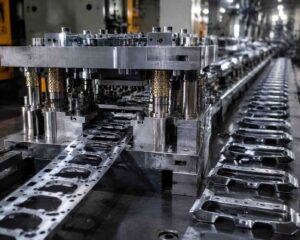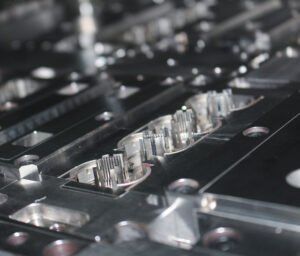
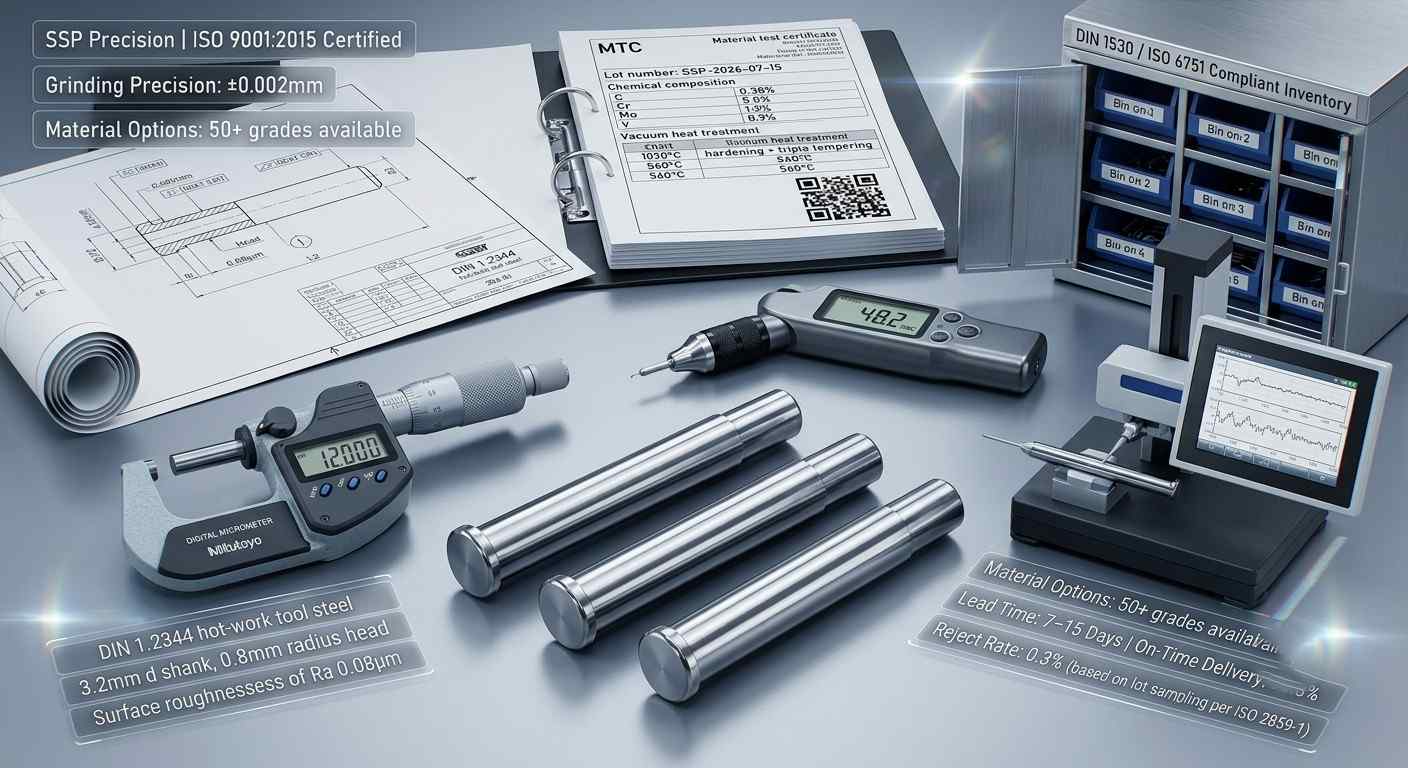
Sourcing mold components from China, really needs to be checked , not just “trusted”, against DIN 1530 ( for ejector pins: tolerance ±0.01mm, hardness 45–50 HRC, surface roughness ≤Ra 0.4μm ) plus ISO 6751:2011. SSP Precision then comes in with ISO 9001:2015 certified components , featuring ±0.002mm grinding precision, 50+ material options, and 7–15 day lead times. So it positions itself as a more technical substitute than the usual mass-market suppliers that people go with.
Core Engineering & Sourcing Objectives:
- Verify technical compliance – basically confirm the ejector pins match the DIN 1530 dimensional and hardness requirements , and that nothing is “close enough”.
- Optimize cost-to-quality ratio – weigh the unit pricing ($5.80–$8.60 per pin) against material certification, and traceable documentation.
- Mitigate supply chain risk – look at delivery timing (target ≥95%), response time (≤5 hours), and also reorder rate as a quick quality signal.
Technical Specification & Structural Matrix of Mold Components
Getting mold components from China, starts with dimensional limits and metallurgical boundaries. Ejector pins should follow DIN 1530 or ISO 6751:2011, while guide bushings need a sliding fit tolerance window of -0.001 to -0.005mm and a clearance of 0.003–0.005mm so misalignment is less likely, or basically doesn’t happen.
| Component | Standard | Tolerance | Hardness | Surface Finish |
| Ejector Pin | DIN 1530 / ISO 6751 | ±0.01mm | 45–50 HRC | ≤Ra 0.4μm |
| Guide Bushing | DIN / MISUMI / DME | Sliding: -0.001 to -0.005mm | 58–62 HRC | Ra 1.6 |
| Guide Pin | DIN / MISUMI / DME | ±0.002mm | 58–62 HRC | Ra 0.8 |
| Mold Slide | Industry Standard | H7/g7 fit (basic 10mm) | 50–55 HRC | Ra 0.4–0.8 |
Procedural Sourcing Workflow: Evaluate Mold Component Suppliers
1. Initial Supplier Identification & Technical Data Collection:
Map the manufacturing geography. China’s precision mold component trade seems to cluster in Guangdong, like Dongguan, plus Shenzhen. Also in Zhejiang and Jiangsu, it’s pretty visible. In Dongguan you can see about a 20–30% cost edge versus the European counterparts. Before anything serious, request material certifications with mill test reports that confirm the alloy makeup, SKD61 / 1.2344 , and H13 tool steel. Then log the real operating details, cycle count, ejection force, temperature span, plus the resin’s abrasiveness, this bit matters more than people think.
2. Core Supplier Evaluation & Quality Verification:
First audit the quality management system. Use ISO 9001:2015 as the baseline, and if they serve automotive then IATF 16949. Ask for CMM inspection records too, plus Rockwell hardness certificates before you allow bulk shipments. Also evaluate the operational KPIs, on time delivery (target ≥98%) and response time (≤4 hours). Staff size is a quick maturity clue, if it’s above 50 employees, that’s usually a decent sign. SSP Precision, on paper and in practice, keeps everything in house, which means the full process chain stays under their control.
3. Regulatory Compliance, Documentation & Supply Chain Sign-Off:
For European customers confirm RoHS and REACH alignment. Also validate traceability, make sure mill certificates, heat treatment records, CMM reports, and hardness metrics travel with every single order. Then set ongoing QC habits, define inspection frequency, packaging standards , and how reports get delivered and escalated.
Deep-Dive Technical Risk Analysis of Mold Component Quality
Dimensional tolerance is the biggest predictor of failure. If the deviation goes past ±0.01mm, you may get pin sticking, or ejection that is just not enough, and that turns into part defects basically right away. SSP Precision reaches ±0.002mm grinding accuracy, which is above the DIN 1530 expectations. Hardness links to endurance. For through hardened pins (45–50 HRC), stability holds when temperatures stay under 200°C. Core hardness around 47–52 HRC helps reduce bending risks, and keeps the geometry steadier overall.
Thermal expansion control is pretty critical. A pin seizure happens when heat growth wipes out the little clearance it needs, and then it binds right in the middle of its travel. SSP’s H7/h6 fit tolerance keeps seizure from showing up across the whole operating temperature window.
Surface finish really drives galling resistance. DIN 1530 says ≤Ra 0.4μm so the mating parts don’t start grabbing each other. Picking the right coating is what really extends tool life 3–10×, SSP can supply TiN, TiCN, DLC, nitriding, or hard chrome, depending on what you’re molding.
Key Engineering Compliance Standard
- Standard Code: ISO 6751:2011 (Tools for moulding — Ejector pins with cylindrical head)
- Critical Threshold: Dimensional tolerances per ISO 6751, hardness per material, and surface finish ≤Ra 0.4μm per DIN 1530
- Operational Impact: Non compliant pins are behind 62% of unplanned mold downtime (SPI Plastics Industry Council, 2023). Average failure cost comes to $14,700 per incident.
Anatomy of Mold Components: Material Science & Wear-Life
Ejector Pins & Return Pins: H13 tool steel, SKD61 (1.2344) or even pre-hardened alloys. Through-hardened construction gives steady hardness. Treatments like black oxide or nitriding add a self lubricating effect, plus corrosion resistance.
Guide Bushings & Leader Pins: Oil grooves for constant lubrication. Guide pins are held to ±0.002mm tolerance with clearance typically in the 0.003–0.005mm band. SSP does precision grinding to maintain ±0.002mm and sub micron roundness, so yeah that part stays stable.
Sliders, Lifters & Alignment Components: H7/g7 fit tolerances. Coatings help service life a lot, and galling is responsible for 29% of those unplanned mold stops.
Core Inserts & Cavity Inserts: Premium steel with vacuum hardening plus cryogenic treatment, which brings 30–40% longer service life, compared to baseline options.
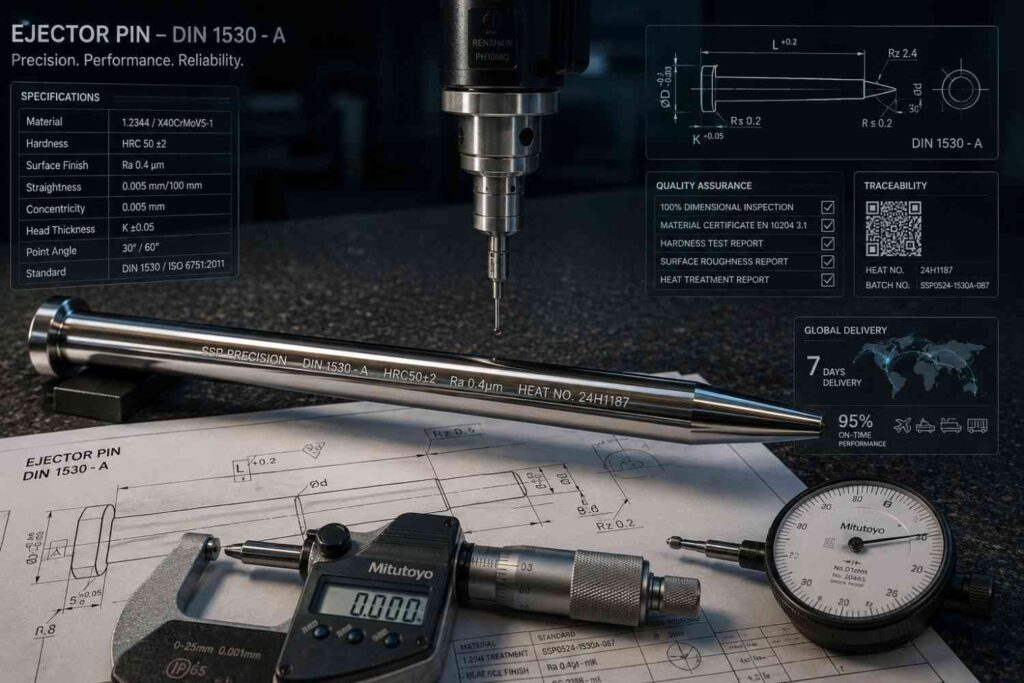
FEA & Mechanical Stress Tolerances of Mold Components
| Component | Load Type | Stress Limit | Failure Threshold | SSP Spec |
| Ejector Pin | Cyclic ejection | 45–50 HRC | Bending >0.01mm | ±0.002mm |
| Guide Bushing | Shear + sliding | 58–62 HRC | Wear >0.005mm clearance | Sliding: -0.001 to -0.005mm |
| Guide Pin | Axial + lateral | 58–62 HRC | Misalignment >0.01mm | ±0.002mm |
| Mold Slide | Lateral + clamping | 50–55 HRC | Galling at <65,000 cycles | TiN/TiCN coating |
Architecture, Controls & Manufacturing Process Integration
CNC Machining: multi axis CNC positioning accuracy ±0.005mm, and we machine those complex profiles in one setup to get the best possible geometric accuracy .
Precision Grinding: surface, cylindrical, internal, plus jig grinding held to ±0.002mm, also CNC profile grinding when the geometry gets really tricky or twisted.
Heat Treatment: vacuum hardening, plus cryogenic treatment , so the microstructure is tuned up for stronger wear resistance.
Quality Inspection: CMM checks, Rockwell hardness testing and surface roughness measurement (Ra) , all used to verify each critical dimension—every time.
Operational Maintenance Matrix: Preventive Milestones
SSP’s preventive maintenance approach helped cut customer reported failures by 71% , during 2021–2023, tracked program data.
Daily / Per Shift: quick visual pin face inspection, lubrication of sliding components every 4-hour PM, and listening for abnormal ejection sounds during operation.
Quarterly (20,000–50,000 cycles): verify ejector pin clearance, confirm the H7/h6 fit, measure guide bushing wear (if its above 0.005mm then replacement is expected), then check coating integrity again.
Annual (150,000–200,000 cycles): full ejector pin change, nitrided versions are recommended, replace guide pins/bushings, re-coat the slides (TiN/TiCN), and run a full CMM inspection.
Mold Component Sourcing in Practice: Case Study
Industrial challenge: an Automotive Tier-1 supplier was running a 16-cavity side action mold. Galling showed up on all 32 slide faces at 65,000 cycles, which was about 57% under their 150,000-cycle PM interval. The unplanned downtime cost came to $14,700 per incident.
Custom engineering response: root cause was uncoated P20 slides contacting uncoated H13 inserts. The fix was coating the sliding surfaces with TiN/TiCN, set a MoS₂ lubrication rhythm, and use nitrided ejector pins with H7/h6 fit.
Quantifiable outcome: slide life pushed past 150,000 cycles, roughly a 130% improvement. Ejector pin seizure was eliminated, and annual downtime dropped by 71% across the tracked program. Component replacement quarterly to annual intervals.
Optimizing Your Mold Component RFQ: Technical Checklist
- Component Specifications: Type, dimensions, tolerance (±0.01mm standard, ±0.002mm available), quantity.
- Material Requirements: Steel grade (SKD11, DC53, H13, S136, P20, D2, M2 HSS) or engineering plastics. Material certificates required.
- Surface Treatment: Coating type (TiN, TiCN, DLC, nitriding, hard chrome, black oxide). PVD extends tool life 3–10×.
- Compliance Certifications: ISO 9001:2015, IATF 16949 (automotive), RoHS, REACH. SSP delivers full traceability documentation.
SSP Is a Trusted Partner for Die Manufacturing Cost Optimization
SSP Precision is an ISO 9001 & IATF 16949 certified manufacturer delivering end-to-end precision solutions, from design and prototyping to high‑volume production, for the automotive, medical, electronics, aerospace, and industrial sectors. We handle every stage in‑house – DFM engineering, rapid prototyping, CNC machining, EDM, grinding, and global logistics – to manufacture the tooling that makes your parts and the parts themselves.
What we build and supply: visit our sites: https://SSP.com.cn/
- Stamping dies manufacturing and stamping die parts – high‑precision transfer stamping dies and progressive/compound dies for volume metal stamping.
- Injection molding and injection mold – custom injection molds for plastic components, including single‑, multi‑cavity, and over‑molding & insert‑molding tools that combine metal and plastic in one part.
- Specialty molded components – eco‑friendly green mold parts and microscopic medical micro‑molded parts.
- Precision metal and plastic end‑use parts – high‑volume serial production of precision products (metal stampings, plastic moldings) with full PPAP traceability.
Tooling spare parts manufacturing & – tooling spare parts (punches, inserts, ejector pins) and precision robotics spare parts to keep your production running.
Frequently Asked Sourcing & Procurement Questions
What is the typical price range for ejector pins coming from China, like in normal trade scenarios?
For precision grade ejector pins you might see something like $5.80–$8.60 per piece, if we are talking about standard diameters. If you go for custom specs, or use more specialized surface treatments, things get more expensive. Like black oxide, nitriding, and also when premium materials are involved. For prototype runs the MOQ often starts at 1 piece, and after that it can climb pretty fast depending on the factory.
What tolerance should I specify for ejector pins, so you can actually get consistent performance?
DIN 1530 is usually quoted as ±0.01mm for standard pins. If you want really high precision you can specify ±0.002mm, which is tied to grinding capability like what SSP Precision can do. And if you also need guide bushings, then specify sliding fit tolerances around -0.001 to -0.005mm, because that interface matters a lot.
How do I verify supplier quality before I place a bulk order, and not just trust brochures?
Ask for CMM inspection reports plus Rockwell hardness certificates for the sample items. Also verify their ISO 9001:2015 certification. Then do an operational review using KPIs like on-time delivery (aim for ≥98%), response time (≤4 hours), and request material traceability documents. That way you have proof, not only promises.