Industrial liquid silicone rubber molding for OEMs. SSPrecision delivers custom LSR injection molding at ±0.002 mm. Get a free DFM quote and design review.
What is LSR injection molding?
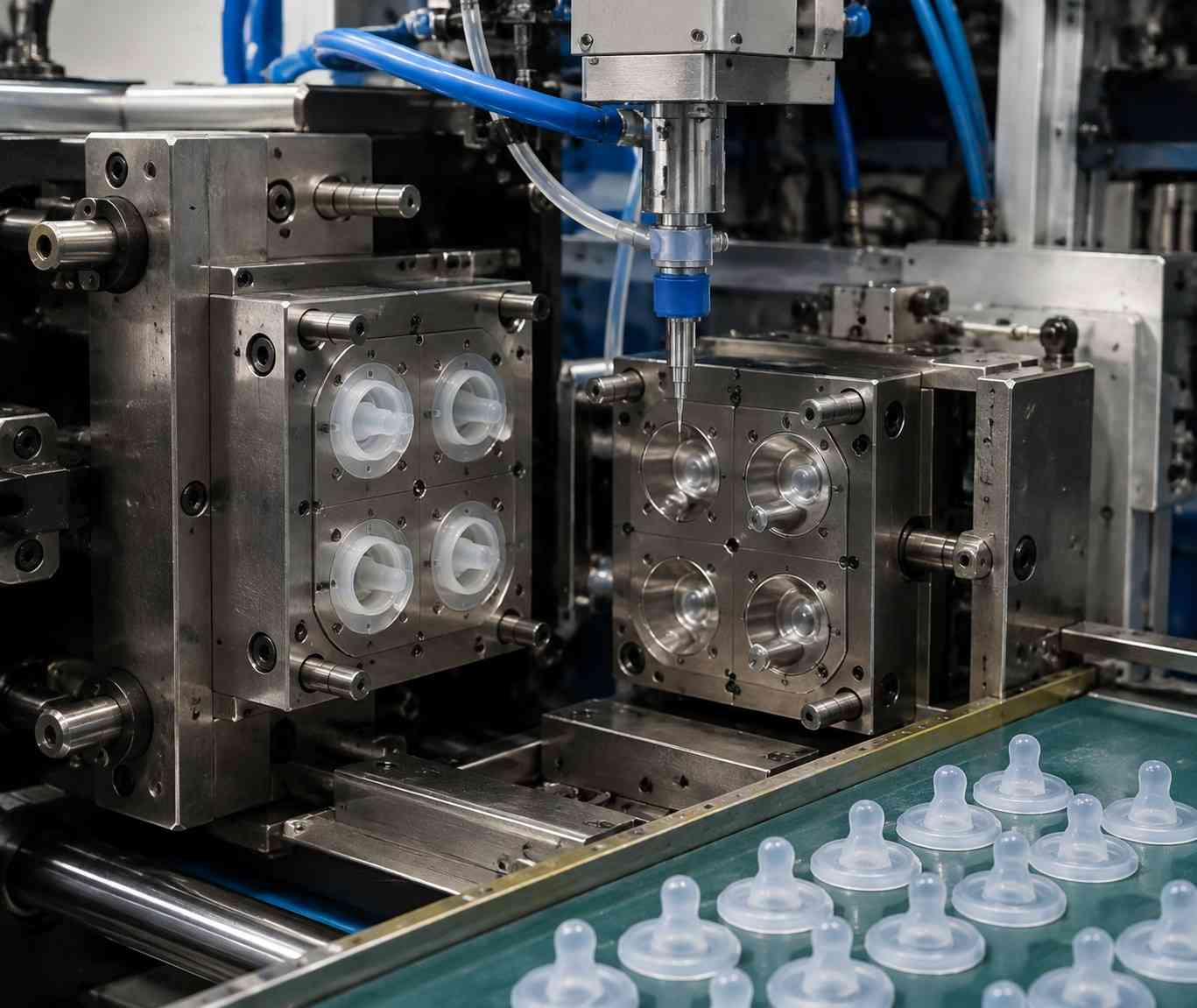
LSR injection molding is an automated manufacturing process that pumps a two-part liquid silicone rubber (LSR) system into a heated mold (160–210°C), triggering rapid heat-cured vulcanization to produce high-precision, flexible elastomeric parts with tolerances down to ±0.002 mm.
Liquid silicone rubber (LSR) molding turns platinum-cured liquid silicone into finished, resilient parts at production speed—from watertight seals in EV battery connectors to flex-tested diaphragms in medical devices.
How It Works & LSR vs. Solid Silicone (HCR)
- 1:1 Precision Metering: Part A (catalyst) and Part B (cross-linker) are pump-mixed as cold liquids and injected directly into a hot mold (160–210°C).
- Fast Thermal Curing: Heat triggers vulcanization at ~5 seconds per millimeter of wall thickness, achieving total cycle times between 10 and 90 seconds.
- LSR vs. HCR: Unlike solid silicone (HCR) which requires manual loading and trimming, liquid silicone flows into intricate cavities effortlessly, cures cleanly, and demolds automatically for continuous 24/7 runs.
Partner with SSPrecision (Dongguan, China)
If you are sourcing high-precision silicone components for automotive, medical, or electronics applications, SSPrecision (operating since 2008 in Dongguan) brings ±0.002 mm tooling precision and ISO 9001:2015 / IATF 16949 certified quality to custom LSR molding and 2K overmolding.
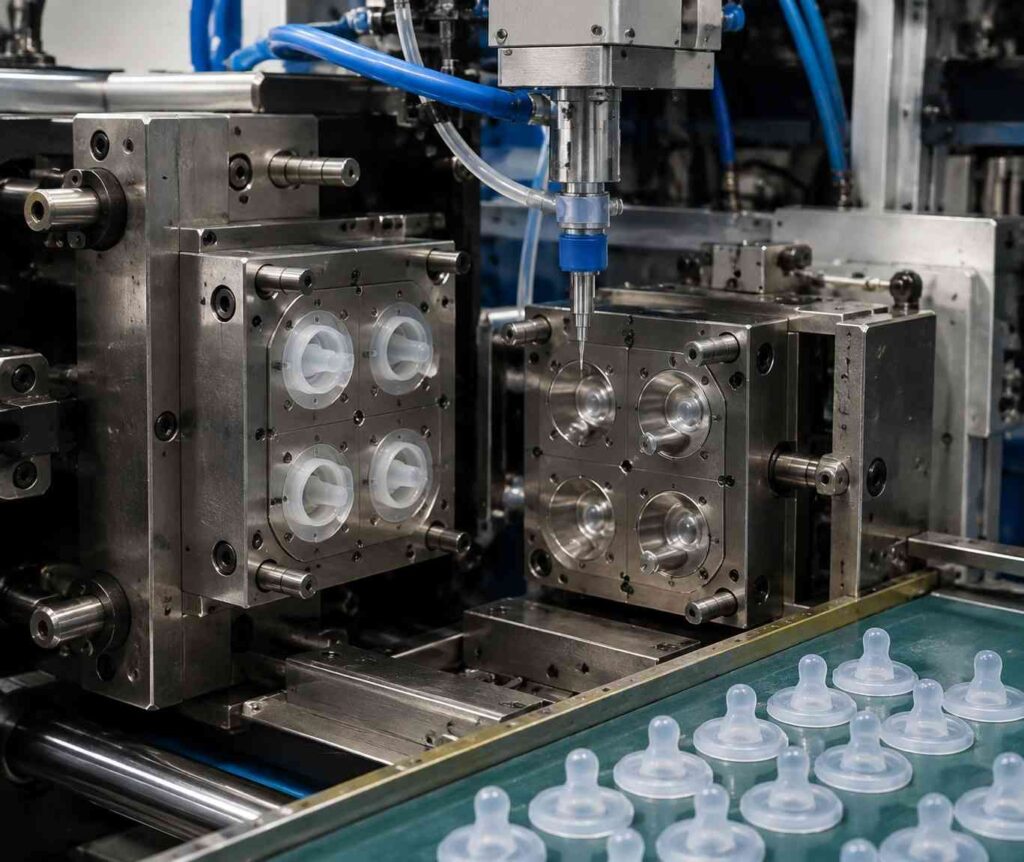
LSR Injection Molding – Key Process Capabilities & Specifications
| Parameter | Specification / Range | Notes |
| Cure (Mold) Temperature | 160°C – 210°C | Triggers platinum-catalyzed vulcanization. |
| Cure Rate | ~5 seconds per mm wall thickness | Determines overall cycle time. |
| Typical Cycle Time | 10 – 90 seconds | Highly dependent on part geometry and cavity count. |
| Mixing Ratio | 1:1 (Part A : Part B) | Precisely metered and static-mixed before injection. |
| Service Temperature Range | -60°C to +180°C (standard); higher with Fluoro-LSR | Maintains elasticity across extreme conditions. |
| Hardness Range (Shore A) | 10 to 80 Shore A | Customizable per application (soft seals to rigid grommets). |
| Mold Tooling Tolerance | ±0.002 mm | Achievable on critical cavity features (verified on CMM). |
| Flash Control | Vents < 7.5 micrometers | Minimizes secondary deflashing operations. |
| Quality Certifications | ISO 9001:2015, IATF 16949 | PPAP Level 3 documentation available for automotive/medical. |
Why OEMs Choose Silicone Over Other Materials
Silicone earns its place because it performs where many materials can’t:
- Temperature range. Standard LSR stays elastic from about −60°C to 180°C, and fluoro-LSR extends further — critical for engine compartments and EV battery packs.
- Biocompatibility. Medical grades meet ISO 10993 and USP Class VI, making LSR a default for devices that touch patients.
- Chemical and weather resistance. Silicone shrugs off oils, fuels, ozone, and UV, and won’t harden or crack like many organic rubbers.
- Electrical performance. Good dielectric strength and stable insulation make it a natural for connectors, grommets, and enclosures.
- Clean and safe. No VOCs, low extractables, hypoallergenic — which is why it’s in baby care and food-contact products.
None of this matters if the material is processed poorly, which is why the mold and the process matter as much as the compound.
Custom LSR Molding: From Prototype to High-Volume Production
Custom LSR molding starts with the part, not the material. A few steps separate a smooth program from a frustrating one:
Design for manufacturability
Wall thickness, draft, gate placement, and venting all change how the silicone fills and cures. A DFM review at the quoting stage catches problems before any steel is cut. SSPrecision runs a free DFM analysis on every request and returns a detailed quote within two business days.
Tooling built for the process
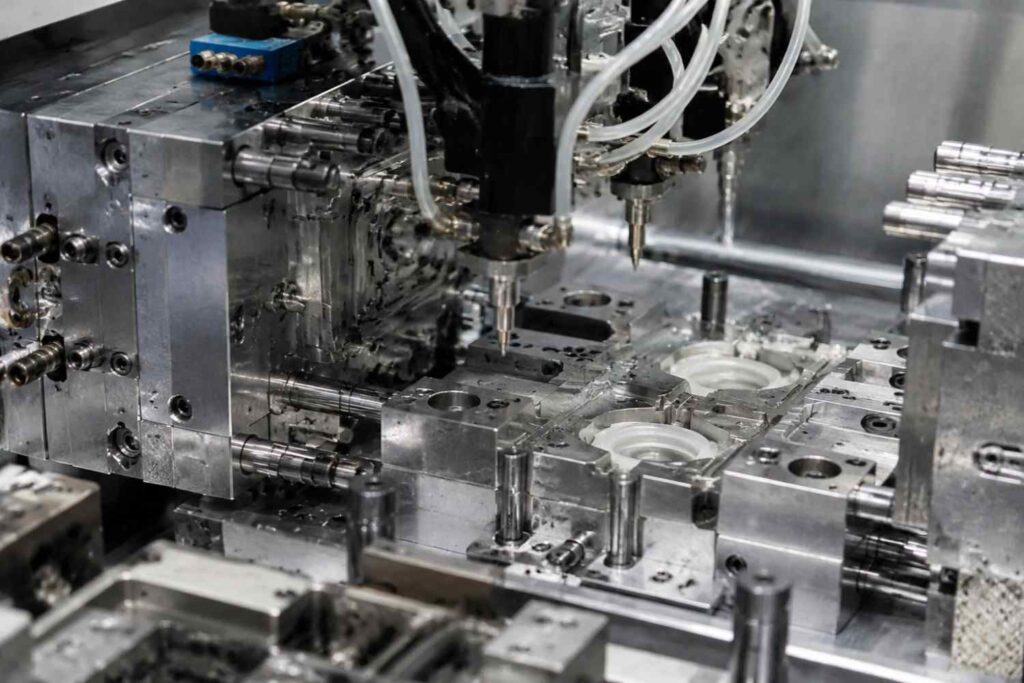
LSR needs cold-runner molds so the liquid doesn’t cure before it reaches the cavity, plus carefully controlled vents — often under 7.5 micrometers — to prevent flash. Building that geometry demands the same five-axis CNC, EDM, and CMM verification SSPrecision applies to its stamping dies and injection molds. With tooling built in-house and six injection presses for trials, engineering and production stay under one roof.
Scaling to high-volume silicone molding
Because the process is fully automatic, scaling is mostly a question of cavity count and cycle time. Add more cavities to a proven mold and per-part cost drops sharply — which is what makes high-volume silicone molding economical for connector seals, gaskets, and disposable medical components.
Where Liquid Silicone Rubber Molding Earns Its Keep
Silicone parts show up wherever sealing, flexibility, and durability meet. The most common applications:
- Automotive and EV: battery pack gaskets, connector seals, grommets, and O-rings that survive heat, coolant, and vibration.
- Medical: diaphragms, catheter components, respiratory masks, valve seals, and baby bottle nipples — produced in validated, documented processes.
- Electronics: keypads, soft-touch buttons, waterproofing seals, and overmolded components for wearables and handsets.
- Industrial: diaphragm seals, fluid-control parts, and insulating components that must keep working for years.
- Consumer: kitchenware, drink valves, and accessories where food safety and feel both matter.
Because LSR overmolds cleanly onto plastic and metal, one silicone part often replaces a multi-part assembly — fewer parts, fewer failure points, simpler sourcing.
LSR Material Grades – Properties & Best-Fit Applications
| LSR Grade | Key Properties | Best-Fit Applications |
| Standard (General Purpose) | Balanced tear strength, good elasticity, cost-effective. | General seals, gaskets, keypads, industrial bumpers. |
| Medical Grade | ISO 10993 / USP Class VI, low extractables, biocompatible. | Catheters, respiratory masks, diaphragms, baby bottle nipples. |
| Fluoro-LSR (FVMQ) | Extreme chemical/fuel resistance; broader high-temp range. | EV battery coolant seals, automotive fuel-system components. |
| High-Tear / High-Strength | Superior mechanical durability & elongation. | Bellows, dynamic shaft seals, heavy-duty grommets. |
| Optically Clear | High transparency, UV/light stable, excellent clarity. | Lighting lenses, wearable light guides, display windows. |
Precision Tooling Is Half the Battle in Silicone Molding
The mold decides whether a silicone part is good, great, or scrapped. Tooling precision shows up as consistent wall thickness, clean edges with no flash, and dimensions that stay stable over millions of cycles.
That’s the core of what SSPrecision does. Since 2008, the company has built stamping dies, injection molds, and tooling spare parts to tolerances down to ±0.002 mm, verified on Zeiss and Mitutoyo CMMs. The same discipline transfers directly to LSR: precise cavities, controlled shut-offs, and thermal management designed around silicone’s cure behavior. ISO 9001:2015 and IATF 16949 certification mean the process is documented and audited, and PPAP Level 3 documentation is available for automotive and medical programs.
Precision tooling costs more up front, but it pays back in flash-free parts, shorter cycles, and longer mold life — the economics show up in the total cost per part, not the tooling price.
Choosing a Custom LSR Molding Partner: What to Ask
The specification is only half the decision. Vet suppliers with questions like:
- Do you build the mold in-house, or subcontract it?
- What tolerance will you hold on critical features, and how do you verify it?
- Can you supply medical-grade LSR with the right certifications and documentation?
- How do you control flash and maintain consistent cycle times?
- What validation documents — first article inspection, PPAP — do you provide?
A partner who answers with data, not promises, is worth the conversation. One who quotes only on price is a risk you’ll carry through the whole program.
SSP Is a Trusted Partner for Die Manufacturing Cost Optimization
SSP Precision is an ISO 9001 & IATF 16949 certified manufacturer delivering end-to-end precision solutions—from DFM engineering and rapid prototyping to high-volume production—for the automotive, medical, electronics, aerospace, and industrial sectors. We handle every stage in-house to manufacture the tooling that makes your parts and the parts themselves.
Visit our to explore our full capabilities: ssprecision.com.cn
Services (tooling design & manufacturing)
- Stamping Dies Manufacturing – high-volume metal stamping with Progressive Die Stamping & Tooling spare parts manufacturing and Transfer Stamping Dies
- Injection Molding – custom plastic molds including Over Molding & Insert Molding and Liquid Silicone Rubber (LSR) Molding
- Green Mold – eco-friendly molded components, Micro Molding – microscopic medical precision parts
Products (end-use parts & spare components)
- Stamping Die – complete stamping tooling
- Injection Mold – complete injection tooling
- Tooling Spare Parts – punches, inserts, ejector pins, Robotics Spare Parts – precision automation spares , Ball Screw Repair Kits – replacement kits for motion systems
- Machine Parts – general precision machine components
FAQ: Liquid Silicone Rubber Molding,
- What is the difference between LSR molding and regular rubber molding?
- Conventional rubber arrives as a solid compound and is shaped by compression or transfer molding, with slower cycles and more finishing. LSR is a liquid injected into a heated mold, curing in place in seconds. That speed, precision, and automation is why LSR is the default for complex, high-volume silicone parts.
- Can liquid silicone rubber be overmolded onto plastic or metal?
- Yes. LSR bonds well to properly prepared substrates, which is how you get soft-touch handles, waterproofed electronics, and sealed connectors. It takes mold and part design that keeps the liquid from curing prematurely — exactly what a DFM review covers.
- What tolerances can LSR molding hold?
- With precision tooling, critical features can be held down to ±0.002 mm in the mold, with molded part tolerances that also depend on material shrinkage and geometry. SSPrecision verifies dimensions on CMMs and documents results with first article inspection.
- Is LSR molding suitable for high volumes?
- Very. The process is fully automatic with fast cycles, so the main levers are cavity count and running time. That combination is what makes high-volume silicone molding cost-effective for automotive, medical, and consumer programs.
- How do I get a quote from SSPrecision?
- Send your part file or sample through ssprecision.com.cn. SSPrecision acknowledges within 24 hours, runs a free DFM analysis, and returns a detailed quote within two business days.
Read More – Intelligence That Protects Your Production Line
- Heavy Duty Transfer Tooling: Multi-Station Transfer Dies for Deep-Drawn Components – Transfer dies handle individual blanks for deep-drawn and heavy gauge parts up to 8mm thick with tolerances to ±0.002mm—here’s how they compare to progressive dies for complex automotive and EV components.
- China Injection Mold Source: High-Cycle Multi-Cavity Production Plastic Molds – Multi-cavity molds produce 4–32+ parts per cycle with tolerances to ±0.002mm—here’s how to source high-volume tooling from China with lead times of 25–45 days.
- Stamping Dies Manufacturing: Custom Dies for OEMs – Custom stamping dies achieve ±0.002 mm tolerances for high-volume production of automotive, electronics, and medical components—here’s the steel selection guide and lead time breakdown for OEM buyers.
- Microelectronics Injection Molding: Precision Micro Molding for Tech OEMs – Micro injection molding achieves ±0.01 mm tolerances on parts weighing under 1 gram for connectors, sensors, and lens arrays—here’s the material selection guide and quality standards for tech OEMs.
- Average Lead Times for China Tooling Production – Stamping dies take 4–12 weeks and injection molds 3–14 weeks depending on complexity, steel grade, and tolerance requirements—here’s a practical guide for automotive buyers on realistic timelines.
- Should You Source Molds in China or Locally? – China molds cost 40–60% less with 3–6 week lead times, while local sourcing offers tighter tolerances and faster design iterations—here’s a side-by-side comparison to help you decide.
- How to Prevent Flash, Warpage & Sink Marks – Flash, warpage, and sink marks account for 35–40% of plastic part rejects—here’s how to eliminate them with precision tooling, process control, and a defect rate as low as 0.7%.
- Precision Robotics Components: Spare Parts Supply Solutions – Custom robotics components and automation spare parts machined to ±0.002 mm—here’s the material selection guide, tolerance data, and why OEMs rely on precision machining for end-effectors, housings, and motion-critical parts.
- Top 10 Best Stamping Dies and Injection Molding Companies in the World – A data-driven ranking of the top 10 stamping die and injection molding companies globally—here’s how they compare across certifications, lead times, and cost, with a detailed China