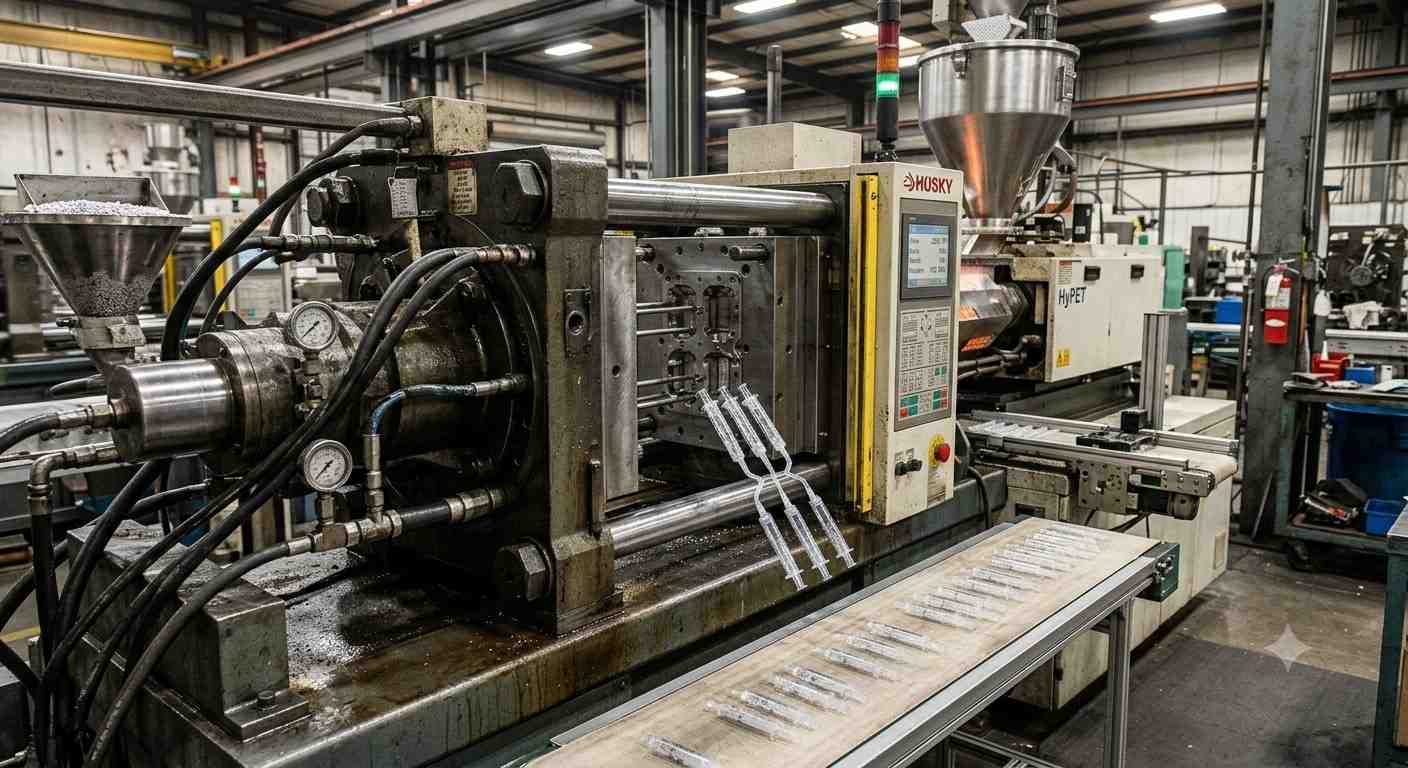
When you’re assessing an expansion or launching a new product line, looking at the overall Injection Mold Cost can end up being this kind of key financial milestone, mostly because it shows up early and then sticks around. If you source high-precision tooling from China, many original equipment manufacturers, or OEMs, often manage to reduce capital expenditures by something like 30% to 50% when compared with Western options. In simple terms, an injection mold is a custom-machined metal block that takes molten plastic , under high pressure, and turns it into matching parts over and over again—fast. At SS Precision (SSP), we try to balance that upfront tooling spend with the long-term reliability of production, delivering molds that are designed for tight tolerances, down to ±0.002mm.
- Sourcing high-precision tooling means you have to balance the first capital commitments against how long the machinery is expected to run.
- Advanced manufacturing approaches reduce material waste and improve throughput timing, which helps long-term efficiency.
- Selecting a verified production collaborator helps keep everything transparent, from technical specs through to delivery calendars.
Cost Drivers in Injection Mold Cost China
To calculate an accurate Injection Mold Cost China, you really need to break down the main engineering drivers. Tooling is not a plain commodity purchase; it’s a heavily tailored mechanical investment.
- Part geometry complexity determines CNC milling workload plus Wire EDM machine hours.
- Surface finish targets, for example high-gloss SPI-A1 diamond polishing, can raise manual bench labor hours a lot.
- Intricate slide assemblies , lifters, and hydraulic core pulls introduce more moving components, which generally increases fabrication spend.
- The decision on parting lines, gate styles, and ejection systems affects tool design time, engineering hours, and overall schedule.
SPI Classifications: The Mold Price Guide
To create a clean reference, procurement managers often lean on an industry-standard Mold Price Guide, structured around Society of Plastics Industry (SPI) classifications. It’s basically a matrix that lines up production volumes with specific structural designs, so teams don’t end up over-engineering low-volume tools, even if the mood is to “go big” too early.
| SPI Class | Production Cycle Rating | Typical Steel Specification | Price Bracket (USD) |
| Class 101 | Over 1,000,000 cycles | Hardened H13 / S136 / 420SS | $15,000 – $60,000+ |
| Class 102 | Under 1,000,000 cycles | P20 / 718H / NAK80 | $7,000 – $25,000 |
| Class 103 | Under 500,000 cycles | P20 Pre-hardened Steel | $4,000 – $15,000 |
| Class 104 | Under 100,000 cycles | Low-carbon steel / Mild alloys | $3,000 – $8,000 |
| Class 105 | Prototype runs (<500) | 7075 Aluminum / Mild steel | $1,500 – $4,000 |
Finding a Trusted China Mold Maker
When picking a professional China Mold Maker you should look past the sales pitch and check their internal quality routines and engineering depth. Working straight with a certified manufacturer such as SSP removes middleman markups, and it also helps keep technical traceability complete, from what I’ve seen.
- Verify the facility has advanced international manufacturing credentials like ISO 9001:2015 and IATF 16949
- Audit the in-house metrology lab to confirm the presence of high-end coordinate measuring machines, (CMM)
- Ensure the supplier can provide complete material mill test reports to confirm steel authenticity
How to Request an Accurate Injection Mold Quote
If you submit a half-finished data package, suppliers commonly respond by adding risk premiums to the Injection Mold Quote. When the technical definitions are exact, the commercial pricing tends to be cleaner, more optimized, and less “guessy”.
- Provide native 3D CAD files in STEP or Parasolid formats, and include detailed 2D drawings that show critical dimensions
- Clearly specify the commercial resin grade, including colorant ratios, so they can calculate exact plastic volumetric shrinkage
- State target annual production volumes, plus estimated part lifecycles, to define the ideal mold cavity arrangement
Steel Grade Selection and Metallurgical Pricing Impact
Choosing the tool steel is one of the largest single cost drivers in mold building. The material has to handle thousands of high-pressure injection cycles without surface deterioration or dimensional creep, because any drift can turn into expensive rework later.
| Steel Grade | Rockwell Hardness (HRC) | Corrosion Resistance | Ideal Resin Application |
| P20 / 718H | 28 – 32 HRC | Low | Standard ABS, PP, PS |
| H13 / SKD61 | 48 – 52 HRC | Moderate | Highly abrasive glass-filled PA |
| S136 / 420SS | 48 – 52 HRC | Exceptional | Optically clear PC, corrosive PVC |
Cavitation and Fluid Dynamic Balancing
More mold cavities means the first fabrication budget gets higher, but during big, high-volume runs the unit price falls kind of fast. In a simple sense, cavitation is just the count of identical pieces that come out in one injection press cycle. For instance, if you use a 4-cavity mold and run a 15-second cycle, you end up at about 960 parts per hour. But with a 1-cavity tool, you’re closer to 240 per hour. So the SSP team tries to balance the runner systems so the melt reaches every cavity in a similar way, this helps avoid uneven part weight and dimensional non conformance, which is honestly what you do not want.
Advanced Cooling Circuit Design Metrics
Cooling is roughly 70% of the overall injection molding cycle time. If you design a mold with properly tuned cooling lines, yes it takes careful engineering work, but the financial return can be huge over millions of cycles. Regular drilled cooling channels are cheaper to machine, however in complicated part shapes they can create thermal hotspots. Switching to conformal cooling channels made using 3D metal printing typically costs more at the start, yet it can shrink cycle times by around 20% to 40%, which then lowers the long-run production overhead.
Quality Assurance, Metrology, and Tolerances
Precision toolmaking is really about tight tolerances and disciplined quality measurements. SSP delivers machining tolerance performance as low as ±0.002mm, so intricate internal components end up fitting correctly when the final product is assembled.
- Real time statistical process control (SPC) monitoring follows critical tool wear indicators while parts are being made.
- Automated CMM dimensional checks compare molded parts directly to the original CAD model.
- Quality systems keep the overall PPM defect rate below 0.5% throughout mass production.
Sourcing Protocols and Workflow Amortization
SSP Precision is an ISO 9001 & IATF 16949 certified manufacturer delivering end-to-end precision solutions, from design and prototyping to high‑volume production, for the automotive, medical, electronics, aerospace, and industrial sectors. We handle every stage in‑house – DFM engineering, rapid prototyping, CNC machining, EDM, grinding, and global logistics – to manufacture the tooling that makes your parts and the parts themselves.
What we build and supply: visit our sites: https://ssprecision.com.cn/
- Stamping dies manufacturing and stamping die parts – high‑precision transfer stamping dies and progressive/compound dies for volume metal stamping.
- Injection molding and injection mold – custom injection molds for plastic components, including single‑, multi‑cavity, and over‑molding & insert‑molding tools that combine metal and plastic in one part.
- Specialty molded components – eco‑friendly green mold parts and microscopic medical micro‑molded parts.
- Precision metal and plastic end‑use parts – high‑volume serial production of precision products (metal stampings, plastic moldings) with full PPAP traceability.
- Tooling spare parts manufacturing & – tooling spare parts (punches, inserts, ejector pins) and precision robotics spare parts to keep your production running.
Real-World Field Case Study: Optimizing High-Volume Tooling
An international automotive electronics tier-1 manufacturer was having trouble with a lot of rejections, mostly because dimensional drift showed up on a glass-filled PBT connector housing. Their older tooling would not stay locked into tight tolerances after around 150,000 cycles or so. SSP basically reworked the tooling, using hardened S136 steel insert matrices with a well-tuned hot runner system that was optimized to the process. With the upgraded multi-cavity mold, the part dimensions stayed steady inside ±0.005mm ,and the cosmetic flashing finally stopped. The result was a clean, quick payback—ROI showed up in the first quarter of high-volume manufacturing, which was pretty fast and honestly unexpected.
Frequently Asked Sourcing Questions
- What kind of lead time should I expect for a production mold?
- For Standard Class 101 production molds, it usually takes 6 to 8 weeks to design, machine, and run validation through initial T1 samples. Prototype tooling tends to be faster , often 2 to 4 weeks.
- How do hot runner systems affect the initial mold expense?
- Hot runner setups can cost more up front on the tooling invoice, however you remove plastic runner scrap entirely. That reduces raw material spend and can improve cycle times during long production runs so the overall picture is cheaper later.
- Is it easy to export a mold that was built in China to Western sites?
- Yes, reputable manufacturers make the tool to work with global standards such as DME or HASCO. That way hydraulic connections, electrical wiring, and ejector pins align so your domestic molding machines fit properly , without the usual hassle.
Read More – Intelligence That Protects Your Production Line
-
D2 vs DC53 Tool Steel: Which is Best for Stamping? – D2 has been the industry standard, but DC53 offers twice the toughness and better machinability—here’s the metallurgical data to decide which alloy delivers lower total cost of ownership for your stamping application.
-
How to Track & Prevent Tool Wear in Progressive Dies – Acoustic sensors, tonnage monitoring, and carbide inserts can push die life beyond 200,000 strokes—here’s the data on tracking wear thresholds before they become catastrophic failures.
-
Insert Dies Vs. Solid Dies: Maintenance & Cost Analysis – Insert dies cost 10–20% of their original price to repair, while solid dies run 40–70%—here’s the data on downtime, spare parts strategy, and which design wins for high-volume stamping.
-
Injection Molding Guide: Costs, Materials, Process, and Mold Tooling – A prototype mold can cost $3,000, while a high-volume production mold runs $80,000+—here’s how to match tooling class to real production volume and avoid overpaying for steel.
-
What Drives Metal Stamping Die Costs? – A progressive die can cost anywhere from $8,000 to over $150,000—here’s a breakdown of the 5 key cost drivers, global price comparisons, and when to repair vs. replace.
-
Injection Molding Tolerances (With Precision Chart) – Tightening a tolerance from IT7 to IT3 can triple your mold cost—here’s the precision grade chart, material-specific shrinkage data, and how to specify only what your design actually needs.
-
Injection molding: Hot Runner Vs Cold Runner – Hot runners add 30–50% to upfront tooling cost but can slash cycle times by 40% and eliminate material waste—here’s how to weigh the trade-off for your production volume.