

The Quality Imperative in Stamping Die Manufacturing
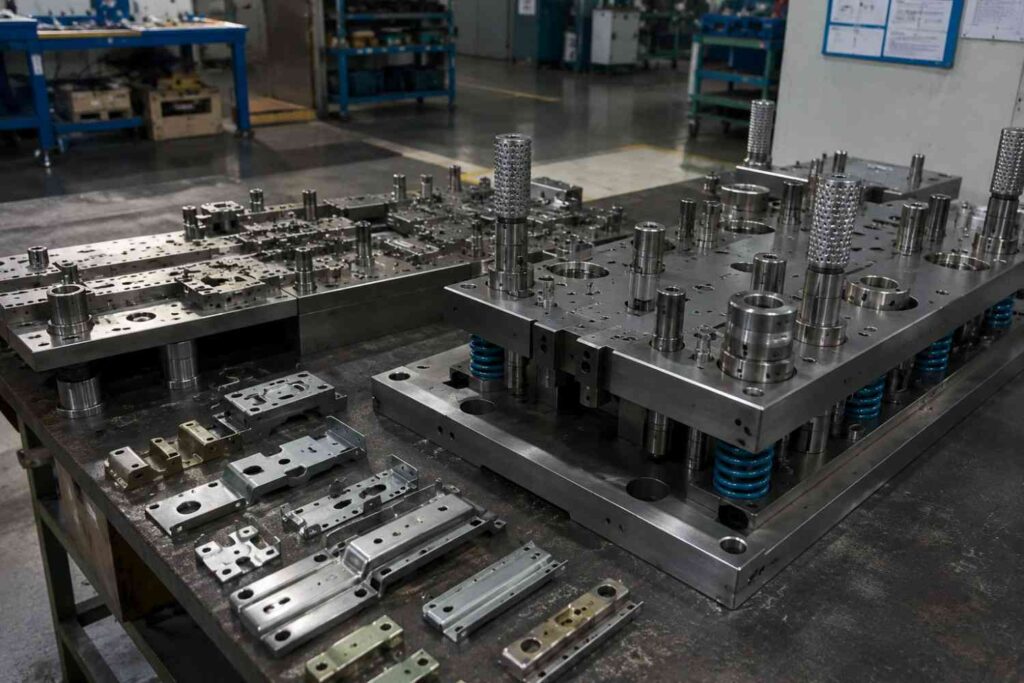
A stamping die is what drives high-volume metal production. It turns flat coil stock into finished parts like brackets, terminals, housings, and connectors at speeds above 1,200 strokes per minute. But a die is only as dependable as the quality assurance system standing behind it.
The reality is sobering. A 2023 industry survey found that unplanned die failure causes two-thirds of all production downtime in stamping plants, and for mid-sized manufacturers that typically works out to $80,000–$250,000 a year in lost production and repairs. When global OEMs source stamping die products from overseas partners, the biggest worry is rarely cost. It is consistent.
This quality assurance review looks at the rigorous systems that separate world-class stamping tooling from everything else, and at why SSPrecision (SSP), a Dongguan-based precision manufacturer since 2008, has built its reputation on custom metal stamping tools that run millions of cycles with zero-defect consistency.
The SSPrecision Quality Framework
SSPrecision works out of a 9,000 m² facility in Dongguan, China, certified to ISO 9001:2015 and IATF 16949. With 300+ precision machining professionals and a tolerance capability of ±0.002 mm on critical die features, the company’s quality system covers every stage of the stamping die lifecycle.
Stage 1: Design & DFM — Quality by Engineering
Quality starts before any steel is cut. On every project, SSPrecision’s engineering team runs a Design for Manufacturability (DFM) review, weighing part geometry, material behavior, and production volumes before recommending the optimum strip layout and die configuration.
Strip layout optimization is where cost and quality get decided. A well-thought-out layout uses material efficiently, keeps the strip rigid, and sequences the forming operations so the part never distorts. SSPrecision engineers target material utilization above 78% on medium-complexity stampings and above 85% for high-volume progressive die parts.
The DFM process flags critical dimensions early, so the tool design can actually hold them in production. Advanced CAE simulation of metal flow, springback, and thinning fine-tunes station sequencing, which keeps defects from ever appearing in the first cutting operation.
Stage 2: Material Selection & Verification
Choosing the tool steel is one of the highest-impact decisions in stamping tool quality. SSPrecision buys only certified tool steels, D2, SKD11, H13, and Cr12MoV, from qualified suppliers. Every batch goes through hardness testing and a material certification review, so the steel can stand up to the stresses of production.
For long-run production, SSPrecision specifies tool steels in the 58 HRC to 66 HRC hardness range, which supports tool life of 500,000 to 5,000,000 strokes before reconditioning. On progressive dies, the company’s documented tool life exceeds 2 million cycles.
Stage 3: Precision Machining — The ±0.002 mm Standard
Every stamping die component is machined to micron-level accuracy on advanced equipment:
| Machining Capability | SSPrecision Standard |
|---|---|
| 5-Axis CNC Machining | ±0.002 mm on critical features |
| Wire EDM | Precision cutting of punch and die clearances |
| Surface Grinding | Ra 0.4 μm finish |
| Heat Treatment | Vacuum hardening, deep freezing, tempering |
| PVD Coating | Extended tool life and wear resistance |
SSPrecision’s 5-axis CNC machining centers and precision Wire EDM machines run under ISO 9001:2015 certified process control, holding Cpk ≥ 1.67 on 98% of production characteristics.
Stage 4: Assembly & Die Tryout — Proving Performance
Assembly is where the individual components come together into a working tool. SSPrecision follows a strict tryout protocol:
- Die assembly with precision alignment of all stations
- Press tryout on a suitable press—confirming forming and dimensional results
- First-article inspection—100% verification of all drawing callouts
- Fine-tuning of die clearances, spring pressures, and pilot timing
Quality assurance sits entirely separate from the machining and design departments, and it follows the tool from manufacturing all the way to shipment confirmation. Before anything ships, quality specialists recheck the reports and checklists against the customer’s standards.
Stage 5: CMM Inspection & PPAP Documentation
SSPrecision’s in-house CMM (Coordinate Measuring Machine) verifies every critical dimension. Every die gets a full dimensional report backed by NIST-traceable measurement records.
Before any die ships, it goes through full PPAP (Production Part Approval Process) documentation:
- Dimensional inspection reports
- Material certifications
- Capability studies (Cpk ≥ 1.67)
- Approved sample parts for customer sign-off
This documentation aligns with the IATF 16949 and ISO 13485 quality systems, giving customers the traceability they need for automotive, medical, and aerospace regulatory submissions.
Stage 6: Serial Production & Ongoing Quality Control
Quality assurance does not end at delivery. During serial production, SSPrecision maintains:
- SPC monitoring of critical dimensions in real-time
- Scheduled die maintenance to prevent unplanned downtime
- Dedicated quality control sustaining zero-defect delivery
That layered approach has produced a 98.5% first-pass yield and a 99.7% quality acceptance rate across production runs.
Quality Metrics That Matter
| Metric | SSPrecision Standard | Industry Benchmark |
|---|---|---|
| Die Tolerance | ±0.002 mm | ±0.005–0.01 mm |
| Surface Finish | Ra 0.4 μm | Ra 1.6 μm |
| Die Speed | 1,200 strokes/min | 400–800 SPM |
| Tool Life | 2+ million cycles | 500,000–1,000,000 |
| First-Pass Yield | 98.5% | 95–97% |
| Quality Acceptance Rate | 99.7% | 97–99% |
| On-Time Delivery | 99% | 90–95% |
| Cpk | ≥ 1.67 | ≥ 1.33 |
Common Quality Failures & How SSPrecision Prevents Them
Across SSPrecision client audits, data from over 1,200 stamping die failure events points to six root causes that account for more than 95% of all incidents:
| Failure Cause | Frequency | SSPrecision Preventive Action |
|---|---|---|
| Premature Tooling Wear | 34% | Optimized tool steel selection; PVD coating; proper heat treatment |
| Misalignment & Misfeed | 22% | Precision piloting; in-die sensors; strip layout verification |
| Inadequate Lubrication | 18% | Documented lubrication protocols; scheduled maintenance |
| Material Non-Conformance | 14% | Incoming material certification; spectrometer verification |
| Thermal Stress & Fatigue | 8% | Proper heat treatment; thermal stress relief |
| Design Defects | 4% | Structured DFM review; CAE simulation |
One documented case shows how costly this can get: a D2 steel punch set rated for 500,000 strokes failed at 310,000 strokes because the hardness of the feed material had risen 12% without anyone catching it, and the result was 28 hours of downtime. SSPrecision heads off exactly this kind of failure with incoming material verification and real-time SPC monitoring.
Why Global OEMs Choose SSPrecision for Stamping Die Products
Since 2008, SSPrecision has been a trusted stamping die manufacturing partner to OEMs and Tier-1 suppliers in automotive, electronics, medical, aerospace, energy, and industrial sectors.
Certifications That Matter
- ISO 9001:2015 — Quality Management System
- IATF 16949:2016 — Automotive Quality Management
- ISO 13485 — Medical Device Quality (upon request)
Capabilities That Deliver
- 60+ multi-axis CNC machining centers including 5-axis and Wire EDM
- Tolerance capability to ±0.002 mm
- Dies designed for 5–2,500 ton presses
- 45+ countries served with international export logistics
- Sample dies in 15–25 days, production tools in 30–45 days
The SSPrecision Difference
- In-house DFM, design, machining, heat treatment, and tryout—all under one roof
- Full PPAP documentation with every die
- 300+ precision machining professionals
- Performance directly competitive with German and Japanese toolmakers at 60–78% lower investment costs
SSP Is a Trusted Partner for Die Manufacturing Cost Optimization
SSP Precision is an ISO 9001 & IATF 16949 certified manufacturer delivering end-to-end precision solutions—from DFM engineering and rapid prototyping to high-volume production—for the automotive, medical, electronics, aerospace, and industrial sectors. We handle every stage in-house to manufacture the tooling that makes your parts and the parts themselves.
Visit our to explore our full capabilities: ssprecision.com.cn
Services (tooling design & manufacturing)
- Stamping Dies Manufacturing – high-volume metal stamping with Progressive die Die Stamping & Tooling spare parts manufacturing and Transfer Stamping Dies
- Injection Molding – custom plastic molds including Over Molding & Insert Molding and Liquid Silicone Rubber (LSR) Molding
- Green Mold – eco-friendly molded components, Micro Molding – microscopic medical precision parts
Products (end-use parts & spare components)
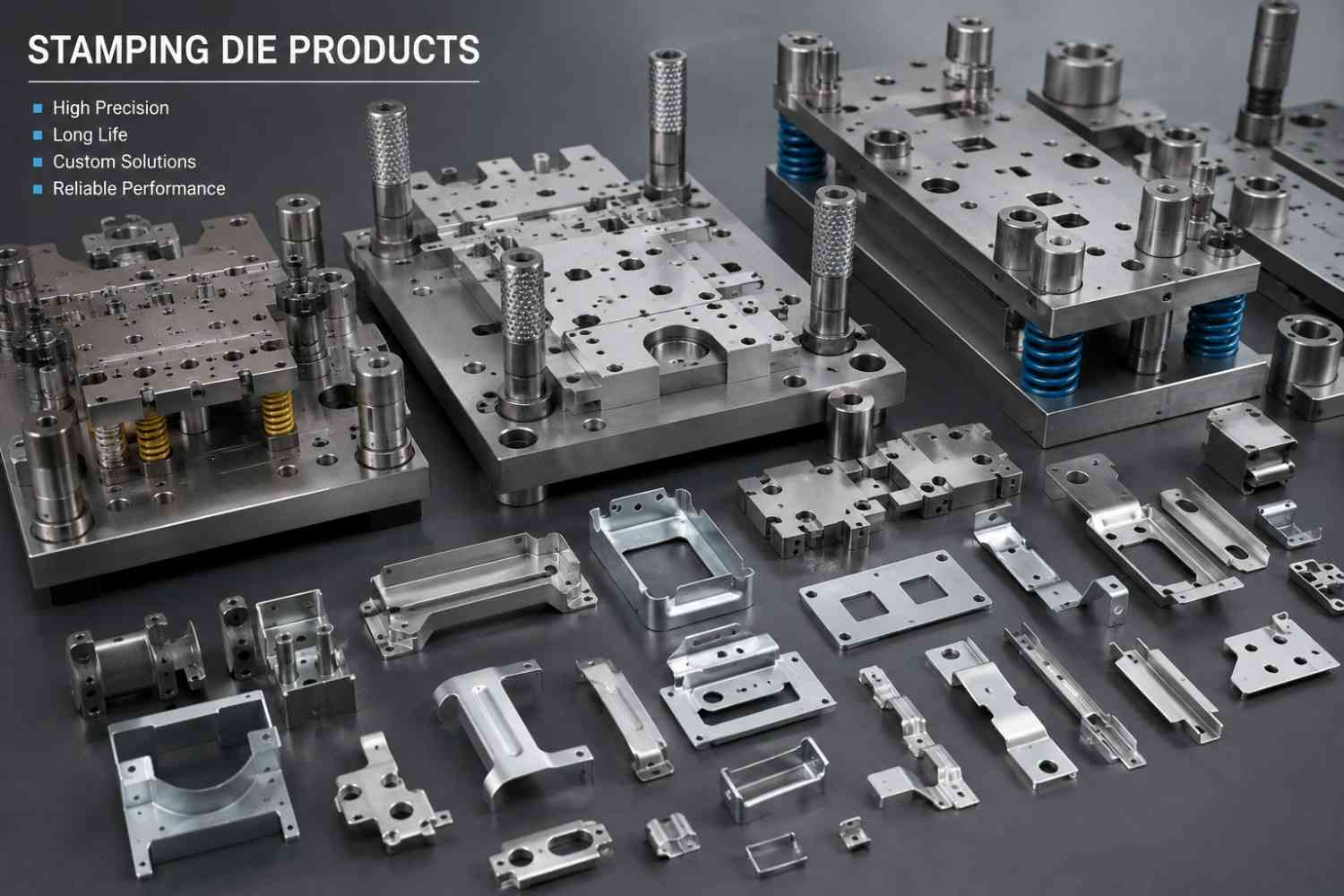
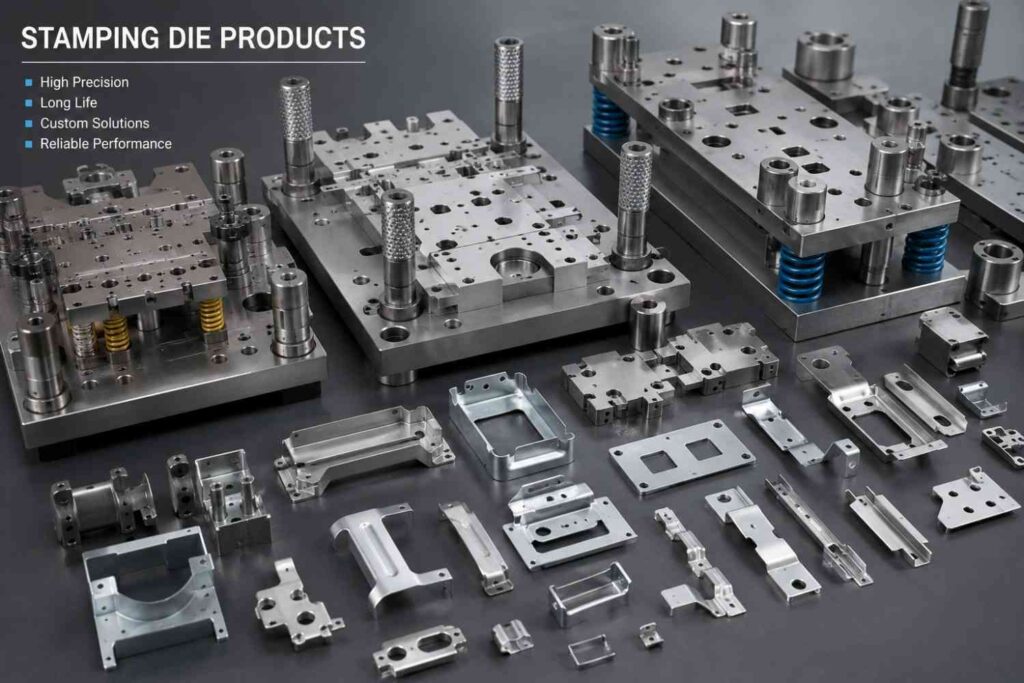
- Stamping Die – complete stamping tooling
- Injection Mold – complete injection tooling
- Tooling Spare Parts – punches, inserts, ejector pins, Robotics Spare Parts – precision automation spares , Ball Screw Repair Kits – replacement kits for motion systems
- Machine Parts – general precision machine components
FAQ
- Q: What is a stamping die?
A stamping die is a custom-built metal tool that forms, cuts, or shapes sheet metal into specific geometries on a press. Each die is made up of punches, die buttons, inserts, guide pins, and plates. - Q: What tolerances can SSPrecision achieve on stamping dies?
SSPrecision holds ±0.002 mm (±2 µm) on critical die features, verified on CMM, while production parts are held to ±0.005 mm as standard. - Q: What materials are used in SSPrecision stamping dies?
Certified tool steels including D2, SKD11, H13, and Cr12MoV, with vacuum hardening and PVD coating to extend tool life. - Q: What certifications does SSPrecision hold?
ISO 9001:2015 and IATF 16949:2016, with ISO 13485 (medical) available on request. - Q: What industries does SSPrecision serve?
Automotive/EV, electronics, medical devices, aerospace, energy, and industrial sectors. - Q: What is PPAP and why is it important?
PPAP (Production Part Approval Process) is a standardized documentation package that verifies the manufacturing process can consistently produce conforming parts. SSPrecision provides full PPAP documentation with every die. - Q: How long does SSPrecision stamping last?
Documented tool life exceeding 2 million cycles, with proper maintenance. - Q: What is the typical lead time for a stamping die from SSPrecision?
Sample dies in 15–25 days; production tools in 30–45 days depending on complexity.
Read More – Intelligence That Protects Your Production Line
- Margin Optimization: Sustainable Injection Mold Design OEM – Conformal cooling, hot runners, all-electric machinery, and closed-loop recycling cut energy use 52%, material waste to under 3%, and per-part cost by 22%—here’s the sustainable mold design framework for margin protection.
- Technical Framework: Multi-Station Progressive die Metal Forming – Progressive dies stack blanking, piercing, bending, and forming into one tool running at 1,200 SPM with ±0.002 mm tolerance—here’s the technical framework for multi-station die design, station sequencing, and automation integration.
- Engineering Walkthrough: Deep Drawn Transfer Dies Stamping – Deep drawing turns flat metal into seamless shells—here’s a stage-by-stage walkthrough of transfer dies, blank holder forces, draw ratios, and how to prevent wrinkling, tearing, and springback on heavy-gauge parts.
- Performance Audit: Precision Die Manufacturer Sheet Forming – Die suppliers look similar on paper—here’s the 7-point audit checklist that separates real capability from marketing: Cpk data, tool life, repeatability, documentation, and how they respond when something goes wrong.
- Applied Proof: Insert Molding Manufacturer Metal Insert – Insert molding fuses metal inserts into plastic in a single step, replacing secondary assembly and improving reliability—here’s how the process works, how it compares to overmolding, and what a custom insert molding partner needs to get right.
- Field Implementation: Tooling Manufacturer in Dongguan – A struggling EV supplier cut scrap from 12% to under 1%, boosted tool life from 500K to 2M+ cycles, and eliminated unplanned downtime—here’s the field data on strip layout optimization
References & standards
- IATF 16949:2016 (International Automotive Task Force) — The automotive quality management standard governing tooling suppliers to OEMs.
- ISO 9000 family — Quality management (ISO) — The quality management system standard SSP is certified to.