

Every stamped or molded part starts its life in a die, and the die decides everything that comes after: dimensional stability, scrap rate, press uptime and ultimately the cost per part. The trouble is that die suppliers look surprisingly similar on paper. Everyone claims precision, capacity and fast delivery. A performance audit cuts through the marketing by measuring what actually matters: tolerances, tool life, repeatability, documentation and how a supplier responds when something goes wrong. This article walks through the benchmarks a serious buyer uses to evaluate a precision die manufacturer, with practical criteria you can apply whether you are sourcing in North America, Europe or from a specialist in Dongguan, China.
Key Takeaways
- Verify actual tolerance capability, not claims: ask for Cpk data on released tools.
- Tool life and maintenance history reveal more than a clean showroom.
- IATF 16949 signals real automotive-grade process control; ISO 9001:2015 is the baseline.
- Check the paperwork: material certificates, heat-treatment records and measurement reports.
- A partner who DFM-checks your part and flags problems before cutting steel is worth more than a lower quote.
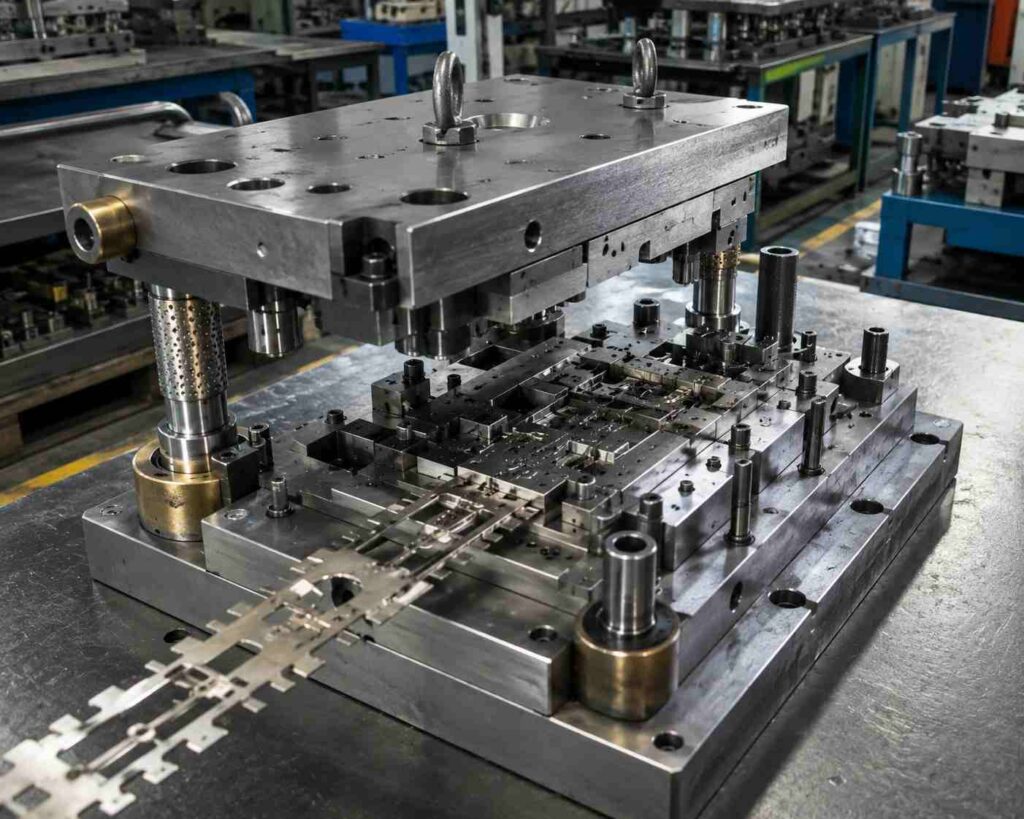
What a Die Performance Audit Actually Measures
An audit is only as good as its checklist, and the checklist needs to map to outcomes you can observe, not adjectives you can be told. These seven measures cover the ground that determines whether a tool performs in production.
- Dimensional capability, expressed as Cpk on the critical features of released tools.
- Tool life between maintenance cycles, in strokes or shots.
- Repeatability across lots, shifts and production runs.
- Scrap and rework rate on the parts the tool produces.
- Response time when a dimensional or delivery issue is raised.
- Documentation quality: PPAP, IMDS, measurement reports and change records.
- Tryout discipline: is the tool verified against first articles before it ships?
Capability Benchmarks: Tolerances, Tool Life, Repeatability
Numbers beat adjectives every time. The ranges below represent what a serious precision die manufacturer can hold with modern wire EDM, grinding and CMM inspection, and they are useful targets when you benchmark a candidate shop.
| Benchmark | Precision stamping dies | Injection molds | What it proves |
| Positioning tolerance | ±0.002–0.01 mm | ±0.005–0.01 mm | Machine and process control |
| Surface finish | 0.2–0.8 µm Ra | SPI A–B | Polish and QC discipline |
| Tool life | 500k–5M+ strokes | 500k–1M+ cycles | Steel grade and heat treatment |
| Tryout and release | First article + Cpk | First article + Cpk | Engineering depth |
SSPrecision routinely holds ±0.002 mm on critical features from its Dongguan facility, and that is not a marketing number: it is the tolerance their CMM reports against on released tools.
Repeatability is the benchmark most buyers overlook. A die that holds tolerance for the first hundred parts but drifts by the two-thousandth is a production problem that stays hidden until scrap appears on the press. Ask for run-to-run data across multiple lots. Consistent Cpk values over time indicate a die built with margin, while values that climb and fall point to a tool running at the edge of its capability.
Evaluating Precision Stamping Dies and Custom Forming Dies
Design and DFM
The best time to improve a die is before any steel is cut. A strong partner runs a formal design-for-manufacturability review on your part, flags springback risk, suggests material changes and proposes die layout options with honest cost trade-offs. If a supplier only quotes your print as-is, they are a machine shop, not an engineering partner.
Material and Heat Treatment
Tool steel grade, heat-treatment cycle and the vacuum or atmosphere used determine how long the die holds an edge. Ask for material certificates and heat-treatment records on every die set. A supplier that cannot produce them cannot prove the tool life they promised.
Surface Finish and Coatings
Polished and coated surfaces reduce galling, improve release and extend maintenance intervals. For sheet metal forming tooling, look for experience with PVD and other coatings that suit your material and stroke rate.
Documentation and Traceability
When a die ships, the file should travel with it: final inspection report, material certificates, revision history and recommended maintenance schedule. This documentation is what makes the next die faster and the current one auditable.
Certification and Quality Systems: ISO 9001:2015 and IATF 16949
ISO 9001:2015 is the baseline quality management standard and a reasonable minimum for any supplier. IATF 16949 adds the automotive layer: APQP planning, PPAP documentation, traceability, change control and a tighter expectation of continuous improvement. If your parts feed an automotive or EV program, an IATF-certified supplier removes a whole category of supply-chain risk. SSPrecision holds both certifications, which is why its customers in automotive, electronics and medical can pull complete documentation without asking twice.
Taken together, the standards and the numbers matter less than what they enable: parts that drop into a downstream assembly without rework. SSPrecision serves automotive and EV, electronics, medical, aerospace, energy and industrial customers, and that breadth is itself a signal. A die maker that ships into regulated sectors is used to being audited, used to document every decision and used to deliver tooling that runs predictably on a customer’s press, not just on its own tryout line.
Red Flags and Green Flags When Auditing a Die Maker
- Red flag: no measurable Cpk data, only claims that the shop is precise.
- Red flag: missing material certificates or heat-treatment records.
- Red flag: single-machine dependency with no backup plan for breakdowns.
- Red flag: vague lead times and no written progress reports.
- Red flag: resistance to sharing dimensional reports on first articles.
- Green flag: documents a DFM review before quoting.
- Green flag: offers tolerance and cost trade-off options rather than a single quote.
- Green flag: produces PPAP documentation without being asked.
- Green flag: maintains a calibrated CMM and a dedicated inspection lab.
- Green flag: backs tool life with a written warranty.
The Audit in Practice: From Desk Review to Shop Floor
A performance audit does not have to be a formal two-week process. It scales to the size of the program, and a practical sequence looks like this:
- Document review: certificates, past PPAPs, measurement reports and a machine list.
- Data call: request Cpk on three representative past tools, plus their maintenance intervals.
- Desk evaluation: see how they respond to a technical question, in writing, within a fixed time.
- Shop floor visit: watch the tryout process, check the inspection lab and confirm calibration records match.
- Reference calls: talk to two customers running tools similar to yours.
Each step is cheap compared with the cost of a bad die, and together they build a picture that no brochure can. A supplier that completes this exercise without friction is already telling you how they will behave when your production line is down.
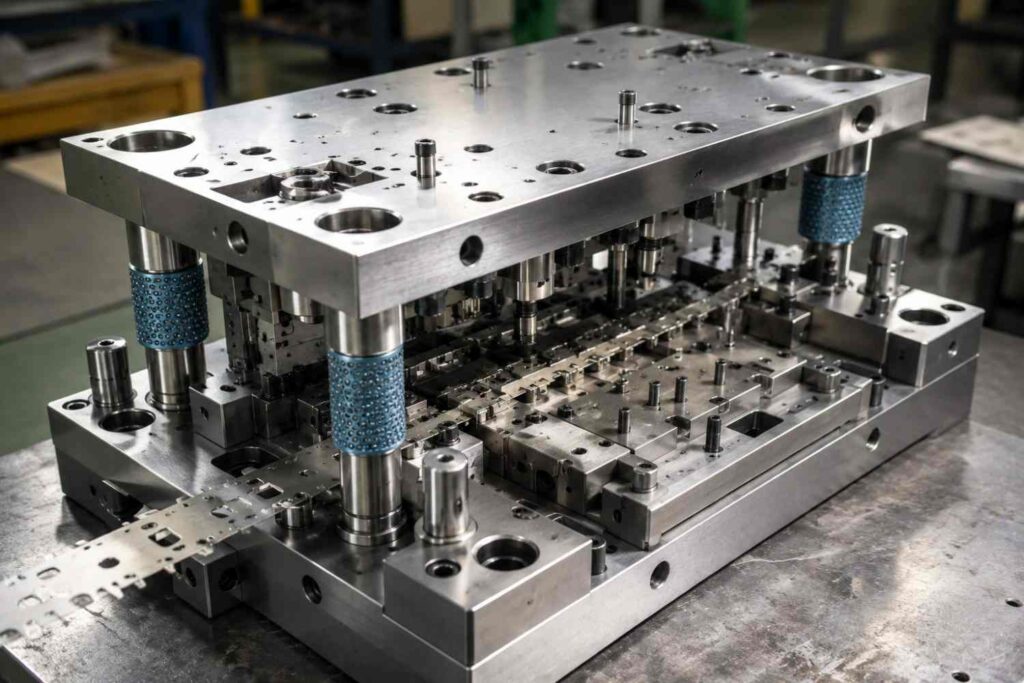
Build a Scorecard for Your Next Die Sourcing Project
Scoring suppliers the same way every time removes bias and makes the final decision defensible. A simple weighted scorecard works well. Score each candidate from 1 to 5 on the criteria below, multiply by the weight, and compare totals. For a stamped or formed part, tolerance and engineering support usually deserve the heaviest weights.
| Criterion | Weight | How to score it |
| Tolerance capability | 25% | Cpk data on critical features |
| Quality system | 20% | ISO 9001 and IATF certificates plus scope |
| Engineering support | 20% | DFM quality and response time |
| Delivery reliability | 15% | On-time record and progress reporting |
| Cost competitiveness | 20% | Total cost including maintenance |
Apply the same scorecard to a domestic shop and an overseas specialist and you get an apples-to-apples comparison. A Dongguan die maker with strong Cpk data and IATF certification often wins on total cost while matching the tolerance story of a local supplier.
SSP Is a Trusted Partner for Die Manufacturing Cost Optimization
SSP Precision is an ISO 9001 & IATF 16949 certified manufacturer delivering end-to-end precision solutions—from DFM engineering and rapid prototyping to high-volume production—for the automotive, medical, electronics, aerospace, and industrial sectors. We handle every stage in-house to manufacture the tooling that makes your parts and the parts themselves.
Visit our to explore our full capabilities: ssprecision.com.cn
Services (tooling design & manufacturing)
- Stamping Dies Manufacturing – high-volume metal stamping with Progressive Die Stamping & Tooling spare parts manufacturing and Transfer Stamping Dies
- Injection Molding – custom plastic molds including Over Molding & Insert Molding and Liquid Silicone Rubber (LSR) Molding
- Green Mold – eco-friendly molded components, Micro Molding – microscopic medical precision parts
Products (end-use parts & spare components)
- Stamping Die – complete stamping tooling
- Injection Mold – complete injection tooling
- Tooling Spare Parts – punches, inserts, ejector pins, Robotics Spare Parts – precision automation spares , Ball Screw Repair Kits – replacement kits for motion systems
- Machine Parts – general precision machine components
Die Manufacturer Frequently Asked Questions
- What tolerance can a precision die manufacturer actually hold?
On critical features of precision stamping dies, ±0.002 to 0.01 mm is realistic with modern wire EDM, grinding and CMM inspection. SSPrecision quotes ±0.002 mm capability and documents it on released tools.
- How long should a stamping die last?
With the right steel grade and heat treatment, progressive dies commonly run from 500,000 to several million strokes before major maintenance. Ask for the candidate’s typical tool-life range.
- What is Cpk and why does it matter for dies?
Cpk measures whether a process consistently holds tolerance. A die with Cpk of 1.33 or higher on critical features produces predictably good parts, which translates directly into low scrap.
- Why does IATF 16949 matter for tooling?
IATF 16949 layers automotive requirements such as APQP, PPAP, traceability and change control on top of ISO 9001. It is effectively mandatory for parts in the automotive and EV supply chain.
- Should I source dies from China?
For many buyers, yes, provided you audit properly. Dongguan has deep tooling expertise and mature logistics. Verify certifications, tolerance claims and communication before committing, and the value is compelling.
Conclusion: A Die Is an Asset, Not a Commodity
A die runs for years and shapes millions of parts, so it deserves more scrutiny than a commodity purchase. Spending a day measuring a potential precision die manufacturer against real benchmarks saves months of scrap, downtime and supplier churn down the line. SSPrecision has built precision stamping dies, injection molds and tooling spare parts from its Dongguan facility since 2008, certified to ISO 9001:2015 and IATF 16949, and routinely holding ±0.002 mm on critical features. If your next project depends on sheet metal forming tooling, run it through the audit: send your part drawing and let them show you the Cpk data rather than promise it.
Put your next die to the test. Send your part drawing to SSPrecision at ssprecision.com.cn for a free die DFM review and a performance-audited quote.
Read More – Intelligence That Protects Your Production Line
- Applied Proof: Insert Molding Manufacturer Metal Insert – Insert molding fuses metal inserts into plastic in a single step, replacing secondary assembly and improving reliability—here’s how the process works, how it compares to overmolding, and what a custom insert molding partner needs to get right.
- Precision Ball Screw Parts: Complete Component Guide – Backlash, noise, and lost accuracy are early signs of ball screw wear—here’s when to repair vs. replace, how to measure runout, and what a complete linear motion repair kit should include for C3–C7 tolerance classes.
- Green Mold Technology: Eco-Conscious Mold Explainer – Sustainability starts at the tooling level—here’s how optimized gating, faster cooling, and ±0.002 mm precision reduce scrap, energy, and material waste across millions of cycles.
- Progressive Die Stamping for High-Volume OEM Parts – High-speed progressive dies run at hundreds of strokes per minute, holding tolerances to ±0.002 mm—here’s the guide to strip layout, tool steel selection, and why OEMs choose progressive stamping for terminals, brackets, and connectors.
- Injection Mold Tooling Design: Multi-Cavity Injection Molding – More cavities cut per-part cost, but only if the injection mold tooling design keeps every cavity balanced and repeatable—here’s the guide to cavity layouts, cooling, and tolerances from a precision mold shop.
- Top 10 Best Stamping Dies and Injection Molding Companies in the World – A data-driven ranking of the top 10 stamping die and injection molding companies globally—here’s how they compare across certifications, lead times, and cost, with a detailed China vs. rest-of-world breakdown.
- Engineering Walkthrough: Deep Drawn Transfer Dies Stamping – Deep drawing turns flat metal into seamless shells—here’s a stage-by-stage walkthrough of transfer dies, blank holder forces, draw ratios, and how to prevent wrinkling, tearing, and springback on heavy-gauge parts.
- Technical Framework: Multi-Station Progressive die Metal Forming – Progressive dies stack blanking, piercing, bending, and forming into one tool running at 1,200 SPM with ±0.002 mm tolerance—here’s the technical framework for multi-station die design, station sequencing, and automation integration.
- Margin Optimization: Sustainable Injection Mold Design OEM – Conformal cooling, hot runners, all-electric machinery, and closed-loop recycling cut energy use 52%, material waste to under 3%, and per-part cost by 22%—here’s the sustainable mold design framework for margin protection.
References & standards
- IATF 16949:2016 (International Automotive Task Force) — The automotive quality management standard governing tooling suppliers to OEMs.
- ISO 9000 family — Quality management (ISO) — The quality management system standard SSP is certified to.