

Hardened steel stamping dies machined to ±0.002 mm for automated production lines. Compound die design, long tool life, ISO 9001 and IATF 16949 certified.
Every stamped part in a high-volume line — a connector terminal, a spring retainer, a battery tab — starts life as a die, and the die is where quality is really decided. A hardened steel stamping die that is well designed and properly heat-treated can run for millions of strokes with little drift. A poorly made one can burn through your production schedule and your tooling budget in months.
This guide explains what goes into hardened steel stamping dies, why compound dies suit many automated production lines, which tool steels and heat treatments to choose, and the design details that separate a 100,000-stroke die from a 5-million-stroke die. If you are sourcing tooling for automotive, electronics, medical or aerospace work, this covers what to ask for — and what to expect.
Key Takeaways
- Compound dies complete several operations in a single press stroke, which suits high-volume, repeatable parts.
- Tool steel grade plus heat treatment decides die life — match both to your material and your production volume.
- Tolerances of ±0.002 mm are achievable with CNC grinding, wire EDM and the right die clearance.
- Coatings and a disciplined maintenance schedule extend tool life dramatically.
- A supplier with automotive (IATF 16949) experience usually delivers tighter, longer-lived tooling.
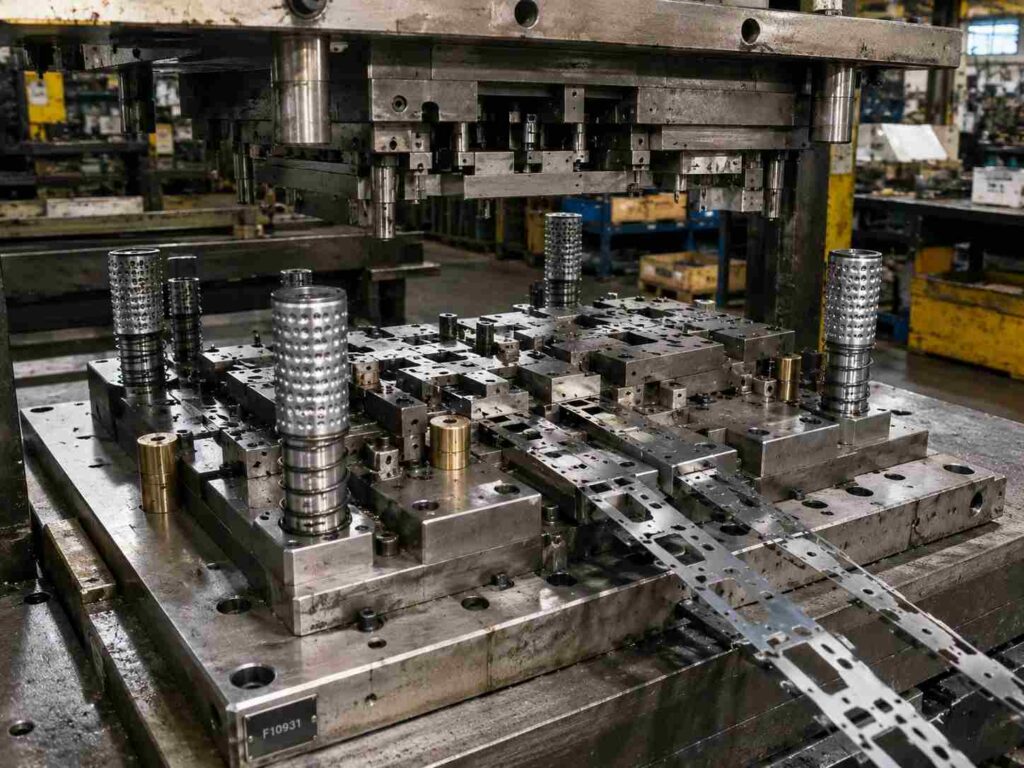
What Are Hardened Steel Stamping Dies?
The Components Inside the Tool
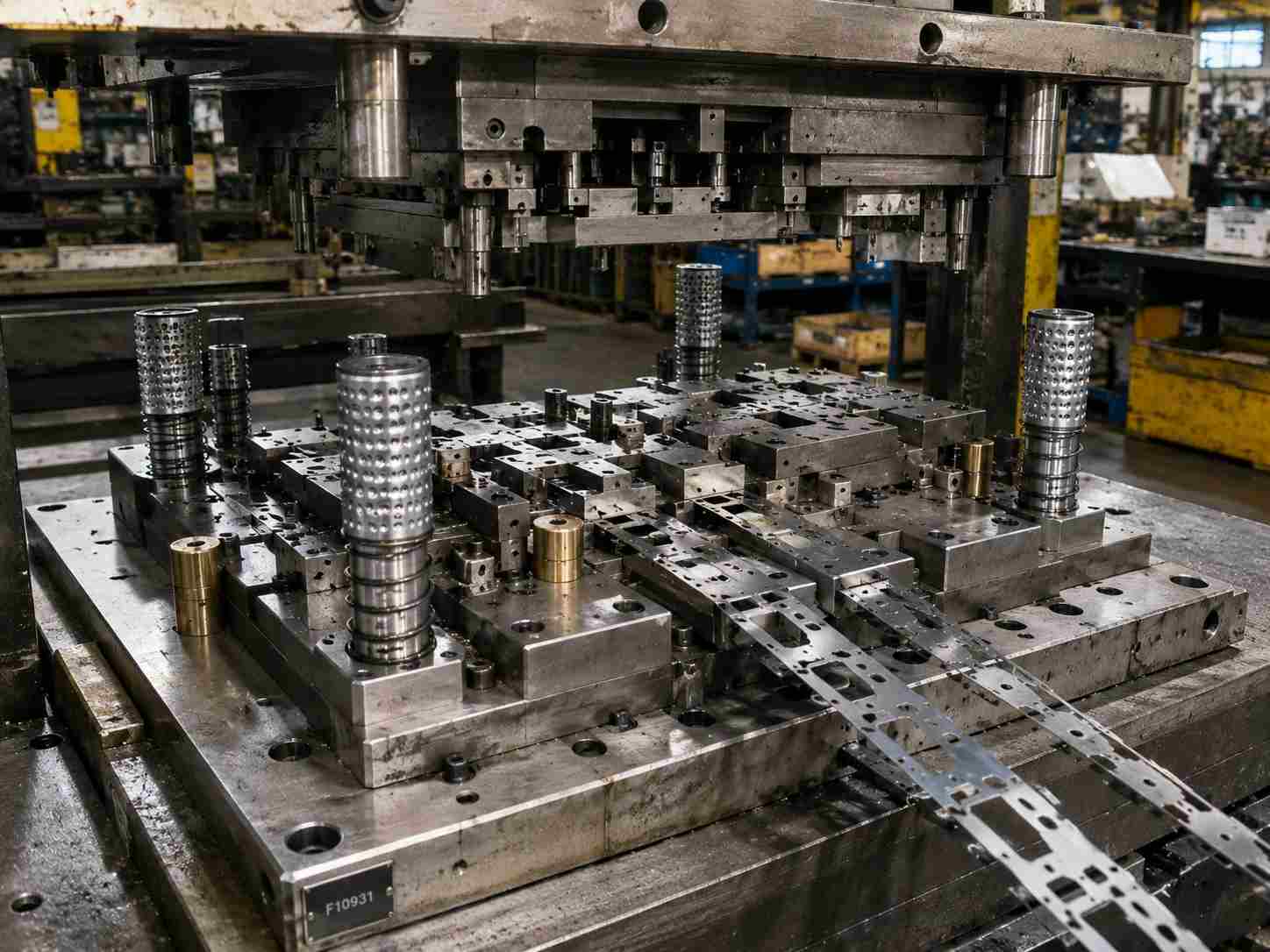
At its core, a stamping die is a pair of precision-ground steel surfaces that shear, form or draw a metal strip into a finished part. The punch and die are the cutting edges; the stripper holds the material and clears the punch after each stroke; and the die base and guide pins keep everything aligned stroke after stroke.
How the tool stays aligned matters just as much as how it cuts. Hardened guide pillars, ball cages and precision-ground base plates keep the punch and die concentric through millions of strokes, so the edge geometry does not wander.
Hardening the working surfaces is what lets a die survive millions of cycles — which is exactly what the name hardened steel stamping dies promises. A compound die goes further: it performs several operations, such as blank, pierce and form, in a single press stroke, which makes it a natural fit for automated lines.
- Blank, pierce and form can all happen in one stroke with a compound die.
- The punch and die are the cutting edges that shear the blank from the strip.
- Guide pins and pillars lock alignment across millions of cycles.
- Hardening plus coatings keeps the working edges sharp far longer.
Compound Dies vs Progressive Dies vs Transfer Dies
All three stamp parts, but they are built around different production strategies. Picking the right type early avoids expensive rework, because the choice shapes the cost and performance of hardened steel stamping dies over their whole life.
| Die type | How it works | Best for | Trade-off |
| Compound | Several operations in one stroke, one station | High-volume parts with tight tolerances | More complex tooling to build |
| Progressive | Strip advances through multiple stations | Medium to high volume, complex parts | Longer die, more material scrap |
| Transfer | Parts move between stations by fingers | Deep draws and heavily formed parts | Slower cycle, more moving parts |
For parts that fit in a single station — most connectors, brackets and terminals — the compound die is often the pragmatic choice on an automated line. The right decision balances part complexity, required volume and the press you actually have; a tooling partner can walk you through the trade-off with your numbers.
Tool Steels and Heat Treatment: Choosing the Right Grade
Die life is set on the day you choose the steel — and for hardened steel stamping dies that decision usually comes down to balancing wear resistance against toughness.
| Grade | Hardness (HRC) | Typical use |
| D2 / SKD11 | 58–62 | General blanking and forming, good balance of wear and toughness |
| M2 | 62–65 | High-speed stamping, thin and abrasive materials |
| H13 | 48–52 | Hot forming and applications needing high toughness |
| ASP / PM steels | 63–67 | Long-run precision dies, hard and abrasive stock |
Heat treatment is equally important. Vacuum hardening and proper tempering reduce distortion and locked-in stress, so the finished die holds its geometry under production loads. For abrasive stock such as stainless and high-strength alloys, a powder-metal grade like ASP generally outlasts conventional D2; for softer materials the simpler grade is often the more economical choice. Match the steel to the material and your die life follows.
Reaching ±0.002 mm Tolerances on an Automated Line
What It Takes to Hold a Micron-Class Tolerance
Tolerance talk is easy; achieving it on every part, every stroke, is the real work. A few steps make the difference between a drawing promise and a production reality.
- CNC wire EDM cuts precise profiles and internal features without tool pressure.
- Surface and form grinding hold flatness and finish on the working faces.
- Die clearance is matched to the material type and thickness being stamped.
- In-die gaging and regular first-article checks catch drift before it becomes scrap.
SSPrecision has held a ±0.002 mm tolerance capability on hardened steel stamping dies since 2008, and it repeats on every project because the whole process is controlled. That capability only holds when every component — punches, dies, strippers, pilots — is ground and verified to the same standard, then assembled with documented clearances.
Design Choices That Extend Die Life
For hardened steel stamping dies, longevity is designed in, not discovered in the press. These details push a die toward millions of strokes.
- Keep clearances and radii realistic for the material being cut.
- Plan lubrication points, or sheet-fed lubrication, to reduce galling.
- Coat punches and dies with TiN, TiCN or CrN to cut edge wear.
- Use hardened guide pillars and ball cages to lock alignment.
- Schedule preventive sharpening before edge wear shows up in the parts.
A short maintenance calendar beats a heroic repair every time. Between services, the biggest enemy is contamination — swarf and lubricant residue accelerate wear at the cutting edges.
Applications Across Industries
Hardened steel stamping dies sit behind a surprising share of everyday products, and automated lines run them around the clock.
- Automotive and EV: connector terminals, brackets and battery components.
- Electronics: lead frames, shields and small precision parts in thin strips.
- Medical: stainless device components produced in controlled small runs.
- Aerospace and industrial: high-strength parts and replacement tooling spares.
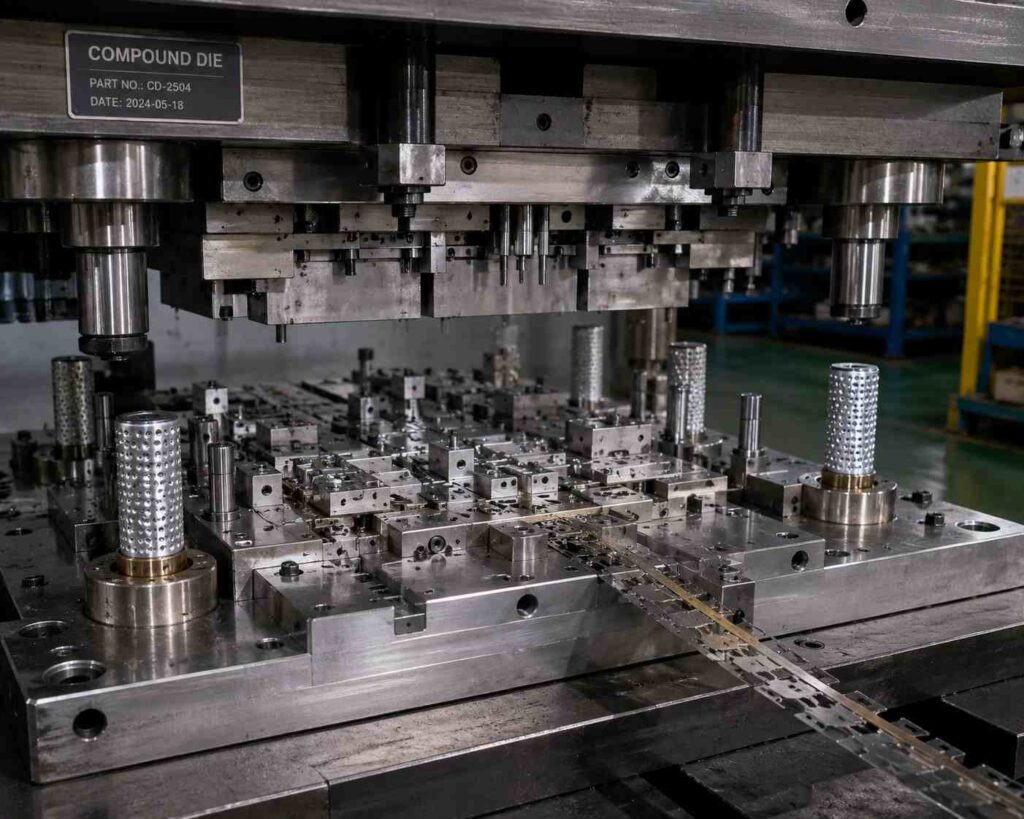
Sourcing Tooling for Automated Lines: What to Ask
The die is a capital asset, so the questions you ask before ordering are worth their weight in gold. A supplier with a documented process — design review, machining, heat treatment, assembly and trial — is the one that delivers hardened steel stamping dies on time and on tolerance.
- Request inspection reports and steel certificates with every tool.
- Ask how the shop verifies its ±0.002 mm tolerance capability, and see the equipment list.
- Confirm the trial and approval process, including first-article parts.
- Check turnaround for tooling spare parts and maintenance service.
The documents and process tell you more than the brochure ever will.
SSP Is a Trusted Partner for Die Manufacturing Cost Optimization
SSP Precision is an ISO 9001 & IATF 16949 certified manufacturer delivering end-to-end precision solutions—from DFM engineering and rapid prototyping to high-volume production—for the automotive, medical, electronics, aerospace, and industrial sectors. We handle every stage in-house to manufacture the tooling that makes your parts and the parts themselves.
Visit our to explore our full capabilities: ssprecision.com.cn
Services (tooling design & manufacturing)
- Stamping Dies Manufacturing – high-volume metal stamping with Progressive Die Stamping & Tooling spare parts manufacturing and Transfer Stamping Dies
- Injection Molding – custom plastic molds including Over Molding & Insert Molding and Liquid Silicone Rubber (LSR) Molding
- Green Mold – eco-friendly molded components, Micro Molding – microscopic medical precision parts
Products (end-use parts & spare components)
- Stamping Die – complete stamping tooling
- Injection Mold – complete injection tooling
- Tooling Spare Parts – punches, inserts, ejector pins, Robotics Spare Parts – precision automation spares , Ball Screw Repair Kits – replacement kits for motion systems
- Machine Parts – general precision machine components
Frequently Asked Questions
What tolerance can hardened steel stamping dies hold?
SSPrecision quotes a ±0.002 mm capability, though the final tolerance always depends on part geometry, material and press conditions. Confirm your drawing.
What is a compound die used for?
It performs several operations in one press stroke at one station, which makes it ideal for high-volume parts with tight tolerances on automated lines.
How long does a hardened die last before sharpening?
That depends on steel grade, coating, material and press speed — well-made dies routinely reach millions of strokes between services.
Do you build dies for automated production lines?
Yes. SSPrecision has designed stamping dies, injection molds and tooling spare parts for automated lines since 2008, including IATF 16949 automotive programs.
Do you handle trial runs and first articles?
Yes. A typical delivery includes the trial, first-article parts and documentation, so the tool runs straight into your production line.
Read More – Intelligence That Protects Your Production Line
- Applied Proof: Insert Molding Manufacturer Metal Insert – Insert molding fuses metal inserts into plastic in a single step, replacing secondary assembly and improving reliability—here’s how the process works, how it compares to overmolding, and what a custom insert molding partner needs to get right.
- Precision Ball Screw Parts: Complete Component Guide – Backlash, noise, and lost accuracy are early signs of ball screw wear—here’s when to repair vs. replace, how to measure runout, and what a complete linear motion repair kit should include for C3–C7 tolerance classes.
- Green Mold Technology: Eco-Conscious Mold Explainer – Sustainability starts at the tooling level—here’s how optimized gating, faster cooling, and ±0.002 mm precision reduce scrap, energy, and material waste across millions of cycles.
- Progressive Die Stamping for High-Volume OEM Parts – High-speed progressive dies run at hundreds of strokes per minute, holding tolerances to ±0.002 mm—here’s the guide to strip layout, tool steel selection, and why OEMs choose progressive stamping for terminals, brackets, and connectors.
- Injection Mold Tooling Design: Multi-Cavity Injection Molding – More cavities cut per-part cost, but only if the injection mold tooling design keeps every cavity balanced and repeatable—here’s the guide to cavity layouts, cooling, and tolerances from a precision mold shop.
- Top 10 Best Stamping Dies and Injection Molding Companies in the World – A data-driven ranking of the top 10 stamping die and injection molding companies globally—here’s how they compare across certifications, lead times, and cost, with a detailed China vs. rest-of-world breakdown.
- Precision Robotics Components: Spare Parts Supply Solutions – Custom robotics components and automation spare parts machined to ±0.002 mm—here’s the material selection guide, tolerance data, and why OEMs rely on precision machining for end-effectors, housings, and motion-critical parts.
- Performance Audit: Precision Die Manufacturer Sheet Forming – Die suppliers look similar on paper—here’s the 7-point audit checklist that separates real capability from marketing: Cpk data, tool life, repeatability, documentation, and how they respond when something goes wrong.