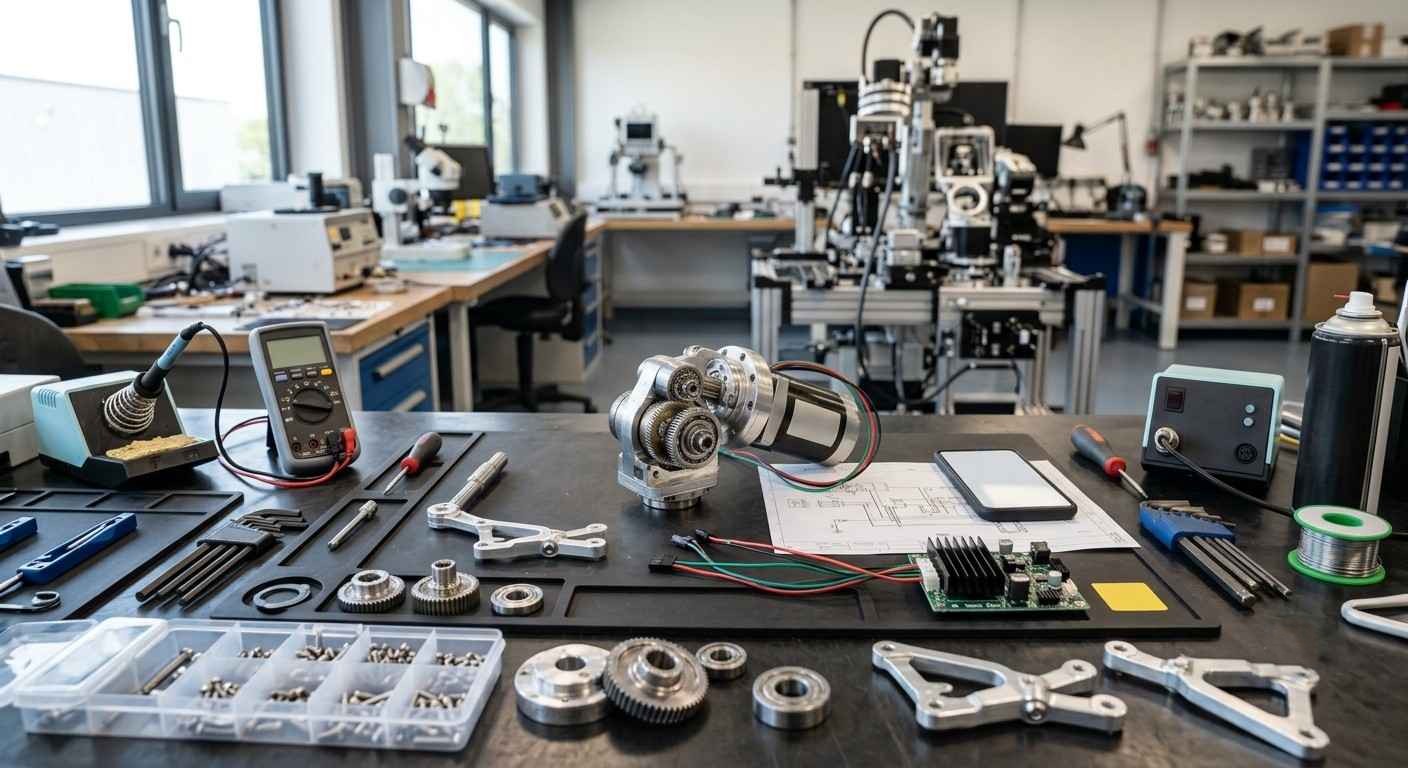
Custom robotics components and precision automation spare parts from a certified manufacturer. Robotic machining and OEM parts with tolerance down to ±0.002 mm.
High-Precision Robotics & Automation Parts
Robots move dynamically, but their environments stay static. For an industrial robot to place components within microns, every precision robotics components must be machined to exact tolerances.
The difference between a seamless production line and costly downtime comes down to the quality of your components. Whether you need custom end-of-arm tooling or durable precision automation spare parts, high-tolerance machining ensures flawless accuracy and keeps your automated systems running smoothly.
- Micron-Level Accuracy: Eliminates spatial deviation in end-of-arm tooling.
- Reduced Downtime: High-quality spare parts prevent mechanical failure.
- Maximum Efficiency: Ensures flawless interaction between moving robots and static lines.
This guide explains what goes into custom robotics components, why robotic machining matters, and how to build a reliable supply chain for OEM robotics parts.
Key Takeaways
- Custom robotics components are machined to tight tolerances that keep automation precise and repeatable over millions of cycles.
- Precision automation spare parts sourced from the original manufacturer reduce downtime and eliminate guesswork.
- Robotic machining of aluminum, steel, and engineered plastics delivers the strength-to-weight balance robots need.
- A certified partner with ±0.002 mm tolerance capability supports everything from end-effectors to spare-part supply.
Why Robots Need Custom Components and Precision Spare Parts
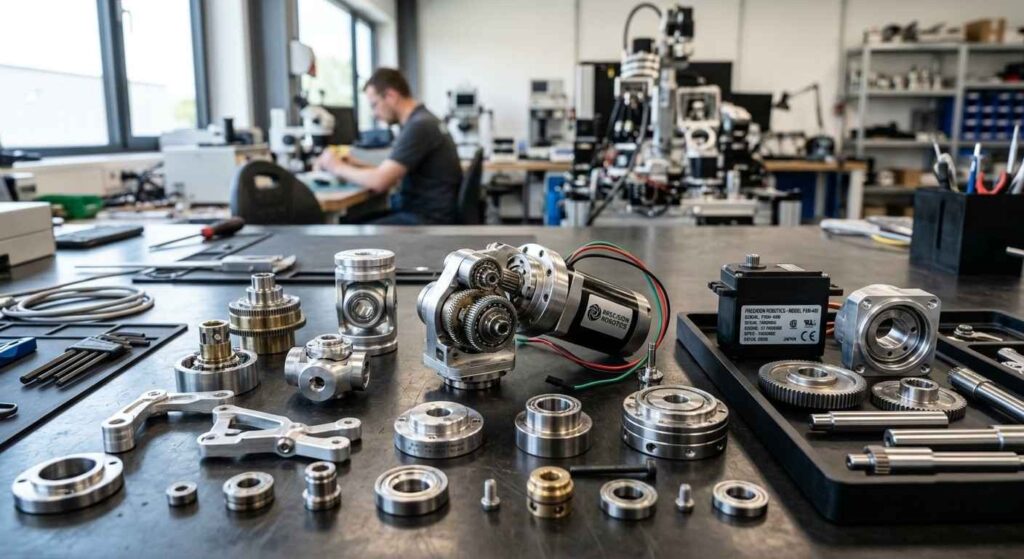
Off-the-shelf parts rarely fit a specific robot design. Robots are engineered around precise geometry—every joint, mounting face, and counterweight is calculated. Custom robotics components fill the gaps: a gripper that matches your exact part shape, a housing with a specific mounting pattern, a bushing with a bespoke bore.
Precision spare parts matter for a different reason: when a wear part fails, production stops. OEM robotics parts that match the original dimensions and material keep the robot behaving exactly as designed, which is why most integrators refuse substitutes that “should work.”
The Role of Robotic Machining in Automation Component Manufacturing
Robotic machining is CNC machining applied to the components that make robots and automation work. It is also the process of robots doing machining—the same equipment often appears both ways. For component manufacturers, the principle is the same: computer-controlled cutting delivers the repeatability that automation demands.
Automation component manufacturing relies on several processes:
- CNC turning for shafts, pins, and fittings.
- CNC milling for housings, plates, and frames.
- Wire EDM for precision profiles and hardened inserts.
- Surface grinding for flatness and finish.
- CMM inspection for dimensional verification.
Materials and Tolerances for Robotics Parts
Material choice balances strength, weight, wear resistance, and cost. Common choices include:
- Aluminum 6061-T6 and 7075 for light, strong arms, frames, and fixtures.
- Stainless steel 304 and 316 for corrosion-resistant parts in wash-down environments.
- Hardened tool steel for wear-prone inserts and guides.
- Engineering plastics such as POM and PEEK for low-friction bushings and insulators.
On tolerances, robot components commonly require ±0.01 mm or tighter on mating features, with precision surfaces achievable down to ±0.002 mm at SSPrecision. Surface finish matters on sliding and sealing surfaces, where a smoother finish extends component life.
| Component type | Common materials | Tolerance | Typical finish | Key property |
| End-effector tooling | Aluminum, stainless steel | ±0.01 mm | Ra 1.6 µm | Lightweight and rigid |
| Frames and housings | Aluminum 6061-T6 | ±0.05 mm | Ra 3.2 µm | Strength-to-weight ratio |
| Shafts, pins, guides | Steel, stainless steel | ±0.01 mm | Ra 0.8 µm | Wear resistance |
| Precision inserts | Hardened tool steel | ±0.002 mm | Ra 0.4 µm | Long tool life |
Design for Manufacturing: Get Robotics Parts Right the First Time
A few decisions made during design save time, money, and rework later. When you brief a robotics component manufacturer, keep these principles in mind:
- Relax tolerances where you can: reserve the tightest tolerances for mating and locating surfaces only, and the part gets cheaper without losing function.
- Choose materials for the environment: a part that lives in a clean, dry cell can often use a lighter alloy than one exposed to washdown or chemicals.
- Call out surface finish and edge breaks: a smooth finish on a sealing or sliding face, a small chamfer where a sharp edge could cut a cable.
- Design for inspection: a flat, accessible datum makes CMM verification straightforward and gives your quality team confidence.
- Share the load data: telling the machinist how the part is stressed helps them recommend geometry or material improvements you had not considered.
A DFM review at the quoting stage catches most of these issues. SSPrecision reviews drawings before steel is cut, suggesting tweaks that lower cost and improve reliability without changing your design intent.
Custom Robotics Components: What Can Be Manufactured
End-of-arm tooling (EOAT)
Grippers, suction cups, and tool changers are machined to your robot model and your parts. Tight tolerances ensure repeatable pick-and-place, cycle after cycle.
Frames, housings, and brackets
Structural parts that mount sensors, controllers, and cables are often custom-machined to reduce weight and fit tight spaces on the robot or cell.
Shafts, gears, and bushings
Motion-critical parts benefit from precision machining and careful material selection, which directly affect positioning accuracy and wear life.
Precision automation spare parts
Replacement parts for robots, conveyors, and assembly machines are produced to original specifications, so you are never stuck with a dead line.
Precision Automation Spare Parts: A Smarter Way to Source
Instead of hunting for discontinued parts or waiting out long lead times, many plants source precision automation spare parts from the original manufacturer or a certified machining partner. The benefits are clear:
- Correct dimensions and material every time.
- Consistent quality, documented and inspected.
- Shorter lead times, with spares held on call.
- Lower cost than brand-name spares for many items.
- Support for obsolete or modified parts.
How to Partner for OEM Robotics Parts
Build the relationship around data and documentation. Start with a clear exchange:
- Provide complete drawings with GD&T and material specifications.
- Agree on inspection and certification requirements.
- Establish a spare-part stocking plan.
- Define lead times and quality metrics.
- Confirm NDAs to protect your robot designs.
A partner that documents every step—and shows you the measurement reports to prove it—becomes an extension of your own engineering team.
| Check | What to verify | Good sign | Red flag |
| Certifications | ISO 9001:2015 and IATF 16949, current and audited | Certificates available and verified | Claims without evidence |
| Tolerance capability | Down to ±0.002 mm, CMM-verified | Shared measurement reports | No inspection data |
| Manufacturing capability | Turning, milling, EDM, grinding | In-house toolroom | Everything outsourced |
| Materials | Aluminum, steel, tool steel, plastics | Clear material certificates | No traceability |
| Documentation | Inspection reports, material certificates | Reports with every order | Documentation is extra cost |
| Support | Spares, design feedback, quick turnaround | Written support plan | No after-sales offering |
SSP Is a Trusted Partner for Die Manufacturing Cost Optimization
SSP Precision is an ISO 9001 & IATF 16949 certified manufacturer delivering end-to-end precision solutions—from DFM engineering and rapid prototyping to high-volume production—for the automotive, medical, electronics, aerospace, and industrial sectors. We handle every stage in-house to manufacture the tooling that makes your parts and the parts themselves.
Visit our to explore our full capabilities: ssprecision.com.cn
Services (tooling design & manufacturing)
- Stamping Dies Manufacturing – high-volume metal stamping with Progressive Die Stamping & Tooling spare parts manufacturing and Transfer Stamping Dies
- Injection Molding – custom plastic molds including Over Molding & Insert Molding and Liquid Silicone Rubber (LSR) Molding
- Green Mold – eco-friendly molded components, Micro Molding – microscopic medical precision parts
Products (end-use parts & spare components)
- Stamping Die – complete stamping tooling
- Injection Mold – complete injection tooling
- Tooling Spare Parts – punches, inserts, ejector pins, Robotics Spare Parts – precision automation spares , Ball Screw Repair Kits – replacement kits for motion systems
- Machine Parts – general precision machine components
FAQ: Custom Robotics Components
- What are custom robotics components?
- Custom robotics components are machined parts made to a robot manufacturer’s or integrator’s drawings—end-effectors, housings, shafts, bushings, and fixtures—built to tight tolerances for reliable automation.
- Why do robots need precision spare parts?
- Robots repeat movements millions of times, so a replacement part must match the original geometry and material to keep the robot accurate. Precision automation spare parts minimize downtime and drift.
- What is robotic machining?
- Robotic machining is CNC machining applied to robotics and automation components, delivering the accuracy and repeatability automation demands. The same approach can use robots to drive cutting tools in production.
- Can I source OEM robotics parts from China?
- Yes. Certified manufacturers such as SSPrecision provide OEM robotics parts and custom robotics components with documented quality, competitive pricing, and shorter lead times.
- How tight tolerances can robotics components hold?
- Mating features commonly hold ±0.01 mm, and precision surfaces can reach ±0.002 mm with CMM verification, depending on material and geometry.
Read More – Intelligence That Protects Your Production Line
- Precision Manufacturing China | IATF 16949 Certified Tooling – IATF 16949 certification isn’t just a badge—it means documented processes, defect prevention, and traceability for stamping dies and molds down to ±0.002 mm. Here’s what to look for in a certified tooling partner.
- LSR Injection Molding | Precision Liquid Silicone Rubber – LSR injection molding cures at 5 seconds per millimeter of wall thickness with tolerances to ±0.002mm—here’s the material grades guide, tooling requirements, and why OEMs choose silicone for seals, gaskets, and medical components.
- Heavy Duty Transfer Tooling: Multi-Station Transfer Dies for Deep-Drawn Components – Transfer dies handle individual blanks for deep-drawn and heavy gauge parts up to 8mm thick with tolerances to ±0.002mm—here’s how they compare to progressive dies for complex automotive and EV components.
- China Injection Mold Source: High-Cycle Multi-Cavity Production Plastic Molds – Multi-cavity molds produce 4–32+ parts per cycle with tolerances to ±0.002mm—here’s how to source high-volume tooling from China with lead times of 25–45 days.
- Stamping Dies Manufacturing: Custom Dies for OEMs – Custom stamping dies achieve ±0.002 mm tolerances for high-volume production of automotive, electronics, and medical components—here’s the steel selection guide and lead time breakdown for OEM buyers.
- Microelectronics Injection Molding: Precision Micro Molding for Tech OEMs – Micro injection molding achieves ±0.01 mm tolerances on parts weighing under 1 gram for connectors, sensors, and lens arrays—here’s the material selection guide and quality standards for tech OEMs.
- Average Lead Times for China Tooling Production – Stamping dies take 4–12 weeks and injection molds 3–14 weeks depending on complexity, steel grade, and tolerance requirements—here’s a practical guide for automotive buyers on realistic timelines.
- Top 10 Best Stamping Dies and Injection Molding Companies in the World – A data-driven ranking of the top 10 stamping die and injection molding companies globally—here’s how they compare across certifications, lead times, and cost, with a detailed China
- Injection Mold Tooling Design: Multi-Cavity Injection Molding – More cavities cut per-part cost, but only if the injection mold tooling design keeps every cavity balanced and repeatable
- Progressive Die Stamping for High-Volume OEM Parts – High-speed progressive dies run at hundreds of strokes per minute, holding tolerances to ±0.002 mm—here’s the guide to strip layout, tool steel selection