If you are weighing where to source your next injection mold or stamping die, here is the short answer: molds in China typically win on price and speed for medium-to-high-volume production, while local sourcing wins on communication ease and shorter shipping. The right call depends on your part complexity, quality requirements, and timeline. This guide compares both paths across cost, tolerance, lead time, and project management.
Takeaways:
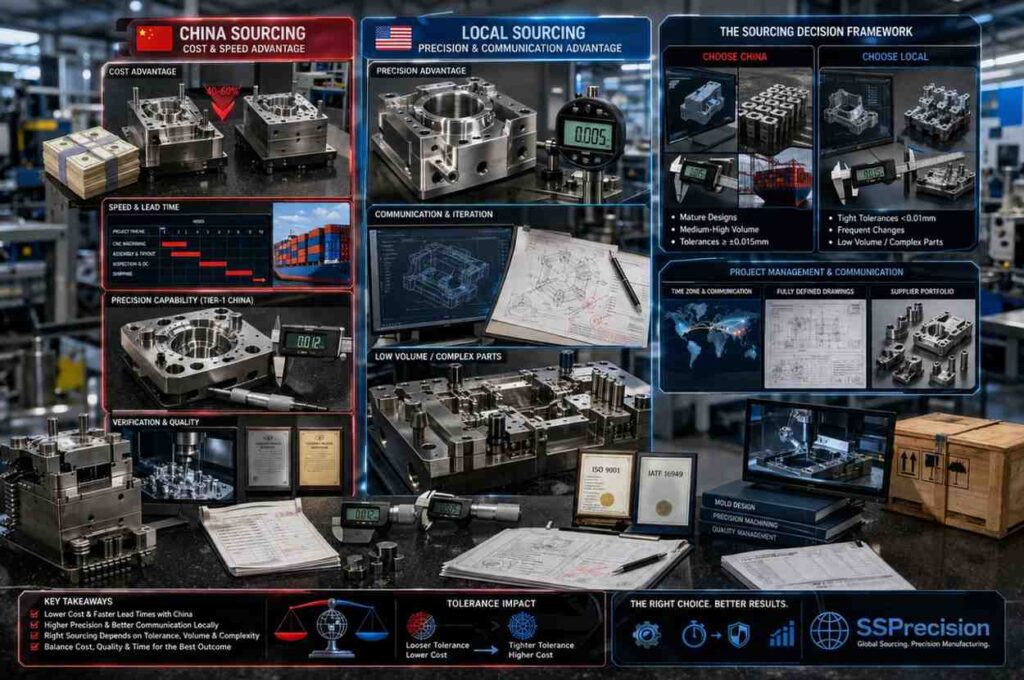
- China molds cost 40–60% less and ship faster (3–6 weeks), plus 2–3 weeks for shipping
- Local holds tighter precision (±0.005 mm); China Tier-1 holds ±0.01–0.02 mm—fine for most parts
- Choose China: mature designs, medium-high volume, tolerances ≥ ±0.015 mm
- Choose local: tight tolerances (<0.01 mm), frequent changes, or low volume
- Always verify ISO 9001 / IATF 16949, specify steel grade, and require trial videos + third-party inspection
- Time zones and language slow iteration—fully defined drawings are critical for China sourcing
- Not all China shops are equal; match supplier portfolio to your part complexity
| Factor | Molds in China (Tier-1) | Local Sourcing |
| Best for | Medium-to-high volume, tight budgets | Low volume, quick iterations |
| Typical Tolerance | ±0.01–0.02 mm | ±0.005–0.01 mm |
| Relative Cost | 40–60% lower than local | Baseline (higher) |
| Lead Time (mold) | 3–6 weeks ex-factory | 4–10 weeks |
| Tool Life (injection mold) | 500k–2M+ shots | 500k–1.5M+ shots |
| Communication | English-speaking project managers | Direct, same time zone |
What “Molds in China” Actually Means for Buyers
When procurement teams compare molds in China or locally, they often imagine two different quality levels. The reality is more nuanced. China has thousands of mold shops, from basic workshops to ISO 9001:2015 certified exporters. A certified supplier like SSPrecision (Dongguan, since 2008) holds IATF 16949 automotive-grade certification. Local shops charge more per mold but offer proximity and faster design reviews.
Cost Comparison: Why China Often Comes in Lower
Cost is the biggest reason buyers consider molds in China. Labor rates for skilled toolmakers in Dongguan or Shenzhen are significantly lower than in North America or Europe, and the dense supplier ecosystem cuts overhead. Typical savings range from 40% to 60% on the mold itself. A $50,000 local mold might cost $20,000–$30,000 from a Chinese counterpart with comparable equipment. For high-volume production, the savings multiply across millions of parts.
Quality and Tolerance: What Each Side Delivers
A common myth is that Chinese molds cannot match local precision. Today a Tier-1 Chinese shop runs the same CNC, EDM, and CMM equipment found in a German or Japanese tool room. Certified suppliers hold ±0.01–0.02 mm on critical dimensions. Local top-tier shops may hold ±0.005 mm, but that matters mainly for medical implants or micro-molding. For 90% of automotive, consumer, and industrial parts, the Chinese tolerance band is adequate. The real risk is uncertified shops that cut corners on steel or heat treatment — which is why ISO 9001 certification and third-party inspections are non-negotiable.
Lead Time and Speed to Production
Chinese mold makers often quote faster build times than local shops. A straightforward mold can ship in 3–5 weeks from a Chinese manufacturer, versus 5–10 weeks from many local shops. That speed comes from round-the-clock shifts and a specialized workforce. The catch is shipping: sea freight takes 2–3 weeks plus customs. Air freight is faster but costs $500–$2,000. Door-to-door, the total timeline often evens out. If you need the mold within four weeks, the local area is usually safer.
Part Complexity and Volume Considerations
Simple parts with relaxed tolerances — packaging, housings, structural brackets — are ideal for molds in China. The savings are largest here because the design is straightforward and iteration risk is low. High-volume parts (500,000+ shots per year) further tilt the scale toward China. Complex parts with tight tolerances or challenging materials benefit from closer collaboration. Being able to adjust a gate location in real time saves weeks when the design is still fluid. For prototype or low-volume runs, local sourcing usually wins.
The table below maps the most important technical factors side by side. Use it as a checklist when shortlisting suppliers.
| Factor | China (Tier-1) | Local (US/EU) | Difference | Key Action |
| Mold Steel | P20, H13, S7 | P20, H13, S7, 420SS | Comparable | Verify mill cert |
| Tolerance | ±0.01–0.02 mm | ±0.005–0.01 mm | Similar range | Define critical dims |
| Surface Finish | SPI A-3 (600 grit) | SPI A-1 (mirror) | Local finer | Specify polish in PO |
| Mold Cooling | Conformal optional | Conformal common | Local ahead | Ask for flow analysis |
| Lead Time | 3–6 wk ex-factory | 4–10 wk | China faster | Add 2–3 wk sea freight |
| Price Index | 0.4–0.6 of local | 1.0 (baseline) | 40–60% less | Get itemized quote |
| Design Support | DFM in 2–3 days | DFM in 1–2 days | Local cycles faster | Check iteration fees |
| Tool Life (P20) | 500k–1.5M shots | 500k–1.5M shots | Comparable | H13 extends life |
| Payment Terms | 30–50% dep., bal. ship | Net 30–60 | China needs deposit | L/C reduces risk |
Communication and Project Management
Experienced China-based exporters like SSPrecision employ English-speaking project managers who bridge your engineers and their toolroom. Video calls, DXF/STEP file sharing, and digital inspection reports are standard. Still, a 12-hour time difference means design feedback takes at least a day per round. Local sourcing eliminates that lag — your engineers can visit the shop floor and have a revised cavity running by morning. For mature designs, time zone gaps are barely noticeable. For evolving designs, proximity is invaluable.
Common Mistakes When Sourcing Abroad vs Locally
The biggest mistake is treating every Chinese mold shop as interchangeable. A supplier cranking out simple two-plate molds may struggle with a complex automotive mold. Always match the supplier’s portfolio to your part family. On the local side, do not assume proximity guarantees quality — a nearby shop with outdated CNC can deliver worse results than a certified overseas partner. Other pitfalls: specifying tolerances tighter than needed, skipping mold trials, and failing to define steel grade in the purchase order. A clear spec sheet eliminates most misunderstandings.
Why Consider SSPrecision for Molds in China
SSPrecision (ssprecision.com.cn) has manufactured precision stamping dies, injection molds, and tooling spare parts in Dongguan since 2008. Its ISO 9001:2015 and IATF 16949 certifications mean processes are audited to automotive-grade standards. They serve automotive, electronics, and industrial buyers who need English-language DFM reports, video mold trials, and third-party inspection. For buyers comparing molds in China or locally, SSP fits the certified Tier-1 category that delivers the best risk-to-reward ratio in cross-border sourcing.
Making the Right Choice for Your Project
Well-defined designs with medium-to-high volumes and tolerances within ±0.015 mm are strong candidates for molds in China from a certified partner like SSPrecision. Parts requiring ultra-tight tolerances, frequent design changes, or very low volumes are better served by local sourcing — the flexibility of a nearby shop can save your timeline, and that is often worth the premium.
SSP Is a Trusted Partner for Die Manufacturing Cost Optimization
SSP Precision is an ISO 9001 & IATF 16949 certified manufacturer delivering end-to-end precision solutions—from DFM engineering and rapid prototyping to high-volume production—for the automotive, medical, electronics, aerospace, and industrial sectors. We handle every stage in-house to manufacture the tooling that makes your parts and the parts themselves.
Visit our to explore our full capabilities: ssprecision.com.cn
Services (tooling design & manufacturing)
- Stamping Dies Manufacturing – high-volume metal stamping with Progressive Die Stamping & Tooling spare parts manufacturing and Transfer Stamping Dies
- Injection Molding – custom plastic molds including Over Molding & Insert Molding and Liquid Silicone Rubber (LSR) Molding
- Green Mold – eco-friendly molded components, Micro Molding – microscopic medical precision parts
Products (end-use parts & spare components)
- Stamping Die – complete stamping tooling
- Injection Mold – complete injection tooling
- Tooling Spare Parts – punches, inserts, ejector pins, Robotics Spare Parts – precision automation spares , Ball Screw Repair Kits – replacement kits for motion systems
- Machine Parts – general precision machine components
Frequently Asked Questions
Are Chinese molds as durable as locally made ones?
- Yes, when sourced from a certified manufacturer. A mold running P20 or H13 steel with proper maintenance can match local tool life — typically 500k to 2M shots.
How much can I save by choosing a Chinese mold maker?
- Typical savings are 40–60% on the mold price. Total cost depends on size, complexity, shipping, and duties.
What certifications should a Chinese mold supplier have?
- ISO 9001:2015 for general quality. IATF 16949 if you are in automotive. Some buyers also require UL recognition for electrical components.
How do I handle quality control from 8,000 km away?
- Use a third-party inspection agency for first-article inspection. Send detailed 2D/3D specs and request a mold trial video before shipment.
What industries source molds from China most often?
- Automotive, electronics, appliances, and medical disposables are the largest segments.
Can a Chinese mold maker match my existing local molds?
- Yes — most Tier-1 shops can reverse-engineer an existing mold or build from your STEP files. Request a mold flow analysis before cutting steel.
Choosing between molds in China or locally comes down to your project’s complexity, volume, and timeline. For mature designs with medium-to-high volumes, a certified Chinese mold maker like SSPrecision delivers the best combination of cost and quality. For low-volume or rapidly changing projects, local sourcing is worth the premium for speed. Request a quote from SSPrecision for your next mold project and compare it against your local options.
Read More – Intelligence That Protects Your Production Line
- How to Prevent Flash, Warpage & Sink Marks – Flash, warpage, and sink marks account for 35–40% of plastic part rejects—here’s how to eliminate them with precision tooling and process control.
- Complete Plastic Shrinkage Chart (ABS, PC, PA66, POM) – ABS shrinks 0.4–0.7%, PC 0.5–0.7%, PA66 1.0–2.0%, and POM 0.6–1.4%—here’s how to adjust your mold design for each material.
- Export-Ready Tooling & Dies: OEM Manufacturing for Global Supply Chains – IATF 16949-certified stamping dies, injection molds, and tooling spare parts under one roof for automotive and industrial OEM buyers.
- Multi-Cavity Injection Molds: Cost & Efficiency Breakdown – A 4-cavity hot runner mold costs 2.5–4x a single-cavity tool but delivers proportionally larger per-part cost savings at volume.
- Sourcing Ejector Pins & Mold Components in China – DIN 1530 ejector pins at $5.80–$8.60 per piece with ±0.002mm grinding precision and 7–15 day lead times.
- China Fiber Optic Connectors | Injection Molding Precision Parts Manufacturer Company – Fiber optic connector housings demand ±0.01 mm tolerances on critical alignment features.
- Reducing Cycle Time Through Better Mold Cooling – Cooling eats 50–70% of your cycle time—conformal channels can slash it by 20–50%.
- Stamping Die Cost Drivers: What Impacts Your Price – A single-station die costs $3,000–$8,000, while a progressive die can hit $120,000+.
- Injection molding: Hot Runner Vs Cold Runner – Hot runners add 30–50% to upfront cost but can slash cycle times by 40%.
-
Average Lead Times for China Tooling Production – Stamping dies take 4–12 weeks and injection molds 3–14 weeks depending on complexity, steel grade, and tolerance requirements.
-
Microelectronics Injection Molding: Precision Micro Molding for Tech OEMs – Micro injection molding achieves ±0.01 mm tolerances on parts weighing under 1 gram for connectors, sensors, and lens arrays.
-
Stamping Dies Manufacturing: Custom Dies for OEMs – Custom stamping dies achieve ±0.002 mm tolerances for high-volume production of automotive, electronics, and medical components.
-
China Injection Mold Source: High-Cycle Multi-Cavity Production Plastic Molds – Multi-cavity molds produce 4–32+ parts per cycle with tolerances to ±0.002mm—here’s how to source high-volume tooling from China.