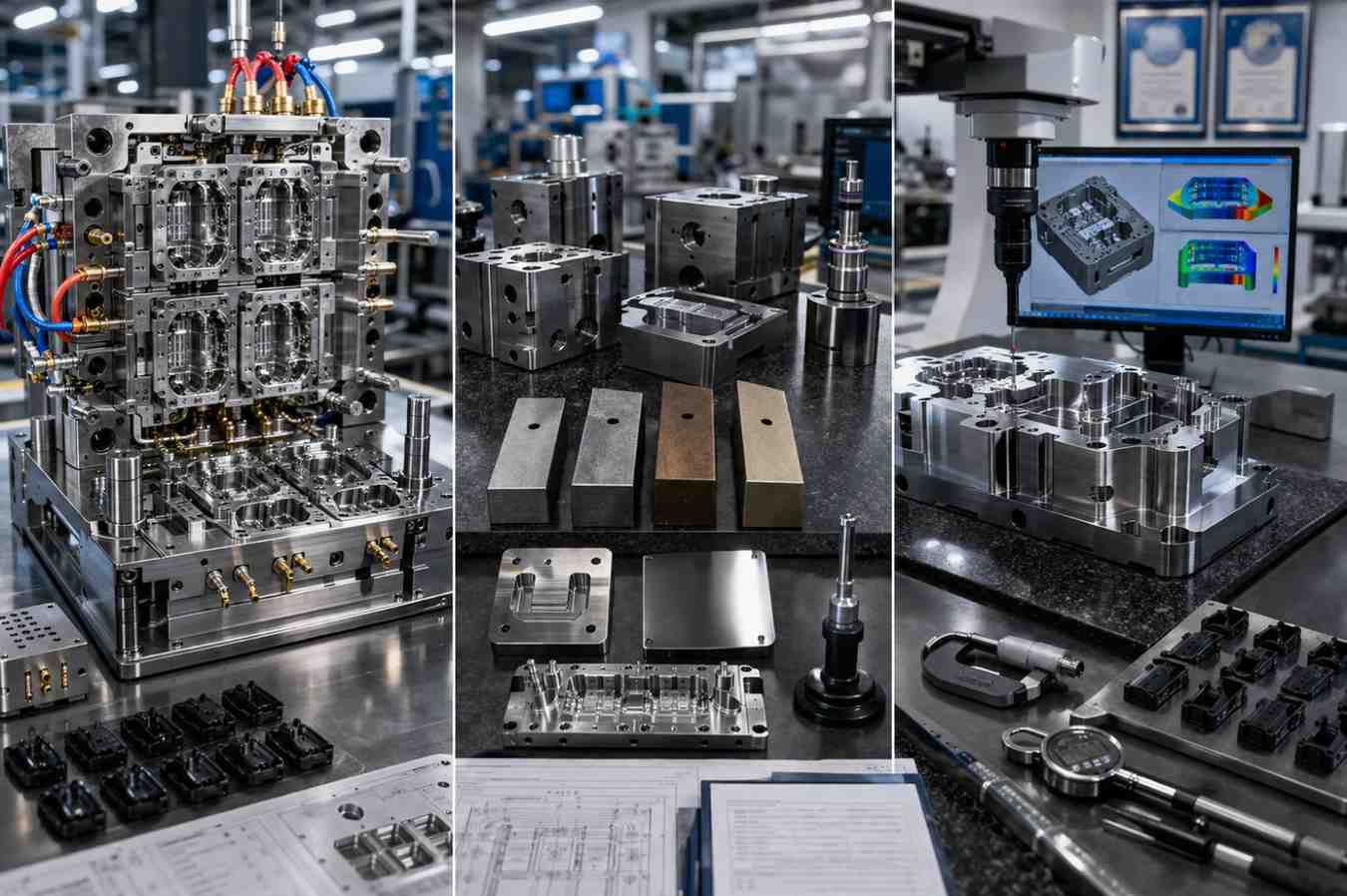
Reliable China injection mold source for high-cycle multi-cavity plastic molds. Precision tooling from SSPrecision since 2008 – ISO 9001, IATF 16949, tolerances to +/-0.002mm.
A China injection mold source delivers high-cavity production tooling that cycles millions of parts per year with repeatable precision. Multi-cavity molds produce multiple identical parts per shot – 2, 4, 8, or 16+ cavities – cutting per-part cost at scale. For manufacturers scaling automotive, medical, or consumer goods production, the mold design, steel, and builder capability determine whether the program succeeds.
SSPrecision (ssprecision.com.cn), based in Dongguan, builds precision molds since 2008 under ISO 9001:2015 and IATF 16949, holding tolerances to +/-0.002 mm for automotive/EV, electronics, medical, aerospace, and industrial applications.
Key Takeaways
- Multi-cavity molds produce multiple parts per cycle, reducing per-unit cost at high volumes
- SSPrecision achieves mold tolerances to +/-0.002 mm under ISO 9001 and IATF 16949
- Steel grades (H13, S136, 718H, NAK80) selected per resin type and production volume
- Full DFM, mold flow analysis, and CMM inspection included before tooling approval
China Injection Mold Source – Fast Facts
| Parameter | Detail |
| Typical Tolerance | +/-0.01-0.02 mm standard; +/-0.002 mm precision capability |
| Cavity Count | 2 to 32+ cavities per mold family |
| Standard Steels | H13, S136, 718H, NAK80, 8407, SKD61 |
| Industries Served | Automotive/EV, electronics, medical, aerospace, energy |
| Lead Time | 25-45 days depending on complexity and cavity count |
| Certifications | ISO 9001:2015, IATF 16949 |
What Is Multi-Cavity Injection Molding and Why Use It?
How Multi-Cavity Tooling Works
A multi-cavity production plastic mold contains multiple identical impressions in a single tool base. During each injection cycle, molten plastic flows through a runner system that feeds every cavity simultaneously. Balanced filling is critical – each cavity must see the same pressure, temperature, and flow rate to produce identical parts across all cavities.
When Multi-Cavity Makes Sense
Multi-cavity tooling is cost-effective when annual volumes exceed 100,000 parts and the design is stable. The upfront mold cost is higher than a single-cavity tool, but per-cycle output multiplies without multiplying machine time, labor, or floor space. A 16-cavity mold on a 15-second cycle produces over 90,000 parts per day.
What Tolerances Can a Chinese Mold Maker Achieve?
A qualified Chinese mold maker delivers precision across multiple classes:
- Standard precision – +/-0.02-0.05 mm for general industrial and consumer products
- High precision – +/-0.01 mm for electronics, medical, and automotive interior parts
- Ultra precision – +/-0.002-0.005 mm for critical mating surfaces, gears, and optical components
SSPrecision validates every critical dimension with CMM inspection and provides full dimensional data with each mold shipment. Tolerances at the +/-0.002 mm end require hardened steel, temperature-controlled machining, and wire EDM finishing.
What Steel Grades Are Used in High-Volume Plastic Tooling?
Steel selection drives mold life, cycle time, and part quality. Common grades:
| Steel Grade | Hardness (HRC) | Best For | Expected Life |
| H13 | 48-52 | General purpose, high-heat resins | 1M+ cycles |
| S136 (416SS) | 48-52 | Corrosive resins (PVC, medical) | 1M+ cycles |
| 718H | 36-40 | Large cavities, automotive parts | 500K-1M cycles |
| NAK80 | 37-43 | Textured surfaces, display frames | 500K-1M cycles |
| 8407 | 50-54 | Abrasive resins, long-run tooling | 2M+ cycles |
| SKD61 | 48-52 | Hot-runner systems, high-temp molds | 1M+ cycles |
For runs exceeding one million cycles, SSPrecision recommends pre-hardened H13 or 8407 with nitriding surface treatment. The mold base is typically P20 or 718H for stability.
Which Industries Benefit from High-Cavity Injection Molding?
High-cavity tooling delivers greatest ROI in four sectors:
- Automotive and EV – connectors, sensors, interior trim, battery components at 8-32 cavities
- Medical devices – syringe barrels, Luer fittings, implant packaging in cleanroom-compatible materials
- Electronics and consumer goods – phone cases, switch housings, connectors with cosmetic finish specs
- Industrial components – gears, bushings, fasteners in PP, PA66, POM, or PEEK
Multi-Cavity vs. Single-Cavity vs. Family Molds: Which Fits?
The table below compares three mold architectures across the factors that matter at quoting time – output, per-part cost, tooling investment, and lead time.
| Factor | Single-Cavity Mold | Multi-Cavity Mold | Family Mold |
| Parts per Cycle | 1 | 4-32+ identical parts | 2-8 different parts |
| Per-Part Cost (high vol.) | Highest | Lowest | Medium |
| Tooling Cost | Lowest | Highest | Medium |
| Lead Time | 20-30 days | 30-45 days | 30-40 days |
| Cavity Consistency | N/A | Critical – balanced fill needed | Less critical |
| Design Flexibility | Easy to modify | All cavities identical | Mixed geometry |
| Best Annual Volume | Under 100K | 500K+ | 100K-500K |
| Maintenance | Simple | Moderate | Higher |
Multi-cavity tooling has the highest upfront cost but the lowest per-part price at scale. For stable, high-volume products – automotive connectors, medical disposables, caps – payback is typically 12-18 months versus running multiple single-cavity tools.
How Does the Mold Manufacturing Process Work?
Building a production injection mold follows a structured workflow:
- DFM review – design analysis, gate location, cooling layout, and ejection strategy
- Steel cutting and rough machining – CNC milling of mold base, cavity, and core blocks
- Hardening and heat treatment – stress relieving and achieving target hardness (HRC 38-54)
- Finishing and EDM – wire EDM for tight corners, graphite/copper electrode sinking for cavities
- Assembly and fitting – inserts, slides, lifters, cooling lines, and hot-runner system installation
- Trial and sampling – mold trials on production machines; dimensional report and process documentation
What Quality Inspections Ensure Mold Precision?
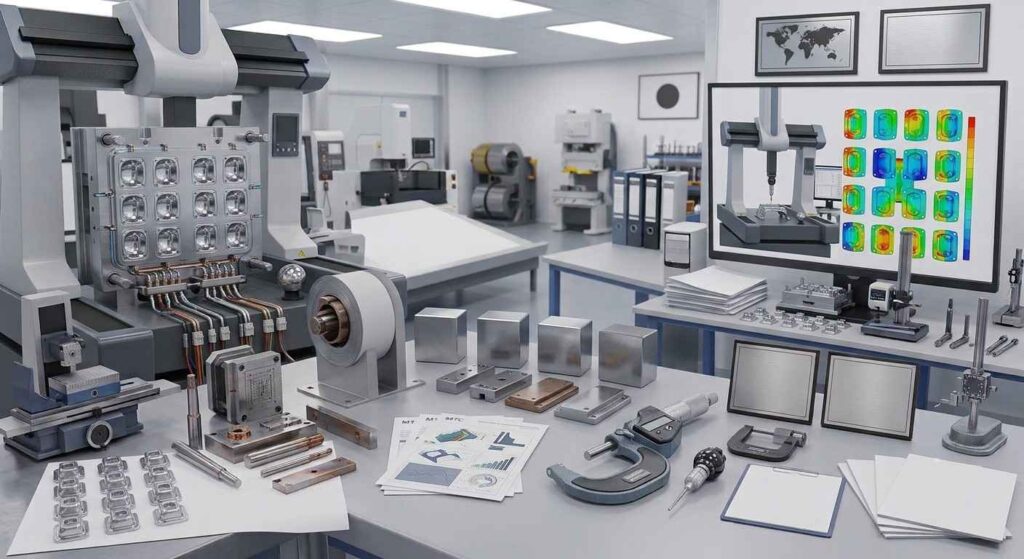
Every precision mold from SSPrecision undergoes CMM inspection, mold flow simulation validation, and trial-shot sampling before shipment. Key checkpoints include cavity/core steel certification, hardness testing, fit and function verification of slides and ejectors, and cooling channel pressure testing. Dimensional reports are provided digitally – every critical dimension marked pass or fail against the drawing tolerance.
Why Source Injection Molds from a China-Based Manufacturer Like SSP?
SSPrecision combines Chinese manufacturing cost structure with international quality systems – ISO 9001:2015 and IATF 16949, precision machining to +/-0.002 mm, and engineering support from DFM through production sampling. Based in Dongguan, they source steels from certified mills (Daido, Assab, ThyssenKrupp) and hot-runner systems from YUDO, HRS, or INCOE per client specification.
As a direct Chinese mold maker, SSP offers competitive pricing on high-cavity injection molding tooling without bypassing quality gates – full dimensional reports, mold try-out samples, and ongoing technical support for the life of the tool.
SSP Is a Trusted Partner for Die Manufacturing Cost Optimization
SSP Precision is an ISO 9001 & IATF 16949 certified manufacturer delivering end-to-end precision solutions—from DFM engineering and rapid prototyping to high-volume production—for the automotive, medical, electronics, aerospace, and industrial sectors. We handle every stage in-house to manufacture the tooling that makes your parts and the parts themselves.
Visit our to explore our full capabilities: ssprecision.com.cn
Services (tooling design & manufacturing)
- Stamping Dies Manufacturing – high-volume metal stamping with Progressive Die Stamping & Tooling spare parts manufacturing and Transfer Stamping Dies
- Injection Molding – custom plastic molds including Over Molding & Insert Molding and Liquid Silicone Rubber (LSR) Molding
- Green Mold – eco-friendly molded components, Micro Molding – microscopic medical precision parts
Products (end-use parts & spare components)
- Stamping Die – complete stamping tooling
- Injection Mold – complete injection tooling
- Tooling Spare Parts – punches, inserts, ejector pins, Robotics Spare Parts – precision automation spares , Ball Screw Repair Kits – replacement kits for motion systems
- Machine Parts – general precision machine components
Frequently Asked Questions
Q: What is the typical lead time for a multi-cavity injection mold from China?
A: Standard lead time is 25-45 days from DFM approval, depending on cavity count, complexity, and steel availability.
Q: How do I decide between 8, 16, or 32 cavities?
A: Base cavity counts on annual volume, available clamp tonnage, and part size. A mold flow analysis confirms filling balance at the target count.
Q: What tolerance can I expect from a Chinese mold maker?
A: Standard is +/-0.02-0.05 mm; high precision to +/-0.01 mm; ultra-precision to +/-0.002 mm for critical applications, validated by CMM.
Q: Does SSPrecision provide DFM feedback before building the mold?
A: Yes – DFM review is standard, covering draft angles, wall thickness, gate location, cooling, and ejection before steel cutting.
Q: What steel is recommended for glass-filled nylon or PEEK?
A: H13 or 8407 hardened to 50-54 HRC with nitriding. These abrasive resins require through-hardened tool steel.
Q: Do you provide samples before shipping the mold?
A: Yes – trial shots on production machines. Samples, dimensional report, and process parameters accompany every mold shipment.
A reliable China injection mold source delivers high-cavity tooling that scales production without scaling per-part cost. Multi-cavity production plastic molds multiply output per machine cycle while holding tolerances down to +/-0.002 mm – essential for automotive, medical, electronics, and industrial programs running millions of parts per year.
SSPrecision combines ISO 9001 and IATF 16949 quality systems with two decades of mold building expertise in Dongguan. Upload your part design for a DFM review and mold quotation at ssprecision.com.cn.
Read More – Intelligence That Protects Your Production Line
- How to Prevent Flash, Warpage & Sink Marks – Flash, warpage, and sink marks account for 35–40% of plastic part rejects—here’s how to eliminate them with precision tooling and process control.
- Complete Plastic Shrinkage Chart (ABS, PC, PA66, POM) – ABS shrinks 0.4–0.7%, PC 0.5–0.7%, PA66 1.0–2.0%, and POM 0.6–1.4%—here’s how to adjust your mold design for each material.
- Export-Ready Tooling & Dies: OEM Manufacturing for Global Supply Chains – IATF 16949-certified stamping dies, injection molds, and tooling spare parts under one roof for automotive and industrial OEM buyers.
- Multi-Cavity Injection Molds: Cost & Efficiency Breakdown – A 4-cavity hot runner mold costs 2.5–4x a single-cavity tool but delivers proportionally larger per-part cost savings at volume.
- Sourcing Ejector Pins & Mold Components in China – DIN 1530 ejector pins at $5.80–$8.60 per piece with ±0.002mm grinding precision and 7–15 day lead times.
- China Fiber Optic Connectors | Injection Molding Precision Parts Manufacturer Company – Fiber optic connector housings demand ±0.01 mm tolerances on critical alignment features.
- Reducing Cycle Time Through Better Mold Cooling – Cooling eats 50–70% of your cycle time—conformal channels can slash it by 20–50%.
- Stamping Die Cost Drivers: What Impacts Your Price – A single-station die costs $3,000–$8,000, while a progressive die can hit $120,000+.
- Injection molding: Hot Runner Vs Cold Runner – Hot runners add 30–50% to upfront cost but can slash cycle times by 40%.
-
Heavy Duty Transfer Tooling: Multi-Station Transfer Dies for Deep-Drawn Components – Transfer dies handle individual blanks for deep-drawn and heavy gauge parts up to 8mm thick with tolerances to ±0.002mm.
-
Custom Machine Parts: High-Precision CNC Machined Components China – CNC machining delivers custom metal and plastic parts to ±0.002mm from prototypes to production runs of 100,000+ units.
- LSR Injection Molding | Precision Liquid Silicone Rubber – LSR injection molding cures at 5 seconds per millimeter of wall thickness with tolerances to ±0.002mm