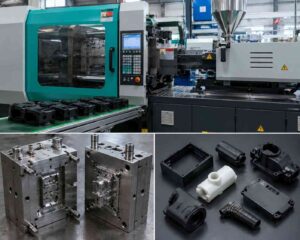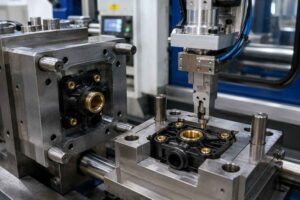


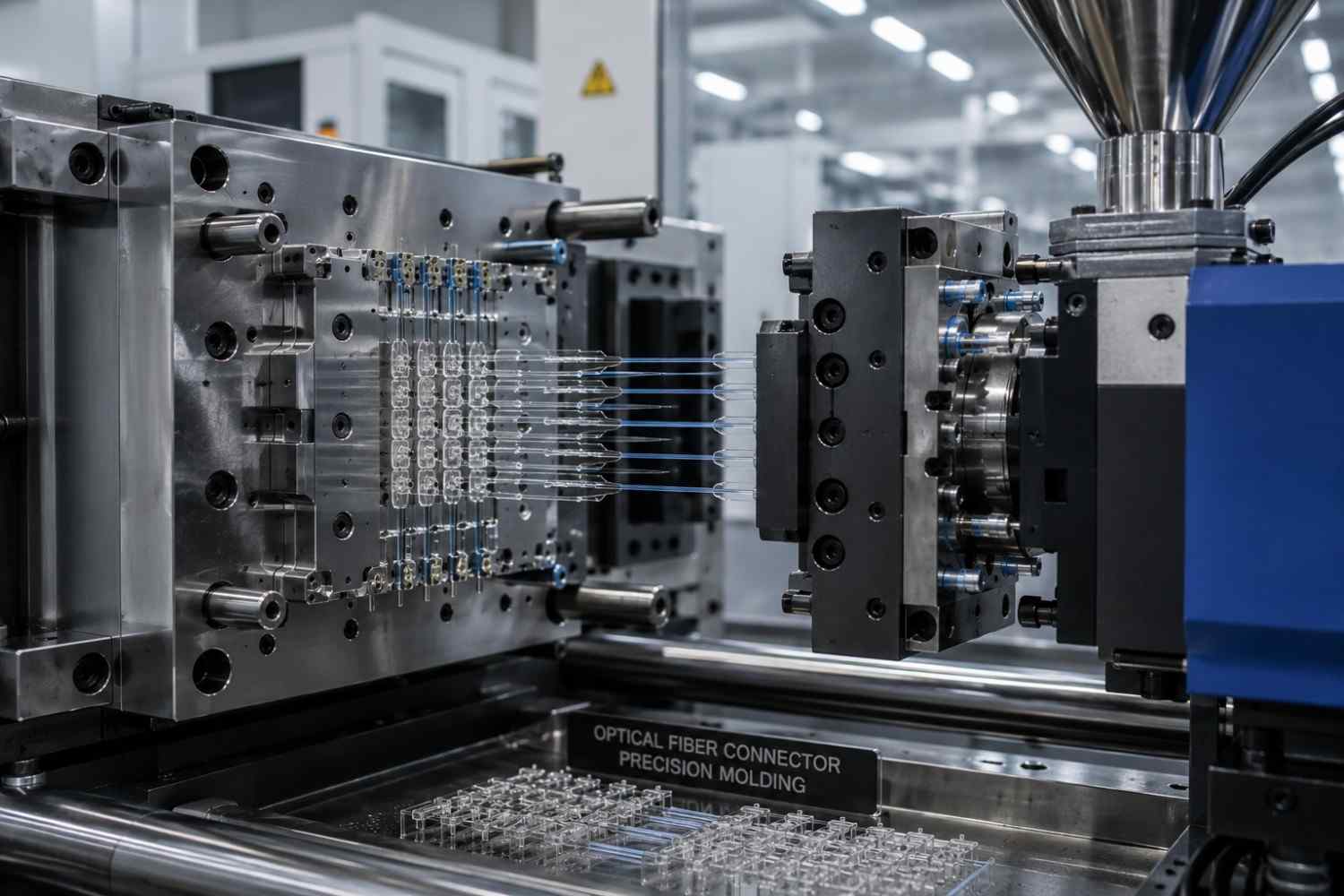
SSP manufactures China fiber optic connectors using precision injection molding, holding tolerances as tight as ±0.01 mm on ferrule housings, latch mechanisms, and alignment features — the dimensional accuracy required for optical components where a few microns of misalignment can degrade signal transmission. @wiki info
Key Takeaways
-
- Fiber optic connector housings demand injection molding precision parts capability because optical alignment tolerances are far tighter than typical plastic component specs — often ±0.01–0.03 mm on critical mating features.
-
- Common connector housing materials include glass-filled nylon (PA), PBT, and liquid crystal polymer (LCP), each selected for dimensional stability, heat resistance, and low warpage during cooling.
-
- A capable precision parts manufacturer company combines high-precision mold tooling, controlled molding process parameters, and in-house metrology to hold these tolerances consistently across production runs.
-
- Secondary operations — insert molding of metal ferrule sleeves, laser marking, and ultrasonic welding of housing halves — are frequently required alongside the core molding step.
-
- Sourcing China fiber optic connectors from an established manufacturer can reduce per-unit cost significantly versus domestic production, provided the supplier demonstrates verified tolerance control and material traceability.
Why Injection Molding for Fiber Optic Connector Components
Fiber optic connectors are made up of multiple precision plastic components: the connector housing (body), latch or bayonet mechanism, dust cap, boot, and often an internal alignment sleeve. Injection molding is the standard manufacturing method for these parts because it can reproduce complex geometry — snap-fit latches, keying slots, internal ribs — at high volume with part-to-part consistency that machining alone cannot match economically at scale.
The core engineering challenge is that optical performance depends on mechanical precision. A connector housing that holds its ferrule even 0.05 mm out of true position can introduce enough fiber-core misalignment to raise insertion loss beyond spec. This means fiber optic connector molds are built and validated to a different standard than general-purpose plastic housings — closer to the tolerancing used in precision metal machining than typical consumer plastic parts.
Precision Requirements for Fiber Optic Connector Housings
Three dimensional factors matter most in connector housing production:
-
- Concentricity and true position of the ferrule bore relative to the housing’s outer mating features, since this directly controls fiber alignment when the connector mates with its counterpart.
-
- Flatness and squareness of mating faces, which affects how evenly two connectors seat against each other.
-
- Repeatability across cavities, since most connector housings are produced from multi-cavity molds (often 4, 8, or 16 cavities), and every cavity must produce parts within the same tolerance band to avoid inconsistent fit in the field.
Holding these specs requires controlling mold steel precision, gate location (to minimize warpage), cooling channel design (to prevent uneven shrinkage), and process parameters like injection pressure, hold time, and mold temperature — all monitored and logged for traceability on precision programs.
Materials Used in Fiber Optic Connector Injection Molding
| Material | Common Use in Connectors | Key Property |
| Glass-filled Nylon (PA) | Connector housings, latch bodies | High stiffness, low creep |
| PBT (Polybutylene Terephthalate) | Housings, boots | Dimensional stability, chemical resistance |
| LCP (Liquid Crystal Polymer) | High-precision small connectors (LC, MU) | Very low warpage, thin-wall moldability |
| PC (Polycarbonate) | Dust caps, non-critical covers | Impact resistance, low cost |
| TPE (Thermoplastic Elastomer) | Strain-relief boots | Flexibility, cable protection |
Quality Control and Tolerancing for Optical Connector Parts
Because connector performance is measured in optical loss (dB), not just mechanical fit, precision molders typically pair dimensional inspection (CMM or optical comparator) with functional gauge testing — verifying that molded housings accept a master ferrule and mate correctly with a reference connector before a production lot ships.
The table below outlines the molding process specifications typically applied across different fiber optic connector part types.
Injection Molding Specifications by Connector Component Type
| Component Type | Typical Tolerance | Common Material | Cavity Configuration | Secondary Operations | Inspection Method |
| Connector housing (SC/LC/FC) | ±0.01–0.02 mm | Glass-filled PA or LCP | 4–16 cavity | Ultrasonic welding, laser marking | CMM, functional gauge |
| Ferrule alignment sleeve | ±0.005–0.01 mm | LCP or ceramic insert-molded | 1–4 cavity | Metal insert molding | Optical comparator |
| Latch/bayonet mechanism | ±0.02–0.03 mm | Glass-filled PA | 8–16 cavity | Snap-fit function test | Go/no-go gauge |
| Strain-relief boot | ±0.05 mm | TPE | 2–8 cavity | Overmolding onto housing | Visual + dimensional spot-check |
| Dust cap | ±0.05–0.1 mm | PC | 16–32 cavity | None typically required | Visual inspection |
| Keying/polarity feature | ±0.02 mm | Glass-filled PA | Integrated with housing tool | None | CMM profile check |
SSP Is a Trusted Partner for Die Manufacturing Cost Optimization
SSP Precision is an ISO 9001 & IATF 16949 certified manufacturer delivering end-to-end precision solutions, from design and prototyping to high‑volume production, for the automotive, medical, electronics, aerospace, and industrial sectors. We handle every stage in‑house – DFM engineering, rapid prototyping, CNC machining, EDM, grinding, and global logistics – to manufacture the tooling that makes your parts and the parts themselves.
What we build and supply: visit our sites: https://ssprecision.com.cn/
-
- Stamping dies manufacturing and stamping die parts – high‑precision transfer stamping dies and progressive/compound dies for volume metal stamping.
-
- Injection molding and injection mold – custom injection molds for plastic components, including single‑, multi‑cavity, and over‑molding & insert‑molding tools that combine metal and plastic in one part.
-
- Specialty molded components – eco‑friendly green mold parts and microscopic medical micro‑molded parts.
-
- Precision metal and plastic end‑use parts – high‑volume serial production of precision products (metal stampings, plastic moldings) with full PPAP traceability.
-
- Tooling spare parts manufacturing & – tooling spare parts (punches, inserts, ejector pins) and precision robotics spare parts to keep your production running.
Why Choose a Precision Parts Manufacturer Company in China
Beyond cost efficiency, an established precision parts manufacturer company based in China brings several practical advantages to fiber optic connector production:
-
- Integrated tooling capability — mold design and fabrication in-house shortens iteration cycles when a housing design needs revision after first-article testing.
-
- Volume flexibility — multi-cavity tooling scales from prototype runs to high-volume production without retooling.
-
- Supply chain proximity — many raw material suppliers (engineering resins, metal insert components) and downstream assembly partners are regionally concentrated, shortening lead times.
-
- Established quality systems — reputable suppliers maintain ISO-certified quality management, full material traceability, and documented first-article inspection reports for every new connector program.
For buyers evaluating suppliers, the differentiator isn’t simply “can this shop mold plastic parts” — it’s whether the shop can demonstrate tolerance control, cavity-to-cavity consistency, and optical functional testing specific to connector components.
Frequently Asked Questions
- What tolerance is required for fiber optic connector housings?
- Fiber optic connector housings typically require tolerances of ±0.01–0.03 mm on critical alignment features, since even small deviations can affect fiber-core alignment and increase optical insertion loss.
- What materials are used for injection molded fiber optic connectors?
- Common materials include glass-filled nylon (PA), PBT, and liquid crystal polymer (LCP) for housings and alignment sleeves, with TPE used for flexible strain-relief boots and polycarbonate for dust caps.
- Why source China fiber optic connectors from a specialized manufacturer?
- Specialized manufacturers combine in-house precision mold tooling, multi-cavity production capability, and connector-specific quality control (functional gauge and optical testing) that general-purpose molders often can’t match, while offering competitive per-unit cost at volume.
- How is quality verified on injection molding precision parts for connectors?
- Quality is typically verified through CMM dimensional inspection, optical comparator checks, and functional gauge testing that confirms molded housings correctly accept ferrules and mate with reference connectors before a production lot ships.
- What secondary operations are common after molding fiber optic connector parts?
- Common secondary operations include ultrasonic welding of housing halves, metal insert molding for ferrule sleeves, laser marking for part identification, and overmolding of strain-relief boots onto the connector housing.
Read More – Intelligence That Protects Your Production Line
-
- Stamping Die Cost Drivers: What Impacts Your Price – A single-station die costs $3,000–$8,000, while a progressive die can hit $120,000+—here’s the breakdown of 7 key cost drivers, from material selection to EDM hours, with real China vs. Western pricing data.
-
- Injection molding: Hot Runner Vs Cold Runner – Hot runners add 30–50% to upfront tooling cost but can slash cycle times by 40% and eliminate material waste—here’s how to weigh the trade-off for your production volume.
-
- Injection Molding Tolerances (With Precision Chart) – Tightening a tolerance from IT7 to IT3 can triple your mold cost—here’s the precision grade chart, material-specific shrinkage data, and how to specify only what your design actually needs.
-
- How Much Does an Injection Mold Cost in China? – A Class 101 production mold runs $15,000–$60,000+, while a prototype tool can cost under $4,000—here’s the SPI classification breakdown and the 5 key cost drivers that shape your final quote.
-
- Holding ±0.001 mm: Thermal Control in Precision CNC – A 2°C temperature swing can add 7 microns of error—here’s how thermal control architecture, spindle warm-up protocols, and granite bases make the difference between hitting tolerance and scrapping the part.
-
- D2 vs DC53 Tool Steel: Which is Best for Stamping? – D2 has been the industry standard, but DC53 offers twice the toughness and better machinability—here’s the metallurgical data to decide which alloy delivers lower total cost of ownership for your stamping application.
-
Sourcing Ejector Pins & Mold Components in China – DIN 1530 ejector pins at $5.80–$8.60 per piece with ±0.002mm grinding precision and 7–15 day lead times.
-
Multi-Cavity Injection Molds: Cost & Efficiency Breakdown – A 4-cavity hot runner mold costs 2.5–4x a single-cavity tool but delivers proportionally larger per-part cost savings at volume.
-
Calculating Plastic Injection Molding Unit Costs: Complete Pricing Breakdown – Unit Price = Material Cost + Processing Cost + (Mold Cost ÷ Total Parts)—here’s the complete formula with real cost ranges, showing how a $22,000 mold drops from $0.37/part at 30,000 units to just $0.20/part at 100,000 units.
-
Multi-Cavity Injection Molds: Cost & Efficiency Breakdown – A 4-cavity hot runner mold costs 2.5–4x a single-cavity tool but delivers proportionally larger per-part cost savings at volume.
-
Export-Ready Tooling & Dies: OEM Manufacturing for Global Supply Chains – IATF 16949-certified stamping dies, injection molds, and tooling spare parts under one roof for automotive and industrial OEM buyers.