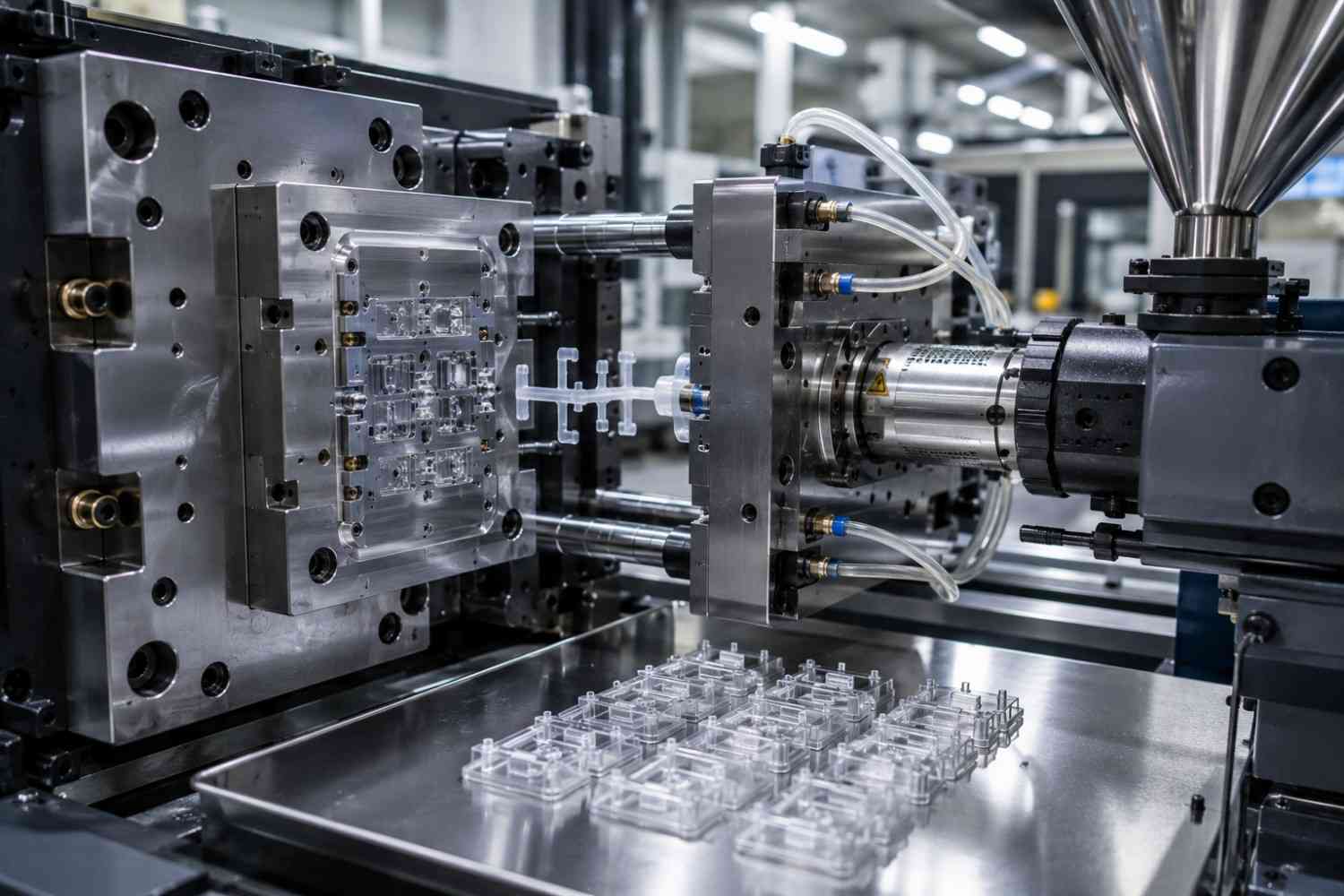
Calculate injection molding unit costs, you can use this formula, like… Unit Price = Material Cost + Processing Cost + (Mold Cost ÷ Total Parts) . In general Material cost sits around 20–50% of the per-part price, while processing is maybe 30–60% . Mold amortization is kinda the big deal at low volumes, because you spread that tooling expense over fewer pieces.
SSP Precision provides ISO 9001 and IATF 16949 certified molding, with 50T–500T presses, and they can hit cycle times as low as 5 seconds. So in practice this is where you’d try to model the cycle time effect, material shot weight, and the mold life assumptions.
Core Engineering & Sourcing Objectives:
-
- Calculate accurate per-part costs, meaning break out material, processing, and tooling components
-
- Optimize production volume decisions, figure the break even between single cavity versus multi cavity molds, right
-
- Reduce total cost of ownership, by spotting how cycle time, resin choice, and cavity count really shift the overall numbers
Technical Specification & Structural Matrix of Injection Molding Costs
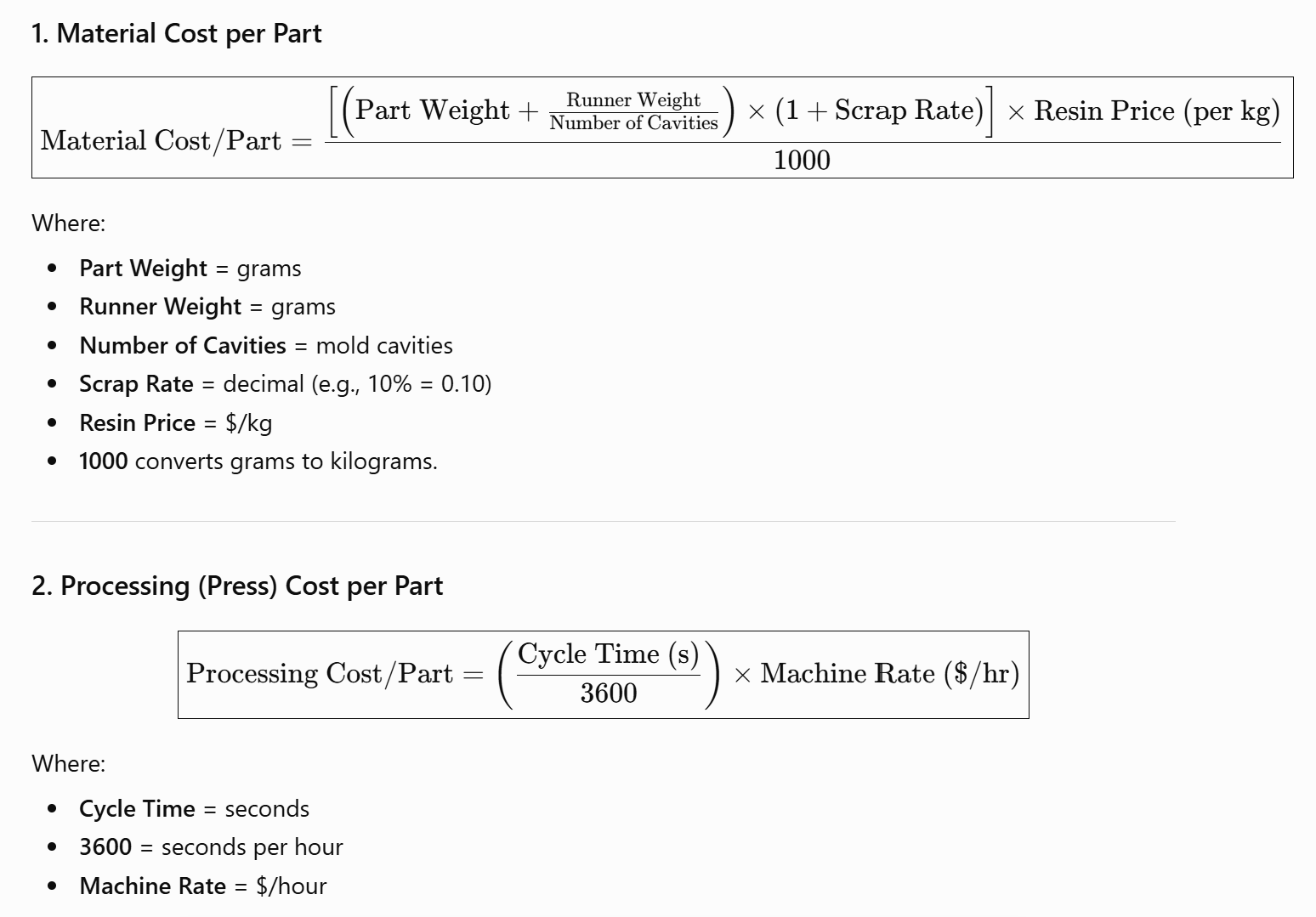
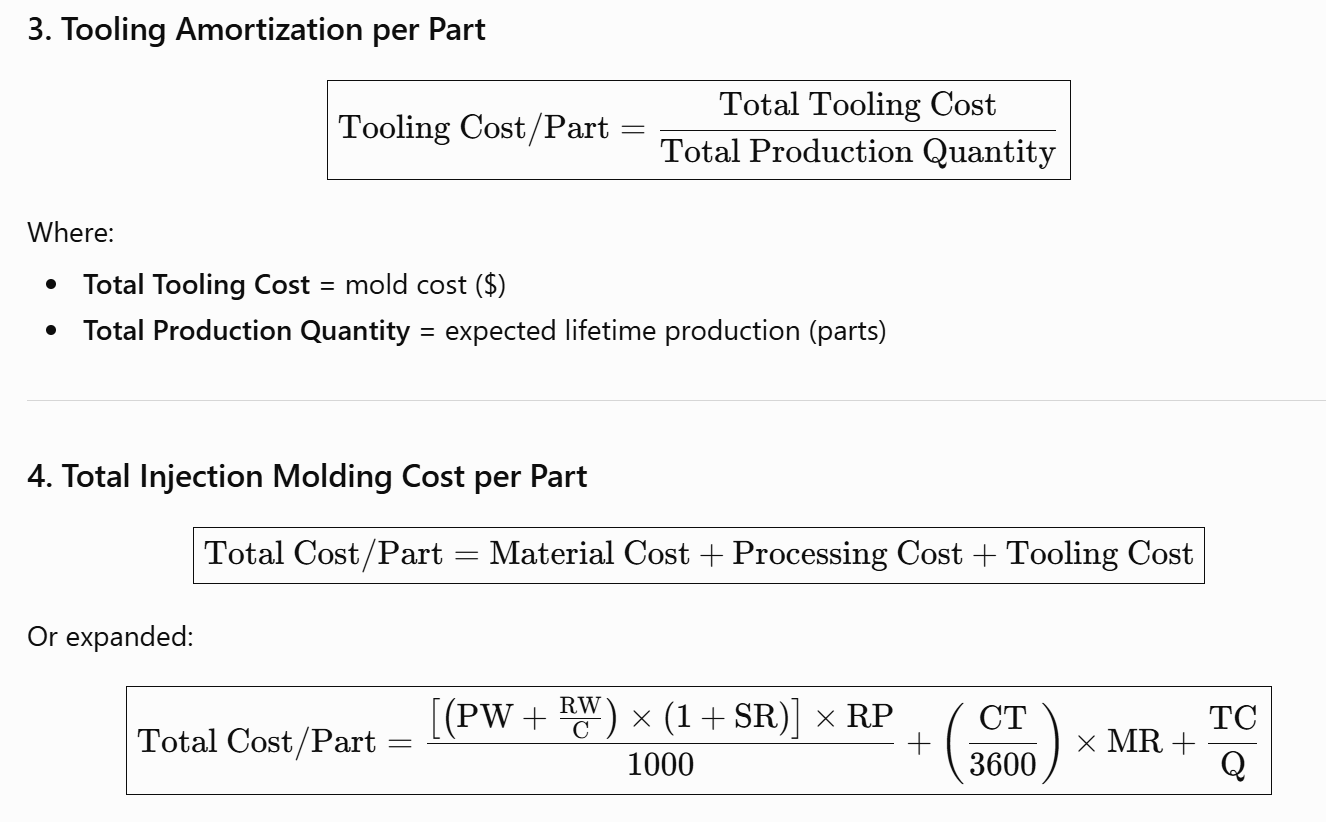
Injection molding unit cost mostly splits into three separate pillars: material cost, processing cost, and tooling cost. Material cost depends on resin pricing and the shot weight. Processing cost is machine rate times cycle time. Tooling cost gets amortized across the production quantity. And honestly, cycle time becomes the biggest “lever” on per-part cost for high volume runs, because small time changes multiply a lot.
| Cost Component | Typical Range | Key Drivers | SSP Precision Capability |
| Material Cost (per part) | $0.01 – $5.00 | Resin grade, part weight, scrap rate | Full material traceability |
| Processing Cost (per part) | $0.10 – $3.00 | Cycle time, machine rate, labor | 5s–60s cycle capability |
| Tooling Amortization | $0.05 – $20.00 | Mold cost, production volume | Single to multi-cavity |
| Secondary Operations | $0.02 – $0.50+ | Trimming, painting, assembly | In-house finishing |
| Total Unit Cost | $0.15 – $5.00 | Volume + complexity combination | Full DFM support |
Procedural Workflow: How to Calculate Injection Molding Unit Costs
1. Initial Parameter Identification and Data Collection:
Figure out the part shape, and what material it needs. Then grab the 3D CAD files, like STEP or IGES, and lock in the resin type. Commodity PP tends to sit around $1.30–$1.80/kg, engineering ABS is more like $2.20–$3.50/kg, and high performance PEEK can be $6–$35/kg. Next, figure the shot weight, usually it’s part weight plus runner weight, plus a scrap allowance. Also estimate the annual production volume, because that ends up steering the cavity count decision, and how tooling costs get spread out.
2. Core System Execution and Formula Application:
 3. Regulatory Compliance, Verification and Safety Sign-Off:
Check the paperwork and certifications, meaning mill test reports, and also RoHS plus REACH. Confirm the dimensions using CMM inspection, SSP Precision keeps ±0.005mm tolerances. Keep records from trial shots, including part weight consistency (aiming for ±0.5% across cavities), cycle time logs, and first article inspection reports.
Deep-Dive Technical Risk Analysis of Injection Molding Costs
Production volume is, sort of, the single biggest cost driver— a $20,000 mold will end up adding about $20/part when you’re at 1,000 units, then it drops to $2/part at 10,000 units, and only $0.20/part once you reach 100,000 units. Tooling seems to dominate at low volumes, taking something like 60–80% of the total project spend for runs under 10,000 parts and that’s pretty hard to escape.
Cycle time then hits profitability pretty directly. Cooling takes up roughly 60–70% of the overall cycle time. So when you reduce cycle time by 10% you get cost savings in roughly the same proportion. SSP Precision does this by optimizing cooling using conformal cooling channel design, more science based molding approaches, or however you want to phrase it.
Material choice affects something like 30–50% of the total TCO. Engineering resins—like PEEK—can cost 10–20× more than commodity PP. Usually material cost is in the 20–50% range of the per-part price, while processing covers about 30–60% of it.
Key Engineering Compliance Standard
Standard Code: SPI Mold Classification Standards / ISO 9001:2015 / IATF 16949
Critical Threshold: Class 101 molds (1M+ cycles) need hardened steel (H13/S136), and dimensional tolerance has to stay within ±0.01mm for all cavities, every single one.
Operational Impact: Non-compliant molds can cause a 57% drop in expected cycle life, plus warranty claims averaging $47,000 per mold.
Anatomy of Injection Molding Cost: Component Breakdown
Tooling (Mold Cost) is usually the biggest upfront… yes investment. Like, a single-cavity steel mold tends to land around $5,000–$12,000, while multi-cavity precision setups with side actions and hot runners can jump to $40,000–$100,000+. You might see Chinese molds coming in roughly 40–50% cheaper than similar North American options. SSP Precision keeps it production-ready and adds real DFM support, so the design isn’t just “made”, it’s prepared.
Raw Material: this is basically resin price per kilogram times the shot weight. Commodity resins such as PP, PE often cost about $1.00–$2.00/kg, engineering resins like PA66, PC are more like $2.50–$5.00/kg. Then for high-performance grades (PEEK, PPS) it’s around $30–$100/kg, depending on the supplier and specs.
Machine Processing: the hourly machine rate is typically $30–$120/hour depending on tonnage and location. For example, a 200-ton press running at $60/hour, producing 360 parts per hour, works out to about **$0.17/part**. Easy math but people still miss it sometimes.
FEA & Mechanical Stress Tolerances of Injection Molds
| Mold Type | Cost Range | Shot Life | Best Application |
| 3D-Printed Prototype | $100 – $500 | <500 shots | Design validation |
| Aluminum Single-Cavity | $1,000 – $5,000 | 50K – 100K shots | Bridge production |
| P20 Steel Multi-Cavity | $10,000 – $25,000 | 500K+ shots | Standard production |
| Hardened Steel Multi-Cavity | $25,000 – $80,000 | 1M+ shots | High-volume |
| Complex Automotive/Medical | $50,000 – $150,000+ | 1M+ shots | Demanding specs |
Architecture, Controls & Manufacturing Integration
CNC Machining & EDM: multi-axis CNC is aimed at ±0.005mm positioning accuracy, because multi-cavity consistency really depends on it. EDM is then used for those complicated cavity features, where normal cutting just won’t behave.
Scientific Molding: pressure plus temperature sensors watch cavity conditions in real time, not afterward. This helps make sure CpK stays >1.33 throughout production runs, not just during the “good” samples.
Quality Inspection: includes CMM verification, optical checks, and material certification. SSP Precision ships full traceability documentation with every order, so you can actually connect the dots later on.
Operational Maintenance Matrix: Preventive Milestones
Daily / Per-Shift: do a visual look at ejector pins, confirm lubrication, and just listen for abnormal sounds while ejection happens. Small stuff, but it matters.
Quarterly (20,000–50,000 cycles): measure guide pins and bushings wear—if clearance is >0.005mm then replacement is typically needed. Also inspect the runner system, and verify cooling channel flow, without assuming it’s fine.
Annual (150,000–200,000 cycles): Full CMM inspection, hot runner nozzle replacement if applicable, surface re-polishing (SPI standards), complete mold overhaul.
Injection Molding Unit Cost in Practice: Case Study
The Industrial Challenge: a US automotive Tier-1 supplier needed 12 injection molds for a new connector housing run. Domestic quotes landed around $420,000, but with 12-week lead times… not great.
The Custom Engineering Response: SSP Precision came in at $180,000 for the very same 12 molds, so basically a 57% drop, and they kept the pace at 6-week lead times. Also , all molds are ISO 9001 & IATF 16949 certified.
The Quantifiable Outcome: total tooling savings added up to $240,000. Production started about 6 weeks earlier than if they went with domestic sourcing. Per-part costs dropped by more than 50% thanks to tuned up multi-cavity configurations, which helped the cycle economics.
Optimizing Your Injection Molding RFQ: Technical Sourcing Checklist
-
- Production Volume: annual demand (units/year) — kind of key for cavity count and tooling decisions.
-
- Part Geometry: 3D CAD files (STEP/IGES), wall thickness, undercuts, and side actions.
-
- Material Requirements: resin type (PP, ABS, PC, PA66, PEEK), color, additives, plus surface finish (SPI standards).
-
- Compliance: ISO 9001:2015, IATF 16949 (automotive), RoHS, REACH. SSP Precision handles the full paperwork, documentation included.
SSP Is a Trusted Partner for Die Manufacturing Cost Optimization
SSP Precision is an ISO 9001 & IATF 16949 certified manufacturer delivering end-to-end precision solutions, from design and prototyping to high‑volume production, for the automotive, medical, electronics, aerospace, and industrial sectors. We handle every stage in‑house – DFM engineering, rapid prototyping, CNC machining, EDM, grinding, and global logistics – to manufacture the tooling that makes your parts and the parts themselves.
What we build and supply: visit our sites: https://ssprecision.com.cn/
-
- Stamping dies manufacturing and stamping die parts – high‑precision transfer stamping dies and progressive/compound dies for volume metal stamping.
-
- Injection molding and injection mold – custom injection molds for plastic components, including single‑, multi‑cavity, and over‑molding & insert‑molding tools that combine metal and plastic in one part.
-
- Specialty molded components – eco‑friendly green mold parts and microscopic medical micro‑molded parts.
-
- Precision metal and plastic end‑use parts – high‑volume serial production of precision products (metal stampings, plastic moldings) with full PPAP traceability.
-
- Tooling spare parts manufacturing & – tooling spare parts (punches, inserts, ejector pins) and precision robotics spare parts to keep your production running.
Frequently Asked Sourcing & Procurement Questions
- What is the typical cost range for injection molded parts, like generally?
- A typical injection molded part ends up at about $0.15–$5.00 per unit. The mold itself costs somewhere around $5,000–$100,000+ depending on how intricate it is, and yes that usually drives everything. Per-part cost also drops pretty fast, kinda exponentially, as your quantity goes up.
- How do I figure out the per-part cost for my injection molded part, step by step?
- You can use: Unit Price = Material Cost + Processing Cost + (Mold Cost ÷ Total Parts) . For Material Cost: it’s shot weight × resin price. For Processing Cost: cycle time × machine rate. For tooling amortization: mold cost ÷ lifetime parts, not just total parts.
- What’s the cost difference between a single-cavity mold and a multi-cavity mold?
- A single-cavity basic mold is roughly $5,000–$12,000. A multi-cavity, more exacting mold can run $40,000–$100,000. Multi-cavity usually costs more at the start, but it slashes the per-part cost by maybe 30–50%. The break-even point depends on annual volume, often over 100,000 units per year.
Read More – Intelligence That Protects Your Production Line
-
Multi-Cavity Injection Molds: Cost & Efficiency Breakdown – A 4-cavity hot runner mold costs 2.5–4× more than a single-cavity tool but slashes per-part cost at volume—here’s the data on cavity scaling, hot vs. cold runner trade-offs, and how conformal cooling cuts cycle time by 20–40%.
-
Sourcing Ejector Pins & Mold Components in China – DIN 1530 demands ±0.01mm and 45–50 HRC—here’s the technical checklist to verify ejector pins, guide bushings, and slides against material certifications, CMM reports, and supply chain KPIs.
-
China Fiber Optic Connectors | Injection Molding Precision Parts Manufacturer Company – Fiber optic connector housings demand ±0.01 mm tolerances on critical alignment features—here’s the material selection guide, cavity configuration data, and quality control protocols for precision optical components.
-
Reducing Cycle Time Through Better Mold Cooling – Cooling eats 50–70% of your cycle time—here’s how conformal cooling channels, turbulent flow design, and high-conductivity inserts can slash cooling time by 20–50% and cut overall cycle time by 15–35%.
-
Stamping Die Cost Drivers: What Impacts Your Price – A single-station die costs $3,000–$8,000, while a progressive die can hit $120,000+—here’s the breakdown of 7 key cost drivers, from material selection to EDM hours, with real China vs. Western pricing data.
-
Injection molding: Hot Runner Vs Cold Runner – Hot runners add 30–50% to upfront tooling cost but can slash cycle times by 40% and eliminate material waste—here’s how to weigh the trade-off for your production volume.
-
Export-Ready Tooling & Dies: OEM Manufacturing for Global Supply Chains – IATF 16949-certified stamping dies, injection molds, and tooling spare parts under one roof for automotive and industrial OEM buyers.
-
Complete Plastic Shrinkage Chart (ABS, PC, PA66, POM) – ABS shrinks 0.4–0.7%, PC 0.5–0.7%, PA66 1.0–2.0%, and POM 0.6–1.4%—here’s how to adjust your mold design for each material.
-
How to Prevent Flash, Warpage & Sink Marks – Flash, warpage, and sink marks account for 35–40% of plastic part rejects—here’s how to eliminate them with precision tooling and process control.